
Overview: CO₂ Compression in the Food & Beverage Industry
Every carbonated drink you pour — from sparkling water to craft beer to soft drinks — owes its familiar fizz to carbon dioxide gas dissolved under pressure into a liquid. Behind that process, in production facilities ranging from small craft breweries to multinational bottling plants, sits a class of industrial equipment that rarely gets the credit it deserves: the food-grade CO₂ compressor. Getting the compressor selection right determines not only the gas purity that reaches the product, but also the long-term reliability, operating cost, and regulatory compliance of the entire CO₂ supply chain.
This guide covers everything a plant engineer or procurement manager needs to know about selecting a food-grade CO₂ compressor: how carbonation works, why oil-free compression is non-negotiable, what specifications to specify, and which certifications to require.
How CO₂ Carbonation Works in Food & Beverage Production
Carbonation is the process of dissolving CO₂ gas into a beverage under pressure. At the molecular level, when CO₂ contacts water under pressure, a small fraction reacts to form carbonic acid (H₂CO₃), which gives carbonated drinks their characteristic tangy taste. The majority of the CO₂ remains dissolved as gas in solution, to be released as bubbles when the pressure drops at the point of consumption.
The amount of CO₂ dissolved — measured in volumes of gas per volume of liquid — varies considerably by product type. Sparkling water typically runs at 3 to 4 volumes; carbonated soft drinks at 3.5 to 4.5 volumes; draught beer at 2.2 to 2.7 volumes. Achieving consistent carbonation levels at production scale requires precise control of both CO₂ gas pressure and temperature throughout the filling line.
In a typical large-scale production facility, CO₂ is sourced either from bulk liquid storage tanks — delivered by tanker — or recovered on-site from fermentation or flue gas streams and then compressed, purified, and liquefied. In both pathways, a reciprocating CO₂ compressor plays a central role: either boosting gas from low-pressure storage to line pressure, or compressing recovered gas to the pressure needed for liquefaction and storage.
Why Food-Grade CO₂ Compressors Must Be Oil-Free
The single most important specification in any food-grade CO₂ compressor is the complete absence of lubricating oil from the gas stream. This requirement flows directly from food safety regulations and the sensitivity of carbonated beverages to even trace-level contamination.
In a conventional oil-lubricated reciprocating compressor, lubricating oil is circulated through the crankcase and cylinder walls to reduce friction and wear. No matter how sophisticated the downstream oil separator and filter system is, some level of oil vapor carryover into the gas stream is unavoidable. For industrial applications compressing nitrogen or instrument air, this may be entirely acceptable. For food-grade CO₂, it is not.
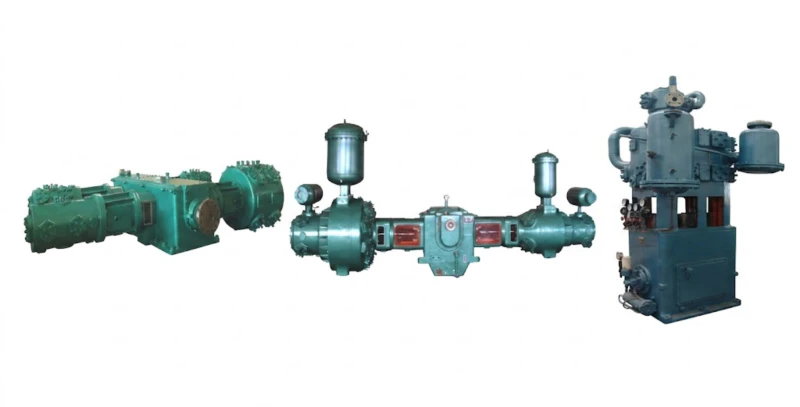
An oil-free reciprocating CO₂ compressor solves this by eliminating oil from the compression chamber entirely. The piston rings and packing seals are manufactured from self-lubricating polymer materials — most commonly PTFE (polytetrafluoroethylene) and PEEK (polyether ether ketone) — which provide sufficient lubrication through the material’s own properties, without any added lubricant. The crankcase bearing system remains oil-lubricated, but a distance piece physically isolates the crankcase from the compression cylinder, with a vent and drain arrangement to ensure no oil migration can occur.
“In food and beverage applications, the compressor is not just a piece of mechanical equipment — it is part of the quality assurance chain. Oil-free design is the baseline, not an option.”
PTFE vs PEEK: Choosing the Right Piston Ring Material
The choice of self-lubricating ring material affects wear life, maximum operating temperature, and the compressor’s ability to handle occasional condensate. PTFE offers excellent chemical inertness and very low friction, but has lower mechanical strength and may wear faster at elevated temperatures or if liquid droplets are present in the gas stream. PEEK provides significantly higher mechanical strength, better resistance to thermal degradation, and improved durability in demanding conditions, at higher material cost. For food-grade CO₂ applications with clean, dry gas streams, PTFE rings are widely used; for more aggressive conditions or extended service intervals, PEEK is the preferred choice.
CO₂ Purity Standards for Food and Beverage Applications
Food-grade CO₂ purity requirements are defined by a combination of international guidelines and national food safety regulations. The most widely referenced standard in the beverage industry is the International Society of Beverage Technologists (ISBT) Guidelines for CO₂ Quality, which specifies purity and contaminant limits for CO₂ used in beverage carbonation.
| Parameter | ISBT Guideline Limit | Measurement Method | Compressor Relevance |
|---|---|---|---|
| CO₂ Purity | ≥ 99.9% v/v | GC analysis | Inlet gas quality |
| Total Oil Content | ≤ 0.1 ppm w/w | Infrared / gravimetric | Oil-free compressor critical |
| Moisture (Water) | ≤ 20 ppm v/v | Electrolytic hygrometer | Aftercooler + dryer |
| Total Hydrocarbons | ≤ 20 ppm v/v | FID detector | Oil-free compressor critical |
| Acetaldehyde | ≤ 0.2 ppm v/v | GC-FID | Source gas / purification |
| Carbon Monoxide | ≤ 10 ppm v/v | Electrochemical sensor | Source gas quality |
| Sulfur Dioxide | ≤ 1 ppm v/v | UV fluorescence | Source gas / purification |
Source: ISBT Guidelines for CO₂ Quality (beverage-grade). Limits may vary by national regulation. The compressor is the primary control point for oil and total hydrocarbon specifications.
It is worth noting that the compressor is the primary control point for oil and total hydrocarbon specifications. The other contaminants — moisture, acetaldehyde, sulfur compounds — are largely determined by the quality of the source gas and the downstream purification train (activated carbon beds, molecular sieves, and gas analyzers). Selecting an oil-free compressor is therefore both a product quality decision and a risk management decision: it eliminates the most controllable source of contamination at the point where control is most effective.
Pressure and Flow Specifications for Beverage CO₂ Compressors
The correct pressure and flow specifications for a food-grade CO₂ compressor depend on the specific application within the beverage or food production process. The table below summarizes the main use cases and their typical requirements.
| Application | Inlet Pressure | Discharge Pressure | Typical Flow | Notes |
|---|---|---|---|---|
| Beverage Carbonation (boost) | Ambient – 0.5 MPa | 1.5 – 3.0 MPa | 5 – 80 Nm³/min | From bulk liquid CO₂ vaporiser to filling line |
| Fermentation CO₂ Recovery | Near-ambient (0–0.05 MPa) | 1.5 – 2.0 MPa | 2 – 60 Nm³/min | Recovery from brewery or bio-ethanol fermentation |
| CO₂ Liquefaction | 0.05 – 0.3 MPa | 6.0 – 8.0 MPa | 10 – 200 Nm³/min | High-pressure for condensation into liquid CO₂ |
| Dry Ice Production | Liquid CO₂ source | 6.0 – 8.0 MPa | 10 – 150 Nm³/min | Liquid CO₂ → expansion → solidification |
| CO₂ Blanket Gas | Ambient | 0.5 – 1.5 MPa | 1 – 20 Nm³/min | Protective atmosphere in tanks and storage vessels |
Choosing the Right Compressor Frame Type for Food & Beverage
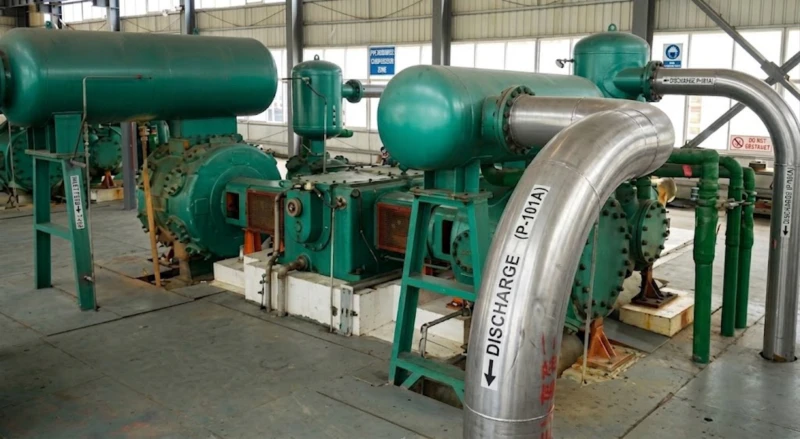
Reciprocating CO₂ compressors are available in several frame configurations, each suited to different capacity ranges and installation constraints. For food and beverage applications, the most commonly specified types are:
Z-Type (Vertical) — Small to Medium Capacity
The Z-type vertical compressor is the most compact configuration, with cylinders arranged vertically above the crankcase. It occupies the smallest floor footprint and is well-suited to applications with space constraints, such as brewery fermentation recovery systems or small-scale carbonation supply. Typical flow range: 2 to 60 Nm³/min. This type is easily skid-mounted for modular installation.
L-Type — Medium Capacity, L-Shaped Cylinder Layout
The L-type uses a combination of horizontal and vertical cylinders in an L-shaped arrangement, providing improved dynamic balance compared to the vertical Z-type while still maintaining a relatively compact footprint. Suitable for medium-scale beverage production and CO₂ recovery applications. Typical flow range: 10 to 100 Nm³/min.
D-Type (Horizontal Opposed) — Large Capacity
For large-scale food and beverage production facilities, CO₂ liquefaction plants, and industrial gas producers supplying beverage-grade CO₂, the D-type or M-type opposed-balance horizontal compressor offers the best combination of high capacity, low vibration, and long service intervals. The opposed-balance configuration — with cylinders acting in pairs on opposite sides of the crankshaft — minimizes unbalanced forces and makes for a machine that runs smoothly without heavy foundations. Typical flow range: 50 to 400 Nm³/min.
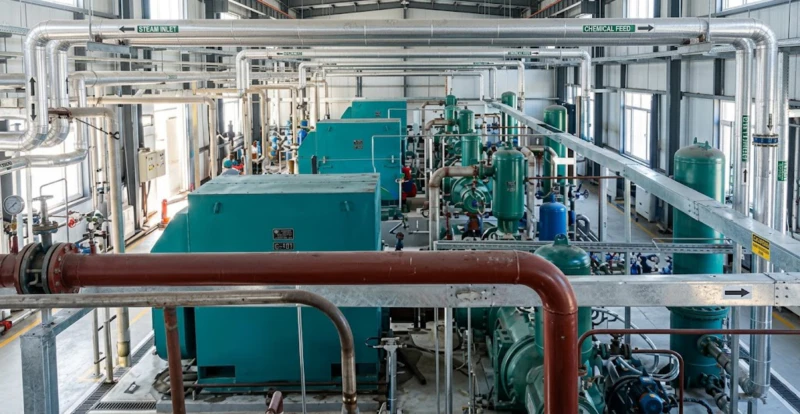
For food and beverage applications where installation simplicity and commissioning speed are priorities, specify a fully factory-assembled skid-mounted package. A well-designed skid package integrates the compressor, motor, aftercooler, moisture separator, suction scrubber, instrumentation, and control panel on a single baseframe — pre-piped, pre-wired, and factory-tested before delivery. This approach significantly reduces on-site installation time and eliminates inter-contractor interface risks.
7 Key Criteria When Specifying a Food-Grade CO₂ Compressor
Confirm oil-free compression — no exceptions
Require PTFE or PEEK piston rings and packing, with a double-compartment distance piece (Type C or D per API 618 classification) vented to atmosphere. Obtain a declaration from the manufacturer confirming oil-free design with zero oil-to-gas contact.
Define inlet gas composition and purity
Provide the compressor manufacturer with a complete inlet gas analysis: CO₂ content, moisture level, presence of H₂S, SO₂, NOₓ or other contaminants. This determines required materials of construction for wetted parts and any special sealing requirements.
Specify discharge pressure and flow with margins
Design for 10–15% margin above the maximum expected operating pressure and flow, to allow for future production capacity growth and seasonal demand peaks without replacing the compressor.
Require factory acceptance testing (FAT)
Insist on a full-load mechanical FAT at the manufacturer’s facility, with performance data documented against contractual specifications. Request FAT participation or remote live video witnessing if travel is not possible.
Verify certifications and documentation
Require ISO 9001 quality management certification for the manufacturer. For EU markets, confirm CE marking. For Russian and CIS markets, confirm GOST-R compliance. Request material certifications (MTCs) for all pressure-retaining components.
Evaluate long-term spare parts availability
For a compressor that will run continuously for 10–20 years, long-term parts availability is as important as initial price. Confirm that piston rings, packing rings, valves, and bearings are available from the manufacturer’s own production, not sourced from third parties.
Consider total cost of ownership, not just purchase price
A lower-priced compressor with shorter piston ring service life, higher energy consumption, and limited after-sales support will typically cost significantly more over a 10-year operating period than a higher-quality machine. Request energy consumption data (shaft power per unit flow) and published ring replacement intervals for comparison.
Maintenance Intervals and Wear Parts for Food-Grade CO₂ Compressors
One practical advantage of oil-free reciprocating CO₂ compressors is the relatively predictable nature of their maintenance requirements. Because the self-lubricating ring materials wear progressively and measurably, it is possible to establish planned maintenance intervals based on operating hours rather than reacting to unexpected failures. The key wear items and their typical replacement intervals are:
Maintaining detailed running-hour logs and gas quality records — particularly oil content measurements at the compressor outlet — is recommended both for maintenance planning and for food safety audit compliance.
Summary: Food-Grade CO₂ Compressor Selection Checklist
Frequently Asked Questions — CO₂ Compressors for Food & Beverage
Ready to Specify Your Food-Grade CO₂ Compressor?
Our engineering team has 70+ years of experience designing oil-free reciprocating CO₂ compressors for food, beverage, and CO₂ liquefaction applications. Send us your process conditions and we will recommend the right configuration.