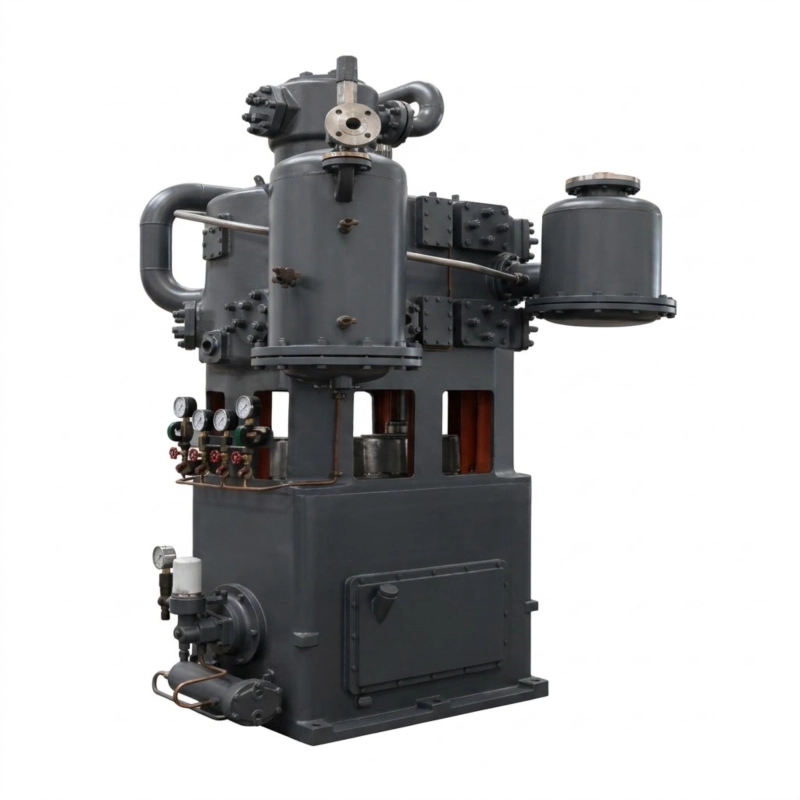
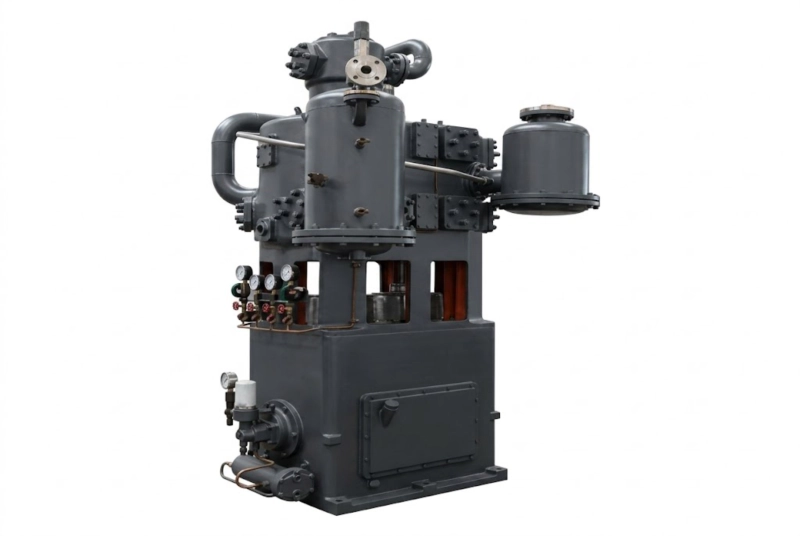
Product Overview: ZW Series CO₂ Compressor
The ZW series carbon dioxide compressor is a vertical two-column (Z-type) reciprocating piston compressor designed for compact, space-constrained installations requiring small to medium CO₂ flow rates. The vertical cylinder arrangement allows the ZW series to occupy the smallest floor footprint of any reciprocating CO₂ compressor in our product range, making it particularly well suited to installations where plant floor area is limited — such as small-scale CO₂ liquefaction units, on-site dry ice production plants, brewery fermentation CO₂ recovery systems, laboratory and pilot plant gas supply, and decentralised carbon capture compression stations.
Manufactured at our production facility in Russia to API 618 Fifth Edition and GOST-R certification requirements, the ZW series is a performance-comparable alternative to Ariel JGZ and JGA series, Dresser-Rand (Siemens Energy) HOS-V series, Bauer Kompressoren K-series, and Siad Macchine Impianti compact reciprocating series compressors in the equivalent flow and pressure class. These brands are referenced solely to assist engineers in cross-referencing performance classes during selection; all ZW units are original designs. We do not manufacture or imply any affiliation with these brands and do not sell counterfeit products.
Industries and duties served: Small CO₂ liquefaction and dry ice production, beverage carbonation gas supply for single-facility bottlers, brewery fermentation CO₂ recovery, food-grade CO₂ conditioning, carbon capture pilot plants and small-volume CCS boost stations, supercritical CO₂ extraction at laboratory and small industrial scale, CO₂ reinjection for small EOR projects, and process gas supply for chemical and pharmaceutical manufacturing.
Technical Specifications — ZW Series CO₂ Compressor
The ZW series covers two pressure sub-ranges. The mid-to-high pressure models (above 1.0 MPa) serve liquefaction, dry ice, and high-pressure process duties; the low-pressure models (0.10–1.00 MPa) serve recovery, recompression, and transfer duties. All models are available in skid-mounted modular package format.
Mid-to-High Pressure Models (1.0–10.0 MPa)
| Model |
Configuration |
Flow (m³/min) |
Pressure (MPa) |
Dimensions L×W×H (mm) |
Weight (t) |
Power (kW) |
Voltage |
| ZW-2/60 (Skid) |
2-col 3-stage |
2 |
6.00 |
1550×1710×1520 |
2.90 |
45 |
380 |
| ZW-4/25 (Skid) |
2-col 3-stage |
4 |
2.50 |
1920×1900×2580 |
3.97 |
55 |
380 |
| ZW-5.5/24 |
2-col 3-stage |
5.5 |
2.40 |
1889×1900×2720 |
3.50 |
75 |
380 |
| ZW-45/25 |
2-col 3-stage |
45 |
2.50 |
Custom / to order |
TBC |
315–355 |
6K/10K |
Note: (Skid) suffix indicates factory-assembled modular skid unit with motor, cooler, separator, instrumentation, and control panel on a single baseframe. Exact dimensions and weights for larger ZW models depend on staging configuration and skid scope; contact our engineering team for project-specific data.
Low-Pressure Models (0.10–1.00 MPa)
| Model |
Configuration |
Flow (m³/min) |
Pressure (MPa) |
Dimensions L×W×H (mm) |
Weight (t) |
Power (kW) |
Voltage |
| ZW-6/8 |
2-col 2-stage |
6 |
0.80 |
2250×1296×2350 |
2.00 |
45 |
380 |
| ZW-2/60 |
2-col 3-stage |
2 |
6.00 |
1550×1710×1520 |
2.90 |
45 |
380 |
Note: The full ZW series covers a continuous range from 2 to 45 m³/min and 0.10 to 10.0 MPa. Models not listed above are available to order — specify your required flow, inlet pressure, discharge pressure, and gas composition for a custom data sheet.
General Series Parameters
| Parameter |
ZW Series Range |
| Compression Medium |
Pure CO₂, CO₂ mixed gas, CO₂/N₂ blends |
| Pressure Range |
0.10 MPa (low-pressure) to 10.0 MPa (high-pressure) |
| Flow Capacity |
2–45 m³/min (120–2,700 Nm³/h) |
| Motor Power |
45–500 kW (custom higher power available) |
| Drive Voltage |
380 V (standard) / 6 kV / 10 kV (larger models) |
| Frame Configuration |
2-column vertical (Z-type); 1, 2, or 3-stage |
| Lubrication |
Oil-free or oil-lubricated cylinder (specify at order) |
| Cooling Method |
Water-cooled or air-cooled; skid package standard |
| Design Standard |
API 618 Fifth Edition; GOST-R (Russia / CIS) |
| Certification |
ISO 9001:2015, Pressure Vessel License, GOST-R |
Working Principle and Structural Composition
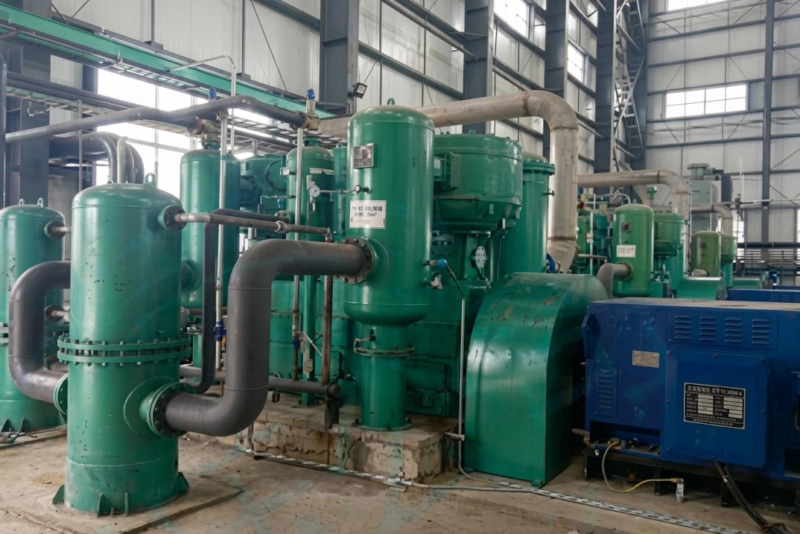
The ZW series operates on the reciprocating piston principle with a vertical two-column (Z-type) cylinder arrangement. The crankshaft, driven by an electric motor through a direct coupling or V-belt transmission, converts rotational motion into the upward and downward reciprocating motion of pistons in vertical cylinders. In contrast to horizontal machines, the vertical orientation means that piston rings and cylinder liners benefit from the even distribution of contact force around the cylinder bore rather than the asymmetric loading that gravity creates in horizontal configurations — a factor that can extend piston ring wear life in smaller, lower-power vertical machines.
The number of compression stages is selected according to the overall compression ratio: single-stage for ratios up to approximately 5:1, two-stage for ratios up to 25:1, and three-stage for the high-pressure models reaching 6.0 MPa and above from near-atmospheric inlet. Between each stage, interstage coolers and separators remove heat of compression and condensed moisture before the gas enters the next stage cylinder, maintaining discharge temperatures within safe limits and preventing liquid carry-over.
Key Structural Components
⚙ Crankshaft & Frame
Forged alloy steel crankshaft with hardened journals. Compact cast iron frame with precision-bored bearing housings. Low overall height for easy building integration.
🔧 Vertical Cylinders & Pistons
Cast iron or 316L stainless steel cylinders. Chrome-plated piston rods. PTFE or PEEK rings for oil-free service; cast iron rings for oil-lubricated configuration.
📈 Gas Valves
316 SS ring-plate or poppet valves with PEEK or PTFE elements. Designed for CO₂ service with low pressure drop and 8,000–12,000 hour service life.
❄ Interstage Cooling
Shell-and-tube or brazed plate heat exchangers between stages with liquid knockout separators. Carbon steel standard; 316L SS for wet CO₂ service.
🔐 Sealing System
PTFE pressure packing with Type C or D double-compartment distance piece per API 618. Crankcase isolated from process gas. Nitrogen purge available.
💻 Skid Package
Complete factory-assembled skid: compressor, motor, cooler, separator, lube oil system, instrumentation, and control panel on one baseframe. Ready to connect.
Core Advantages of the ZW Series
📈
Smallest Footprint in the Range
The ZW-2/60 skid measures just 1550×1710×1520 mm and weighs 2.90 tonnes — small enough to be transported by standard freight and installed in existing buildings without structural modifications. The vertical orientation minimises floor area to a fraction of equivalent horizontal-frame machines.
🏭
Factory-Integrated Skid Package
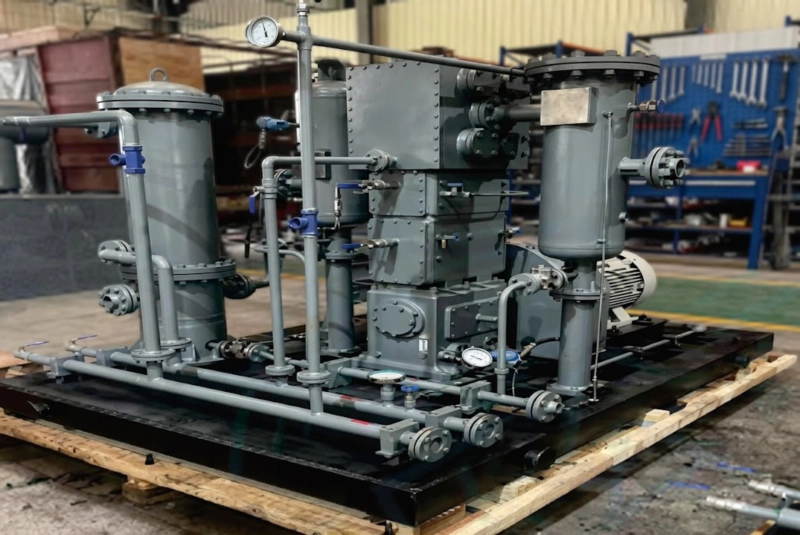
ZW series units are delivered as complete factory-tested skid packages — compressor, motor, cooler, separator, instrumentation, and control panel pre-assembled, pre-piped, and pre-wired. Site installation requires only utility connections, dramatically reducing commissioning time and on-site engineering cost.
⚖
API 618 and GOST-R Dual Compliance
Full API 618 Fifth Edition design compliance with rod load certification, distance piece classification, and materials documentation. GOST-R certification standard for all models, enabling straightforward procurement and customs clearance in Russia, Kazakhstan, Belarus, and all EEU member states.
🥥
Food-Grade Oil-Free Option
Oil-free cylinder configuration with PTFE or PEEK piston rings and double-compartment distance piece ensures zero oil contamination of the CO₂ gas stream, meeting ISBT food-grade CO₂ purity requirements (total oil below 0.1 ppm). Suitable for beverage carbonation, dry ice production, and food processing.
🔌
Wide Pressure Range in a Compact Body
Despite its small footprint, the ZW series covers pressures from 0.10 MPa (CO₂ recovery) to 10.0 MPa (high-pressure liquefaction and supercritical process duties) in the same vertical frame architecture, using 1, 2, or 3 compression stages as required by the overall compression ratio.
🕑
Low Maintenance Cost
Piston ring and packing service intervals of 6,000–10,000 hours. Gas valve replacement at 8,000–12,000 hours. All wear parts manufactured in-house and stocked for rapid supply throughout the compressor’s 20+ year operating life, with no dependency on third-party supply chains.
Structure and Material Quality Standards
| Component |
Material / Standard |
Notes |
| Crankshaft |
42CrMo forged alloy steel, hardened journals |
UT and MPI inspection |
| Frame |
HT250 or QT500 cast iron |
Precision-bored bearing housings |
| Cylinders |
HT250 grey cast iron; 316L SS for wet service |
Hydrostatic test at 1.5 x MAWP |
| Piston Rods |
42CrMo, hard chrome plated |
Roundness ≤ 0.01 mm; HRC 60–65 |
| Piston Rings / Packing |
PTFE (standard) or PEEK (food-grade / high-temp) |
Service life 6,000–10,000 h |
| Gas Valves |
316 SS seats; PEEK or PTFE elements |
Service life 8,000–12,000 h |
| Coolers / Separators |
CS shell-and-tube or brazed plate; 316L SS option |
Pressure Vessel License certified |
Typical Application Scenarios
🥦
Small-Scale CO₂ Liquefaction and Dry Ice Production
The ZW-2/60 and ZW-5.5/24 models are the most widely deployed compressors in small-scale CO₂ liquefaction plants — where recovered CO₂ from fermentation or flue gas is compressed to 2.4–6.0 MPa and condensed into liquid form for storage and dry ice production. The compact skid footprint allows installation in existing production buildings without structural modifications. Oil-free cylinder configuration ensures the resulting liquid CO₂ meets food-grade and dry ice purity specifications.
Related: Liquid CO₂ produced by the ZW series is used in PET bottle blowing for carbonated beverage packaging. Our partner site offers a one-step injection stretch blow moulding machine for integrated beverage production operations, providing a complete solution from CO₂ compression to bottle manufacture.
🍾
Brewery and Fermentation CO₂ Recovery
In craft breweries, wine fermentation facilities, and bio-ethanol plants, CO₂ exits fermentation vessels at near-atmospheric pressure and must be collected, dried, and recompressed to storage pressure. The ZW-6/8 (low-pressure series) and ZW-4/25 are well-sized for single-brewery and medium-sized fermentation plant recovery duties, providing a compact, low-energy solution that pays back its capital cost through recovered CO₂ value in 2–4 years at current CO₂ prices. Oil-free specification ensures that the recovered gas meets beverage-grade purity requirements without additional downstream processing.
🌿
Carbon Capture Pilot Plants and Small CCS Boost Stations
As carbon capture projects move from demonstration to commercial deployment, the ZW series provides the compression solution for early-stage CCS installations, research facilities, and small-volume point-source capture projects where full-scale DW or 4MW machines would be oversized. The compact footprint and 380 V power supply compatibility make ZW units straightforward to install in industrial facilities that are retrofitting CO₂ capture capability without major electrical infrastructure upgrades. Models up to 45 m³/min cover CO₂ volumes up to approximately 60,000 tonnes per year from a single unit.
🔌
Laboratory and Supercritical CO₂ Extraction
Supercritical CO₂ extraction at laboratory and small industrial scale — for pharmaceutical intermediates, specialty flavourings, natural extracts, and cannabis processing — requires a high-pressure CO₂ circulation compressor at 7.4–30 MPa with minimal flow rate (typically 0.5–5 Nm³/min). The ZW-2/60 at 6 MPa provides the pressure level required for most supercritical extraction processes in a package small enough to stand beside the extraction vessel, with oil-free cylinder specification ensuring zero contamination of the extracted product. Higher-pressure variants to 10 MPa are available on request.
Selection Guide: Choosing the Right ZW Model
Use the following framework to identify the correct ZW model configuration. For applications above 45 m³/min or above 4.0 MPa, consider the DW or 4MW series.
1
Confirm flow and pressure at actual operating conditions
For flows up to 6 m³/min at 0.80 MPa, the ZW-6/8 low-pressure model is the starting point. For flows of 2–5.5 m³/min at 2.4–6.0 MPa, the ZW-2/60, ZW-4/25, or ZW-5.5/24 high-pressure models apply. For flows of 6–45 m³/min in the mid-pressure range, contact our engineering team for a model recommendation based on your specific duty.
2
Specify oil-free or oil-lubricated based on downstream gas quality requirement
Food-grade CO₂, dry ice production, beverage carbonation, pharmaceutical extraction, and any application with oil content specification below 1 ppm require oil-free cylinder specification. Chemical synthesis and non-food process duties where trace hydrocarbons are tolerable may use oil-lubricated cylinders for longer ring service life.
3
Provide complete gas composition including all impurities
CO₂ purity, moisture content, H₂S concentration, hydrocarbons. Even trace H₂S requires NACE-compliant stainless steel materials throughout. Free water requires 316L SS wetted parts regardless of H₂S level. Upstream dehydration to −40°C dew point is recommended for all CO₂ recovery applications.
4
Confirm available drive voltage and cooling method
Small ZW models (45–75 kW) are supplied with 380 V drive motors as standard, making them compatible with standard industrial electrical supply without special transformers. Larger models (above 110 kW) use 6 kV or 10 kV. Confirm available cooling water supply; air-cooled skid packages are available where cooling water is not accessible.
5
Confirm GOST-R requirement for Russia and CIS procurement
All ZW series models are available with GOST-R certification documentation for Russian Federation, Kazakhstan, Belarus, and other EEU member state procurement. State this requirement at enquiry stage so it is included in the engineering scope and documentation package.
ZW Series vs. International Brands: Objective Comparison
Transparency Notice: Ariel Corporation, Dresser-Rand (Siemens Energy), Bauer Kompressoren, and Siad Macchine Impianti are referenced solely to help engineers cross-reference performance classes. We do not manufacture, sell, or claim affiliation with these brands. All ZW compressors are original designs. We do not sell counterfeit or unlicensed products.
| Factor |
ZW Series (Our Make) |
Ariel JGZ |
Dresser-Rand HOS-V |
Bauer K-series |
| API 618 Compliance |
✓ Full |
✓ Full |
✓ Full |
Varies by model |
| GOST-R (Russia/CIS) |
✓ Standard |
Case by case |
Case by case |
Case by case |
| Capital Cost (2–45 m³/min) |
30–50% below European OEM |
High (USD) |
High (EUR) |
Premium (EUR) |
| Lead Time |
4–6 months |
6–12 months |
8–14 months |
6–10 months |
| Skid Package |
Factory-integrated standard |
Optional |
Optional |
Optional |
| Spare Parts Supply |
In-house; rapid dispatch |
OEM only |
OEM only |
OEM only |
| Russia/CIS On-Site Service |
Direct manufacturer support |
Agent network |
Regional office |
Agent network |
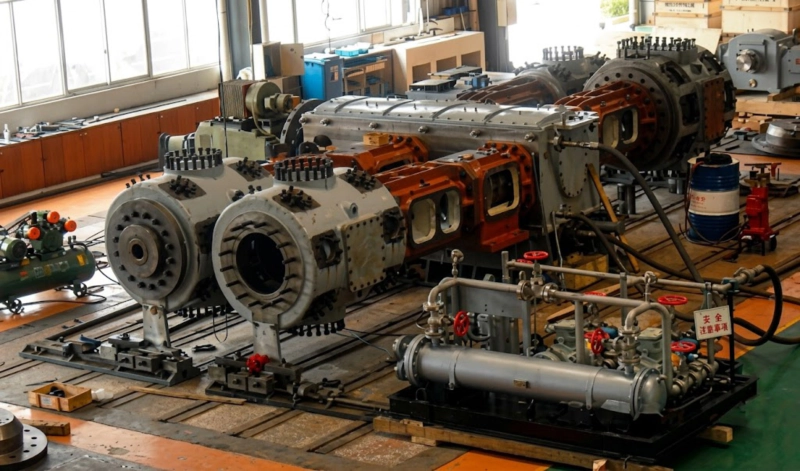
Factory acceptance test — every ZW series unit is mechanically tested at design operating conditions before shipment, with performance data recorded against the contractual data sheet
Frequently Asked Questions — ZW Series CO₂ Compressor
Q1: What does ZW stand for and how does the vertical design differ from horizontal compressors?
ZW designates a two-column vertical (Z-type) reciprocating compressor — the Z referring to the vertical cylinder orientation. In a vertical design, the pistons move upward and downward, with gravity acting parallel to the cylinder axis rather than perpendicular to it as in horizontal machines. This means the contact force between piston rings and cylinder wall is distributed more evenly around the bore circumference, which can extend piston ring life in smaller vertical machines. The primary practical advantage is floor space: a ZW-2/60 skid occupies less than 2.7 m² of floor area, compared to 8–12 m² for an equivalent-flow horizontal compressor. The trade-off is that vertical machines are less suitable for very large flow rates and high rod loads, which is why the DW and 4MW series use horizontal opposed configurations for larger duties.
Q2: Is the ZW-2/60 suitable for dry ice production?
Yes. Dry ice production requires liquid CO₂ at 6–7 MPa, which is then expanded through a press to solidify into dry ice. The ZW-2/60 delivers 2 m³/min at 6.0 MPa — appropriate for a small dry ice plant producing approximately 100–200 kg/h of dry ice depending on inlet CO₂ pressure and temperature conditions. The compact skid footprint makes it straightforward to integrate alongside a dry ice press in a small production facility. Oil-free cylinder specification is required for any dry ice production intended for food or industrial-cleaning use, ensuring the product meets purity specifications without downstream filtration.
Q3: Can the ZW series handle CO₂ from brewery fermentation directly?
Yes, with appropriate upstream conditioning. CO₂ from fermentation is water-saturated and contains ethanol vapour, acetaldehyde, and other volatile organic compounds that must be removed before the gas enters the compressor suction. A standard upstream conditioning train for fermentation CO₂ includes a foam trap, water scrubber, activated carbon bed, and molecular sieve dryer to bring the gas to the quality required by the compressor and the downstream purity specification. After conditioning, the ZW-6/8 or ZW-4/25 handles the recompression duty. The whole conditioning and compression package can be supplied as a factory-integrated unit for brewery and winery installations.
Q4: What is the minimum order quantity and can a single ZW unit be supplied?
Single units can be and are regularly supplied. There is no minimum quantity requirement. The ZW series is designed for single-unit deployment in small to medium applications, and most of our ZW orders are for one or two units per project. For larger projects requiring multiple units running in parallel, we can supply matched-performance units built to the same data sheet and factory-tested together to confirm uniform performance. Contact our engineering team with your project requirements and we will provide a proposal for any quantity from one unit upward.
Q5: Does the ZW series require a special foundation?
For the small ZW skid-mounted models (ZW-2/60 at 2.90 t and ZW-5.5/24 at 3.50 t), a standard level concrete floor with anchor bolt provisions is sufficient. The vertical cylinder arrangement of the ZW series generates lower horizontal shaking forces than a single-column horizontal compressor of equivalent capacity, because the vertical inertia forces are partially absorbed by the mass of the skid frame itself. Anti-vibration mounts are available as an option for installations in buildings where floor vibration transmission is a concern. No heavy isolated foundations of the type required by large horizontal machines are needed for ZW series installations in the standard model range.
Q6: What is the GOST-R certification scope for ZW series units supplied to Russia?
GOST-R certification covers the compressor unit design, the pressure-retaining components (cylinders, heads, piping, coolers, and separators), and the safety systems. The documentation package provided with each GOST-R certified ZW unit includes the certification certificate, the technical file, and the conformity declaration — all documents required for customs clearance and registration of process equipment in the Russian Federation. The GOST-R certificate is valid for five years from the date of issuance and can be used across multiple units of the same type. Specify the GOST-R requirement at enquiry stage; it is included at no additional charge for standard configurations supplied to Russia and CIS markets.
Q7: How is the ZW series different from the LW series in the same catalogue?
The LW and ZW series are both vertical two-column reciprocating compressors in the same general product family. The key distinction is in cylinder bore size, stroke length, and the resulting flow-pressure envelope. LW models typically cover higher flow rates in the low-to-mid pressure range, while ZW models extend to higher pressures with smaller flow rates. For CO₂ service specifically, the ZW series has been optimised for the pressure levels required in liquefaction (2.4–6.0 MPa) and process duties, with sealing and materials specifications specifically validated for CO₂ service. For applications at the boundary of the two ranges, our engineering team can advise on the most economical configuration for your specific duty.
Q8: What capacity control options are available on the ZW series?
Three options are available. Suction valve unloaders provide step-wise capacity reduction (typically 50% or 0% for two-cylinder models, or 33%/67%/100% for three-cylinder models) without stopping the machine — the lowest-cost and most reliable option for applications with relatively stable demand. Variable frequency drive (VFD) on the motor provides continuous smooth modulation from approximately 50% to 100% of design capacity with the best part-load energy efficiency — recommended for brewery and fermentation recovery applications where gas generation rate varies continuously. A combination of suction valve unloaders and VFD provides the widest overall turndown range. Specify the minimum flow rate your process requires at enquiry stage.
Q9: Can the ZW series be supplied with air cooling instead of water cooling?
Yes. Air-cooled skid packages are a standard option for all ZW series models. The air-cooled configuration replaces the shell-and-tube interstage coolers with fin-fan (forced air) coolers mounted on or adjacent to the compressor skid. This is the preferred configuration where cooling water is not readily available — common in remote locations, small industrial premises, and portable or mobile CO₂ recovery units. Air-cooled units require slightly more space than equivalent water-cooled units and are less effective in very hot climates (ambient above 40°C) where the achievable interstage temperature after cooling is higher, potentially requiring a higher discharge pressure to achieve the same liquefaction performance. Our engineering team will confirm the air-cooled performance at your ambient design temperature as part of the proposal process.
Q10: What maintenance does a ZW series compressor require and how long do wear parts last?
Under normal conditions with clean, dry CO₂ and correct lubrication oil: piston rings and packing rings should be inspected at 4,000 hours and replaced at 6,000–10,000 hours; gas valve elements should be replaced at 8,000–12,000 hours; piston rod surface should be inspected annually for chrome layer integrity; and main bearings should be inspected at 20,000–30,000 hours. For ZW units in oil-free service, the piston ring wear rate is also influenced by gas moisture content and inlet temperature — drier, cooler gas results in longer ring life. All wear parts are manufactured in-house and stocked for rapid dispatch, supporting ZW operators in Russia and CIS with minimised import lead times for consumable spares.
Request a Technical Proposal for Your CO₂ Application
Whether you are specifying a new small-scale CO₂ liquefaction unit, recovering fermentation gas from a brewery, or compressing CO₂ for a pilot carbon capture installation, our engineering team can recommend the right ZW configuration for your duty and provide a complete technical and commercial proposal. As the manufacturer of the widest range of industrial CO₂ compressors in Russia, we provide GOST-R documentation as standard for all CIS market deliveries.
ZW Series CO₂ Compressor — Engineering Enquiry
Ready to Discuss Your CO₂ Compression Requirements?
Send your process data and we will return a technical recommendation within 48 hours. GOST-R certification provided for all Russia and CIS project deliveries.
Request a Technical Quote
Include in Your Enquiry
✓ Required flow rate (Nm³/min or Nm³/h)
✓ Inlet and discharge pressures
✓ CO₂ gas composition and purity
✓ Oil-free or lubricated requirement
✓ Cooling water or air-cooled preference
✓ Available drive voltage
✓ GOST-R requirement (Russia/CIS)
✓ Required delivery date