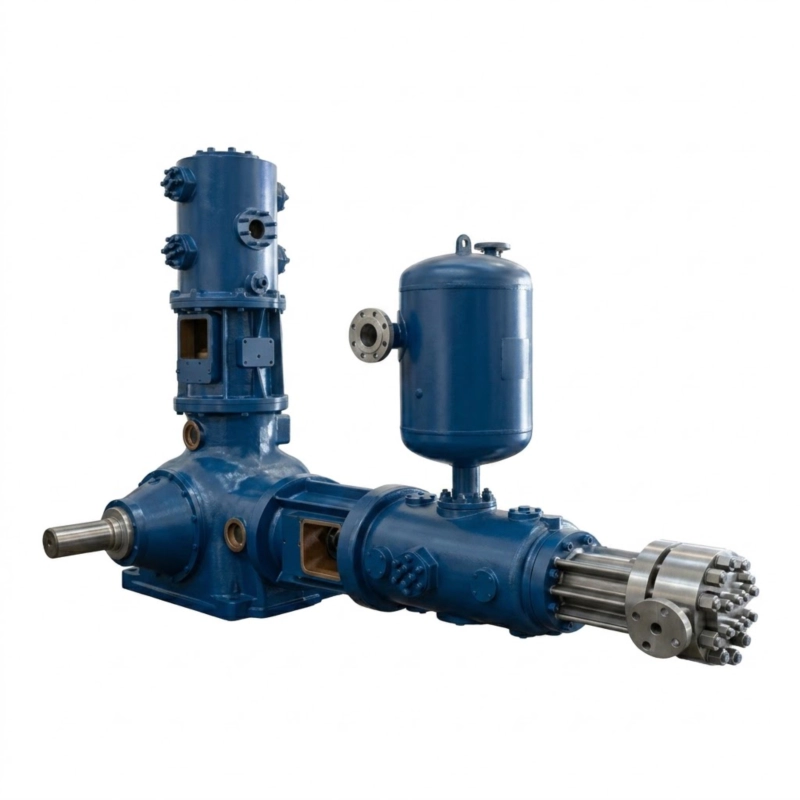
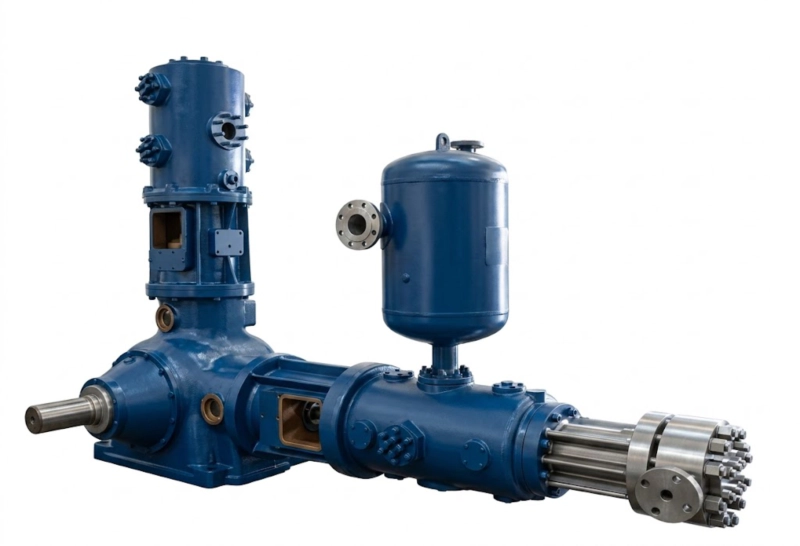
Product Overview: LW Series Hydrogen Recirculation Compressor
The LW series hydrogen recirculation compressor is a two-column horizontal long-stroke reciprocating piston compressor engineered exclusively for the closed-loop recirculation of hydrogen and hydrogen-rich gas in refinery and chemical process reactor systems. Its defining engineering requirements — oil-free compression, copper-free wetted parts, ATEX Group IIC explosion-proof equipment, Type D distance piece with nitrogen purge, and low molecular weight gas cylinder design — distinguish it completely from the standard gas service LW series machines, even though both share the same long-stroke frame architecture.
Hydrogen recirculation compressors maintain the hydrogen partial pressure and velocity in catalytic reactor loops. In a hydrotreating or hydrocracking unit, hydrogen is consumed by the desulphurisation and cracking reactions but must be maintained at a high molar fraction and sufficient circulation rate across the catalyst bed to prevent coke deposition, maintain catalyst activity, and keep sulphur compounds in the vapour phase for removal. The recirculation compressor draws hydrogen-rich gas from the high-pressure separator, boosts it across the relatively small pressure differential of the reactor loop (typically 0.10–0.50 MPa), and returns it to the reactor inlet, completing the loop. Any oil contamination from the compressor immediately poisons the catalyst — which is why oil-free compression is not an option but an absolute requirement for this service.
17 standard models cover 15–75 Nm³/min at discharge pressures of 0.15–1.60 MPa, spanning the full range of single-reactor-train hydrotreating units through to large hydrocracking complexes. 380 V motors are standard throughout most of the range, enabling installation at refinery sub-stations without dedicated high-voltage switchgear. All models are manufactured to API 618 Fifth Edition and GOST-R at our production facility in Russia, with full Rostechnadzor registration documentation provided as standard for Russia and CIS installations. GOST-R certification and ATEX Zone 1, Group IIC certificates are included as standard — not available as options.
Technical Specifications — Low Pressure Recirculation (0.15–0.80 MPa)
Single-stage and two-stage configurations for hydrotreating, catalytic reforming, and coal chemical reactor hydrogen recirculation where the loop differential pressure is below 0.80 MPa. Inlet conditions: slightly positive suction pressure (near atmospheric to 0.80 MPa depending on the loop). All models: oil-free PTFE rings, copper-free wetted parts, ATEX IIC, Type D distance piece with N₂ purge.
| Model |
Config |
Flow (Nm³/min) |
Discharge (MPa) |
Dimensions L×W×H (mm) |
Weight (t) |
Power (kW) |
Voltage |
| LW-15/8 |
2-col 1-stage |
15 |
0.80 |
5100×1700×2200 |
6.50 |
132 |
380 |
| LW-20/2 |
2-col 2-stage |
20 |
0.20 |
2730×1550×2432 |
3.00 |
110 |
380 |
| LW-20/4 |
2-col 2-stage |
20 |
0.40 |
2730×1550×2432 |
3.00 |
110 |
380 |
| LW-20/8 |
2-col 2-stage |
20 |
0.80 |
5200×1700×2200 |
6.50 |
160 |
380 |
| LW-25/3.5 |
2-col 1-stage |
25 |
0.35 |
2926×1550×2690 |
3.20 |
132 |
380 |
| LW-30/2 |
2-col 1-stage |
30 |
0.20 |
3140×1550×2445 |
3.40 |
90 |
380 |
| LW-30/4 |
2-col 2-stage |
30 |
0.40 |
2990×2370×1550 |
4.00 |
132 |
380 |
| LW-40/2 |
2-col 1-stage |
40 |
0.20 |
2990×1550×2690 |
3.20 |
132 |
380 |
| LW-40/4 |
2-col 2-stage |
40 |
0.40 |
2360×1655×2548 |
4.50 |
160 |
380 |
| LW-50/6 |
2-col 2-stage |
50 |
0.60 |
3260×1685×2235 |
6.50 |
220 |
380/6K/10K |
| LW-60/2.5 |
2-col 1-stage |
60 |
0.25 |
3260×1655×2548 |
5.00 |
220 |
380/6K/10K |
| LW-60/4 |
2-col 2-stage |
60 |
0.40 |
3260×1655×2548 |
5.00 |
260 |
380/6K/10K |
| LW-75/1.5 |
2-col 1-stage |
75 |
0.15 |
4000×2100×2600 |
7.80 |
220 |
380/6K/10K |
All low-pressure models: oil-free PTFE piston rings and packing, copper-free wetted parts, ATEX Zone 1 Group IIC, Type D distance piece with N₂ purge. Flow in Nm³/min at 0°C and 0.1013 MPa. All dimensions L×W×H in mm.
Technical Specifications — Mid-High Pressure Recirculation (0.80–1.60 MPa)
Multi-stage configurations for hydrocracking, ammonia synthesis loop, and methanol synthesis H₂ recirculation where the loop discharge pressure reaches 1.0–1.60 MPa. These models handle both fresh H₂ boost and loop recirculation at elevated system pressures.
| Model |
Config |
Flow (Nm³/min) |
Discharge (MPa) |
Dimensions L×W×H (mm) |
Weight (t) |
Power (kW) |
Voltage |
| LW-20/18 |
2-col 3-stage |
20 |
1.80 |
3500×2600×1850 |
6.00 |
240 (250) |
380/6K/10K |
| LW-22/0.4–16 |
2-col 2-stage |
22 |
1.60 |
5000×1450×2400 |
7.00 |
280 |
380/6K/10K |
| LW-27/1.1MPa |
2-col 1-stage |
27 |
1.58 |
5100×3700×2520 |
9.00 |
315 |
380/6K/10K |
LW-22/0.4–16: inlet pressure range 0.04–0.40 MPa, discharge 1.60 MPa — covers both near-atmospheric suction and loop recirculation at existing system pressure. LW-27/1.1MPa: inlet at 1.10 MPa, single-stage boost to 1.58 MPa for high-pressure loop recirculation. All dimensions L×W×H in mm.
General Series Parameters
| Parameter |
LW H₂ Recirculation Specification |
| Compression Medium |
Hydrogen (H₂), hydrogen-rich gas (H₂ above 70%), hydrocarbon-hydrogen mixtures (hydrotreating, hydrocracking loop gas) |
| Discharge Pressure |
0.15–1.80 MPa |
| Flow Range |
15–75 Nm³/min (900–4,500 Nm³/h) at 0°C, 0.1013 MPa |
| Motor Power |
90–315 kW |
| Drive Voltage |
380 V standard (most models); 6 kV / 10 kV available |
| Lubrication |
Oil-free PTFE piston rings and packing — standard on all models without exception |
| ATEX Classification |
Zone 1, Group IIC — mandatory for all hydrogen service |
| Wetted Part Materials |
Copper-free throughout: no brass, bronze, or copper alloy fittings in any gas-contacting component |
| Distance Piece |
Type D double-compartment with continuous nitrogen purge — standard on all models |
| H₂S Service |
NACE MR0103 materials available for hydrotreating loop gas containing H₂S |
| Design Standard |
API 618 Fifth Edition; GOST-R (Russia / CIS) |
| Certification |
ISO 9001:2015, GOST-R, ATEX Zone 1 Group IIC, Pressure Vessel License |
Working Principle and Hydrogen-Specific Engineering
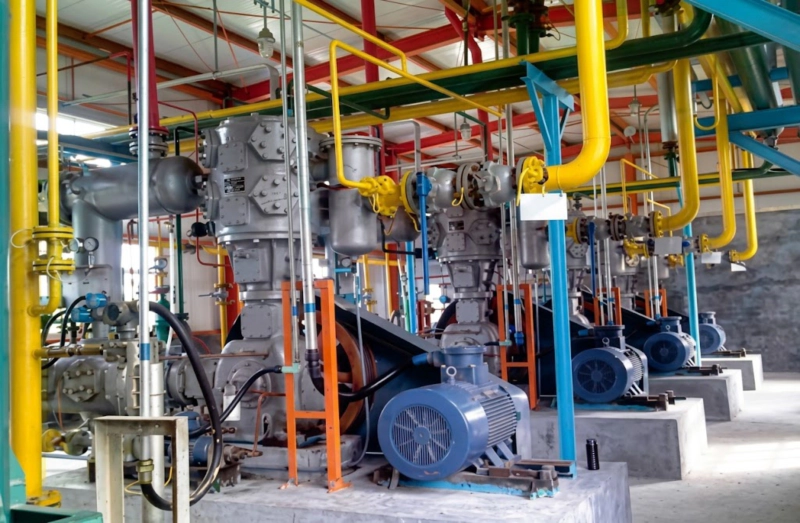
The LW series hydrogen recirculation compressor uses the same horizontal long-stroke reciprocating piston principle as the standard gas LW series, but every detail of the wetted gas circuit is re-engineered for hydrogen service. Hydrogen is the lightest gas in industrial compression service — molecular weight 2 versus 16–28 for natural gas — and this low molecular weight drives a set of engineering requirements that fundamentally change the compressor specification:
Very Large Cylinder Bore
At molecular weight 2, a given mass flow of H₂ occupies 8–14 times the volume of the same mass of natural gas at the same conditions. The H₂ recirculation cylinder bore is therefore substantially larger than for equivalent-duty gas machines — requiring thicker cylinder walls and larger gas valves than appears from the pressure rating alone.
Oil-Free Mandatory
Cylinder lubricating oil introduced into the reactor loop immediately deposits on the catalyst surface, blocking active sites and irreversibly reducing catalyst activity. PTFE piston rings and packing operate without any lubrication at the cylinder wall, eliminating this risk. Oil-lubricated H₂ recirculation compressors are not acceptable in modern refinery or chemical synthesis units.
Copper-Free Wetted Circuit
Copper and copper alloys (brass, bronze) are susceptible to hydrogen embrittlement at elevated pressures and are prohibited in hydrogen service per API 618. All flanges, fittings, valve bodies, and piping in the gas circuit must be copper-free. No standard brass instrument fittings are permitted anywhere in the gas path.
Enhanced Sealing — Type D Distance Piece
Hydrogen has the smallest molecular diameter of any gas and leaks through sealing clearances that are gas-tight for larger molecules. Type D double-compartment distance piece with continuous nitrogen purge at positive pressure prevents H₂ from reaching the crankcase and ensures any packing leakage is captured in the purge stream rather than escaping to the machine room atmosphere.
H₂S Co-Presence (Hydrotreating)
Hydrotreating loop gas contains hydrogen sulphide (H₂S) liberated from the feed. Where H₂S concentration exceeds the NACE MR0103 threshold, all carbon steel components in the gas circuit must be replaced with 316L SS or NACE-compliant alloy steel. This requirement is assessed per the specific H₂S concentration provided at enquiry.
ATEX Group IIC Mandatory
Hydrogen has a minimum ignition energy of 0.017 mJ — far below methane (0.29 mJ) or ethylene (0.082 mJ). Any electrical equipment below Zone 1, Group IIC certification is unsafe in hydrogen service. This applies to the motor, control panel, sensors, junction boxes, lighting, and all cable glands at the compressor package.
Application Scenarios
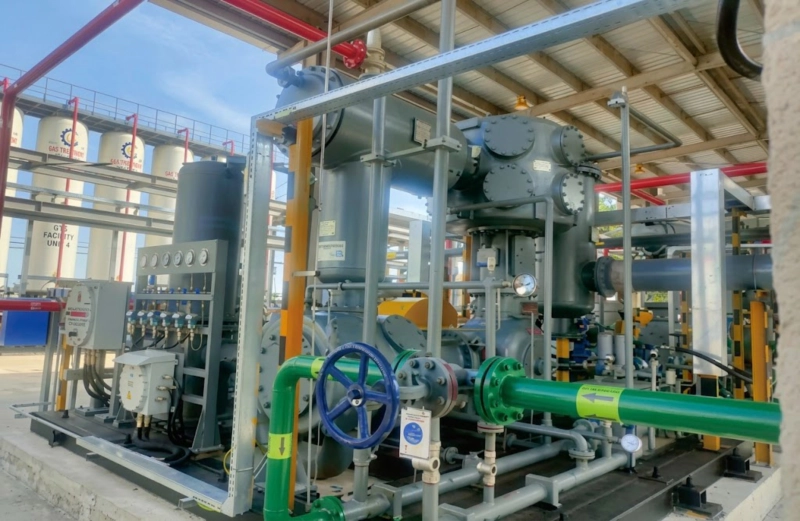
🏭Hydrotreating Unit Hydrogen Recirculation
Hydrotreating units (naphtha, kerosene, diesel, vacuum gas oil) consume hydrogen to remove sulphur, nitrogen, and oxygen from the feed. The recirculation compressor maintains the H₂ partial pressure across the reactor bed and circulates unreacted hydrogen back to the reactor inlet after high-pressure separator gas-liquid separation. The LW-20/4, LW-30/4, LW-40/4, and LW-60/4 are the most commonly specified models for hydrotreating H₂ recirculation duties in Russia and CIS refineries. The presence of H₂S in the loop gas requires NACE MR0103 materials and Type D distance piece with N₂ purge at all times.
⚙️Hydrocracking Unit Hydrogen Recirculation and Makeup
Hydrocracking units operate at higher hydrogen partial pressures than hydrotreating (typically 8–18 MPa total loop pressure) and consume more hydrogen per tonne of feed. The recirculation compressor handles the loop pressure differential (0.30–0.80 MPa typically) at high hydrogen purity (80–90% H₂). The LW-20/8, LW-40/4, and LW-50/6 are suited to smaller hydrocracking train sizes. The LW-22/0.4–16 at 280 kW covers the wider inlet pressure variation encountered in hydrocracking loops where system pressure varies across the operating cycle.
🔌Catalytic Reforming Hydrogen Recirculation
Catalytic reforming units produce high-purity hydrogen as a by-product (typically 85–95% H₂) and also require hydrogen recirculation across the reforming reactor train. The loop gas is hydrogen-dominant with methane, ethane, and C3+ hydrocarbons as minor components. Because the gas contains no H₂S in clean reforming service, materials can often remain at carbon steel specification — but ATEX Group IIC remains mandatory regardless of H₂S content due to the high hydrogen mole fraction. The LW-25/3.5, LW-30/2, and LW-40/2 are typical for catalytic reforming recirculation duties.
🌿Coal Hydrogenation and Chemical Synthesis H₂ Recirculation
Coal direct liquefaction, coal-to-chemicals, and methanol synthesis units in Russia and Kazakhstan require large-volume hydrogen recirculation at moderate pressures. The LW-60/2.5, LW-60/4, and LW-75/1.5 at 220–260 kW cover the hydrogen recirculation requirements of medium-scale coal chemical plants. Where the synthesis gas contains CO in addition to hydrogen, the materials and sealing specification must also comply with CO service requirements — Type D distance piece with N₂ purge and CO detector system.
Core Advantages of the LW Series for Hydrogen Recirculation
🔥
ATEX IIC as Standard, Not Optional
Every LW H₂ recirculation unit is supplied with ATEX Zone 1, Group IIC explosion-proof electrical equipment as standard — motor, panel, instruments, junction boxes, cable glands, and lighting. No surcharge, no optional upgrade. The ATEX IIC certificate is included in the delivery documentation.
📈
Catalyst-Safe Oil-Free Compression
PTFE piston rings and packing on all cylinder stages operate without any cylinder wall lubrication. Zero oil carryover to the reactor loop. PTFE ring service life 6,000–8,000 hours. Oil-free compression is not a premium feature — it is the baseline specification for every LW H₂ recirculation model.
⚙
H₂S Service Specification Available
For hydrotreating loop gas containing H₂S above the NACE MR0103 threshold, all carbon steel wetted components are replaced with NACE-compliant 316L SS or alloy steel. Provide the H₂S concentration at enquiry and the correct material specification is included in the proposal without requiring a separate materials review.
📄
Full GOST-R and Rostechnadzor Documentation
GOST-R certificate, technical passport, pressure vessel certification, ATEX IIC certificates, and all documentation required for Rostechnadzor registration of hydrogen compression equipment as an explosive-medium hazardous production facility — provided as standard for every Russia and CIS delivery.
🌎
Russia-Based PTFE Parts — No Import Wait
PTFE piston rings, packing rings, and gas valve elements for all LW H₂ models are manufactured in-house at our Russian facility. For hydrotreating units where a compressor outage shuts down the reactor train, having the critical replacement sealing parts available with 24–72 hour dispatch eliminates the import lead time risk on refinery-critical spares.
⚡
380 V on Most Models
Most LW H₂ recirculation models operate at 380 V, compatible with standard refinery unit electrical supply without a dedicated high-voltage transformer. The refinery sub-station 380 V feed is typically sufficient for LW models up to 220 kW, covering the hydrotreating units typical of Russian refineries at 20,000–50,000 tonnes per year throughput.
Material Specifications for Hydrogen Service
| Component |
Clean H₂ (Reforming / Low-H₂S) |
H₂ with H₂S (Hydrotreating Loop) |
| Cylinders |
HT250 cast iron (copper-free) |
316L SS; NACE MR0103 alloy steel |
| Piston Rings / Packing |
PTFE oil-free — all stages |
PTFE oil-free — all stages |
| Piston Rods |
42CrMo, hard chrome plated (copper-free) |
Inconel overlay or 316L SS for H₂S above threshold |
| Gas Valves |
CS body; PEEK elements; copper-free seat |
316L SS body and seat; PEEK elements |
| Piping / Fittings |
Carbon steel; no copper alloy fittings |
316L SS piping; NACE-compliant flanges |
| Distance Piece |
Type D + continuous N₂ purge — all models |
Type D + continuous N₂ purge — all models |
| Electrical Equipment |
ATEX Zone 1, Group IIC — all models |
ATEX Zone 1, Group IIC — all models |
Selection Guide
1
Provide the actual reactor loop flow, not the fresh makeup flow — the recirculation compressor handles the full circulating hydrogen flow, which is typically 3–8 times larger than the fresh hydrogen consumption rate. For a hydrotreating unit consuming 500 Nm³/h of fresh H₂, the recirculation flow may be 2,000–4,000 Nm³/h. Confirm the recirculation flow with the process licensor before selecting the compressor model.
2
State the H₂S concentration in the loop gas — hydrotreating loop gas always contains H₂S; catalytic reforming loop gas typically does not. The H₂S level determines whether NACE MR0103 materials are required and at what threshold. Do not specify a standard carbon steel machine for hydrotreating service without confirming the H₂S content — material failure in H₂S service can occur within months of commissioning on the wrong material specification.
3
Confirm the loop differential pressure — not just the suction or discharge pressure alone — the recirculation compressor must overcome only the pressure drop around the loop (reactor, heat exchangers, separator, piping). This is typically 0.10–0.80 MPa for hydrotreating and 0.30–1.20 MPa for hydrocracking, regardless of the absolute loop pressure. A machine rated for the wrong differential pressure cannot be corrected without re-staging the cylinders.
4
GOST-R and Rostechnadzor documentation required for all Russia installations — hydrogen compression facilities in Russia are classified as explosive-medium hazardous production facilities (OPO, explosive-atmosphere production facilities) under Federal Law 116-FZ and require Rostechnadzor registration before commissioning. The full documentation package is provided as standard with every LW H₂ recirculation unit delivered to Russia or EEU member states.
LW H₂ Recirculation vs. Alternatives
Transparency Notice: Ariel JGC/JGT, Dresser-Rand HOSS, and Burckhardt Laby are referenced for performance class comparison only. We do not manufacture or claim affiliation with these brands. All LW compressors are original designs. We do not sell counterfeit or unlicensed products.
| Factor |
LW H₂ Recirculation |
Ariel JGC/JGT |
Dresser-Rand HOSS |
| API 618 |
✓ Full |
✓ Full |
✓ Full |
| GOST-R (Russia / CIS) |
✓ Standard |
Case by case |
Case by case |
| ATEX IIC as standard |
✓ Included |
Available |
Available |
| Oil-free as standard |
✓ Included |
Available |
Available |
| Capital Cost |
30–45% below European |
High (USD) |
High (EUR) |
| Lead Time |
4–6 months |
10–16 months |
12–18 months |
| Spare Parts (Russia) |
In-house; 24–72 h dispatch |
Import; 3–9 months |
Import; 3–9 months |
| On-Site Service (Russia) |
Direct from Russia |
Agent network |
Regional office |
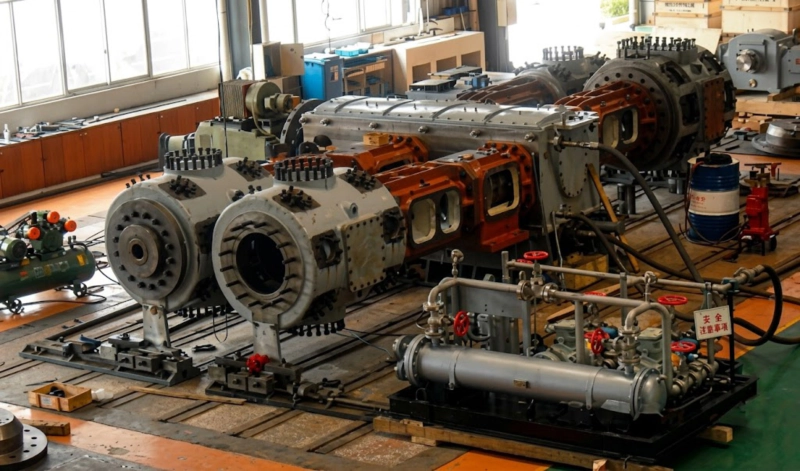
Factory acceptance test — every LW series hydrogen recirculation compressor is run-tested at rated conditions with ATEX IIC systems armed, oil-free cylinder operation verified, and Type D distance piece N₂ purge flow confirmed before shipment
Frequently Asked Questions
Q1: Why must hydrogen recirculation compressors be oil-free when standard gas compressors use lubricated cylinders?
Cylinder lubricating oil carried over into the reactor loop deposits on the catalyst surface at the high temperatures of the reactor bed (typically 300–450°C for hydrotreating). This oil deposition progressively blocks the catalyst pore structure and active sites, reducing conversion activity and increasing pressure drop across the reactor bed. Catalyst replacement is extremely costly — a hydrotreating catalyst charge can cost hundreds of thousands of US dollars. A single oil-lubricated compressor overhaul event that allows a slug of oil into the loop can advance the catalyst replacement date by 1–2 years. PTFE oil-free rings on the LW series eliminate this risk at source.
Q2: Why is ATEX Group IIC required even for mixed hydrogen-hydrocarbon loop gas where hydrogen may be below 70%?
The ATEX group classification is determined by the most ignition-sensitive component present in the mixture at its most hazardous concentration, not by the average mixture composition. Hydrogen is always present at above 25% by volume in hydrotreating and hydrocracking loop gas — which places the mixture in Group IIC per standard electrical area classification methodology. Even if the bulk gas is 60% H₂ and 40% hydrocarbons, the 60% H₂ fraction governs the ATEX group. Using Group IIB equipment (suitable for ethylene but not hydrogen) in a hydrogen-containing loop is a safety code violation regardless of the other gas components present.
Q3: What is the purpose of the Type D distance piece and nitrogen purge, and why is it mandatory for all LW H₂ models?
The distance piece is the enclosure between the cylinder packing gland and the crankcase, through which the piston rod passes. Type C provides one compartment separation; Type D provides two independent compartments. In the LW H₂ series, the inner compartment of the Type D distance piece is purged with nitrogen at positive pressure relative to the crankcase. Any hydrogen leaking past the cylinder packing enters this nitrogen-purged compartment and is carried out of the compressor frame through the purge vent line without reaching the crankcase oil or the compressor room atmosphere. Hydrogen in the crankcase would form an explosive mixture with air through the crankcase breather; hydrogen in the machine room is an ATEX Zone 1 hazard that requires continuous gas monitoring and ventilation. The nitrogen purge prevents both risks by intercepting any H₂ leak before it reaches the crankcase or the atmosphere.
Q4: What is the PTFE ring service life and how does hydrogen service compare to standard gas service?
PTFE piston ring and packing service life in clean, dry hydrogen service is typically 6,000–8,000 operating hours — comparable to PTFE service life in clean CO₂ or nitrogen service. Hydrogen is a dry, clean gas with no liquid phase under normal recirculation conditions, so ring wear is driven primarily by the surface speed at the cylinder wall rather than by chemical attack. In hydrotreating loop gas containing H₂S or moisture, ring life can be reduced to 4,000–6,000 hours. We recommend maintaining an on-site spare ring set sufficient for two replacement intervals — the replacement itself takes 4–6 hours per cylinder from a trained maintenance team with the compressor at rest. All PTFE ring and packing sets are available from our Russian facility with 24–72 hour dispatch.
Q5: How is the LW series hydrogen recirculation compressor different from the standard LW gas compressor at the same model designation?
Despite sharing the same frame and model number system, the hydrogen recirculation LW and the standard gas LW are different machines in every gas-contacting component. The hydrogen version has: substantially larger cylinder bore (hydrogen molecular weight 2 vs. 16–28 for natural gas — at the same Nm³/min flow rate, hydrogen occupies far more volume per unit mass, demanding a bigger bore to achieve the same volumetric flow); PTFE oil-free rings instead of cast iron lubricated rings; copper-free all wetted parts; Type D distance piece with nitrogen purge instead of Type C; PEEK gas valve elements instead of PTFE (PEEK has better resistance to the trace aromatics in hydrotreating loop gas); and ATEX IIC instead of IIA or IIB. A standard gas LW machine cannot be converted to hydrogen recirculation service — the cylinder bore, ring specification, valve design, and ATEX classification would all need to change.
Q6: What H₂S concentration triggers NACE MR0103 materials in the hydrotreating loop?
The threshold per NACE MR0103 for aqueous H₂S service is 0.34 kPa partial pressure of H₂S (approximately 50 ppm at 7 MPa total pressure, or 3,400 ppm at 0.1 MPa). In a hydrotreating loop at 7–14 MPa total pressure, even modest H₂S concentrations in the gas phase (50–500 ppm by volume) can exceed this partial pressure threshold, especially at the cooler suction end of the compressor where dissolved H₂S can concentrate. Provide the gas phase H₂S concentration in ppm, the total loop pressure, and the compressor suction temperature at enquiry — our engineering team will calculate the actual H₂S partial pressure and confirm whether NACE MR0103 materials are required for your specific duty.
Q7: What capacity control is available and what is the minimum stable flow?
Two control methods are available. Suction valve unloaders on one cylinder provide step-wise capacity reduction — approximately 50% turndown for single-stage two-cylinder models. Variable frequency drive (VFD) on the 380 V motor provides continuous modulation from 50–100% of design flow with proportionally reduced power. For hydrogen recirculation service, VFD is recommended where the reactor feed rate varies significantly during the campaign, as maintaining a stable H₂ recirculation-to-feed ratio is more critical for catalyst life than operating the compressor at a fixed speed. The minimum stable flow with PTFE rings in hydrogen service is approximately 40% of design flow — below this, the PTFE rings may not seat consistently and packing leak rate increases. The suction valve unloader option is preferable when only 50% and 100% operating points are needed.
Q8: What is the delivery time and what are the main lead-time items for LW H₂ recirculation compressors?
Standard delivery from confirmed purchase order is 4–6 months. The main items that govern the schedule are: the large-bore hydrogen cylinders (which require longer machining cycles than equivalent-pressure standard gas cylinders due to their greater bore-to-wall-thickness ratio), the ATEX Group IIC certified motor (which must be sourced specifically to IIC Group — not a standard motor with IIB certification), and the Type D distance piece N₂ purge system (which requires a custom fabrication specific to the model and pressure rating). PTFE ring sets and PEEK valve elements are stocked in standard sizes and do not extend lead time. Provide the required commissioning date at the enquiry stage so the production schedule can be confirmed in the technical proposal.
Q9: What GOST-R documentation is provided and what does Rostechnadzor registration require for hydrogen service in Russia?
Every LW H₂ recirculation compressor delivered to Russia or EEU member states is supplied with: GOST-R certificate of conformity, technical passport (tekhnicheskiy pasport) with all H₂ service design parameters including ATEX IIC classification and oil-free specification, pressure vessel certification for all interstage coolers and separators, ATEX Zone 1, Group IIC certificate for all explosion-proof electrical equipment, nitrogen purge system design documentation, factory acceptance test report, and operating and maintenance instructions in Russian. Hydrogen compression facilities in Russia are classified as explosive-medium hazardous production facilities (OPO) requiring Rostechnadzor registration under Federal Law 116-FZ before startup. The documentation we provide is structured to support this registration. We dispatch the documentation package 2–3 weeks before machine shipment to allow registration to begin in parallel with installation and commissioning activities.
Q10: What spare parts should be stocked on-site for an LW H₂ recirculation compressor?
The recommended two-year operating stock for an LW H₂ recirculation unit includes: two complete sets of PTFE piston rings and packing for each cylinder stage (covering the machine through three to four PTFE ring replacements at 6,000–8,000 hours per set), one complete set of PEEK gas valve elements for each cylinder position (LP suction and discharge, HP suction and discharge on two-stage models), one set of nitrogen purge system O-rings and seals, and one set of critical gaskets for the pressure casing. On-site stock of the valve elements is particularly important for hydrogen recirculation service: PEEK valve elements are not interchangeable with the standard PTFE elements used in other gas service LW machines, and importing the correct PEEK grade for hydrogen service can take 4–8 weeks without our in-house stock. All LW H₂ spare parts are available from our Russian facility within 24–72 hours of order.
Request a Technical Proposal
Our engineering team has deep experience supplying hydrogen recirculation compressors to refineries and chemical plants across Russia and the CIS. The LW series hydrogen recirculation compressor provides API 618 oil-free performance with ATEX Zone 1 Group IIC certification and full GOST-R and Rostechnadzor documentation as standard — with Russia-based PTFE and PEEK spare parts available within 24–72 hours to protect your reactor uptime.
LW Series H₂ Recirculation Compressor — Engineering Enquiry
Discuss Your Hydrotreating or Hydrocracking H₂ Recirculation Project
Process engineers with refinery and chemical synthesis experience answer all enquiries. GOST-R, ATEX IIC, and Rostechnadzor documentation included as standard. Response within 48 hours.
Request a Technical Quote
Include in Your Enquiry
✓ Process type (hydrotreating / hydrocracking / reforming)
✓ H₂ recirculation flow (Nm³/h)
✓ Loop suction and discharge pressure (MPa)
✓ H₂ purity (mol%) and H₂S concentration (ppm)
✓ Suction gas temperature (°C)
✓ Available voltage (380V / 6kV / 10kV)
✓ GOST-R / Rostechnadzor requirement
✓ Required delivery date