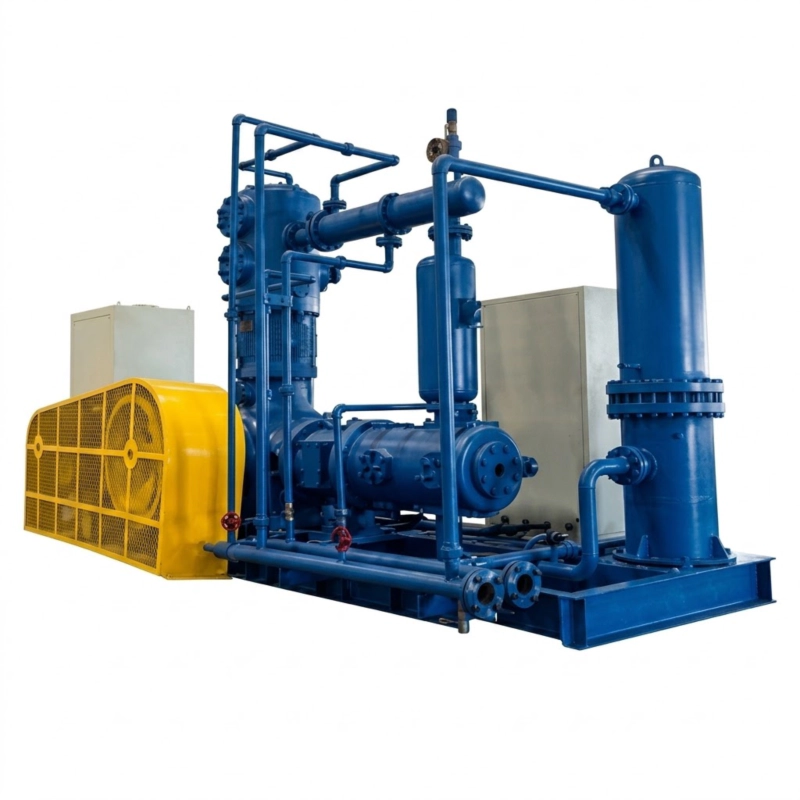
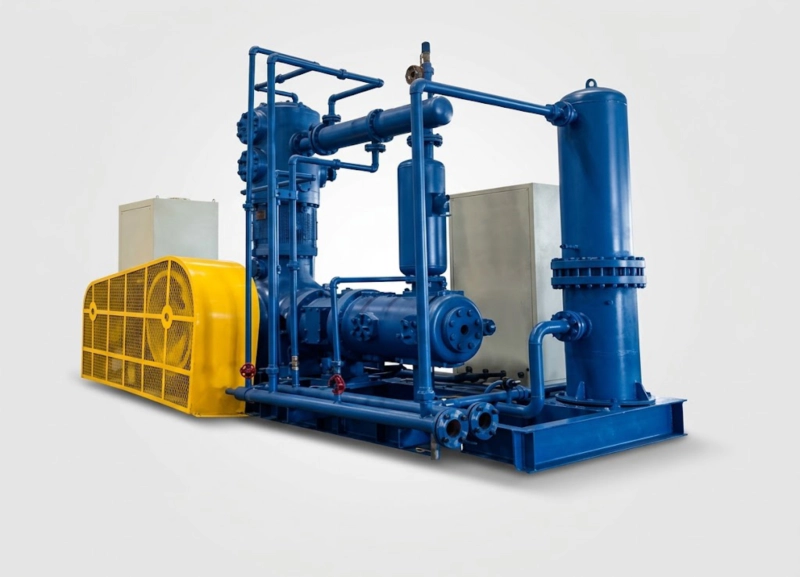
Product Overview: LW Series Gas Compressor
The LW series gas compressor is a two-column horizontal long-stroke (L-type) reciprocating piston compressor designed for medium-scale industrial gas compression duties where a high flow rate at low-to-medium pressure is required at the lowest possible capital and operating cost. The long-stroke geometry — where the piston stroke is characteristically long relative to the cylinder bore — maximises the swept volume per crankshaft revolution, producing more Nm³/h of gas flow per kilowatt of installed motor power than shorter-stroke or vertical configurations at the same pressure. This makes the LW series the economical workhorse of our gas compressor range for duties in the 12–100 m³/min bracket.
The 380 V drive voltage on the majority of standard LW models is a practical advantage that the larger DW and 4MW series cannot offer: it means a small-to-medium industrial gas installation — a biogas plant, a coke oven gas recovery system, a blast furnace gas boost station, or a mine gas drainage compression facility — can install the LW series directly on standard Russian or CIS industrial supply without the 6 kV or 10 kV switchgear investment that high-voltage machines require. 20 standard models cover a wide range of gas types and duties, from near-atmospheric collection at 0.15 MPa to mid-pressure pipeline injection at 2.50 MPa.
Gas media served include coal gas, coke oven gas, blast furnace gas, biogas, landfill gas, methane, carbon monoxide, water gas, flue gas, and general mixed industrial gas. For each gas type, the material specification — cylinder material, piston ring type, valve material, and distance piece classification — is selected at the design stage based on the full gas composition provided at enquiry. ATEX explosion-proof electrical equipment is standard for all flammable gas applications, rated at Zone 1 and at the correct gas group (IIA for methane-dominant gas, IIB for ethylene-equivalent mixed gas, IIC for gas with hydrogen above 25% by volume). All LW series units are manufactured at our production facility in Russia to API 618 Fifth Edition and GOST-R, with full Rostechnadzor registration documentation provided as standard for Russia and CIS deliveries.
Typical applications: Small-to-medium city gas distribution network boost stations, coke oven gas recovery and transfer at metallurgical plants, biogas upgrading and pipeline injection at anaerobic digestion facilities, blast furnace gas pipeline boost, carbon monoxide compression for chemical synthesis, coalmine gas drainage and surface compression, industrial gas plant transfer, and general process gas supply within chemical and petrochemical facilities.
Technical Specifications — Low and Medium Pressure (0.15–1.00 MPa)
Single-stage and two-stage configurations for gas pipeline boost and large-volume low-pressure gas transfer. Application note: gas media include coal gas, coke oven gas, biogas, methane, blast furnace gas, flue gas, water gas, CO, and mixed industrial gas with discharge pressure below 1.0 MPa.
| Model |
Config |
Flow (m³/min) |
Pressure (MPa) |
Dimensions L×W×H (mm) |
Weight (t) |
Power (kW) |
Voltage |
| LW-15/8 |
2-col 1-stage |
15 |
0.80 |
2632×1550×2330 |
3.00 |
110 |
380 |
| LW-20/3.5 |
2-col 1-stage |
20 |
0.35 |
2370×910×2070 |
2.00 |
75 |
380 |
| LW-25/1.5 |
2-col 1-stage |
25 |
0.15 |
2500×910×2180 |
2.50 |
75 |
380 |
| LW-25/3.5 |
2-col 2-stage |
25 |
0.35 |
2450×1550×2150 |
2.60 |
132 |
380 |
| LW-30/3.5 |
2-col 2-stage |
30 |
0.35 |
2990×1600×2370 |
3.40 |
132 |
380 |
| LW-40/4 (10) |
2-col 1-stage |
40 |
0.40 |
2450×1550×2150 |
2.80 |
132 |
380 |
| LW-40/4 |
2-col 2-stage |
40 |
0.40 |
2890×1600×2773 |
5.00 |
250 |
380/6K/10K |
| LW-40/20 |
2-col 1-stage |
40 |
2.00 |
2450×1550×2150 |
2.60 |
132 |
380 |
| LW-45/8 |
2-col 2-stage |
45 |
0.80 |
2890×1600×2773 |
7.00 |
280 |
380/6K/10K |
| LW-50/4 |
2-col 2-stage |
50 |
0.40 |
2630×1600×2235 |
6.50 |
200 |
380 |
| LW-50/8 |
2-col 2-stage |
50 |
0.80 |
2630×1600×2235 |
6.50 |
315 |
380/6K/10K |
| LW-5.5-60/4 |
2-col 1-stage |
55 |
0.40 |
2990×1600×2210 |
5.00 |
250 |
380/6K/10K |
| LW-60/4 |
2-col 2-stage |
60 |
0.40 |
2630×1600×2235 |
6.50 |
250 |
380/6K/10K |
| L8-90/1.5 |
2-col 1-stage |
90 |
0.15 |
2750×1500×2820 |
6.00 |
250 |
380/6K/10K |
| L8-100/2.2 |
2-col 1-stage |
100 |
0.22 |
2750×1500×2820 |
6.00 |
315 |
380/6K/10K |
Note: LW-40/20 at 2.00 MPa is a single-stage model listed in the low-pressure group for its 380 V drive compatibility; see also mid-high pressure table. All dimensions L×W×H in mm.
Technical Specifications — Mid-High Pressure (1.00–2.50 MPa)
Two-stage configurations for gas injection, mid-pressure pipeline supply, and chemical process gas feed. Application note: gas media include higher-pressure methane, synthesis gas, CO, and mixed process gas at 1.0–2.5 MPa for reactor feed and pipeline injection.
| Model |
Config |
Flow (m³/min) |
Pressure (MPa) |
Dimensions L×W×H (mm) |
Weight (t) |
Power (kW) |
Voltage |
| LW-12/10 |
2-col 2-stage |
12 |
1.00 |
2764×2000×3277 |
5.00 |
110 |
380 |
| LW-20/18 |
2-col 2-stage |
20 |
1.80 |
2500×1600×2800 |
6.00 |
220 |
380 |
| LW-22/25 |
2-col 2-stage |
22 |
2.50 |
6000×2800×2800 |
6.50 |
240 (250) |
380/6K/10K |
| LW-25/16 |
2-col 2-stage |
25 |
1.60 |
3920×1800×2465 |
6.80 |
280 |
380/6K/10K |
| LW-28/25 |
2-col 2-stage |
28 |
2.50 |
2920×1685×2335 |
6.50 |
315 |
380/6K/10K |
Power notation 240(250) kW indicates motor power options at different voltage configurations. All dimensions L×W×H in mm. Custom flow and pressure configurations available within the series range.
General Series Parameters
| Parameter |
LW Series Range |
| Compression Media |
Coal gas, coke oven gas, biogas, methane, CO, water gas, flue gas, mixed industrial gas |
| Pressure Range |
0.15–2.50 MPa |
| Flow Range |
12–100 m³/min (720–6,000 Nm³/h) |
| Motor Power |
75–315 kW |
| Drive Voltage |
380 V standard (most models); 6 kV / 10 kV available for larger models |
| Frame Configuration |
2-column horizontal long-stroke; 1 or 2 compression stages |
| Lubrication |
Oil-lubricated (standard) or oil-free PTFE rings for purity-critical service |
| Electrical (flammable gas) |
ATEX Zone 1, Group IIA / IIB / IIC per gas composition |
| Design Standard |
API 618 Fifth Edition; GOST-R (Russia / CIS) |
| Certification |
ISO 9001:2015, GOST-R, ATEX (per gas type), Pressure Vessel License |
Working Principle and Structural Composition
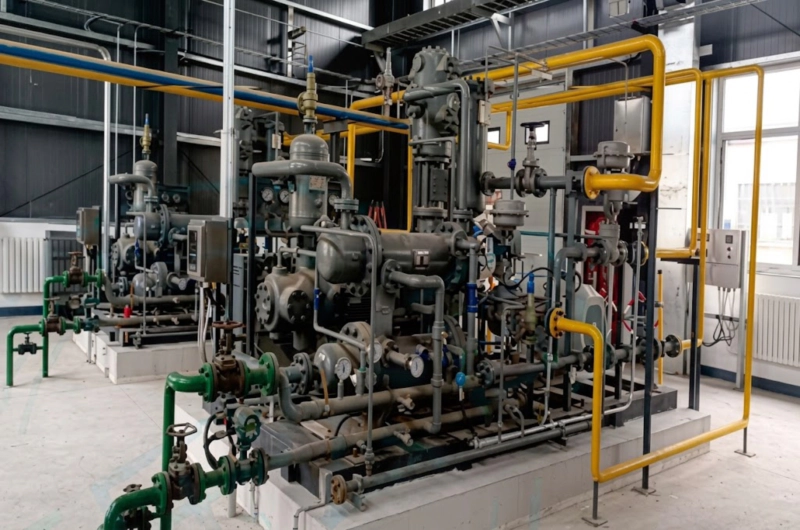
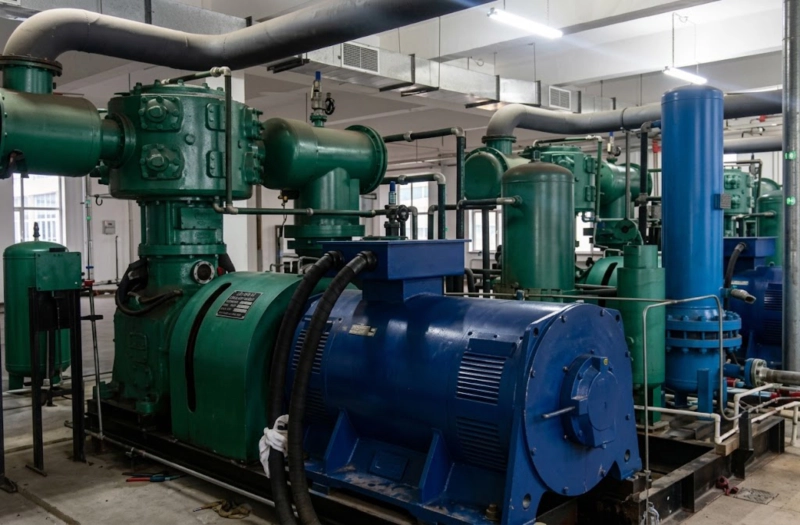
The LW series uses the horizontal long-stroke reciprocating piston principle. A motor drives the crankshaft through a direct or belt coupling; the crankshaft converts rotational motion into the horizontal reciprocating motion of one or two pistons. The characteristically long piston stroke relative to cylinder bore diameter is the defining feature: it maximises the swept volume per crankshaft revolution, producing higher volumetric flow per unit of motor power than shorter-stroke machines at the same pressure. For single-stage models, gas enters the cylinder on the suction stroke, is compressed to discharge pressure in a single pass, and exits through the discharge valve. Two-stage models use a large-bore low-pressure cylinder followed by a small-bore high-pressure cylinder with a shell-and-tube interstage cooler and liquid separator between them; the cooler removes heat of compression between stages, maintaining acceptable discharge temperatures and improving volumetric efficiency of the high-pressure stage.
For flammable gas service, the compressor specification includes ATEX Zone 1 explosion-proof electrical equipment at the correct gas group, copper-free materials for any gas containing acetylene, and Type D double-compartment distance piece with nitrogen purge for toxic gas service including carbon monoxide. The horizontal cylinder orientation provides direct end access to the piston, rings, and valve from ground level without a platform or lifting equipment — a maintenance advantage over vertical machines in industrial plant environments where working space around compressors is often restricted.
Long-Stroke Crankshaft
Forged 42CrMo alloy steel with hardened and ground journals. Long throw maximises swept volume per revolution for high flow efficiency at lower motor power than equivalent short-stroke machines.
Horizontal Cylinders
HT250 cast iron or 316L SS per gas service. Chrome-plated 42CrMo piston rods. PTFE piston rings (oil-free) or cast iron rings (lubricated) selected per gas composition and purity requirement.
Gas Valves
Ring-plate or poppet valves with 316L SS seats and PTFE or PEEK elements. Valve material is specified per gas composition and ATEX classification. Service life 8,000–12,000 hours under clean gas conditions.
API 618 Distance Piece
Type C or D double-compartment per API 618. Type D with nitrogen purge mandatory for CO and toxic gas service, isolating crankcase oil from the process gas circuit at all times.
Interstage Cooling
Shell-and-tube interstage cooler and aftercooler with automatic-drain liquid separator on two-stage models. 316L SS tube bundles for wet or corrosive gas. Thermal sizing confirmed for design ambient conditions.
ATEX Control Panel
PLC panel with HMI monitoring suction and discharge temperatures and pressures, lube oil, cooling water, and vibration. Automatic shutdown on all critical parameters. ATEX-rated panel enclosure for flammable gas installations.
Core Advantages of the LW Series
📈
Highest Flow per Unit of Capital Cost
The long-stroke L-type design delivers the most Nm³/min per kilowatt of installed motor power in the 12–100 m³/min bracket at pressures up to 2.5 MPa. For industrial gas facilities where cost per unit of throughput is the primary decision criterion, the LW series consistently provides the lowest capital cost option.
⚡
380 V Throughout Most Models
Unlike the DW and 4MW series which require 6 kV or 10 kV for most models, the majority of LW models use 380 V motors compatible with standard Russian industrial supply. This eliminates the high-voltage switchgear investment at smaller installation sites, reducing total installed cost significantly.
🔥
ATEX Group IIC for Hydrogen-Rich Gas
All LW models are available with ATEX Zone 1, Group IIC explosion-proof electrical equipment for coke oven gas and other hydrogen-rich mixed gas streams. The correct ATEX group is determined from the gas composition provided at enquiry and fixed into the specification at the design stage.
🕑
4–6 Month Delivery
Standard delivery from confirmed purchase order is 4–6 months for most LW models — shorter than the DW (5–8 months) and 4MW (6–10 months) series. The smaller machine weight and simpler two-column frame also reduces installation and commissioning time compared to multi-column machines at equivalent flow rates.
📄
Full GOST-R and Rostechnadzor Documentation
GOST-R certificate, technical passport, pressure vessel certification, ATEX certificates, and all documentation required for Rostechnadzor registration of gas-handling equipment as hazardous production equipment — provided as standard with every LW unit delivered to Russia and CIS member states at no additional cost.
🌎
Russia-Based Spare Parts
All consumable wear parts — piston rings, packing rings, gas valve elements, rod seals, and gaskets — are manufactured in-house at our Russian production facility and stocked for all current LW models. Critical spare parts can be dispatched within 24–72 hours, with no import lead times or currency risk.
Material Specifications for Gas Service
| Component |
Standard Gas (Dry / Inert) |
Wet / Corrosive / H₂S Service |
| Cylinders |
HT250 grey cast iron |
316L SS; NACE MR0103 for H₂S service |
| Piston Rings / Packing |
Cast iron (lubricated) or PTFE (oil-free) |
PTFE oil-free recommended; PEEK at elevated temperature |
| Piston Rods |
42CrMo, hard chrome plated |
Same; Inconel overlay for severe H₂S |
| Gas Valves |
CS or 316L SS seats; PTFE / PEEK elements |
316L SS mandatory for wet or corrosive gas |
| Intercooler Tubes |
Carbon steel |
316L SS for wet or H₂S-containing gas |
| Distance Piece |
Type C per API 618 |
Type D with N₂ purge for CO or toxic gas |
| Electrical Equipment |
ATEX Zone 1, IIA or IIB |
ATEX Zone 1, Group IIC for H₂ above 25% |
Selection Guide: Choosing the Right LW Model
1
Confirm the duty is within the LW range — flow 12–100 m³/min, pressure 0.15–2.50 MPa. For flows above 100 m³/min, the DW series provides a balanced opposed-column machine in the same pressure range. For pressures above 2.50 MPa, the DW series also covers to 4.0 MPa. The LW is the correct choice when the combination of 380 V availability, moderate flow, and lowest capital cost drives the selection decision.
2
Provide the complete gas composition — every component including H₂ percentage (determines ATEX group: IIC for H₂ above 25%), H₂S level (determines whether NACE materials and 316L SS are required), moisture content (determines whether PTFE oil-free rings and 316L SS wetted parts are needed), and any trace contaminants including siloxanes in biogas or tar compounds in coke oven gas.
3
Select single-stage or two-stage based on the compression ratio — for overall ratios up to 5:1 (e.g. near-atmospheric inlet to 0.50 MPa), single-stage models are more economical. For ratios above 5:1 (e.g. to 1.0–2.5 MPa from near-atmospheric), two-stage models are required to maintain acceptable discharge temperatures and volumetric efficiency. Check both the single-stage and two-stage columns at your target flow rate to confirm which configuration applies.
4
State GOST-R and Rostechnadzor requirements at enquiry — gas compression facilities handling flammable or toxic gas in Russia are classified as hazardous production facilities under Federal Law 116-FZ and require Rostechnadzor registration before commissioning. The GOST-R certificate, technical passport, pressure vessel certification, and ATEX documentation required for this registration are provided as standard with every LW unit delivered to Russia and EEU member states.
LW Series vs. Alternatives: Objective Comparison
Transparency Notice: Ariel JGT and Dresser-Rand HOS are referenced for performance class comparison only. We do not manufacture or claim affiliation with these brands. All LW compressors are original designs. We do not sell counterfeit or unlicensed products.
| Factor |
LW Series (Our Make) |
Ariel JGT |
Dresser-Rand HOS |
| API 618 |
✓ Full |
✓ Full |
✓ Full |
| GOST-R (Russia / CIS) |
✓ Standard |
Case by case |
Case by case |
| Capital Cost |
30–45% below European OEM |
High (USD) |
High (EUR) |
| 380 V Compatibility |
✓ Most models standard |
Limited |
Limited |
| Lead Time |
4–6 months |
8–14 months |
10–16 months |
| Spare Parts (Russia) |
In-house; days not months |
Import; 2–6 months |
Import; 2–6 months |
| On-Site Service (Russia) |
Direct from Russia |
Agent network |
Regional office |
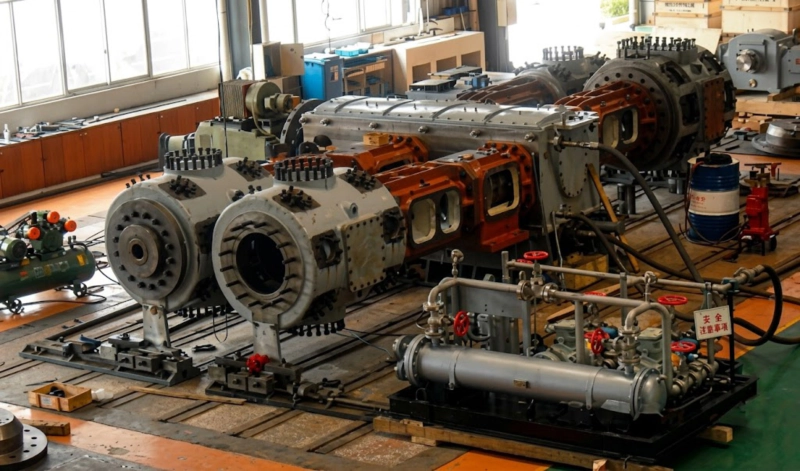
Factory acceptance test — every LW series unit is mechanically run-tested at rated conditions and all ATEX safety shutdown functions are verified before shipment from our Russian production facility
Frequently Asked Questions — LW Series Gas Compressor
Q1: How does the LW series differ from the DW series for gas compression?
The LW series is a two-column horizontal long-stroke machine without opposed-balance. It offers lower capital cost, 380 V availability, and shorter delivery compared to the DW two-column opposed-balance machine. The DW series cancels primary inertia forces, producing less vibration and requiring less foundation mass — it is the better choice above 100 m³/min or where vibration limits are the governing design constraint. For smaller gas installations at standard industrial sites where 380 V supply is available and cost is the primary driver, the LW series is the more economical choice.
Q2: What ATEX group is required for coke oven gas and biogas?
Coke oven gas contains 55–60% hydrogen by volume and requires ATEX Zone 1, Group IIC — the highest explosion-protection classification covering hydrogen atmospheres. Biogas is methane-dominant (typically below 5% hydrogen) and requires ATEX Group IIA. For mixed gas streams where hydrogen content is uncertain, IIC should be specified conservatively. Specifying a lower group than required (e.g. IIB equipment in a coke oven gas atmosphere) is a safety code violation that cannot be corrected without replacing all electrical equipment on the machine after manufacture. Always confirm the hydrogen percentage at enquiry stage.
Q3: Why does LW-40/4(10) have lower power than LW-40/4 at the same flow and pressure?
The two models share the same nominal flow (40 m³/min) and discharge pressure (0.40 MPa) but use different configurations. LW-40/4(10) is a single-stage machine with a large-bore cylinder compressing in one pass at a low ratio; at 132 kW it handles lower-inlet-pressure gas (near atmospheric) with a single compression step. LW-40/4 is a two-stage machine at 250 kW handling gas at higher inlet-to-discharge ratios — for example, where the suction gas arrives at higher pressure and must reach 0.40 MPa in two stages for temperature control. Specifying the correct variant requires stating both the inlet pressure and the discharge pressure, not just the discharge pressure alone.
Q4: What upstream equipment is required before the LW compressor suction for coke oven gas?
Coke oven gas requires upstream conditioning before the compressor suction: a primary tar separator or electrostatic precipitator to reduce tar aerosol content below 50 mg/Nm³; a naphthalene scrubber or chiller to prevent naphthalene deposition in the intercooler; an ammonia scrubber if ammonia concentration could cause corrosion; an H₂S scrubber if H₂S exceeds the threshold for standard cast iron materials; and a final knock-out separator immediately before the suction nozzle. Without adequate upstream conditioning, intercooler fouling and accelerated valve wear are the most common maintenance issues in coke oven gas service. Our engineering team can review upstream conditioning proposals and confirm compatibility with the LW compressor specification at enquiry stage.
Q5: What capacity control options are available on the LW series?
Two options are available. Suction valve unloaders on the low-pressure cylinder provide step-wise capacity reduction — typically 50% turndown for two-cylinder models. Variable frequency drive (VFD) on the motor provides continuous smooth capacity modulation from approximately 50% to 100% of design flow, with proportionally reduced power consumption at lower loads — the most energy-efficient option for gas supplies that vary over time, such as biogas generation rates at anaerobic digestion plants. A combination of unloaders and VFD provides the widest overall turndown range. Specify the minimum required gas flow at enquiry so the correct control configuration is included in the machine design.
Q6: What is the typical maintenance interval for LW series gas compressors?
Under normal operating conditions with clean, dry gas: piston rings and packing should be inspected at 4,000 hours and replaced at 6,000–8,000 hours for standard gas service; at 4,000–5,000 hours for wet or aggressive gas. Gas valves should be inspected at 5,000 hours and replaced at 8,000–10,000 hours. Main bearing overhaul at 30,000–40,000 hours. The horizontal cylinder orientation of the LW series means cylinder head and valve access is from ground level — typically 2–3 hours for a trained maintenance team without lifting equipment. All spare parts are available from our Russian facility with 24–72 hour dispatch for critical items.
Q7: Why is Type D distance piece with nitrogen purge required for CO compression?
Carbon monoxide is acutely toxic at concentrations above 50 ppm in the working atmosphere. The distance piece between the cylinder packing and the crankcase is the primary barrier preventing process gas from entering the crankcase oil and the machine room atmosphere. Type C distance piece provides a single compartment separation; Type D provides two independent compartments, and when purged continuously with nitrogen, creates a positive-pressure inert gas zone between the process gas and the crankcase. Any gas leaking past the packing flows into the nitrogen purge rather than accumulating in the crankcase or escaping to atmosphere. For CO service, Type D with continuous nitrogen purge and CO gas detector plus automatic shutdown on detector alarm is mandatory throughout the compressor room. Our engineering team includes this specification as standard in any LW proposal for CO or CO-containing gas.
Q8: What GOST-R documentation is provided and what does Rostechnadzor registration require?
Every LW series unit delivered to Russia or EEU member states is supplied with the complete GOST-R documentation package as standard: GOST-R certificate of conformity, technical passport with all design parameters, pressure vessel certification for all interstage vessels and heat exchangers, ATEX certificates for all explosion-proof equipment, factory acceptance test report, and operating and maintenance instructions in Russian. Gas compression facilities handling flammable or toxic gas are classified as hazardous production facilities (OPO) under Federal Law 116-FZ and require Rostechnadzor registration before commissioning. The documentation package is structured to support this registration process without requiring additional certification. We dispatch the documentation 2–3 weeks before machine shipment to allow registration to begin in parallel with shipping and installation.
Q9: Can the LW series handle biogas directly from the digester without upstream drying?
The LW series can mechanically handle wet biogas provided the cylinders and interstage piping are specified in 316L stainless steel and the interstage separators are sized for complete liquid knockout at all anticipated moisture levels. However, operating on water-saturated biogas accelerates PTFE piston ring and packing wear compared to dry gas service, because water reduces the self-lubricating performance of PTFE at the cylinder wall. For pipeline injection or biomethane upgrading applications where the downstream specification requires low moisture content, upstream dehydration to a dew point of minus 40 degrees Celsius or below at the compressor suction is strongly recommended. A complete upstream conditioning skid — knock-out separator, H₂S scrubber, moisture removal, and a final suction separator — can be supplied as an integrated package with the LW compressor on request.
Q10: What spare parts should be stocked on-site and for how long do they last?
At the time of purchase, we provide a recommended first-fill spare parts list, a two-year operating stock list, and a major overhaul spares list. The recommended two-year operating stock for a standard LW unit includes: one complete set of PTFE piston rings and packing for each cylinder stage (covering the machine through two to three replacement intervals at 6,000–8,000 hours each), one complete set of gas valve elements for each cylinder position (LP suction and discharge, HP suction and discharge on two-stage models), and a set of critical O-rings and flat gaskets. This stock is typically consumed over 12,000–18,000 operating hours — three to four years at continuous operation — without requiring any additional procurement during that period. All parts are available from our in-house production in Russia and can be dispatched within 24–72 hours of order, eliminating import lead time risk for facilities in the Russian Federation and CIS.
Request a Technical Proposal
Our engineering team has over 70 years of experience manufacturing gas compressors for coal gas networks, coke oven gas recovery, biogas facilities, and industrial gas pipeline stations across Russia and the CIS. The LW series gas compressor delivers API 618 performance with full GOST-R and Rostechnadzor documentation as standard, at the lowest capital cost in its flow and pressure class, with spare parts dispatched from Russia without import delays.
LW Series Gas Compressor — Engineering Enquiry
Discuss Your Gas Pipeline or Industrial Gas Compression Project
Process engineers with gas plant experience respond to all enquiries. GOST-R and Rostechnadzor documentation included. Response within 48 hours.
Request a Technical Quote
Include in Your Enquiry
✓ Complete gas composition
✓ Suction and discharge pressures
✓ Required flow rate (m³/min)
✓ Hazardous area zone and ATEX group
✓ Available voltage (380V / 6kV / 10kV)
✓ Cooling preference (water or air)
✓ GOST-R / Rostechnadzor requirement
✓ Required delivery date