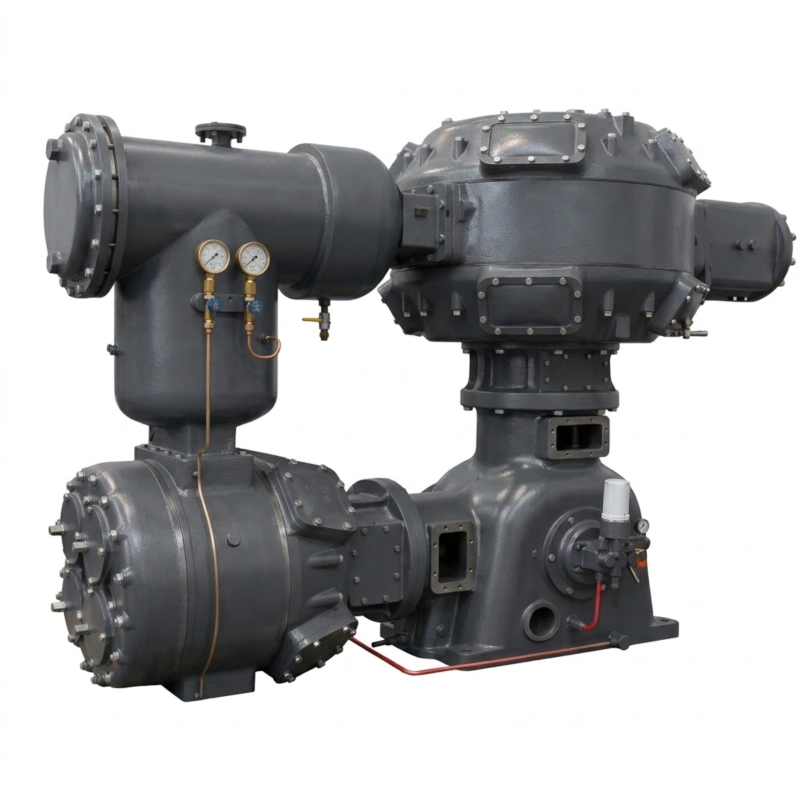
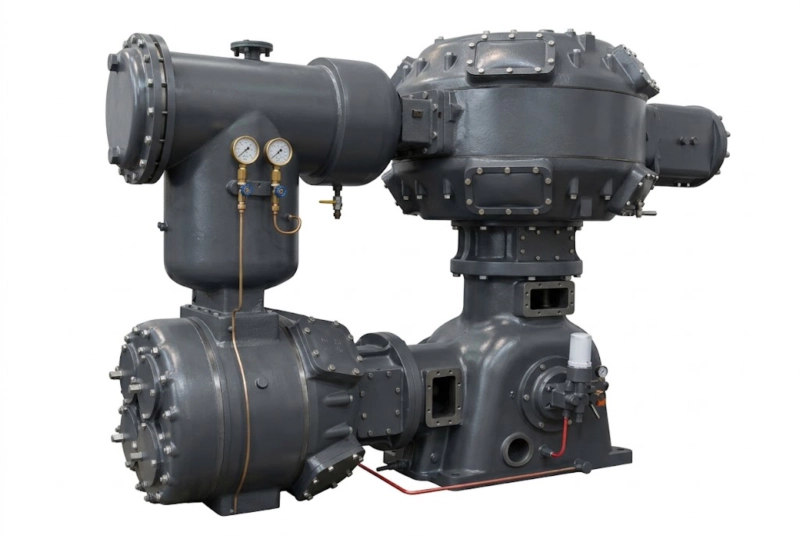
Product Overview: LW Series CO₂ Compressor
The LW series carbon dioxide compressor is a two-column horizontal (L-type) reciprocating piston compressor designed for large-volume, low-to-medium pressure CO₂ handling. The L-type designation identifies the horizontal two-column arrangement with a relatively long stroke, which produces a high volumetric flow rate per cylinder bore size — making the LW the most economical frame choice for moving large volumes of CO₂ at pressures from 0.10 to 3.60 MPa. Unlike smaller vertical ZW units or more highly rated DW machines, the LW series is optimised specifically for throughput: it moves the most gas per unit of capital cost at pressures that cover the majority of CO₂ recovery, bulk transfer, and feed compression duties in the food, beverage, and environmental sectors.
Manufactured at our production facility in Russia to API 618 Fifth Edition and GOST-R requirements, the LW series is a direct-performance alternative to Ariel JGT and JGA series, Dresser-Rand (Siemens Energy) HOS series, GEA Grasso reciprocating CO₂ compressors, and Neuman & Esser PCH low-pressure series in the equivalent flow and pressure class. These brands are referenced solely to assist engineers in cross-referencing performance classes during selection. All LW units are original designs manufactured by our own engineering team; we do not sell counterfeit or unlicensed products and claim no affiliation with these brands.
Industries and duties served: Large-scale fermentation and brewery CO₂ recovery, bulk CO₂ transfer and loading, food-grade CO₂ conditioning and purification, carbon capture post-combustion intermediate recompression, CO₂ pipeline injection boost, industrial gas plant CO₂ handling, LNG plant acid gas low-pressure collection, chemical plant inert gas purging with CO₂, and urea plant CO₂ feed pre-compression.
Technical Specifications — LW Series Mid-to-High Pressure (1.2–3.60 MPa)
Two-column, 2-stage and 3-stage configurations for CO₂ liquefaction feed, intermediate compression, and mid-pressure process duties.
| Model |
Configuration |
Flow (m³/min) |
Pressure (MPa) |
Dimensions L×W×H (mm) |
Weight (t) |
Power (kW) |
Voltage |
| LW-6/18 |
2-col 2-stage |
6 |
1.80 |
2050×910×2070 |
1.80 |
65 |
380 |
| LW-8/18 |
2-col 2-stage |
8 |
1.80 |
2014×910×2006 |
1.80 |
75 |
380 |
| LW-10/18 |
2-col 2-stage |
10 |
1.80 |
2632×1550×2332 |
3.00 |
110 |
380 |
| LW-16/30 |
2-col 3-stage |
16 |
3.00 |
3500×2600×1850 |
6.00 |
220 |
380 |
| LW-20/30 |
2-col 3-stage |
20 |
3.00 |
3500×2600×1850 |
6.00 |
240 (250) |
380/6K/10K |
| LW-20/36 (Skid) |
2-col 3-stage |
20 |
3.60 |
4000×3100×2800 |
9.50 |
250 |
380/6K/10K |
| LW-25/30 |
2-col 3-stage |
25 |
3.00 |
2960×1685×2335 |
6.50 |
280 |
380/6K/10K |
Note: (Skid) suffix indicates factory-assembled modular skid unit. Power notation e.g. 240(250) kW indicates motor power options at different voltage configurations. Custom flow and pressure combinations available to order.
Technical Specifications — LW Series Low Pressure (0.10–1.00 MPa)
Single-stage and two-stage configurations for large-volume low-pressure CO₂ recovery, transfer, and feed boost duties. The extended HW series models cover exceptionally high flows for large-scale industrial gas plants.
| Model |
Configuration |
Flow (m³/min) |
Pressure (MPa) |
Dimensions L×W×H (mm) |
Weight (t) |
Power (kW) |
Voltage |
| LW-10/8 |
2-col 2-stage |
10 |
0.80 |
2340×910×2070 |
1.80 |
110 |
380 |
| LW-20/2 |
2-col 1-stage |
20 |
0.20 |
2632×1550×2332 |
1.80 |
75 |
380 |
| LW-20/8 |
2-col 2-stage |
20 |
0.80 |
2630×1550×2332 |
3.00 |
132 |
380 |
| LW-30/4 |
2-col 2-stage |
30 |
0.40 |
2975×1550×2370 |
3.40 |
132 |
380 |
| LW-40/2.5 |
2-col 1-stage |
40 |
0.25 |
2980×1550×2650 |
3.40 |
160 |
380 |
| LW-40/4 |
2-col 2-stage |
40 |
0.40 |
2965×1550×2370 |
3.40 |
160 |
380 |
| LW-50/5 |
2-col 2-stage |
50 |
0.50 |
2360×1685×2235 |
6.50 |
240 (250) |
380/6K/10K |
| LW-60/2.5 |
2-col 1-stage |
60 |
0.25 |
2995×1600×2170 |
4.82 |
200 |
380/6K/10K |
| LW-60/4 |
2-col 2-stage |
60 |
0.40 |
2995×1600×2170 |
4.82 |
240 (250) |
380/6K/10K |
Note: For very large CO₂ flow duties above 60 m³/min at low pressure (0.10–0.65 MPa), the extended 4MW and HW series low-pressure variants extend coverage to 600 m³/min. Contact our engineering team for sizing on these larger duties.
Extended High-Flow Low-Pressure Range (above 60 m³/min)
| Model |
Flow (m³/min) |
Pressure (MPa) |
Power (kW) |
Dimensions (mm) |
Weight (t) |
Voltage |
| 4MW-180/6.5 |
180 |
0.65 |
1,000 |
6250×3905×3020 |
26.00 |
6K/10K |
| 4MW-240/6.5 |
240 |
0.65 |
1,300 |
6250×3905×3020 |
26.00 |
6K/10K |
| HW-380/2.5 |
380 |
0.25 |
1,300 |
6250×7900×2735 |
28.00 |
6K/10K |
| HW-600/1 |
600 |
0.10 |
1,100 |
6200×8500×2860 |
30.00 |
6K/10K |
General Series Parameters
| Parameter |
LW Series Range |
| Compression Medium |
Pure CO₂, CO₂ mixed gas, CO₂/N₂ blends |
| Pressure Range |
0.10 MPa (low-pressure) to 3.60 MPa (mid-pressure) |
| Flow Capacity (standard) |
6–60 m³/min (360–3,600 Nm³/h) |
| Flow Capacity (extended) |
180–600 m³/min (4MW/HW extended range) |
| Motor Power |
65–280 kW (standard) / up to 1,300 kW (extended) |
| Drive Voltage |
380 V / 6 kV / 10 kV |
| Frame Configuration |
2-column horizontal (L-type); 1, 2, or 3-stage |
| Lubrication |
Oil-free or oil-lubricated cylinder (specify at order) |
| Cooling Method |
Water-cooled standard; air-cooled option available |
| Design Standard |
API 618 Fifth Edition; GOST-R (Russia / CIS) |
| Certification |
ISO 9001:2015, Pressure Vessel License, GOST-R |
Working Principle and Structural Composition
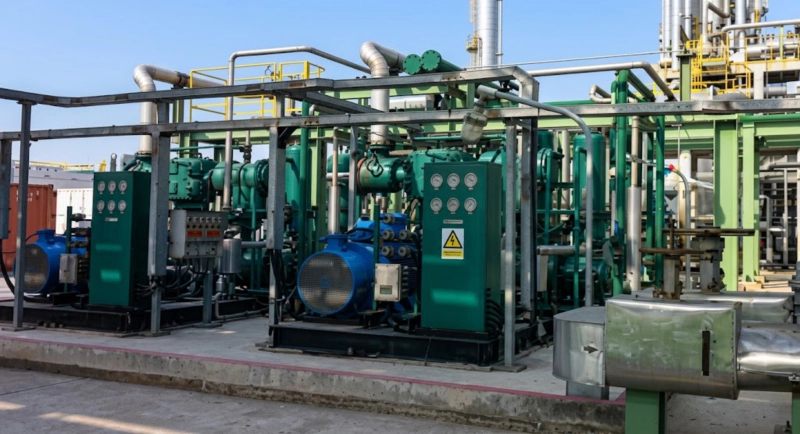
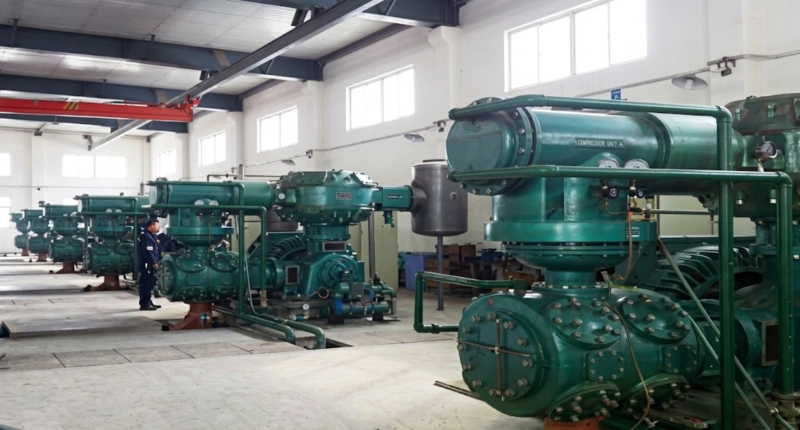
The LW series operates on the reciprocating piston principle with a two-column horizontal cylinder arrangement and a characteristically long piston stroke relative to bore diameter — the feature that gives the L-type its designation and its productivity advantage. A drive motor coupled directly or via V-belt transmission to the crankshaft converts rotational motion into the forward and backward reciprocating motion of horizontal pistons. The long stroke maximises the swept volume per cylinder revolution, allowing the LW series to achieve higher flow rates per unit of motor power and capital cost than shorter-stroke machines of the same bore size.
Stage count is selected based on the overall compression ratio required. Low-pressure models (0.10–0.50 MPa) typically operate as single-stage machines, accepting near-atmospheric CO₂ and raising it to storage or pipeline pressure in one cylinder pass. Models in the 0.50–1.80 MPa range use two-stage compression with an interstage cooler and separator. The highest-pressure LW models (3.00–3.60 MPa) use three stages with two interstage cooling steps. Between each stage, shell-and-tube coolers remove heat of compression and separators remove condensed water, keeping discharge temperatures within the safe range and preventing liquid carry-over into the next-stage cylinder.
Key Structural Components
⚙ Long-Stroke Crankshaft
Forged 42CrMo alloy steel crankshaft with hardened bearing journals and precision-ground crankpins. Long throw dimension maximises swept volume per revolution for high volumetric flow efficiency.
🔧 Horizontal Cylinders
HT250 or QT500 cast iron cylinders for standard service; 316L stainless steel for wet or sour CO₂. Chrome-plated piston rods. PTFE or PEEK rings for oil-free; cast iron for lubricated configurations.
📈 High-Flow Gas Valves
Large-bore ring-plate valves in 316 SS with PEEK or PTFE elements, designed for the high volumetric flow rates characteristic of L-type machines. Low pressure drop ensures energy-efficient operation across the full flow range.
❄ Interstage Cooling System
Shell-and-tube heat exchangers between stages with automatic-drain liquid separators. Carbon steel standard; 316L SS for wet CO₂. Thermal performance designed for worst-case ambient conditions.
🔐 Rod Sealing & Distance Piece
PTFE pressure packing with Type C or D double-compartment distance piece isolating crankcase from process gas, per API 618. Nitrogen purge option for sour or hazardous CO₂ compositions.
💻 Control Panel
PLC-based panel with HMI touchscreen. Continuous monitoring of suction and discharge pressures and temperatures, vibration, rod drop, lube oil pressure, and cooling water flow. Safety shutdown on all critical parameters.
Core Advantages of the LW Series
📈
Highest Flow per Unit of Capital Cost
The long-stroke L-type design delivers more Nm³/min per kilowatt of installed power and per unit of capital investment than any other reciprocating frame type for the 0.10–3.60 MPa pressure range. For large-volume CO₂ recovery and transfer duties, the LW series consistently provides the lowest cost per tonne of CO₂ processed.
⚖
API 618 and GOST-R Dual Certification
Full API 618 Fifth Edition compliance with rod load certification and distance piece classification. GOST-R certification standard for all models, enabling straightforward procurement and customs clearance in Russia and all EEU member states without additional certification lead time.
🍾
Food-Grade Oil-Free Configuration
Oil-free cylinder option with PTFE or PEEK piston rings and double-compartment distance piece produces CO₂ with oil content below 0.1 ppm, compliant with ISBT food-grade CO₂ specifications. Suitable for beverage carbonation gas supply and food processing CO₂ handling at any LW model flow rate.
🛠
380 V Compatibility Across the Standard Range
All standard LW models from LW-6/18 to LW-40/4 are supplied with 380 V motors, making them directly compatible with standard industrial power supply without the need for high-voltage transformers or switchgear. This significantly reduces installation cost for small and medium industrial facilities in Russia and CIS where 6 kV or 10 kV supply is not always available at the point of installation.
🕑
Low Maintenance Cost and Long Wear-Part Life
Piston ring and packing service life 6,000–10,000 hours under clean, dry CO₂ conditions. Gas valve replacement at 8,000–12,000 hours. Main bearing overhaul at 30,000–40,000 hours. All wear parts manufactured in-house and stocked for rapid supply throughout the 20+ year operating life.
🌎
Scalable from Single Units to Large Plant Arrays
LW units can be supplied as single machines or as matched-performance sets running in parallel for large CO₂ plants. The standard LW range covers 6–60 m³/min per machine; the extended 4MW and HW variants scale to 600 m³/min from a single frame, providing a continuous product family from small-scale recovery to large industrial gas plant duties.
Structure and Material Quality Standards
| Component |
Material / Standard |
Notes |
| Crankshaft |
42CrMo forged alloy steel, hardened journals |
Long-stroke design; UT and MPI inspected |
| Frame |
HT250 or QT500 cast iron |
Stress-relief annealed; precision bearing housings |
| Cylinders |
HT250 grey cast iron; 316L SS for wet service |
Hydrostatic test at 1.5 x MAWP |
| Piston Rods |
42CrMo, hard chrome plated |
Roundness ≤ 0.01 mm; HRC 60–65 |
| Piston Rings / Packing |
PTFE (standard) / PEEK (food-grade) |
Service life 6,000–10,000 h |
| Gas Valves |
316 SS seats; PEEK or PTFE elements |
Service life 8,000–12,000 h |
| Interstage Coolers |
CS shell-and-tube; 316L SS option |
Pressure Vessel License certified |
Typical Application Scenarios
🍾
Food-Grade CO₂ Recovery and Bulk Transfer
The LW series handles the primary recovery and recompression step in food-grade CO₂ plants — collecting low-pressure CO₂ from fermentation, combustion, or purification systems and raising it to the storage or pipeline pressure needed for downstream liquefaction. Models from LW-6/18 to LW-60/4 cover the flow range of most food and beverage CO₂ production facilities operating in Russia and the CIS. Oil-free cylinder specification at this stage protects the downstream liquefaction and purification equipment and ensures the final product meets ISBT food-grade CO₂ purity standards.
Related application: CO₂ recovered and liquefied in these plants is used for beverage carbonation in PET bottle filling lines. For operations that also produce bottles, our partner site offers a one-step injection stretch blow moulding machine compatible with integrated carbonated beverage production facilities, providing a complete solution from CO₂ recovery to bottle manufacture.
🔌
Large-Scale Brewery and Bio-Fermentation CO₂ Recovery
Industrial-scale breweries, yeast manufacturers, and bio-ethanol plants produce large volumes of near-atmospheric CO₂ as a fermentation by-product. The LW-40/4, LW-50/5, and LW-60/4 are sized for facilities producing 1,000 to 3,000 kg/h of CO₂, covering the flow rate range of most large industrial breweries. Single-stage LW models (LW-20/2, LW-40/2.5, LW-60/2.5) are particularly energy-efficient for this duty because the very low compression ratio (near-atmospheric inlet to 0.20–0.25 MPa transfer pressure) requires minimal work per unit of CO₂ recovered, maximising the economic payback from CO₂ recovery investment.
🌿
Carbon Capture Feed Compression (Post-Combustion CCS)
In post-combustion carbon capture installations, CO₂ exits the amine absorber at near-atmospheric pressure and requires initial boost compression to 1.5–3.0 MPa before entering the main high-pressure compression train. The LW series — particularly the LW-20/30 and LW-25/30 models — is well-positioned for this intermediate boost stage in small-to-medium CCS installations. For large power plants or industrial facilities capturing more than 50,000 tonnes per year, the extended 4MW-180/6.5 or 4MW-240/6.5 models cover the higher flow rates required at the lower-pressure boost stage.
⚙️
CO₂ Pipeline Boost and Industrial Gas Transfer
CO₂ must maintain minimum delivery pressure throughout a pipeline distribution network. When line pressure falls below the minimum due to system demand or distance from the source, a boost compressor raises the pressure to the required level. The LW-8/18, LW-10/18, and LW-16/30 are commonly deployed as mid-line boost compressors in regional CO₂ distribution networks supplying food and beverage producers in Russia and the CIS. The 380 V power supply requirement of these models makes them easy to install at remote pipeline booster stations without high-voltage electrical infrastructure.
Selection Guide: Choosing the Right LW Model
1
Confirm that pressure is within the LW range (0.10–3.60 MPa)
For pressures above 3.60 MPa, the DW series (to 4.0 MPa) or 4MW series (to 10+ MPa) should be specified instead. For pressures of 0.10–1.00 MPa with flows above 60 m³/min, consider the extended 4MW or HW models in this same low-pressure family.
2
Select 1-stage or 2-stage based on compression ratio
For overall ratios up to 5:1 (e.g. atmospheric inlet at 0.10 MPa to 0.50 MPa), single-stage LW models are the most economical. For ratios of 5:1 to 18:1 (e.g. 0.10 MPa inlet to 1.80 MPa discharge), two-stage models are required. For ratios above 18:1 (e.g. atmospheric to 3.0–3.6 MPa), three-stage models are specified.
3
Provide complete gas composition and moisture content
CO₂ purity, moisture, H₂S, SO₂, hydrocarbons. Wet CO₂ from fermentation requires 316L SS wetted parts and upstream dehydration. Even trace H₂S requires NACE-compliant materials throughout all pressure-retaining components.
4
Specify available drive voltage to minimise electrical installation cost
Models with 380 V motors (LW-6/18 to LW-40/4) require no special high-voltage equipment. Larger models (LW-50/5 and above) should be specified at 6 kV or 10 kV where available to avoid power factor and conductor sizing issues at high motor ratings on a 380 V system.
5
Confirm GOST-R and oil-free requirements at enquiry stage
GOST-R certification for Russia and CIS procurement is included as standard at no additional cost for all LW series models. Oil-free cylinder specification for food-grade CO₂ must be stated at the time of order so that PTFE/PEEK rings and distance piece configuration are correctly specified in the engineering package.
LW Series vs. International Brands: Objective Comparison
Transparency Notice: Ariel Corporation, Dresser-Rand (Siemens Energy), GEA Grasso, and Neuman & Esser are referenced solely to assist engineers in cross-referencing performance classes during equipment selection. We do not manufacture, sell, or claim affiliation with these brands. All LW compressors are original designs. We do not sell counterfeit or unlicensed products.
| Factor |
LW Series (Our Make) |
Ariel JGT |
Dresser-Rand HOS |
GEA Grasso |
| API 618 |
✓ Full |
✓ Full |
✓ Full |
✓ Full |
| GOST-R (Russia/CIS) |
✓ Standard |
Case by case |
Case by case |
Case by case |
| Capital Cost |
30–50% below European OEM |
High (USD) |
High (EUR) |
High (EUR) |
| Lead Time |
4–7 months |
8–14 months |
10–16 months |
8–14 months |
| 380 V Compatibility |
Standard (up to 160 kW) |
Limited |
Limited |
Limited |
| Spare Parts |
In-house; rapid dispatch |
OEM only |
OEM only |
OEM only |
| Russia/CIS Service |
Direct on-site support |
Agent network |
Regional office |
Agent network |
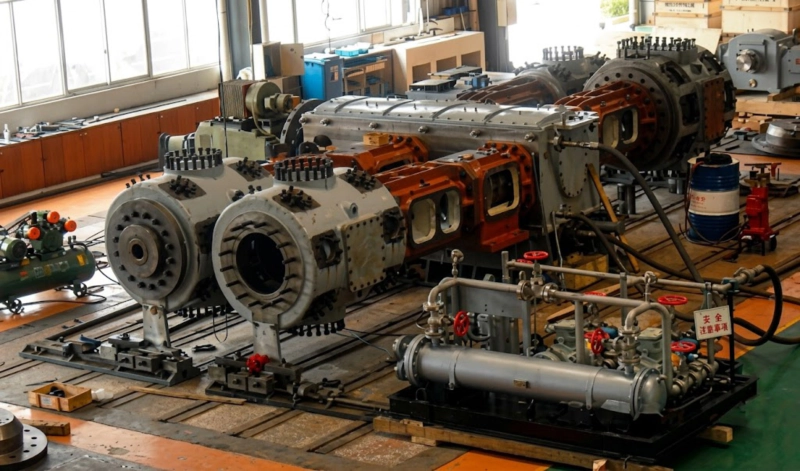
Factory acceptance test — every LW series unit is mechanically tested at design conditions before shipment, with performance data documented against the contractual data sheet
Frequently Asked Questions — LW Series CO₂ Compressor
Q1: What makes the LW series different from the DW or ZW series for CO₂ service?
The three series address different zones of the flow-pressure space. The ZW series (vertical, 2–45 m³/min) provides the smallest footprint for compact, space-constrained installations at all pressures. The LW series (horizontal long-stroke, 6–60 m³/min) is optimised for maximum flow rate per unit of capital cost in the 0.10–3.60 MPa range — making it the most economical choice for bulk CO₂ recovery and transfer. The DW series (horizontal opposed, 25–325 m³/min) overlaps with the LW at higher flows but covers a wider pressure range (to 4.0 MPa). For a given flow and pressure in the LW range, the LW typically has a lower purchase price than a DW of equivalent capacity because the long-stroke L-type frame is simpler to manufacture at these pressure levels.
Q2: Why does the LW-20/30 have a higher power rating than the LW-20/2 despite the same flow rate?
The power required to compress a given volume of gas increases with the compression ratio (the ratio of discharge to suction pressure). The LW-20/2 compresses 20 m³/min from atmospheric pressure to just 0.20 MPa — a very low ratio requiring minimal compression work, hence the 75 kW motor. The LW-20/30 compresses the same 20 m³/min to 3.00 MPa — an overall ratio approximately 15 times higher — requiring 240–250 kW of motor power. This relationship between compression ratio and power is why specifying the correct pressure is as important as specifying the correct flow rate when selecting a model.
Q3: Is the LW series suitable for food-grade CO₂ and beverage carbonation supply?
Yes. With oil-free cylinder specification — PTFE or PEEK piston rings, PTFE pressure packing, and Type C or D double-compartment distance piece — the LW series delivers CO₂ with oil content below 0.1 ppm w/w, meeting ISBT food-grade CO₂ specifications. This makes the LW series appropriate for the recovery and recompression stage in food-grade CO₂ production plants, upstream of the liquefaction and final purification steps. An outlet gas purity analysis can be included in the factory acceptance test on request to verify compliance before the unit leaves the manufacturing facility.
Q4: Which LW models are available with 380 V supply and which require 6 kV or 10 kV?
Models with motor power up to 160 kW — LW-6/18 (65 kW), LW-8/18 (75 kW), LW-10/18 and LW-10/8 (110 kW), LW-20/2 (75 kW), LW-20/8 (132 kW), LW-30/4 (132 kW), LW-40/2.5 (160 kW), and LW-40/4 (160 kW) — are all supplied as standard with 380 V drive motors. Larger models — LW-16/30 (220 kW), LW-20/30 and LW-20/36 (240–250 kW), LW-25/30 (280 kW), LW-50/5, LW-60/2.5, and LW-60/4 — are available at 380 V, 6 kV, or 10 kV. For installations in Russia where 380 V is the available supply at many industrial premises, the broad 380 V range of the standard LW models is a significant practical advantage compared to European competitors whose large models typically require high-voltage supply.
Q5: What GOST-R documentation is provided with LW series compressors for Russia?
Every LW series unit delivered to the Russian Federation or EEU member states is supplied with GOST-R certification documentation as standard, at no additional charge. The documentation package includes the GOST-R conformity certificate, the technical file covering design calculations and pressure vessel compliance, the factory test records, and the conformity declaration. These documents are sufficient for customs clearance and plant equipment registration in Russia, Kazakhstan, Belarus, Armenia, and Kyrgyzstan. GOST-R certificates are valid for five years from issue and can be extended. Specify the GOST-R requirement at the enquiry stage so that it is formally included in the engineering and documentation scope.
Q6: What is the difference between the LW-40/2.5 and LW-40/4 — both have 40 m³/min flow and 160 kW power?
The LW-40/2.5 is a single-stage machine discharging at 0.25 MPa; the LW-40/4 is a two-stage machine discharging at 0.40 MPa. Despite the same motor power, the two-stage LW-40/4 achieves a higher discharge pressure because the compression work is split across two stages with interstage cooling — each stage operating at a lower ratio than a single stage would need for the same overall ratio. Both machines handle the same 40 m³/min flow, but the LW-40/2.5 is optimised for near-atmospheric CO₂ collection and short-distance transfer at very low pressure, while the LW-40/4 is suited to recovery applications where CO₂ must be raised to 0.40 MPa for pipeline injection or intermediate storage. The dimensions are nearly identical, reflecting the same frame size with different cylinder and staging arrangements.
Q7: What is the typical delivery time for an LW series compressor?
Standard delivery from confirmed purchase order and signed-off technical data sheet is 4–7 months. Smaller standard models in the 380 V range (LW-6/18 to LW-20/8) typically have the shorter end of this range as lead times because the crankshaft and cylinder forgings are from our regular production stock. Larger models and custom configurations may require the full 7 months. For urgent project schedules, contact our engineering team with the required delivery date at the enquiry stage; production schedule availability for accelerated delivery is confirmed at the time of order.
Q8: Can the LW series handle wet CO₂ directly from fermentation without upstream drying?
The LW series can mechanically handle wet CO₂ provided the cylinders and interstage piping are specified in 316L stainless steel, and the interstage separators are sized for complete liquid knockout at all anticipated moisture levels. However, operating an oil-free compressor continuously on water-saturated CO₂ will accelerate PTFE piston ring and packing wear, because water reduces the self-lubricating performance of PTFE in CO₂ service. For food-grade CO₂ production, upstream dehydration to a dew point of −40°C or below before the compressor suction is strongly recommended both to protect piston rings and to avoid moisture accumulation in the downstream liquefaction system. A complete upstream conditioning skid — foam trap, scrubber, activated carbon, and molecular sieve — can be supplied as an integrated package with the LW compressor.
Q9: What capacity control is available on the LW series?
Three options are available. Suction valve unloaders provide step-wise capacity reduction without stopping the machine — typically 50% turndown for two-cylinder models, or 33%/67% for three-cylinder models. Variable frequency drive (VFD) provides continuous smooth capacity modulation from approximately 50% to 100% of design flow, with the best part-load energy efficiency — particularly recommended for brewery and fermentation recovery duties where CO₂ generation rate changes continuously through the fermentation cycle. A combination of suction valve unloaders and VFD provides the widest overall turndown range for highly variable applications. Specify your minimum required flow rate at enquiry stage so that the correct control configuration is designed into the machine from the outset.
Q10: Are spare parts available throughout the operating life of an LW series compressor?
Yes. All spare parts for the LW series — piston rings, packing rings, gas valve elements, piston rods, bearings, seals, and gaskets — are manufactured in-house from our own production and not sourced from third-party suppliers. This guarantees parts supply for the full design life of the compressor, typically 20–30 years, without dependency on international supply chains that could be disrupted by logistics, currency, or sanctions conditions. We maintain a standing stock of consumable wear parts for all current LW models and can dispatch critical spares within 24–48 hours from our facility in Russia. At the time of order we provide a recommended commissioning spare parts list, a two-year operating stock list, and a major overhaul spare parts list to support the buyer’s maintenance planning from day one.
Request a Technical Proposal
Our engineering team has over 70 years of experience manufacturing reciprocating CO₂ compressors for food-grade production, industrial gas plants, and carbon capture applications. The LW series CO₂ compressor delivers the highest flow per unit of capital cost for low-to-medium pressure duties, with full GOST-R certification for Russia and CIS procurement as standard. Send us your process data and receive a complete technical and commercial proposal within 48 hours.
LW Series CO₂ Compressor — Engineering Enquiry
Discuss Your CO₂ Recovery or Transfer Compression Project
All enquiries answered by qualified process engineers. GOST-R documentation included as standard for all Russia and CIS deliveries. Response within 48 hours.
Request a Technical Quote
Include in Your Enquiry
✓ Required flow rate (Nm³/min)
✓ Inlet and discharge pressures
✓ CO₂ composition and purity
✓ Oil-free or lubricated preference
✓ Available drive voltage (380V/6kV/10kV)
✓ Cooling water or air-cooled preference
✓ GOST-R requirement (Russia/CIS)
✓ Required delivery date