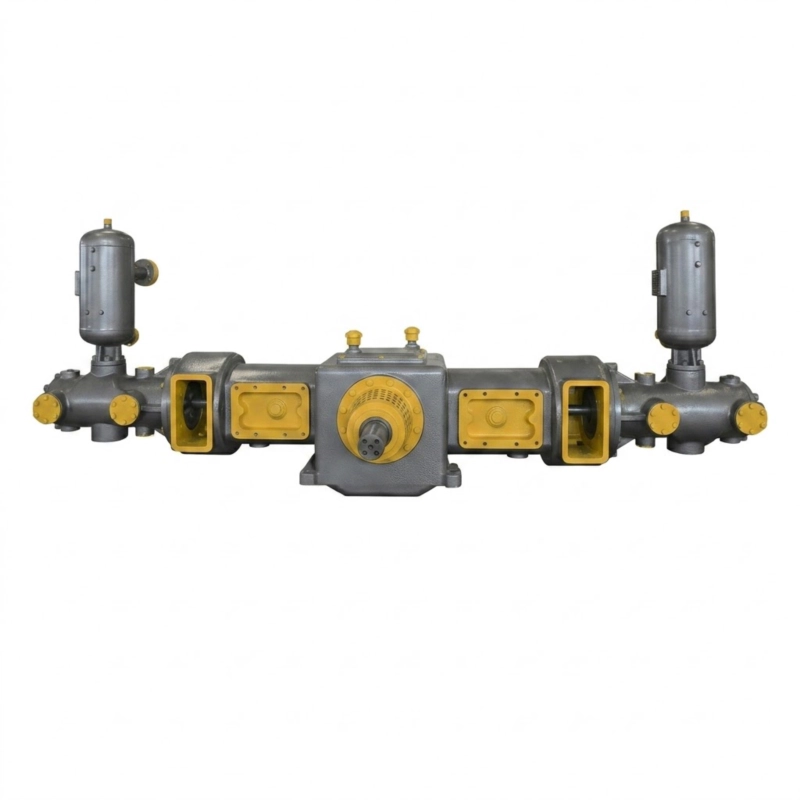
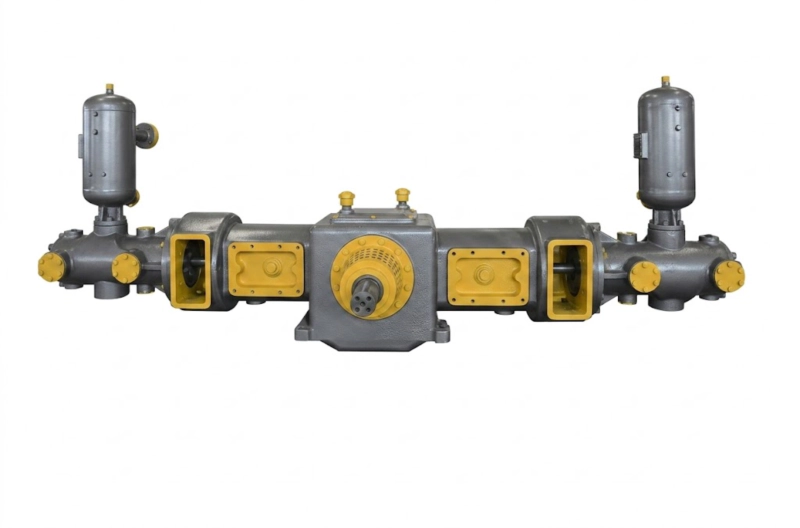
Product Overview: DW Series Hydrogen Recirculation Compressor
The DW series hydrogen recirculation compressor is a two-column horizontal opposed-balance reciprocating piston compressor for medium-to-large scale hydrogen recirculation duties in refinery hydroprocessing units and chemical synthesis reactor systems. It occupies the most demanding segment of the hydrogen recirculation compressor range — above the compact ZW series (which covers below 15 Nm³/min) and extending beyond the standard LW series (which reaches 75 Nm³/min at up to 1.8 MPa) — with 21 standard models covering 5–100 Nm³/min at 0.08–6.00 MPa and motor power from 132 to 1,500 kW.
The opposed-balance frame architecture — in which two cylinder columns face each other on opposite sides of the crankshaft, with pistons moving in opposing directions simultaneously — cancels the primary inertia forces that are the main source of vibration and foundation loading in reciprocating machines at high power levels. For a 500–1,500 kW hydrogen recirculation compressor in a refinery hydrotreating or hydrocracking unit, this balance advantage is a practical requirement: vibration transmitted to the high-pressure reactor loop pipework causes fatigue at pipe bends and nozzle welds, and at the power levels of the DW series the unbalanced force of a non-opposed machine would be unacceptably large without a massive isolated foundation block.
Every DW hydrogen recirculation unit carries the complete hydrogen service specification as standard: oil-free PTFE piston rings and packing eliminating any risk of catalyst contamination, copper-free wetted parts throughout the gas circuit, ATEX Zone 1 Group IIC explosion-proof electrical equipment for hydrogen atmospheres, and Type D double-compartment distance piece with continuous nitrogen purge to prevent hydrogen from reaching the crankcase or machine room atmosphere. NACE MR0103 materials are available for hydrotreating loop gas containing hydrogen sulphide above the threshold partial pressure. All models are manufactured at our production facility in Russia to API 618 Fifth Edition and GOST-R, with full Rostechnadzor registration documentation as standard for Russia and CIS deliveries.
Technical Specifications — Low Pressure (0.08–1.00 MPa)
Single-stage and two-stage opposed-balance configurations for hydrotreating loop boost, hydrogen gas-phase reactor recirculation, and atmospheric hydrogen transfer. All models: oil-free PTFE, copper-free, ATEX IIC, Type D distance piece with N₂ purge as standard.
| Model |
Config |
Flow (Nm³/min) |
Discharge (MPa) |
Dimensions L×W×H (mm) |
Weight (t) |
Power (kW) |
Voltage |
| DW-5/0.8~120 |
4-col 1-stage |
5.0 |
0.08–1.20 |
5000×4500×2200 |
12.0 |
132 |
380 |
| DW-20/8 |
2-col 1-stage |
20.0 |
0.80 |
5200×1700×2200 |
6.50 |
160 |
380 |
| DW-27.5/5–8 |
2-col 1-stage |
27.5 |
0.50–0.80 |
5200×1700×2200 |
7.00 |
220 |
380/6K/10K |
| DW-35/8 |
2-col 1-stage |
35.0 |
0.80 |
5200×1700×2200 |
7.00 |
250 |
380/6K/10K |
| DW-40/2–3.5 |
2-col 1-stage |
40.0 |
0.20–0.35 |
4760×2045×2105 |
5.50 |
160 |
380 |
| DW-40/8 |
2-col 1-stage |
40.0 |
0.80 |
5200×1700×2200 |
7.50 |
280 |
380/6K/10K |
| DW-51.5/6 |
2-col 2-stage |
51.5 |
0.60 |
5000×1450×3100 |
7.00 |
350 |
6K/10K |
| DW-57.5/4.5 |
2-col 2-stage |
57.5 |
0.45 |
5000×1450×3100 |
6.00 |
315 |
6K/10K |
| DW-60/6 |
2-col 2-stage |
60.0 |
0.60 |
5000×1450×3100 |
7.00 |
350 |
6K/10K |
| DW-100/8 |
2-col 1-stage |
100.0 |
0.80 |
5600×3000×2550 |
17.0 |
620 |
6K/10K |
DW-5/0.8~120: 4-column frame for wide pressure range 0.08–1.20 MPa adjustable recirculation. DW-27.5/5–8 and DW-40/2–3.5: variable discharge pressure for loop pressure-adjustable systems. All dimensions L×W×H in mm.
Technical Specifications — Mid-High and High Pressure (1.20–6.00 MPa)
Multi-stage opposed-balance configurations for hydrocracking loop recirculation, high-pressure hydrogen supply to synthesis reactors, and hydrogen compression for downstream pipeline injection at elevated pressures. All models: oil-free PTFE, copper-free, ATEX IIC, Type D + N₂ purge as standard.
| Model |
Config |
Flow (Nm³/min) |
Discharge (MPa) |
Dimensions L×W×H (mm) |
Weight (t) |
Power (kW) |
Voltage |
| DW-11.5/12 |
4-col 2-stage |
11.5 |
1.20 |
4880×1700×1220 |
6.10 |
132 |
380 |
| DW-22/0.4–16 |
2-col 2-stage |
22.0 |
0.40–1.60 |
5000×1450×2400 |
7.00 |
280 |
380/6K/10K |
| DW-27/1.1 MPa |
2-col 1-stage |
27.0 |
1.58 |
5100×3700×2520 |
9.00 |
315 |
380/6K/10K |
| DW-34.2/16 |
2-col 2-stage |
34.2 |
1.60 |
5200×1700×2200 |
9.00 |
315 |
380/6K/10K |
| DW-8/5/45 |
4-col 2-stage |
8.5 |
4.50 |
4850×2500×1000 |
5.50 |
160 |
380 |
| DW-6/8/60 |
4-col 1-stage |
6.8 |
6.00 |
4850×2500×1000 |
5.50 |
160 |
380 |
| DW-10/24–36 |
4-col 1-stage |
10.0 |
2.40–3.60 |
4900×3300×2500 |
10.0 |
355 |
6K/10K |
| DW-35/40 |
2-col 4-stage |
35.0 |
4.00 |
6200×3300×2500 |
13.0 |
500 |
6K/10K |
| DW-60/28 |
2-col 2-stage |
60.0 |
2.80 |
5900×4300×3100 |
13.0 |
900 |
6K/10K |
| DW-66/28–12.5 |
2-col 1-stage |
66.0 |
1.25 |
7000×4200×3100 |
25.0 |
1,400 |
6K/10K |
| DW-92/5–13 |
2-col 2-stage |
92.0 |
1.30 |
7000×4200×3100 |
25.0 |
1,500 |
6K/10K |
DW-35/40: 4-stage configuration compressing H₂ to 4.0 MPa in a single DW frame — the highest discharge pressure in the standard DW H₂ range. DW-66/28–12.5: inlet pressure 2.80 MPa, discharge 1.25 MPa notation indicates loop boost from high system pressure. DW-92/5–13 and DW-66/28–12.5 at 1,400–1,500 kW are the highest-power models in the DW H₂ series. All dimensions L×W×H in mm.
General Series Parameters
| Parameter |
DW Series H₂ Recirculation |
| Compression Medium |
Hydrogen, hydrogen-rich loop gas (hydrotreating, hydrocracking), electrolyser H₂, synthesis gas H₂ |
| Pressure Range |
0.08–6.00 MPa discharge |
| Flow Range |
5–100 Nm³/min (300–6,000 Nm³/h) |
| Motor Power |
132–1,500 kW |
| Drive Voltage |
380 V (models up to 380 kW); 6 kV / 10 kV (models above 350 kW) |
| Frame Configuration |
2-column or 4-column horizontal opposed-balance; 1, 2, or 4 compression stages |
| Dynamic Balance |
Primary inertia force cancelled — opposed-balance standard |
| Lubrication |
Oil-free PTFE piston rings and packing — standard all models |
| ATEX Classification |
Zone 1, Group IIC — mandatory all models |
| Wetted Part Materials |
Copper-free throughout; 316L SS or NACE MR0103 for H₂S service |
| Distance Piece |
Type D + continuous N₂ purge — all models |
| Design Standard |
API 618 Fifth Edition; GOST-R (Russia / CIS) |
| Certification |
ISO 9001:2015, GOST-R, ATEX Zone 1 Group IIC, Pressure Vessel License |
Working Principle: Opposed-Balance Meets Hydrogen Service
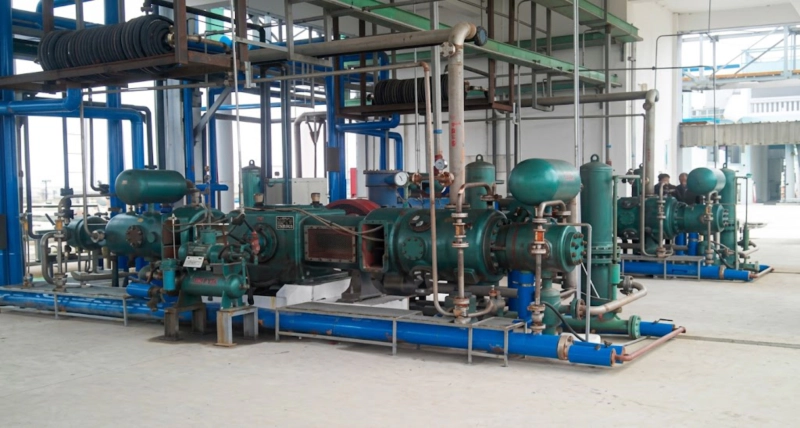
The DW series combines two independently essential design features into a single machine: the opposed-balance reciprocating frame for vibration control, and the complete hydrogen service specification for catalyst protection and personnel safety. In the opposed-balance configuration, pistons on opposite cylinder columns move in opposing directions simultaneously, cancelling the primary inertia forces that would otherwise be transmitted to the foundation and into the connected reactor loop pipework. At motor power levels of 200–1,500 kW, this force cancellation is not a convenience feature but an engineering necessity: the alternating force from an unbalanced machine of equivalent power would fatigue reactor nozzle welds, instrument connections, and high-pressure hydrogen pipework within months of startup.
The hydrogen service specification adds a complete layer of requirements on top of the frame engineering. Because hydrogen has a molecular weight of only 2 — the lowest of any gas in industrial compression service — the same mass flow of hydrogen occupies 8–14 times the volume of the equivalent mass flow of natural gas at the same conditions. This means the DW hydrogen recirculation cylinder bores are substantially larger than the standard DW gas compressor bores at equivalent power, and the gas valves must have proportionally larger flow areas to avoid excessive pressure drop at the hydrogen mass flow rates involved. PTFE piston rings replace cast iron lubricated rings on every stage — oil contamination of the reactor catalyst is irreversible and terminates the catalyst life prematurely. Copper-free materials are mandatory throughout the gas circuit — hydrogen embrittlement of copper alloys at elevated pressure, and the purity requirement of the hydrogen stream, both prohibit any brass or bronze fittings in the gas path.
Opposed-Balance Crankshaft
Forged 42CrMo with 180-degree opposed crank throws. Primary inertia force cancellation at source. Reduced vibration at reactor loop pipework connections, instrument nozzles, and high-pressure flanges throughout the hydrogen circuit.
Large-Bore H₂ Cylinders
Cylinder bores sized for hydrogen molecular weight 2 — substantially larger than equivalent-power gas compressor bores. HT250 cast iron (copper-free) for clean H₂; 316L SS for H₂S-containing hydrotreating loop gas.
Oil-Free PTFE Rings — All Stages
PTFE self-lubricating piston rings and packing on every cylinder stage. Zero oil carryover to reactor loop. PEEK valve elements where trace aromatic compounds in hydrotreating loop gas could swell PTFE valve seats.
Type D Distance Piece + N₂ Purge
Double-compartment distance piece purged with nitrogen at positive pressure on both cylinder columns. H₂ leaking past PTFE packing is captured in the nitrogen purge stream and vented to a safe outdoor point rather than reaching the crankcase or machine room air.
H₂S NACE Service Option
For hydrotreating loop gas where H₂S partial pressure exceeds the NACE MR0103 threshold, all carbon steel wetted parts are replaced with 316L SS or NACE-compliant alloy steel. Specified per the H₂S concentration and total loop pressure provided at enquiry.
ATEX IIC Electrical Package
Motor, control panel, instruments, junction boxes, cable glands, and lighting — all Zone 1, Group IIC certified. Includes H₂ gas detection with automatic shutdown on alarm. Commissioning within Zone 1 classified area per the unit’s area classification drawing.
Application Scenarios
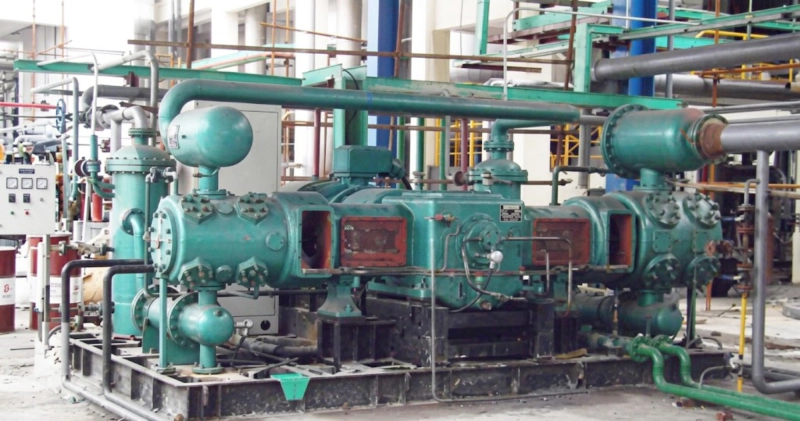
🏭Refinery Hydrotreating Unit — Main H₂ Recirculation
Medium and large hydrotreating units processing 200,000–2,000,000 tonnes per year of feed require hydrogen recirculation compressors handling 600–6,000 Nm³/h at 0.50–0.80 MPa loop differential pressure — the flow and pressure range of the DW-20/8 through DW-60/6 models. The opposed-balance frame is preferred for these duties because the reactor loop pipework, including the reactor inlet and outlet nozzles operating at 5–15 MPa total loop pressure, is sensitive to vibration-induced fatigue. H₂S is present in hydrotreating loop gas at concentrations requiring NACE MR0103 materials in all wetted components. The DW-35/8 at 250 kW and DW-40/8 at 280 kW are the most commonly specified models for medium-scale diesel hydrotreating units in Russian refineries.
⚙️Hydrocracking Unit — High-Pressure Hydrogen Recirculation
Hydrocracking units operate at total loop pressures of 8–18 MPa with hydrogen recirculation flows of 1,000–6,000 Nm³/h and loop pressure differentials of 0.30–1.20 MPa. The DW-34.2/16 at 315 kW (1.60 MPa discharge) and DW-60/28 at 900 kW (2.80 MPa discharge) cover the range of single-train hydrocracking units from smaller regional refineries to large integrated refinery complexes. The DW-66/28–12.5 at 1,400 kW and DW-92/5–13 at 1,500 kW serve the largest Russian hydrocracking units, where the recirculation duty is the highest-power single-machine hydrogen compression in the refinery. All high-pressure DW hydrogen units require 6 kV or 10 kV drive and dedicated high-voltage switchgear.
🔥High-Pressure Hydrogen Supply — DW-35/40 to 4.0 MPa
The DW-35/40 four-stage model compresses hydrogen to 4.0 MPa in a single opposed-balance frame at 500 kW — covering applications such as hydrogen pipeline injection at regional distribution pressure, high-pressure synthesis reactor H₂ feed where the DW frame provides both the pressure capability and the low-vibration characteristic needed for safe connection to high-pressure reactor systems. For applications requiring discharge above 4.0 MPa, the DW-6/8/60 at 6.0 MPa discharge (6.8 Nm³/min, 160 kW) and DW-8/5/45 at 4.5 MPa (8.5 Nm³/min, 160 kW) are the dedicated high-pressure models for smaller-flow high-pressure duties.
🌘Coal Chemical Plant and Large-Scale H₂ Recirculation in Russia and CIS
Coal-to-chemicals plants in Russia, Kazakhstan, and Uzbekistan require large-volume hydrogen recirculation for coal liquefaction and hydrogenation reactor loops. The DW-92/5–13 at 92 Nm³/min and 1,500 kW is the highest-flow single-machine DW hydrogen model, suited to the largest coal chemical plant hydrogen loops where multiple ZW or LW machines would otherwise be needed in parallel. The full GOST-R and Rostechnadzor documentation package for hazardous production facility registration is included as standard, covering the registration requirements for hydrogen compression facilities under Federal Law 116-FZ.
Core Advantages of the DW Series for Hydrogen Recirculation
⚖
Opposed-Balance: Protects Reactor Pipework
Primary inertia force cancellation at source reduces the vibration load on connected high-pressure reactor pipework, nozzle welds, and instrument connections. For hydrogen reactor loops at 5–15 MPa total pressure, this is the engineering requirement that justifies the DW machine over a non-balanced equivalent at the same flow and power.
📈
Widest Flow and Pressure Range in H₂ Recirculation
5–100 Nm³/min at 0.08–6.00 MPa covers the full range of medium-to-large refinery hydrogen recirculation duties. No other machine type in our H₂ recirculation range — ZW, LW — reaches 100 Nm³/min or 6.0 MPa discharge pressure simultaneously.
🔥
ATEX IIC and Oil-Free as Standard — Not Optional
ATEX Zone 1 Group IIC explosion-proof equipment and oil-free PTFE compression are included in the base machine price on every DW hydrogen recirculation model. There are no upcharges for the mandatory hydrogen service features, and no model is supplied with standard (IIA/IIB) electrical equipment for hydrogen service.
📄
Full GOST-R and Rostechnadzor Documentation
GOST-R certificate, technical passport, pressure vessel certification, ATEX IIC certificates, nitrogen purge system documentation, and all records required for Rostechnadzor registration of hydrogen compression as a hazardous production facility under Federal Law 116-FZ — provided as standard for every Russia and CIS delivery.
🌎
Russia-Based PTFE and PEEK Spare Parts
PTFE piston rings, PTFE packing, and PEEK gas valve elements for all DW hydrogen models are manufactured in-house at our Russian facility and stocked for immediate dispatch. For large refinery hydrogen recirculation compressors where an unplanned outage shuts down the hydrotreating unit, having replacement sealing parts available within 24–72 hours is a core operational requirement.
🕑
5–8 Month Delivery
Standard delivery from confirmed purchase order is 5–8 months for DW hydrogen recirculation models — shorter than the 10–18 month lead times of equivalent European OEM machines, and without the import logistics risk for Russia and CIS installations. The largest models (DW-66/28–12.5, DW-92/5–13) at 1,400–1,500 kW are at the 7–8 month end of this range.
Material Specifications for Hydrogen and H₂S Service
| Component |
Clean H₂ (Reforming / Electrolyser) |
H₂ + H₂S (Hydrotreating / Hydrocracking Loop) |
| Cylinders |
HT250 cast iron (copper-free) |
316L SS or NACE MR0103 alloy steel |
| Piston Rings / Packing |
PTFE oil-free — all stages, all models |
PTFE oil-free — all stages, all models |
| Piston Rods |
42CrMo, hard chrome plated, copper-free |
Inconel overlay for severe H₂S; NACE-compliant rod material |
| Gas Valve Elements |
PEEK; copper-free valve body |
PEEK; 316L SS valve body and seats |
| All Piping / Fittings |
No copper alloy — carbon steel or 316L SS |
No copper alloy — 316L SS or NACE-compliant |
| Distance Piece |
Type D + N₂ purge — both columns |
Type D + N₂ purge — both columns |
| Electrical Equipment |
ATEX Zone 1, Group IIC — all models |
ATEX Zone 1, Group IIC — all models |
Selection Guide: When to Specify the DW Series
1
Choose DW when flow is 5–100 Nm³/min and vibration control is required — the DW opposed-balance frame is specified when the hydrogen reactor loop pipework is sensitive to vibration-induced fatigue. Below 15 Nm³/min, the ZW series provides a compact alternative. Between 15 and 75 Nm³/min at up to 1.8 MPa, the LW series is the non-balanced lower-cost option. Above 75 Nm³/min, the DW is the only available model in the H₂ recirculation range.
2
Confirm the recirculation flow — not the fresh H₂ makeup flow — the recirculation compressor handles the total circulating hydrogen flow in the reactor loop, typically 3–10 times larger than the fresh hydrogen consumption rate. A hydrotreating unit consuming 1,000 Nm³/h of fresh H₂ may require 4,000–8,000 Nm³/h of loop recirculation flow. Provide the recirculation flow confirmed by the process licensor.
3
Provide H₂S partial pressure, not just concentration — the NACE MR0103 threshold is a partial pressure, not a volume percentage. At 10 MPa total loop pressure, even 100 ppm of H₂S by volume gives a significant partial pressure that may exceed the NACE threshold. Provide the gas phase H₂S concentration in ppm, the total loop operating pressure, and the suction temperature; our engineering team will calculate the H₂S partial pressure and confirm whether NACE materials apply.
4
State GOST-R, Rostechnadzor, and Federal Law 116-FZ requirements at enquiry — hydrogen compression facilities in Russia are classified as explosive-atmosphere hazardous production facilities (OPO) requiring Rostechnadzor registration before startup. The complete documentation package is included as standard. Stating this requirement at enquiry ensures the documentation scope is confirmed in the technical proposal.
DW H₂ Recirculation vs. International Alternatives
Transparency Notice: Ariel Corporation (JGC/JGT), Dresser-Rand (Siemens Energy) HOSS, and Burckhardt Compression Laby are referenced for performance class comparison only. We do not manufacture or claim affiliation with these brands. All DW compressors are original designs. We do not sell counterfeit or unlicensed products.
| Factor |
DW H₂ Recirculation |
Ariel JGC/JGT |
Burckhardt Laby |
| API 618 |
✓ Full |
✓ Full |
✓ Full |
| GOST-R (Russia / CIS) |
✓ Standard |
Case by case |
Case by case |
| ATEX IIC standard |
✓ Included |
Available |
✓ Included |
| Oil-free standard |
✓ Included |
Available |
✓ Included |
| Capital Cost |
35–50% below European |
High (USD) |
Very high (CHF) |
| Lead Time |
5–8 months |
12–18 months |
14–22 months |
| Spare Parts (Russia) |
In-house; 24–72 h |
Import; 3–9 months |
Import; 3–9 months |
| On-Site Service (Russia) |
Direct from Russia |
Agent network |
Agent network |
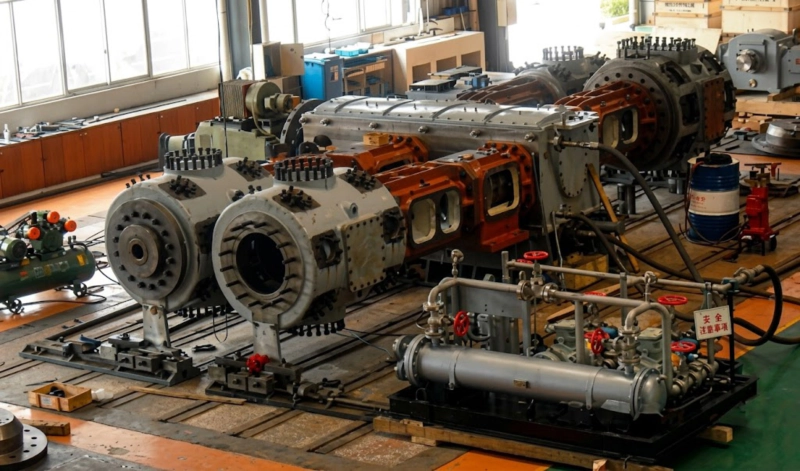
Factory acceptance test — every DW series hydrogen recirculation compressor is run-tested with ATEX IIC systems armed, oil-free PTFE cylinder operation verified at rated conditions, and Type D nitrogen purge flow confirmed on both column distance pieces before shipment
Frequently Asked Questions — DW Series Hydrogen Recirculation Compressor
Q1: Why is the opposed-balance frame necessary for hydrogen recirculation compressors at high power levels?
At power levels above 200 kW, the alternating inertia force of a non-balanced reciprocating compressor is large enough to cause measurable vibration in connected high-pressure pipework. Hydrogen reactor loops operate at total pressures of 5–18 MPa, and the nozzle welds, instrument connections, and pipe bends in these loops are designed with a finite fatigue life. Sustained vibration at the natural frequency of the piping system — which a non-balanced compressor driving at its operating frequency can excite — advances the fatigue life consumption rate and can cause failures within months. The DW opposed-balance configuration cancels primary inertia forces at source, reducing the dynamic load on connected pipework to a fraction of the unbalanced equivalent. For refinery engineers specifying a 500–1,500 kW hydrogen recirculation compressor, the opposed-balance requirement is typically set by the process licensor’s mechanical specification for the reactor loop.
Q2: How does the DW hydrogen recirculation compressor differ from the standard DW gas compressor at the same model number?
The frame and crankshaft are shared, but every gas-contacting component is different. The hydrogen recirculation DW has substantially larger cylinder bores than the standard gas DW at equivalent power — because hydrogen at molecular weight 2 occupies 8–14 times the volume of the equivalent mass flow of natural gas. The hydrogen DW has PTFE oil-free rings and packing replacing cast iron lubricated rings; copper-free material specification throughout the gas circuit; PEEK gas valve elements replacing PTFE valve elements; Type D distance piece with nitrogen purge replacing Type C; and ATEX Zone 1 Group IIC electrical equipment replacing IIA or IIB. A standard gas DW machine cannot be converted to hydrogen recirculation service without replacing all cylinders, piston rods, rings, valves, distance pieces, and all electrical equipment.
Q3: What does DW-5/0.8~120 mean and why does it have a 4-column frame at only 5 Nm³/min?
DW-5/0.8~120 indicates: DW type (opposed-balance), flow 5.0 Nm³/min, pressure range 0.08–1.20 MPa variable. The 4-column frame in this model is used not for flow capacity but for pressure range flexibility: by activating different numbers of cylinders and adjusting valve loading, the machine can operate across the wide 0.08–1.20 MPa discharge pressure range while maintaining mechanical balance at all operating points. This makes the DW-5/0.8~120 suitable for reactor loops where the operating pressure varies significantly across different feed stocks or operating campaigns — common in flexible-feed hydrotreating units. At 5 Nm³/min (300 Nm³/h), this model covers small hydrotreating units and reactor loop development units.
Q4: At what H₂S concentration does NACE MR0103 material specification become mandatory?
NACE MR0103 applies when the partial pressure of H₂S in the gas exceeds 0.34 kPa (approximately 50 ppm at 7 MPa total pressure, or 34 ppm at 10 MPa). In a typical hydrocracking loop at 12 MPa total pressure, even 28 ppm of H₂S by volume in the loop gas exceeds this threshold. The NACE threshold is a partial pressure calculation, not a concentration limit — the same gas composition gives a higher H₂S partial pressure at higher total loop pressure. For all hydrotreating and hydrocracking loop duties, provide the gas phase H₂S concentration in ppm, the total loop operating pressure in MPa, and the suction temperature. Our engineering team performs the NACE threshold calculation and confirms whether the standard carbon steel specification or the NACE upgrade is required for your specific operating condition.
Q5: What capacity control is available for the DW series hydrogen recirculation compressors?
Two control methods are available. Suction valve unloaders on one column provide approximately 50% turndown in a two-column machine — by unloading the low-pressure cylinder of one column, the effective swept volume is halved. For the larger models (above 500 kW), this unloading reduces reactor recirculation flow to 50% of design at approximately 55% of full-load power. Variable frequency drive (VFD) on the motor provides continuous modulation from 50–100% of design flow with proportionally reduced power — preferred for units where the reactor feed rate varies and maintaining an accurate H₂/feed ratio is important for catalyst life. For hydrogen recirculation at the flow and power levels of the DW series, the starting current without VFD on a 6 kV or 10 kV motor is a significant grid disturbance; soft-start or VFD is recommended for all DW H₂ models above 500 kW.
Q6: What is the PTFE ring service life in hydrotreating loop gas and how is it affected by H₂S?
In clean hydrogen service (catalytic reforming loop gas, electrolyser output), PTFE ring and packing service life is 6,000–8,000 operating hours, determined primarily by cylinder wall surface speed and temperature. In hydrotreating loop gas containing H₂S and trace heavy hydrocarbons, PTFE ring life is typically 4,000–6,000 hours — the heavy hydrocarbon fraction can deposit on the PTFE ring face and cause abrasive wear. For the largest DW hydrogen recirculation models (DW-66/28–12.5, DW-92/5–13) with multiple cylinders per machine, we recommend maintaining a two-year on-site stock covering three to four complete ring-and-packing sets per cylinder column, ensuring the machine can be maintained through multiple service intervals without any procurement requirement during the critical early years of operation.
Q7: What is the delivery time for DW hydrogen recirculation compressors and what are the main lead-time items?
Standard delivery from confirmed purchase order is 5–8 months for the DW hydrogen recirculation series. The main long-lead items are: the large-bore hydrogen cylinders (requiring extended machining time due to the larger bore diameter vs. equivalent-pressure standard gas cylinders), the ATEX Zone 1 Group IIC certified motor (which must be sourced specifically to Group IIC — not a standard IIA or IIB motor), and the Type D distance piece nitrogen purge system (custom-fabricated per the cylinder column layout). For the largest models — DW-66/28–12.5 and DW-92/5–13 at 1,400–1,500 kW — delivery is at the 7–8 month end of the range due to the large-bore forgings and the extended factory acceptance test period at high power. Confirm the required commissioning date at enquiry; production schedule availability is confirmed in the technical proposal.
Q8: What does the DW-35/40 four-stage configuration mean and why is four stages needed for 4.0 MPa?
The DW-35/40 compresses 35 Nm³/min of hydrogen from near-atmospheric to 4.0 MPa in a single two-column machine using four compression stages. Four stages are required because the total compression ratio of approximately 40:1 (atmospheric to 4.0 MPa) must be divided into stages with a per-stage ratio of approximately 2.5:1 to maintain hydrogen discharge temperatures within the PTFE ring operating limit. The high specific heat ratio of hydrogen (approximately 1.41) means each stage heats the gas more rapidly than the equivalent compression of a heavier gas — so more stages at a lower per-stage ratio are needed compared to a CO₂ or natural gas machine of the same discharge pressure. In a two-column frame, four stages are achieved by tandem cylinder arrangement: two cylinder bores of different sizes on the same piston rod in each column, giving stages 1 and 3 on one column and stages 2 and 4 on the other, with intercoolers between each stage.
Q9: What GOST-R documentation is provided for DW H₂ recirculation units in Russia?
Every DW hydrogen recirculation unit delivered to Russia or EEU member states is supplied with: GOST-R certificate of conformity, technical passport with all hydrogen service design parameters including ATEX IIC classification, oil-free specification, and copper-free material declaration, pressure vessel certification for all interstage coolers and separators, ATEX Zone 1 Group IIC certificates for all explosion-proof electrical equipment, nitrogen purge system design documentation with flow calculations for each column distance piece, factory acceptance test report including PTFE ring performance verification and N₂ purge flow measurement, and Russian-language operating and maintenance instructions. Hydrogen compression facilities in Russia are classified as explosive-atmosphere hazardous production facilities (OPO) requiring Rostechnadzor registration under Federal Law 116-FZ before startup. The documentation package is structured to support this registration. We dispatch the package 2–3 weeks before machine shipment.
Q10: What spare parts should be stocked on-site for a DW H₂ recirculation compressor at a Russian refinery?
The recommended on-site stock for a DW hydrogen recirculation unit includes: two complete sets of PTFE piston rings and packing for each cylinder stage across both columns (supporting three to four ring replacements at 4,000–8,000 hours each over the first two years), one complete set of PEEK gas valve elements for every cylinder position (LP suction and discharge on each column, HP suction and discharge on each column for two-stage machines), nitrogen purge system consumables including O-rings, seals, and check valve internals for both distance pieces, and one set of pressure casing gaskets. For the largest DW models with six or eight cylinder positions, the two-year ring-and-packing stock is the dominant cost item in the spare parts package. All PTFE, PEEK, and sealing parts are manufactured in-house at our Russian facility with 24–72 hour dispatch capability, providing assurance that a refinery hydrotreating unit outage caused by a DW recirculation compressor seal failure can be resolved within days rather than the 3–9 month import lead time that European OEM parts currently require in Russia.
Request a Technical Proposal
Our engineering team supplies DW series hydrogen recirculation compressors to refineries and chemical plants across Russia and the CIS, with over 70 years of reciprocating compressor manufacturing experience. API 618 opposed-balance, oil-free PTFE, ATEX IIC, and full GOST-R and Rostechnadzor documentation — standard on every unit. PTFE, PEEK, and sealing spare parts manufactured in Russia and dispatched within 24–72 hours to protect your reactor uptime.
DW Series H₂ Recirculation — Engineering Enquiry
Discuss Your Refinery Hydrotreating or Hydrocracking H₂ Recirculation Project
Process engineers with refinery hydrogen service experience respond to all enquiries. GOST-R, ATEX IIC, and Rostechnadzor documentation included. Response within 48 hours.
Request a Technical Quote
Include in Your Enquiry
✓ Process type (hydrotreating / hydrocracking / other)
✓ H₂ recirculation flow (Nm³/h)
✓ Loop suction and discharge pressure (MPa)
✓ H₂ purity (mol%) and H₂S concentration (ppm)
✓ Total loop operating pressure (MPa)
✓ Available voltage (380V / 6kV / 10kV)
✓ GOST-R / Rostechnadzor requirement
✓ Required delivery date