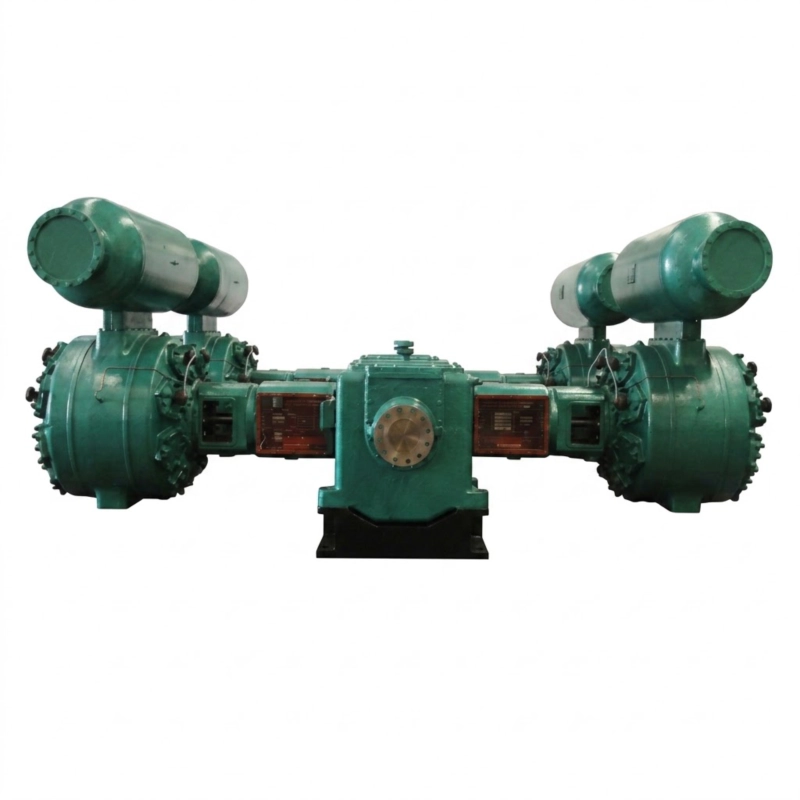
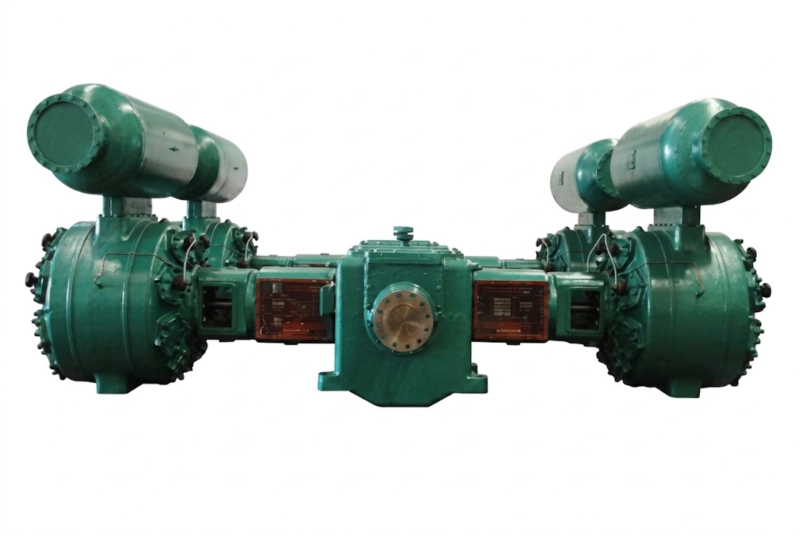
Product Overview: D Series Process Gas Compressor
The D series process gas compressor is a single-column horizontal reciprocating piston compressor designed for chemical process gas duties where the combination of medium-to-high flow rate and moderate discharge pressure characterises the application. The D designation identifies the single horizontal cylinder column arrangement — one cylinder bore per compression stage, set horizontally — which produces a simple, accessible, and compact machine that is easier to install and maintain than multi-column frames while delivering flow rates that exceed the capacity of vertical Z-type configurations at comparable pressures.
The D series covers a broad range of process gas compression duties across the chemical industry. The D-20/12 and D-25/13.5 models serve chemical synthesis applications where acetylene-nitrogen mixed gas, acetylene-hydrogen mixtures, or other flammable process gases must be compressed to 1.2–1.35 MPa for reactor feed or pipeline transfer. The D-120/4 handles large-volume low-pressure CO₂ recovery at 0.40 MPa. The series is also available in configurations for other process gases including synthesis gas, methane-rich gas, and inert gas mixtures, with compression medium and materials specification adjusted accordingly for each application.
Manufactured at our production facility in Russia to API 618 Fifth Edition and GOST-R certification requirements, the D series is available as a direct alternative to Ariel JGA series, Dresser-Rand HOS single-column series, and Neuman & Esser PCL horizontal series compressors in the equivalent flow and pressure class. These brands are referenced solely to assist engineers in cross-referencing performance classes during selection. All D series units are original designs and we do not sell counterfeit or unlicensed products.
Industries and duties served: Chemical synthesis gas feed compression (BDO, acetic acid, vinyl acetylene, acetaldehyde processes), CO₂ recovery and low-pressure recompression, mixed gas and process gas transfer, general chemical plant utility gas compression, industrial gas supply, and oxy-acetylene gas plant support compression.
D Series Frame Architecture: Single-Column Horizontal Design
The D-type frame is one of the five standard reciprocating compressor frame geometries in our product range alongside Z (vertical), L (horizontal long-stroke), M (multi-column balanced), and the opposed-balance 4MW/6MW configurations. Understanding where the D-type fits in the overall product architecture helps in selecting the right series for a given duty.
| Frame Type |
Orientation |
Columns |
Typical Flow |
Best For |
D Series Position |
| Z (ZW) |
Vertical |
2 |
2–45 m³/min |
Minimum footprint; small plants |
— |
| L (LW) |
Horizontal long-stroke |
2 |
6–60 m³/min |
Maximum flow per capital; low-mid pressure |
— |
| D (This series) |
Horizontal |
1 |
20–7,200 Nm³/h |
Process gas; flammable/mixed gas; CO₂ |
✓ This page |
| DW |
Horizontal opposed |
2 |
25–325 m³/min |
High flow CO₂; better balance |
— |
| 4MW / 6MW |
Horizontal 4/6-col opposed |
4 / 6 |
85–600 m³/min |
Large plant; minimum vibration |
— |
The D series occupies a specific niche in this range: it is the preferred choice when the gas being compressed is a chemical process gas — flammable, reactive, or requiring special materials — at flow rates above those economically served by the Z series but where the application does not require the multi-column balance of the DW series. The D-type horizontal orientation provides easy access to cylinders and valves from both ends of the machine, simplifying maintenance in chemical plant environments where technician access around large compressors is often restricted by adjacent equipment.
Technical Specifications — D Series Process Gas Compressor
The following models represent the principal configurations in the D series product range. Custom flow and pressure combinations outside this matrix are available to order with the same single-column horizontal frame architecture.
| Model |
Configuration |
Flow (Nm³/h) |
Pressure (MPa) |
Compression Medium |
Drive |
Voltage |
| D-20/12 |
1-col 2-stage |
1,200 |
1.20 |
Mixed gas / acetylene-N₂ / process gas |
Belt-drive |
380 V |
| D-25/13.5 |
1-col 2-stage |
1,500 |
1.35 |
Mixed gas / chemical synthesis gas |
Belt-drive |
380 V |
| D-120/4 |
1-col 1-stage |
7,200 |
0.40 |
CO₂ low-pressure recovery / inert gas |
Direct or belt |
6K / 10K |
Note: Flow rates stated at standard conditions (0°C, 0.101325 MPa). The model number encodes capacity: D-20/12 indicates 20 Nm³/min flow at 12 bar (1.2 MPa) discharge. Custom configurations across the full series flow and pressure range are available to order. For flammable gas service (acetylene-nitrogen, mixed hydrocarbon gas), ATEX explosion-proof motor and instrumentation are standard.
General Series Parameters
| Parameter |
D Series Range |
| Compression Medium |
Mixed gas, acetylene-N₂, CO₂, synthesis gas, process gas |
| Pressure Range |
0.10–4.00 MPa |
| Flow Capacity |
20–1,000 Nm³/h (series); 7,200 Nm³/h (D-120/4 CO₂ variant) |
| Motor Power |
5.5–800 kW |
| Piston Force |
1.5–25 T |
| Frame Configuration |
1-column horizontal (D-type); 1 or 2 compression stages |
| Drive Options |
Belt-drive or direct-drive; VFD available as option |
| Drive Voltage |
380 V (standard) / 6 kV / 10 kV (high-power models) |
| Lubrication |
Oil-lubricated standard; oil-free available (PTFE rings) for flammable gas |
| Cooling Method |
Water-cooled standard; air-cooled available |
| Electrical (flammable gas) |
ATEX Zone 1, Group IIA/IIB/IIC as required by gas classification |
| Design Standard |
API 618 Fifth Edition; GOST-R (Russia / CIS) |
| Certification |
ISO 9001:2015, GOST-R, Pressure Vessel License |
Working Principle and Structural Composition
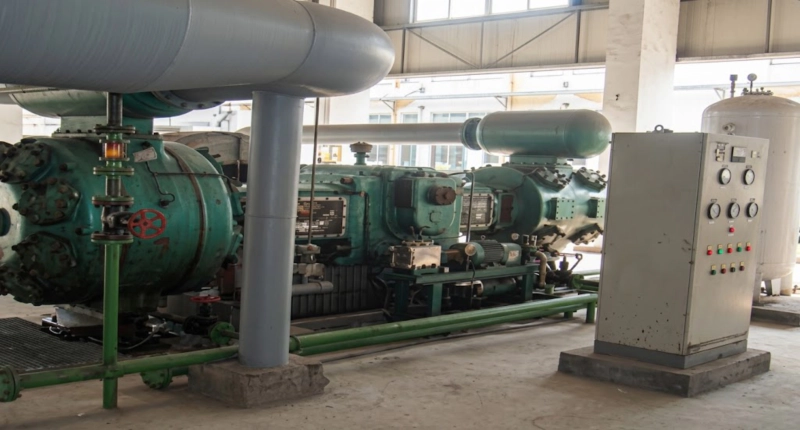
The D series operates on the reciprocating piston principle with a single horizontal cylinder column. The crankshaft — driven by a motor through a V-belt and flywheel or direct coupling — converts rotational motion into the horizontal reciprocating motion of one or two pistons in sequence. In the single-stage D-120/4 configuration, the single cylinder handles the full compression ratio in one pass. In the two-stage D-20/12 and D-25/13.5 configurations, a larger-bore low-pressure cylinder compresses the gas from suction to the interstage pressure, and a smaller-bore high-pressure cylinder raises it from interstage to the final discharge pressure. An interstage cooler and liquid separator between the stages removes heat of compression and any condensed liquid before the gas enters the high-pressure cylinder.
The single-column horizontal arrangement provides equal access to the cylinder head and piston from either end of the machine — unlike vertical Z-type compressors where the cylinder head is at the top and access requires a step or platform. This access advantage is significant in chemical plant environments where maintenance technicians work in PPE and where the quick visual inspection of valve condition between planned maintenance intervals is an important operational practice. The horizontal orientation also simplifies the drainage of any condensate accumulation in the cylinder bore — particularly relevant for CO₂ service where moisture can condense during startup and shutdown cycles.
Key Structural Components
⚙ Single-Column Crankshaft
Forged 42CrMo alloy steel crankshaft with one or two crank throws depending on stage count. Hardened journal surfaces for long bearing life under the sustained loading of process gas compression duties.
🔧 Horizontal Cylinders
Cast iron or 316L stainless steel cylinders depending on gas service. Chrome-plated piston rods. Oil-lubricated (standard) or PTFE oil-free rings (flammable gas or purity-critical service). Easy end access for valve inspection.
📈 Process Gas Valves
Ring-plate or poppet valves with 316 SS seats and PEEK or PTFE elements. Valve selection adapted for each gas service — acetylene-compatible copper-free materials for acetylene-containing mixtures; standard construction for CO₂ and inert gas service.
❄ Interstage Cooling
Shell-and-tube interstage cooler and aftercooler with automatic-drain liquid separator. Carbon steel standard; 316L SS for corrosive gas or wet CO₂ service. Thermal performance confirmed for worst-case ambient conditions.
🔐 Sealing and Distance Piece
PTFE pressure packing with Type C or D double-compartment distance piece per API 618. Nitrogen purge available for flammable or toxic gas service. Crankcase fully isolated from process gas at all times.
💻 Control and Safety System
PLC-based panel with HMI. Continuous monitoring of temperature, pressure, vibration, rod drop, and lube oil. For flammable gas service: ATEX-rated control panel, gas detectors, and automatic ESD on all critical parameters.
Gas Service Variants: Adapting the D Frame to Different Process Gases
One of the key advantages of the D series horizontal frame is its adaptability to different process gas compositions through materials specification changes, without changing the fundamental frame architecture. The three primary service variants are described below.
⚙️
Acetylene Mixed Gas Service (D-20/12, D-25/13.5)
In chemical synthesis plants producing BDO (butanediol), vinyl acetylene, acetaldehyde, and acetic acid, acetylene must be mixed with nitrogen, hydrogen, or other diluent gases at controlled ratios before being fed to the reaction vessel. The D-20/12 and D-25/13.5 compress these acetylene-containing mixed gas streams from near-atmospheric to 1.2–1.35 MPa reactor feed pressure. For acetylene-containing gas mixtures, all wetted components must be copper-free (less than 70% copper by mass), cylinders must be oil-free with PTFE piston rings, and all electrical equipment must carry ATEX Group IIC explosion-proof certification. The D-series single-column layout provides a compact machine suitable for the constrained space of most synthesis plant compressor rooms.
Key specification requirements: Oil-free cylinders, copper-free materials throughout gas path, ATEX Group IIC motor and instrumentation, water or air cooling, nitrogen purge on distance piece.
🌿
CO₂ Low-Pressure Recovery Service (D-120/4)
The D-120/4 handles large-volume CO₂ recovery at 0.40 MPa in single-stage configuration — collecting near-atmospheric CO₂ from fermentation, combustion, or purification systems and raising it to storage or pipeline pressure. At 7,200 Nm³/h per unit, this is the highest-flow model in the D series. For food-grade CO₂ applications, oil-free cylinder specification applies (PTFE rings, Type C distance piece). For industrial CO₂ recovery where downstream oil content is less critical, oil-lubricated cylinders are used with downstream coalescing separators. The 6 kV or 10 kV drive voltage at 550 kW motor power requires appropriate high-voltage electrical infrastructure at the installation site.
Key specification requirements: Oil-free or oil-lubricated per downstream purity requirement, 6 kV or 10 kV power supply, water cooling, GOST-R certification for Russia/CIS.
🔌
General Chemical Process Gas Service (Custom Configurations)
Beyond the standard models listed above, the D series frame is available in custom configurations for a wide range of chemical process gas compression duties: synthesis gas (H₂/CO mixtures), natural gas components, propylene and propane process streams, and other light hydrocarbon and industrial gases where the single-column horizontal configuration provides the required combination of flow rate, pressure, and compact installation. Each custom configuration requires a full thermodynamic sizing calculation, materials selection review for the specific gas composition, and hazardous area classification confirmation before design is finalised. Contact our engineering team with your process data sheet for a custom proposal.
Core Advantages of the D Series
🔧
End Access From Both Sides
The horizontal single-column arrangement provides direct access to both the front cylinder head (piston and rings) and the rear cylinder head (gas valves) from ground level without platforms or lifting equipment. In chemical plants where compressor rooms are often congested, this access advantage reduces maintenance time significantly compared to vertical or multi-column machines.
🛠
Adaptable to Multiple Process Gas Types
The same D-type frame serves acetylene mixed gas, CO₂, synthesis gas, and hydrocarbon gas duties by changing the cylinder liner material, piston ring type, valve materials, and distance piece classification. This versatility reduces the number of different machine types a chemical plant must maintain in its installed base and spare parts inventory.
⚖
API 618 and GOST-R Compliance
Full API 618 Fifth Edition design compliance with rod load certification and distance piece classification. GOST-R certification standard for all D series units delivered to Russia and EEU member states, providing the documentation required for Rostechnadzor registration of hazardous production equipment in chemical plants.
📈
380 V Compatibility on Standard Models
The D-20/12 and D-25/13.5 models at 55–75 kW use 380 V motors, making them compatible with standard industrial electrical supply in most Russian and CIS chemical plant facilities without high-voltage transformer requirements. This reduces installation cost and simplifies electrical safety compliance in hazardous areas.
🏭
Compact Single-Machine Installation
The single-column D frame requires less floor area than two-column or multi-column machines of equivalent capacity. For chemical plants adding a new compression duty to an existing facility with limited available floor space, the D series frequently offers a solution that fits within the available footprint without building extension.
🕑
Long Wear-Part Life with In-House Spares
Piston ring and packing service life 6,000–10,000 hours. Gas valve replacement at 8,000–12,000 hours. All spare parts manufactured in-house and stocked for rapid dispatch from Russia throughout the 20+ year operating life of the machine.
Material Quality and Gas-Service-Specific Specifications
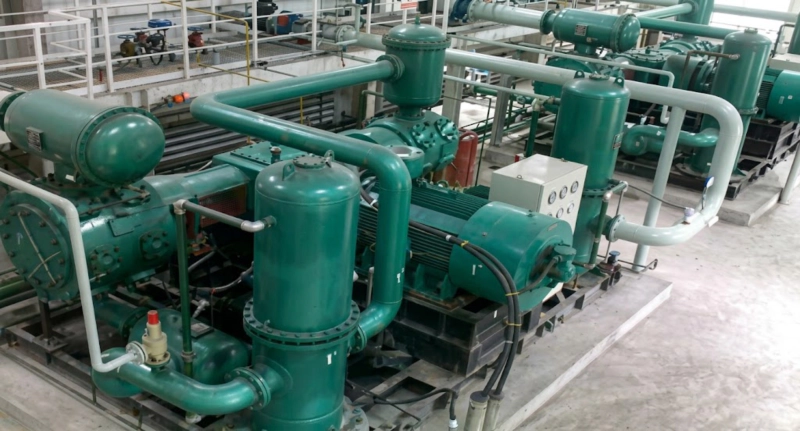
| Component |
Standard Service (CO₂, inert gas) |
Flammable / Acetylene-Mixed Gas Service |
| Frame / Crankcase |
HT250 cast iron |
HT250 cast iron (copper-free; compliant for acetylene) |
| Cylinders |
HT250 cast iron; 316L SS for wet CO₂ |
Cast iron or 316L SS — copper content below 70% mandatory |
| Piston Rings / Packing |
PTFE (oil-free) or cast iron (lubricated) |
PTFE oil-free mandatory for acetylene-containing gas |
| Piston Rods |
42CrMo, hard chrome plated |
42CrMo, hard chrome plated (copper-free; compliant) |
| Gas Valve Bodies |
316L SS or carbon steel |
316L SS only — no brass valves for acetylene gas |
| Valve Elements |
PTFE or PEEK |
PTFE or PEEK — no silver or copper contacts |
| Gas-Side Piping |
Carbon steel or 316L SS |
No brass fittings — carbon steel or 316L SS only |
| Distance Piece |
Type C or D per API 618 |
Type D with nitrogen purge for flammable gas |
| Electrical Equipment |
Standard industrial |
ATEX Zone 1, Group IIC for acetylene; IIA/IIB for other flammable gas |
Selection Guide: Is the D Series the Right Choice?
Use the following framework to confirm whether the D series is appropriate for your application, or whether another series in our range is a better match.
1
Confirm flow and pressure are within the D series range
D series piston models cover 20–1,000 Nm³/h at 0.10–4.0 MPa in standard configuration, with the D-120/4 extending to 7,200 Nm³/h at 0.40 MPa. For flows above 7,200 Nm³/h, consider the LW or DW series. For pressures above 4.0 MPa, consider the DW or 4MW series. For flows below 20 Nm³/h, the ZW series is more appropriate.
2
Provide complete gas composition including all trace components
The gas composition determines materials specification: acetylene content above 1% triggers copper-free and oil-free requirements; H₂S above the NACE threshold triggers stainless steel and post-weld heat treatment; free water requires 316L SS wetted parts; flammable gas requires ATEX-rated electrical equipment. Provide the full composition analysis and not just the primary component percentages.
3
Confirm hazardous area classification and ATEX group
For flammable gas service, confirm the hazardous area zone (typically Zone 1 for compressor room installations) and the ATEX gas group (IIC for acetylene and hydrogen; IIB for ethylene and cyclopropane; IIA for most other hydrocarbons). This determines the motor, control panel, and instrumentation specification. Incorrect ATEX group selection is a safety risk that cannot be corrected without replacing all electrical equipment after installation.
4
Specify drive voltage based on motor power
D-20/12 (55–75 kW) and D-25/13.5 (75–90 kW) use 380 V motors as standard — compatible with standard Russian industrial supply. D-120/4 (550 kW) requires 6 kV or 10 kV supply and appropriate high-voltage switchgear. Confirm the available voltage at the installation point before placing the order.
5
State GOST-R and Rostechnadzor requirements at enquiry
For chemical plant installations in Russia, the D series compressor handling flammable process gas is classified as hazardous production equipment and requires Rostechnadzor registration. GOST-R certification and the full registration documentation package are provided as standard with all D series units delivered to Russia and CIS. State this at enquiry stage so the correct documentation scope is confirmed in the offer.
D Series vs. International Alternatives: Objective Comparison
Transparency Notice: Ariel Corporation, Dresser-Rand (Siemens Energy), and Neuman & Esser are referenced solely to help engineers cross-reference performance classes. We do not manufacture or claim affiliation with these brands. All D series compressors are original designs. We do not sell counterfeit or unlicensed products.
| Factor |
D Series (Our Make) |
Ariel JGA |
Dresser-Rand HOS |
N&E PCL |
| API 618 |
✓ Full |
✓ Full |
✓ Full |
✓ Full |
| GOST-R (Russia/CIS) |
✓ Standard |
Case by case |
Case by case |
Case by case |
| ATEX IIC (Acetylene Gas) |
✓ Standard for applicable service |
✓ Available |
✓ Available |
✓ Available |
| Capital Cost |
30–45% below European OEM |
High (USD) |
High (EUR) |
High (EUR) |
| Lead Time |
4–7 months |
8–14 months |
10–16 months |
10–16 months |
| Spare Parts |
In-house; rapid Russia dispatch |
OEM; import delays |
OEM; import delays |
OEM; import delays |
| Russia/CIS On-Site Service |
Direct manufacturer support |
Agent network |
Regional office |
Agent network |
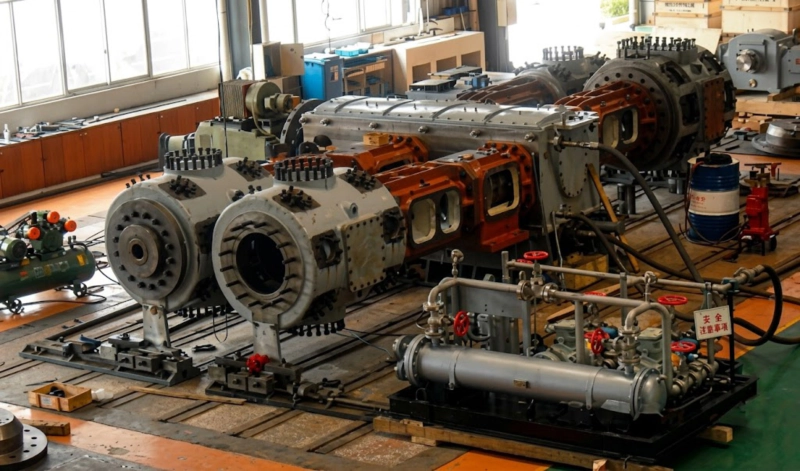
Factory acceptance test — every D series unit is mechanically tested at design operating conditions before shipment, with performance, vibration, and safety system function documented against the contractual data sheet
Frequently Asked Questions — D Series Process Gas Compressor
Q1: What does the D designation mean and how does D-type differ from L-type and Z-type frames?
The D designation identifies a single-column horizontal reciprocating frame with a relatively short stroke compared to cylinder bore diameter — contrasting with the L-type which has a long stroke relative to bore. In practical terms, the D-type produces a higher compression ratio per stage than the long-stroke L-type at the same flow rate, making it better suited to two-stage compression duties reaching 1.0–4.0 MPa from near-atmospheric, while the L-type is more economical for low-pressure single-stage duties. Compared to the Z-type (vertical), the D-type provides horizontal access from both ends of the cylinder — easier for chemical plant environments — but occupies a longer floor footprint in one direction. Compared to the DW series (two horizontal opposed columns), the D-type is simpler, lower cost, and more compact, but does not achieve the same dynamic balance that the DW provides for larger machines.
Q2: What is acetylene-nitrogen mixed gas and why is it compressed in the D-20/12?
In chemical synthesis plants producing butanediol (BDO), acetic acid via the Wacker process, and vinyl acetylene for speciality chemicals, pure acetylene is too reactive and explosive at the pressures required for reactor feed to be handled safely without a diluent gas. By mixing acetylene with nitrogen at a controlled ratio — typically 15–40% acetylene in nitrogen — the mixture is maintained below the explosive decomposition range while still providing the acetylene concentration needed for the synthesis reaction. The D-20/12 compresses this acetylene-nitrogen mixed gas stream from near-atmospheric pressure to the 1.2 MPa reactor feed pressure. Even in a diluted mixture, the presence of acetylene triggers all the same copper-free materials and oil-free cylinder requirements as pure acetylene service, because any local concentration of acetylene at the cylinder wall could reach unsafe levels if oil or copper were present.
Q3: Can the same D series frame be used for both acetylene mixed gas and CO₂ service?
Yes, the D-type horizontal frame is mechanically the same for both services. The differences lie entirely in the materials specification and safety equipment: for acetylene-containing gas, all wetted parts must be copper-free, cylinders must be oil-free with PTFE rings, and all electrical equipment must carry ATEX Group IIC certification. For CO₂ service without acetylene, standard carbon steel or 316L SS materials are used, oil-lubricated or oil-free cylinders can be specified depending on downstream purity requirements, and standard (non-ATEX) electrical equipment is acceptable. A compressor manufactured for CO₂ service cannot be converted to acetylene-mixed-gas service without replacing all the gas-path metals that may contain copper and all the electrical equipment. The reverse is possible but economically wasteful. Always specify the service gas at the time of order.
Q4: Why is ATEX Group IIC required for acetylene-containing gas, and not just IIA or IIB?
ATEX equipment groups are classified by the minimum ignition energy and flameproof gap size required to prevent ignition of the gas mixture. Group IIA covers gases like propane and methane — relatively tolerant of spark and hot surface energy. Group IIB covers gases like ethylene — more sensitive. Group IIC covers acetylene and hydrogen — the most sensitive gases, with minimum ignition energies below 0.017 mJ and requiring the narrowest flameproof joint gaps in explosion-proof enclosures. An enclosure rated IIC can be used in any IIA or IIB atmosphere, but an IIA or IIB rated enclosure cannot safely contain an acetylene ignition. For acetylene mixed gas compression, even when the acetylene concentration is below the flammable limit in the bulk gas stream, local pockets of higher concentration can form during startup, shutdown, or abnormal conditions. All electrical equipment must therefore be rated for the pure acetylene worst case — Group IIC.
Q5: What capacity control options are available for the D series?
Three options are available. Suction valve unloaders on the low-pressure cylinder provide step-wise capacity reduction (50% on a two-stage single-LP-cylinder machine) without stopping the compressor. Variable frequency drive (VFD) on the motor provides continuous smooth capacity modulation from approximately 50% to 100% of design flow with optimal energy efficiency. A combination of suction valve unloaders and VFD provides the widest overall turndown. Note: for acetylene-containing gas service, suction valve unloaders must be specified with care — the unloaded cylinder must be continuously purged with nitrogen to prevent acetylene accumulation in a dead-end volume. This purge system must be included in the safety analysis for any acetylene mixed gas installation. Contact our engineering team to confirm the appropriate capacity control arrangement for your specific gas composition and operating schedule.
Q6: What is the D-120/4 and how does it differ from the LW-60/4 at similar pressures?
The D-120/4 delivers 7,200 Nm³/h (120 Nm³/min) at 0.40 MPa in a single-stage single-column horizontal configuration. The LW-60/4 delivers 3,600 Nm³/h (60 Nm³/min) at 0.40 MPa in a two-stage two-column horizontal configuration. The D-120/4 is essentially a larger-bore, shorter-stroke variant of the same horizontal frame family, sized for cases where a very high flow rate at low pressure must be achieved in a single machine. The D-type construction at this size uses a single large cylinder rather than the paired cylinders of the LW-60/4, resulting in a higher flow per cylinder at the cost of somewhat higher vibration per unit than the two-column LW frame. For applications where the D-120/4 flow rate is needed but vibration is a primary concern, two LW-60/4 units in parallel may be preferable. For applications where a single machine is required and floor area is limited, the D-120/4 is the more compact solution.
Q7: What maintenance intervals are typical for D series compressors in chemical process service?
Under normal operating conditions with clean, dry process gas: piston rings and packing should be inspected at 4,000 hours and replaced at 6,000–8,000 hours for inert or CO₂ service; at 3,000–5,000 hours for flammable or reactive gas service where ring wear rates are higher. Gas valves should be inspected at 5,000 hours and replaced at 7,000–10,000 hours. The horizontal cylinder orientation of the D-type makes ring and valve inspection faster than on vertical machines — the cylinder can be accessed by removing the front head cover and the rear valve cover without lifting equipment, typically within 2–3 hours for a trained maintenance team. Main bearing overhaul at 30,000–40,000 hours. For belt-drive models, V-belt inspection at 1,000 hours and replacement at 6,000–8,000 hours.
Q8: What GOST-R documentation does the D series provide for Russian chemical plant registration?
The D series documentation package for Russia includes: GOST-R certificate of conformity, technical passport (tekhnicheskiy pasport) with design parameters and pressure ratings, pressure vessel certification for all interstage vessels and coolers, ATEX Group IIC certificates for electrical equipment (flammable gas models), factory acceptance test records, operating and maintenance instructions in Russian, and the declaration of conformity. For compressors handling flammable acetylene-containing gas, the documentation includes the safety analysis confirming compliance with the Acetylene Safety Regulations and Federal Law 116-FZ for hazardous production facilities. This package supports Rostechnadzor registration at the regional office without requiring additional certification procedures.
Q9: Can the D series handle synthesis gas (H₂/CO mixture) in addition to acetylene-containing gas?
Yes. The D-type horizontal frame is suitable for synthesis gas compression when configured with appropriate materials. For H₂/CO (syngas) mixtures, the key design considerations are: hydrogen embrittlement resistance of high-strength steel components in the high-pressure stage (requiring material selection per NACE MR0103 or similar at elevated pressures), CO toxicity requiring Type D distance piece with nitrogen purge and CO detector in the compressor area, and the higher specific compression heat of hydrogen-rich gas requiring more effective interstage cooling than equivalent CO₂ or mixed gas duties. The ATEX group for syngas is typically IIA (methane group) unless hydrogen content is significant, in which case IIC (hydrogen group) applies. Provide the full syngas composition including H₂, CO, CO₂, CH₂, and trace components for our engineering team to confirm the correct materials and safety specification for your application.
Q10: How does the D series compare to buying a used or rebuilt unit for a process gas duty?
Used and rebuilt compressors for chemical process gas duties carry risks that are difficult to quantify: the complete maintenance history may be unknown; piston rod condition and crankshaft fatigue status cannot be reliably assessed without expensive non-destructive testing; for acetylene or flammable gas service, the materials of all wetted components must be verified by material analysis — not just review of documentation that may be incomplete or inaccurate; and the ATEX certification of the electrical equipment on a rebuilt machine may not be current or appropriate for the new gas service. A new D series unit from our production in Russia provides a known starting point: all materials are verified at our factory, the ATEX certification is current, the GOST-R certification is valid, and the warranty covers the entire unit. For process gas duties where an unplanned failure has significant consequences — production loss, safety incident — the cost certainty and reliability baseline of a new unit is almost always the lower-risk choice over the apparent cost saving of a used machine.
Request a Technical Proposal for Your Process Gas Application
Our engineering team has over 70 years of experience specifying process gas compressors for chemical plants across Russia and the CIS, covering acetylene mixed gas, CO₂, synthesis gas, and a broad range of industrial process gas compression duties. The D series process gas compressor brings the same API 618 and GOST-R standard to chemical synthesis applications that our CO₂ series brings to carbon dioxide processing — with full Rostechnadzor registration documentation as standard for all Russia and CIS deliveries.
D Series Process Gas Compressor — Engineering Enquiry
Discuss Your Chemical Process Gas Compression Requirements
Process engineers with chemical plant experience respond to all enquiries. GOST-R and Rostechnadzor documentation included as standard. Response within 48 hours.
Request a Technical Quote
Include in Your Enquiry
✓ Complete gas composition
✓ Inlet and discharge pressures
✓ Required flow rate (Nm³/h or Nm³/min)
✓ Hazardous area zone and ATEX group
✓ Oil-free or lubricated requirement
✓ Available drive voltage
✓ GOST-R / Rostechnadzor requirement
✓ Required delivery date