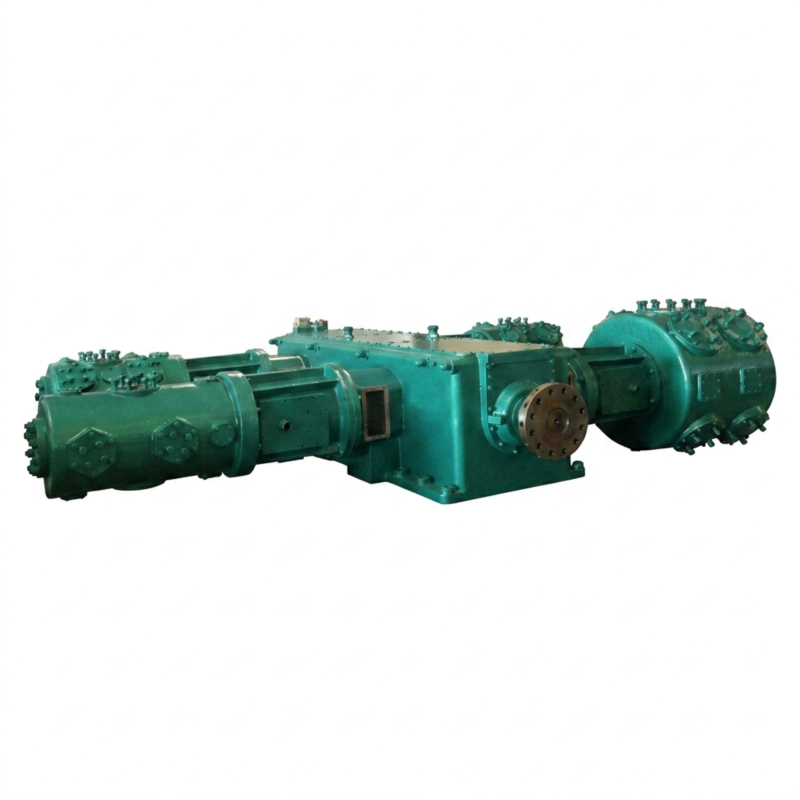
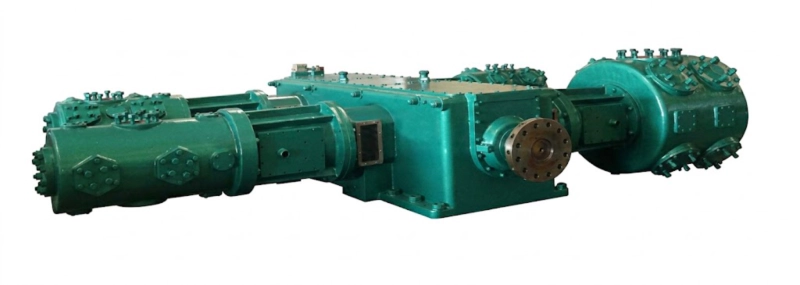
Product Overview: 4MW Series Gas Compressor
The 4MW series gas compressor is a four-column horizontal opposed-balance reciprocating piston compressor representing the apex of our reciprocating compressor range. The 4MW designation identifies the four-cylinder-column configuration in which two pairs of opposed pistons are arranged on a common crankshaft — providing full cancellation of both primary and secondary inertia forces simultaneously. This dual-plane balance is not achievable in two-column machines (DW series) where secondary forces remain, making the 4MW series the only truly complete balance configuration in standard reciprocating compressor design.
At the power levels of the 4MW series — 800 to 2,300 kW — this distinction is not academic: it is the engineering requirement that permits these machines to operate in existing buildings on standard industrial floor slabs, adjacent to sensitive process equipment, and in city-centre gas compressor stations where transmitted vibration would be unacceptable from any non-balanced machine of equivalent output.
12 standard models cover four distinct application groups: large-volume low-pressure gas (coal gas, biogas, flue gas at 0.25–0.65 MPa), CO₂ low-pressure recompression, CO₂ high-pressure liquefaction feed (to 4.00 MPa), and chemical process mid-high pressure gas (to 2.50 MPa). The 4MW-230/25 at 230 m³/min and 2,300 kW is the highest-power single-machine configuration in our entire product range. Manufactured at our production facility in Russia to API 618 Fifth Edition and GOST-R with full Rostechnadzor registration documentation as standard.
Why Four Columns: The Complete Balance Architecture
Reciprocating compressor vibration arises from two sources. Primary forces are proportional to the rotating mass and the square of the crank speed — they act once per revolution and are the dominant source in slow-speed machines. Secondary forces are proportional to the same parameters but act at twice per revolution — they arise from the geometric non-linearity of the piston-crank mechanism and become more significant at higher speeds and with longer stroke-to-connecting-rod-length ratios.
| Frame Type |
Columns |
Primary Forces |
Secondary Forces |
Foundation Requirement |
| Z / L (vertical / long-stroke) |
2 |
Not cancelled |
Not cancelled |
Heavy mass isolation required |
| DW (2-col opposed) |
2 |
✓ Cancelled |
Residual |
Reduced foundation; some isolation |
| 4MW (4-col opposed) |
4 |
✓ Fully cancelled |
✓ Fully cancelled |
Minimum foundation; floor-slab mounting possible |
In the 4MW four-column arrangement, the crankshaft has four crank throws arranged at 90-degree intervals. Two pairs of opposing columns cancel primary forces in the same way as the DW two-column machine. The 90-degree angular offset between the two pairs simultaneously cancels the secondary forces that remain in the DW machine — because the secondary force of each pair is 90 degrees out of phase with the other pair, and the two cancel in the same way that two sine waves at 90 degrees cancel their vector sum over one cycle. The practical result is that for a 4MW machine at 1,000–2,300 kW, the net force transmitted to the foundation is a small fraction of that produced by an equivalent DW machine, and a very small fraction of that from a single-column machine at the same power.
4MW Complete Balance: What It Means in Practice
Floor-Slab MountingIn many cases the 4MW can be mounted directly on an existing reinforced concrete floor slab without a dedicated machine foundation block.
Adjacent EquipmentVibration transmitted to adjacent piping, vessels, and instruments is near-zero — enabling installation close to sensitive process equipment.
Long Bearing LifeEven crankshaft loading at all four crank throws produces the most uniform bearing wear of any reciprocating frame type.
Urban SitesGas compressor stations within city boundaries or near residential areas where vibration ordinances apply — the 4MW is the standard solution.
Technical Specifications — All 4MW Series Models
The 4MW series spans four application groups. Each group uses the same four-column frame architecture with different cylinder bore, staging, and drive configurations matched to the specific gas and duty requirements.
Group A — Large-Volume Low-Pressure Gas (0.25–0.65 MPa)
Coal gas, biogas, methane, flue gas, mixed industrial gas pipeline transmission and boost compression.
| Model |
Config |
Flow (m³/min) |
Pressure (MPa) |
Dimensions L×W×H (mm) |
Weight (t) |
Power (kW) |
Voltage |
| HW-400/2.5 |
4-col 1-stage |
400 |
0.25 |
6250×7200×2735 |
30.0 |
1,400 |
6K/10K |
| HW-400/4.5 |
4-col 2-stage |
400 |
0.45 |
6250×7300×2820 |
34.0 |
1,200 |
6K/10K |
| 4MW-250/4.5 |
4-col 2-stage |
250 |
0.45 |
7200×7300×2820 |
36.0 |
1,400 |
6K/10K |
| 4MW-180/6.5 |
4-col 2-stage |
180 |
0.65 |
6250×3905×3020 |
26.0 |
1,000 |
6K/10K |
| 4MW-240/6.5 |
4-col 2-stage |
240 |
0.65 |
6250×3905×3020 |
26.0 |
1,300 |
6K/10K |
HW-400 models use the extended-width 4-column frame with four large-bore cylinders side-by-side for maximum flow at near-atmospheric pressures. 4MW-180/6.5 and 4MW-240/6.5 use a more compact 4-column layout optimised for 0.65 MPa CO₂ boost duties.
Group B — CO₂ High-Pressure Liquefaction Feed (4.00 MPa)
CO₂ compression to 4.0 MPa for industrial liquefaction plants, food-grade CO₂ production, carbon capture intermediate recompression, and EOR injection. Four models cover 85–150 m³/min in this pressure class.
| Model |
Config |
Flow (m³/min) |
Pressure (MPa) |
Dimensions L×W×H (mm) |
Weight (t) |
Power (kW) |
Voltage |
| 4MW-85/40 |
4-col 2-stage |
85 |
4.00 |
6250×3905×3130 |
27.0 |
900 |
6K/10K |
| 4MW-100/40 |
4-col 2-stage |
100 |
4.00 |
6250×3905×3130 |
27.0 |
1,000 |
6K/10K |
| 4MW-120/40 |
4-col 2-stage |
120 |
4.00 |
6500×3905×3130 |
30.0 |
1,250 |
6K/10K |
| 4MW-150/40 |
4-col 2-stage |
150 |
4.00 |
6500×3905×3130 |
30.0 |
1,500 |
6K/10K |
Suffix /40 indicates 4.0 MPa (40 bar) discharge. Oil-free PTFE rings standard for food-grade CO₂. GOST-R certification included. Ariel JGC and Dresser-Rand HOSS alternative in the 85–150 m³/min, 4.0 MPa class.
Group C — Chemical Process Mid-High Pressure Gas (1.60–2.50 MPa)
High-hydrogen gas, coal gas, CO, biogas, and mixed chemical process gas at 1.6–2.5 MPa for synthesis plants, chemical reactors, and gas injection duties. The 4MW-230/25 is the highest-power machine in the series at 2,300 kW.
| Model |
Config |
Flow (m³/min) |
Pressure (MPa) |
Dimensions L×W×H (mm) |
Weight (t) |
Power (kW) |
Voltage |
| 4MW-80/25 |
4-col 3-stage |
80 |
2.50 |
6500×6500×3200 |
26.0 |
800 |
6K/10K |
| 4MW-180/16 |
4-col 3-stage |
180 |
1.60 |
7800×8000×2700 |
37.0 |
1,800 |
6K/10K |
| 4MW-230/25 |
4-col 3-stage |
230 |
2.50 |
8000×8000×2700 |
40.0 |
2,300 |
6K/10K |
The 4MW-230/25 at 2,300 kW and 40 tonnes is the largest single-machine configuration in our entire reciprocating compressor range. ATEX Group IIC explosion-proof electrical equipment available as standard for hydrogen-rich gas streams. All dimensions L×W×H in mm.
General Series Parameters
| Parameter |
4MW Series Specification |
| Compression Media |
CO₂, coal gas, coke oven gas, biogas, methane, CO, mixed process gas, hydrogen-containing gas |
| Discharge Pressure |
0.25–0.65 MPa (low pressure); 1.60–2.50 MPa (mid-high); 4.00 MPa (CO₂ high pressure) |
| Flow Range |
80–400 m³/min (4,800–24,000 Nm³/h) |
| Motor Power |
800–2,300 kW |
| Machine Weight |
26–40 tonnes |
| Drive Voltage |
6 kV or 10 kV throughout (all models) |
| Frame Configuration |
4-column horizontal, fully opposed-balance; 1, 2, or 3 compression stages |
| Dynamic Balance |
Full cancellation of both primary and secondary inertia forces |
| Cylinder Lubrication |
Oil-free (PTFE) standard for CO₂ and food-grade; oil-lubricated for general gas |
| Electrical (flammable gas) |
ATEX Zone 1, Group IIA / IIB / IIC as required by gas composition |
| Design Standard |
API 618 Fifth Edition; GOST-R (Russia / CIS) |
| Certification |
ISO 9001:2015, GOST-R, ATEX (per gas), Pressure Vessel License |
Working Principle and Structural Composition
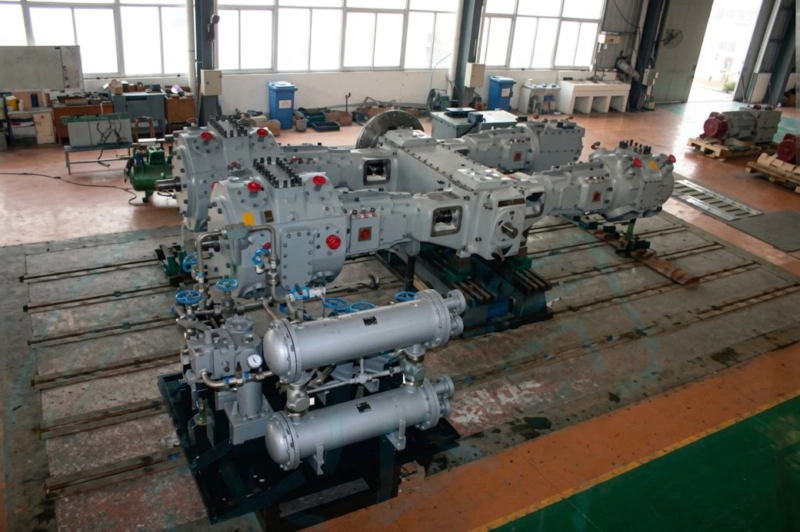
The 4MW series uses the four-column horizontal opposed-balance reciprocating piston principle. A high-voltage motor drives the crankshaft, which has four crank throws arranged at 90-degree intervals. Two pairs of opposing pistons (left column vs. right column in each pair) move in opposite directions simultaneously, cancelling primary inertia forces. The 90-degree angular spacing between the two pairs ensures that the secondary inertia forces of each pair — which occur at twice the crankshaft frequency — are phase-shifted and cancel each other across the full machine. The result is the most dynamically balanced configuration achievable in a standard reciprocating compressor.
Gas compression staging is matched to the overall compression ratio required by the application. Single-stage 4MW models (HW-400/2.5) achieve 0.25 MPa discharge from near-atmospheric suction with minimal interstage equipment. Two-stage models (4MW-85/40 through 4MW-150/40 for CO₂ at 4.0 MPa; HW-400/4.5 and 4MW-250/4.5 for gas at 0.45 MPa) compress through two stages with one interstage cooler and separator. Three-stage models (4MW-80/25, 4MW-180/16, 4MW-230/25) achieve 1.60–2.50 MPa discharge with two interstage coolers. In each case, the four cylinder columns are distributed across the stages to share the compression load evenly across all four crank throws, maximising the dynamic balance advantage.
Key Structural Components
⚙ Four-Throw Crankshaft
Forged 42CrMo alloy steel with four crank throws at 90-degree intervals. The 90-degree geometry is the key to secondary force cancellation. Hardened and ground journal surfaces, full ultrasonic and magnetic particle inspection. Dynamic balance verified at rated speed per API 618 during factory acceptance.
🔧 Four Horizontal Cylinder Columns
Four horizontal cylinder columns arranged in two opposed pairs. Cylinder material — HT250 cast iron, QT500 nodular iron, or 316L stainless steel — selected per gas service. Water jackets on all cylinders and heads. PTFE piston rings (oil-free) standard for CO₂ and food-grade service; cast iron rings for general gas lubricated service.
📈 High-Flow Gas Valves
Large-bore ring-plate or poppet valves, material matched to gas service: 316 SS seats with PEEK or PTFE elements for CO₂ and clean gas; carbon steel for general industrial gas. Eight suction and eight discharge valves (two per cylinder column) provide the high aggregate valve area needed for 80–400 m³/min flow rates.
❄ Multi-Stage Intercooling
Shell-and-tube intercoolers and aftercooler between each stage with large-capacity automatic-drain liquid separators. 316L SS tube bundles for wet CO₂ or corrosive gas. The intercooler sizing for the 4MW series accounts for the higher total heat duty of four cylinders running simultaneously.
🔐 API 618 Distance Piece × 4
Type C or D double-compartment distance piece per API 618 on all four cylinder columns, isolating crankcase lubricant from process gas. Type D with nitrogen purge on all four columns for toxic or hazardous gas service (CO, H₂S-containing). The four independent distance pieces are a manufacturing complexity that reflects the safety priority of this design.
⚡ High-Voltage Drive and PLC Control
6 kV or 10 kV synchronous or asynchronous motor with VFD or soft-starter option. PLC control panel with HMI: continuous monitoring of suction and discharge temperatures and pressures on all stages across all four cylinder columns, vibration at all main and cross-head bearings, rod drop, lube oil pressure and temperature, cooling water flow rate. Automatic shutdown on any trip parameter.
Application Scenarios by Group
🏕
Group A: Large-Scale Gas Pipeline Transmission and Boost
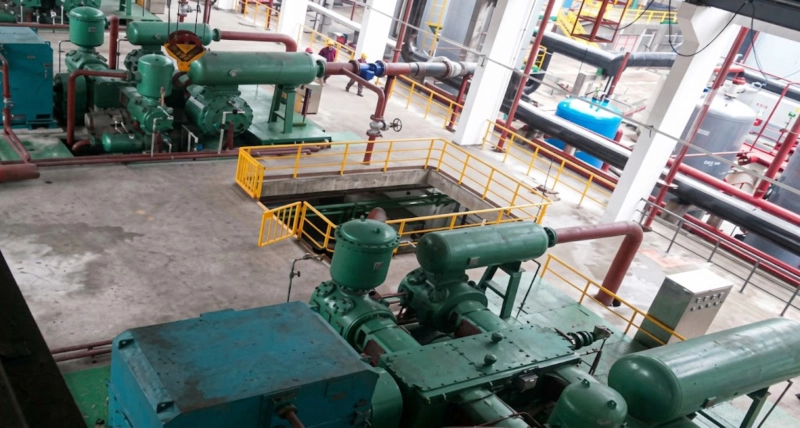
City gas network main stations and large coke chemical plant gas pipelines require compressors moving 250–400 m³/min at modest pressures. The HW-400/2.5 and HW-400/4.5 are sized exactly for these duties — handling 24,000 Nm³/h of coal gas, coke oven gas, or biogas at 0.25–0.45 MPa in a single machine. At 400 m³/min and 1,200–1,400 kW, these are the highest-flow reciprocating compressors in our range. The 4MW fully-balanced four-column frame makes floor-slab mounting feasible at these power levels, eliminating the large inertia foundation block that a non-balanced machine of equivalent power would require. For biogas plant feed compression at high-volume anaerobic digestion sites, the 4MW-240/6.5 at 240 m³/min and 0.65 MPa covers the flow rate of very large facilities.
🌿
Group B: Industrial CO₂ Liquefaction Feed and EOR Injection
CO₂ must reach 4.0 MPa for economical liquefaction, and the 4MW-85/40 through 4MW-150/40 cover 85–150 m³/min in this pressure range — corresponding to 5,100–9,000 Nm³/h of CO₂ throughput and equivalent food-grade CO₂ production capacity of 230–405 tonnes per day. For enhanced oil recovery (EOR) operations in Siberian oil fields requiring 4.0 MPa injection pressure, the 4MW-120/40 and 4MW-150/40 provide the high throughput and reliability needed for continuous 24-hour injection campaigns. The four-column full balance of the 4MW frame is particularly valued in EOR installations where the compressor is housed within an existing production facility structure, eliminating the need for new heavy foundation construction.
🔥
Group C: Large Chemical Plant Process Gas at 1.6–2.5 MPa
The 4MW-80/25, 4MW-180/16, and 4MW-230/25 handle large-volume chemical synthesis gas, coke oven gas, and mixed gas compression at 1.6–2.5 MPa for reactor feed, pipeline injection, and large coal chemical plant operations. The 4MW-230/25 at 230 m³/min and 2,300 kW is the largest machine in the series — equivalent in flow and power to two or three DW-series machines in parallel, but in a single fully-balanced frame. For chemical plants handling hydrogen-rich gas (coke oven gas, reformed gas) at 2.5 MPa, ATEX Group IIC electrical equipment is standard. The 4MW frame at this power level produces less vibration than two parallel DW-70/25 machines combined, simplifying pipework design and reducing fatigue risk on connected equipment.
🏭
Post-Combustion Carbon Capture (CCS/CCUS) Intermediate Stage
Large power plant CCS installations capture CO₂ from flue gas at near-atmospheric pressure and must recompress it through intermediate stages before the main supercritical pipeline compression train. The 4MW-180/6.5 and 4MW-240/6.5 (at 0.65 MPa discharge) and the 4MW-85/40 through 4MW-150/40 (at 4.0 MPa discharge) cover the flow rates of coal-fired power plants in the 300–1,000 MW class. The four-column fully-balanced construction is the preferred choice for CCS compressors co-located with the power plant turbine building, where vibration transmission to the sensitive plant structure and instrumentation is a governing design constraint that no two-column machine can satisfy at these power levels.
Core Advantages of the 4MW Series
⚖
Complete Primary and Secondary Balance
The only standard reciprocating compressor configuration that cancels both primary and secondary inertia forces simultaneously. Foundation mass requirements are at an absolute minimum, enabling installation on existing floor slabs without a dedicated inertia block.
📈
Highest Single-Machine Power in the Range
The 4MW-230/25 at 2,300 kW and the HW-400/2.5 at 1,400 kW are the two highest-power single-machine configurations in our entire reciprocating compressor range — delivering the throughput of multiple smaller machines in a single balanced frame.
🕑
Longest Bearing Life of Any Reciprocating Frame
Four-throw 90-degree crankshaft produces the most uniform possible main bearing loading cycle — no single bearing sees a peak load disproportionate to the others. Main bearing overhaul intervals are 30,000–45,000 hours, longer than equivalent DW and L-type frames at comparable power.
⚷
Multi-Gas Capability in One Product Family
Twelve standard models serve CO₂, coal gas, coke oven gas, biogas, methane, CO, and high-hydrogen mixed gas across three pressure bands — making the 4MW series applicable to the broadest range of large industrial gas duties of any machine in our range.
📄
Full GOST-R and Rostechnadzor Documentation
GOST-R certificate, technical passport, pressure vessel certification, ATEX certificates, factory acceptance test report, and all documentation required for Rostechnadzor registration of the 4MW series as hazardous process equipment — provided as standard for all Russia and CIS deliveries at no additional charge.
🌎
Russia-Based Manufacturing — No Import Risk
All 4MW units and their spare parts manufactured in Russia. Wear parts dispatched within 24–72 hours. On-site commissioning and service engineers available throughout Russia and CIS without international travel logistics. For large CCS and gas pipeline projects where equipment procurement risk is a major project concern, Russian manufacture removes import lead time and currency exposure from the critical path.
Material Specifications
| Component |
CO₂ Service |
Flammable / High-H₂ Gas Service |
| Crankshaft |
42CrMo, 4-throw 90-degree, hardened journals |
Same; NACE MR0103 for H₂S above threshold |
| Cylinders |
HT250 CI (dry CO₂); 316L SS (wet CO₂) |
HT250 CI or 316L SS; NACE for H₂S |
| Piston Rings / Packing |
PTFE oil-free standard for all CO₂ |
PTFE or PEEK; cast iron for lubricated gas service |
| Piston Rods |
42CrMo, hard chrome plated × 4 rods |
Same; Inconel overlay for severe H₂S |
| Gas Valves |
316L SS seats; PTFE or PEEK elements |
316L SS or CS per gas; no copper alloys for H₂-rich |
| Intercoolers |
CS shell; 316L SS tubes (wet CO₂) |
CS shell; 316L SS tubes for corrosive gas |
| Distance Piece |
Type C or D per API 618 × 4 |
Type D with N₂ purge × 4 for toxic / flammable gas |
| Electrical Equipment |
Standard industrial; ATEX IIA for gas contamination |
ATEX Zone 1 IIC for H₂ above 25%; IIB for coke oven gas |
Selection Guide: When to Specify the 4MW Series
The 4MW series is not the lowest-cost option at any given flow and pressure — the additional manufacturing complexity of four cylinder columns and a four-throw crankshaft means a premium over equivalent DW two-column machines. The decision to specify a 4MW is driven by one or more of these conditions:
1
Vibration limit is the governing constraint
When the installation is within an existing building structure, adjacent to sensitive instruments or rotating equipment, or in an urban location subject to vibration ordinances, the 4MW full balance is the only standard reciprocating configuration that satisfies the vibration limit without a large dedicated isolation foundation. If a DW machine at the same power requires a 50–80 tonne inertia block and an ATEX-rated trench grouting system, and the 4MW can be floor-slab mounted, the civil cost saving often justifies the premium machine cost.
2
Required flow exceeds the DW two-column range
For flows above 300 m³/min at low pressure or above 80 m³/min at 2.5 MPa in a single machine, only the 4MW / HW range provides the required capacity. The HW-400/2.5 and HW-400/4.5 at 400 m³/min are not available in any two-column DW configuration at these pressures.
3
Single-machine simplicity is required above 1,000 kW
Above 1,000 kW, installing two or more DW machines in parallel increases the number of individual machines to maintain, the number of ATEX electrical panels, the number of cooling water connections, and the total footprint. A single 4MW machine at 1,200–2,300 kW reduces all of these to one machine, one panel, one cooling circuit, and one smaller overall footprint with better balance than multiple machines combined.
4
Longest possible bearing and overhaul intervals are required
For continuous-duty applications where unplanned downtime is very costly — large EOR injection campaigns, CCS installations supplying carbon credits on a continuous basis, city gas main stations — the 4MW series’ extended bearing life and the uniform four-throw load distribution maximise the time between planned overhauls and minimise the risk of unscheduled failures.
5
Provide the full gas composition and GOST-R requirement at enquiry
The gas composition determines materials, ATEX group, distance piece type, and intercooler separator sizing. GOST-R certification and Rostechnadzor documentation are provided as standard. State these explicitly at enquiry so the full specification and documentation scope is confirmed in the technical proposal.
4MW Series vs. International Alternatives
Transparency Notice: Ariel Corporation (JGC/JGT), Dresser-Rand (Siemens Energy) HOSS and opposed-balance series, and Burckhardt Compression Laby are referenced for performance class comparison only. We do not manufacture, claim affiliation with, or sell products of these brands. All 4MW compressors are original designs. We do not sell counterfeit or unlicensed products.
| Factor |
4MW Series (Our Make) |
Ariel JGC/JGT |
Dresser-Rand HOSS |
Burckhardt Laby |
| API 618 |
✓ Full |
✓ Full |
✓ Full |
✓ Full |
| GOST-R (Russia / CIS) |
✓ Standard |
Case by case |
Case by case |
Case by case |
| Full 4-column balance |
✓ Primary + secondary |
2-col; primary only |
2 or 4-col options |
Special design |
| Capital Cost |
35–50% below European |
Very high (USD) |
Very high (EUR) |
Very high (CHF) |
| Lead Time |
6–10 months |
12–18 months |
14–20 months |
14–20 months |
| Spare Parts (Russia) |
In-house; days not months |
Import; 3–9 months |
Import; 3–9 months |
Import; 3–9 months |
| On-Site Service (Russia) |
Direct from Russia |
Agent network |
Regional office |
Agent network |
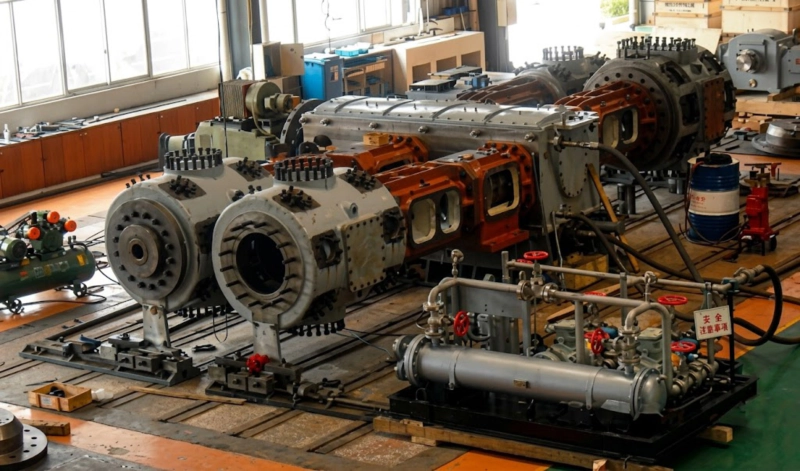
Factory acceptance test — every 4MW series unit undergoes a full API 618 mechanical run test including vibration measurement at all eight main bearings and four cross-head bearings, confirming the dynamic balance performance before shipment
Frequently Asked Questions — 4MW Series Gas Compressor
Q1: What makes the 4MW series fundamentally different from the DW two-column machines?
The DW series cancels primary inertia forces (forces at crankshaft frequency) by opposing two cylinder columns — but secondary forces (forces at twice crankshaft frequency) remain. The 4MW adds a second pair of opposed columns at 90 degrees to the first pair. The 90-degree angular offset means the secondary force of the first pair is 90 degrees out of phase with the secondary force of the second pair — and two equal sinusoidal forces at 90 degrees to each other sum to a constant, not a fluctuating force, which the crankshaft bearings can absorb without transmitting vibration. The practical result is that the 4MW transmits near-zero net dynamic force to the foundation at all running speeds, while the DW transmits a residual secondary force that grows with the square of the running speed.
Q2: Can the 4MW-230/25 be mounted on a standard industrial floor slab?
In many cases, yes — subject to a site-specific foundation analysis. A standard reinforced concrete industrial floor slab designed for 20–25 kN/m² point load capacity can typically support the 4MW-230/25 (machine weight 40 tonnes, distributed across the four-column base frame of approximately 8 m x 8 m footprint, giving a distributed load of roughly 6 kN/m²) without a dedicated inertia mass foundation block, because the near-zero dynamic force transmitted to the slab means that the dynamic amplification factor is close to 1.0 rather than the 3–5 typical for non-balanced machines. Our engineering team provides a foundation load specification sheet with the technical proposal for each model, which the client’s civil engineer can use to confirm slab suitability without a full dynamic analysis.
Q3: Why does the HW-400/4.5 have lower power (1,200 kW) than the HW-400/2.5 (1,400 kW) despite the higher discharge pressure?
At first glance this appears counterintuitive — higher discharge pressure should mean more compression work. However, the HW-400/2.5 is a single-stage machine: all four cylinder columns act as first-stage cylinders simultaneously, each handling 100 m³/min of gas at a near-atmospheric suction pressure. The volumetric flow at the cylinder inlet is very large, and the work required to compress this volume — even to the low pressure of 0.25 MPa — is substantial at 400 m³/min total. The HW-400/4.5 is a two-stage machine: the gas enters the LP cylinders at near-atmospheric, exits at about 0.20 MPa interstage, passes through the intercooler, and then enters the HP cylinders. The intercooler removes heat of compression, reducing the density and temperature entering the HP stage — which makes the HP compression step more efficient. The net effect, for these specific capacity and pressure combinations, is that the two-stage HW-400/4.5 achieves 0.45 MPa final discharge at lower total motor power than the single-stage HW-400/2.5 at 0.25 MPa discharge from the same 400 m³/min gas flow. This is an unusual result specific to the very low-pressure, very-high-flow operating point of these machines.
Q4: What ATEX group is required for the high-hydrogen chemical gas applications in the 4MW-80/25, 4MW-180/16, and 4MW-230/25?
It depends on the specific gas composition. For coal gas with hydrogen content above 25% by volume — which is typical of coke oven gas at 55–60% H₂ — ATEX Zone 1, Group IIC is mandatory for all electrical equipment. For coal gas or synthesis gas with hydrogen below 25% but containing hydrocarbons, ATEX IIB typically applies. For pure CO or blast furnace gas with very low hydrogen, ATEX IIA is sufficient. The hydrogen content is the primary determinant: IIC for H₂ above 25%, IIB for ethylene-group equivalents, IIA for propane-group equivalents. For the 4MW-230/25 handling coke oven gas or high-hydrogen reformed gas, ATEX IIC on all four cylinder columns, all four distance pieces, and the entire control panel and motor circuit is standard. Confirm the hydrogen percentage at enquiry so the correct ATEX classification is included in the specification from the start — changing ATEX group after order requires replacing all electrical equipment.
Q5: How long does the 4MW-230/25 take to deliver and what are the main lead-time items?
The 4MW-230/25 at 2,300 kW has a standard delivery period of 8–10 months from confirmed purchase order and signed-off technical data sheet. The main long-lead items are the four-throw crankshaft forging (the 90-degree four-throw geometry requires a dedicated forging die and an extended machining programme), the four large-bore cylinder forgings, and the 2,300 kW high-voltage motor with its dedicated switchgear and soft-starter. Smaller 4MW models — 4MW-80/25 through 4MW-150/40 — have shorter delivery periods of 6–8 months. For projects with fixed commissioning dates, our engineering team should be consulted at the enquiry stage; production schedule availability for the specific model is confirmed with the technical proposal.
Q6: What is the difference between the 4MW-85/40 for CO₂ and the 4MW-80/25 for chemical process gas?
The two models have very similar flow rates (85 and 80 m³/min) but different discharge pressures (4.00 and 2.50 MPa). The 4MW-85/40 is a two-stage machine specifically configured for CO₂ compression: oil-free PTFE piston rings as standard, 316L SS wetted parts for wet CO₂ option, and thermodynamic staging optimised for the specific heat ratio and molecular weight of CO₂. The 4MW-80/25 is a three-stage machine for flammable or industrial process gas at 2.50 MPa — ATEX-rated electrical equipment, materials selected per the specific gas composition, and distance piece with nitrogen purge for flammable or toxic gas. Despite similar footprints, they are not interchangeable: the cylinder bore sizes, staging, and all materials differ between the two machines. Specifying the gas type (CO₂ vs. process gas) and the discharge pressure is the primary selection decision.
Q7: What capacity control is available on 4MW series machines?
Three methods are available. Suction valve unloaders on one or two of the four cylinder columns provide step-wise capacity reduction at 25% increments — 100%, 75%, 50%, and 25% of full capacity by unloading 0, 1, 2, or 3 columns respectively. Variable frequency drive (VFD) on the 6 kV or 10 kV motor provides continuous modulation from approximately 50–100% with proportionally reduced power — the most energy-efficient option for variable-gas-supply applications. A combination of suction valve unloaders and VFD provides the widest overall turndown. For the largest models (4MW-180/16 and 4MW-230/25) at 1,800–2,300 kW, VFD with motor-rated soft-start is recommended: the starting current of a 2,300 kW motor without VFD on a 6 kV or 10 kV system can cause significant voltage dips in the local electrical network, and the VFD eliminates this by ramping motor speed smoothly from zero.
Q8: What maintenance does the 4MW series require and how does it compare to the DW series?
The 4MW series maintenance schedule per cylinder is essentially identical to the DW series: piston ring and packing inspection at 4,000–6,000 hours, replacement at 6,000–10,000 hours; gas valve inspection at 5,000 hours, replacement at 8,000–12,000 hours. The key difference is that the 4MW has four cylinder columns to maintain rather than two — so a complete ring and valve overhaul involves twice the number of cylinders compared to an equivalent two-column DW machine. However, the 4MW’s more uniform crankshaft loading means main bearing inspection intervals can be extended to 35,000–45,000 hours rather than 30,000–40,000 hours for the DW series. For operators planning planned maintenance shutdowns, the four-column layout means that one pair of opposing columns can be brought offline for maintenance while the machine continues running at 50% capacity on the remaining two columns — a feature unique to the multi-column design that minimises plant downtime during scheduled maintenance.
Q9: What GOST-R and Rostechnadzor documentation is provided for 4MW series units in Russia?
Every 4MW series unit delivered to Russia or EEU member states is supplied with the complete GOST-R documentation package as standard: GOST-R certificate of conformity, technical passport (tekhnicheskiy pasport) covering all design parameters, ratings, and materials for all four cylinder columns, pressure vessel certification for all interstage vessels and heat exchangers, ATEX Zone 1 certificates for all explosion-proof electrical equipment, factory acceptance test report including vibration measurements at all eight main bearings, and operating and maintenance instructions in Russian. Gas compression facilities handling flammable or toxic gas are classified as hazardous production facilities (OPO) under Federal Law 116-FZ and require Rostechnadzor registration before commissioning. The documentation package we provide is specifically structured to support this registration process. Documentation is dispatched 2–3 weeks before machine shipment to allow the registration process to begin in parallel with shipping and installation.
Q10: Are spare parts for the 4MW series available in Russia and what should be stocked on-site?
Yes. All consumable wear parts for the 4MW series — PTFE piston rings and packing (four sets per machine), gas valve elements and seats (eight cylinder positions), piston rod seals, O-rings, and gaskets — are manufactured in-house at our Russian production facility and stocked for all current 4MW models. Critical spare parts can be dispatched within 24–72 hours. For the four-column 4MW machine, we recommend on-site stock of: one complete set of piston rings and packing for all four cylinders; one complete set of gas valve elements for all eight cylinder positions (suction and discharge on each of four columns); and one set of critical gaskets and seals. This stock supports the machine through two to three ring-and-valve maintenance intervals without requiring procurement action during the critical early operating period. Major components — piston rods, cylinder liners, connecting rods — are available from production with 4–8 weeks lead time from our Russian facility.
Request a Technical Proposal
The 4MW series gas compressor represents the highest-performance reciprocating compressor configuration we manufacture — full primary and secondary balance, 800–2,300 kW, 80–400 m³/min, with API 618 and GOST-R certification as standard. Our engineering team has over 70 years of experience with large reciprocating compressors for city gas networks, coke chemical plants, CO₂ liquefaction facilities, and carbon capture installations across Russia and the CIS.
4MW Series Gas Compressor — Engineering Enquiry
Discuss Your Large Gas Compression or CCS Project
Process engineers with large-machine experience answer all enquiries. GOST-R and Rostechnadzor documentation included as standard. Response within 48 hours.
Request a Technical Quote
Include in Your Enquiry
✓ Complete gas composition
✓ Suction and discharge pressures
✓ Required flow rate (m³/min)
✓ Hazardous area zone and ATEX group
✓ Available voltage (6kV / 10kV)
✓ Foundation constraint or floor slab limit
✓ GOST-R / Rostechnadzor requirement
✓ Required delivery date