Selection Guide · ZW / DW / LW Series · N₂ / O₂ / Ar · Russia
Three reciprocating nitrogen compressor families cover 0.5 to 300 m³/h at discharge pressures from 5.0 to 30.0 MPa. The right series depends on flow rate, vibration requirement, discharge pressure, and whether the machine connects to rigid process pipework in a permanent installation. This guide explains what distinguishes each frame type and how to match the selection to your specific duty.
✓ DW Series · Opposed-Balance
✓ LW Series · Opposed-Balance
✓ N₂ / O₂ / Ar · GOST-R Certified
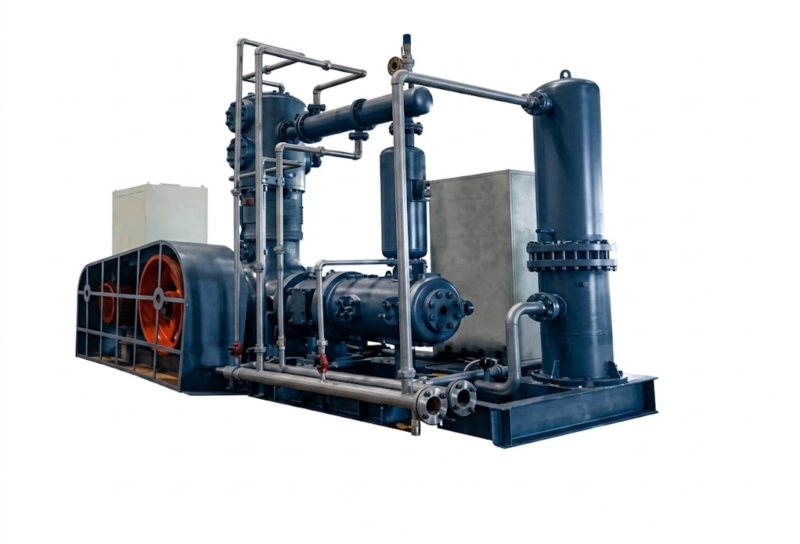
ZW, DW, and LW series nitrogen compressor selection — L-type and opposed-balance horizontal reciprocating frames for N₂, O₂, and Ar compression from 0.5 to 300 m³/h at pressures up to 30.0 MPa. GOST-R certified, manufactured in Russia.
What the Three Frame Types Mean
The ZW, DW, and LW designations refer to the mechanical frame architecture of the nitrogen compressor — specifically how the cylinder columns are arranged on the crankcase and how the primary inertia forces of the reciprocating pistons are managed. This is not a cosmetic difference. The frame type determines the vibration level transmitted to the foundation and connected pipework, the capacity range the machine covers economically, and the suitability of the nitrogen compressor for permanent installation in rigidly piped process plant environments.
All three series are horizontal reciprocating piston nitrogen compressors for N₂, O₂, and Ar compression from atmospheric suction to high-pressure discharge. They share the same oil-free cylinder option for oxygen service — PTFE piston rings and labyrinth distance piece satisfying GOST 12.2.052 — the same multi-stage inter-stage cooling arrangement, and the same GOST-R certification documentation package for Russian installations. What differs is the frame geometry, and that single difference drives most of the selection decision.
Technical Comparison — ZW vs DW vs LW Nitrogen Compressor
| Parameter | ZW Series | DW Series | LW Series |
|---|---|---|---|
| Frame type | L-type, 2-column | Opposed-balance | Opposed-balance |
| Vibration balance | Partial | Full — primary cancelled | Full — primary cancelled |
| Flow range (m³/h) | 0.5–30 | 10–100 | 30–300 |
| Motor power (kW) | 7.5–250 | 15–200 | 30–500 |
| Max discharge pressure | 30.0 MPa | 20.0 MPa | 30.0 MPa |
| O₂ oil-free option | ✓ PTFE | ✓ PTFE | ✓ PTFE |
| Suitable for rigid piped plant | With mounts | Yes | Yes |
| Capital cost | Lowest | Medium | Medium-high |
| GOST-R / O₂ certification | ✓ Standard | ✓ Standard | ✓ Standard |
| Delivery from Russia | 8–16 weeks | 10–16 weeks | 12–20 weeks |
All three nitrogen compressor series are manufactured in Russia with GOST-R certification and Russian-language documentation as standard. Oil-free PTFE cylinder option for oxygen service satisfies GOST 12.2.052 across all three series.
Why Vibration Balance Is the Primary Selection Factor
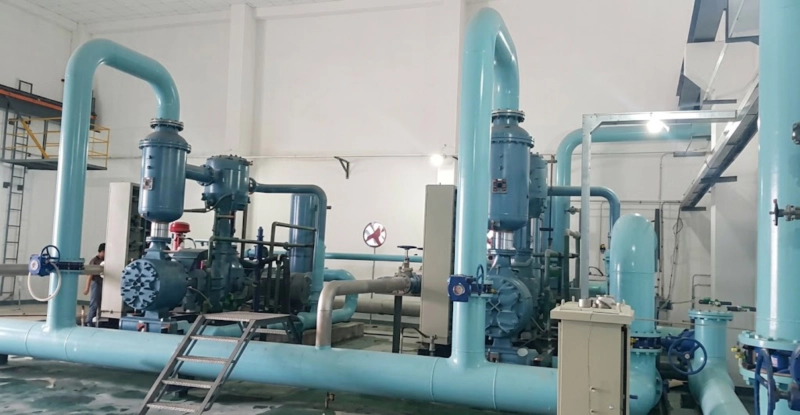
Reciprocating compressors of this type generate alternating inertia forces from the back-and-forth motion of their pistons and connecting rods. These forces transmit to the machine frame, to the foundation bolts, and — most critically — to the rigid steel pipework connected to the compressor suction and discharge nozzles. Over time, the alternating force at each pipe flange progressively fatigues the gasket face and bolted joint. In a nitrogen or oxygen pipeline operating continuously for 20–30 years, this fatigue accumulation is the primary cause of joint leakage. In oxygen service, a leaking flanged joint at pressure is a safety event governed by GOST 12.2.052, not merely a maintenance inconvenience.
The L-type ZW series nitrogen compressor partially cancels primary inertia forces because the vertical and horizontal cylinder components act in perpendicular directions. The reduction is real but incomplete — a residual alternating force remains, and in a permanently piped plant installation, this residual accumulates fatigue at every joint over the plant service life. The opposed-balance DW and LW series nitrogen compressors cancel primary inertia forces completely: the two horizontal pistons move in exactly opposite directions, and their inertia forces are equal and opposite at every crank angle. The net force at the foundation and connected pipework is near zero throughout the operating cycle.
In practical terms: for a standalone nitrogen cylinder filling station where the compressor connects to a flexible hose filling manifold, or for a laboratory gas supply with short rigid runs and anti-vibration mounts, the ZW series L-type vibration level is fully acceptable and is the most cost-effective choice. For a permanent installation at an air separation plant where the machine connects directly to the product header, the inter-stage separator vessel, and the high-pressure filling manifold by rigid welded steel pipework fixed to the building structure — and where that installation must run continuously for 25 years — the opposed-balance DW or LW series is the engineering specification. This is not a preference: it is the difference between pipework joints that require inspection every 3–5 years and joints that run maintenance-free for 15–20 years.
Four Questions to the Right Nitrogen Compressor Series
Typical Applications by Series
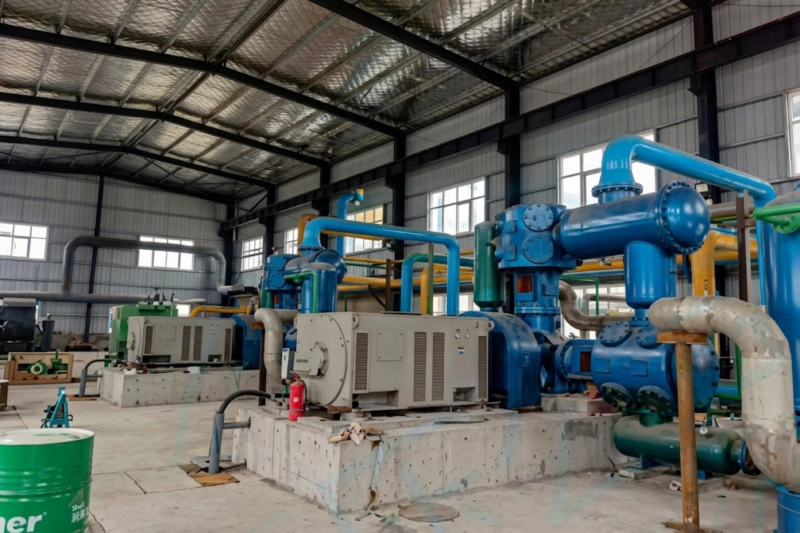
- Small air separation plant N₂ boost, 0.5–10 m³/h
- Laboratory nitrogen gas supply
- Small medical oxygen cylinder filling (1–6 m³/h)
- Electronics plant low-flow nitrogen
- Portable or semi-portable nitrogen supply
- High-pressure N₂ to 30 MPa at small flow (4-stage)
- Medium air separation plant N₂ product boost (10–100 m³/h)
- Chemical plant nitrogen blanketing and purging
- Regional medical oxygen filling (20–50 m³/h)
- Medium nitrogen cylinder filling to 20 MPa
- Permanent installation requiring opposed-balance below LW capacity
- Electronics and pharmaceutical plant nitrogen inert atmosphere
- Large air separation plant N₂ and O₂ product compression (30–300 m³/h)
- Large medical oxygen supply centre (60–150 m³/h)
- Large chemical plant nitrogen supply, continuous duty
- High-volume nitrogen cylinder filling (100–200 m³/h, 30 MPa)
- Any duty requiring 24/7 operation in a rigidly piped plant over 20–30 years
Nitrogen Compressor in PET Bottle Production Facilities
Injection stretch blow moulding (ISBM) machine lines producing PET bottles and preforms require both high-pressure compressed air (up to 4.0 MPa for blow moulding) and a reliable nitrogen supply for two distinct purposes: nitrogen purging of the mould cooling circuit to prevent moisture condensation in humid environments, and nitrogen blanketing of the preform hopper and material storage areas to prevent hygroscopic degradation of PET resin before processing. In facilities running multiple ISBM lines continuously, the nitrogen supply system typically uses a small to medium ZW or DW series nitrogen compressor — often in the 5–30 m³/h range at 0.5–1.0 MPa — to maintain the blanketing pressure across all connected points without the logistics cost of delivered liquid nitrogen or high-pressure cylinder supply.
For facilities evaluating both the ISBM production equipment and the supporting nitrogen supply system, the ZW series nitrogen compressor at 5–15 m³/h covers the nitrogen demand of a typical multi-station one-step ISBM line, with the option to add a second compressor unit in parallel as the production line count grows. The low capital cost and compact footprint of the ZW series are well matched to the space constraints of plastics manufacturing plants where floor space is prioritised for production equipment.
Decision Matrix
| Project type | ZW | DW | LW |
|---|---|---|---|
| Small N₂ / O₂ cylinder filling, below 10 m³/h | Best | Oversized | Oversized |
| Medium capacity, flexible hose connections, 10–50 m³/h | Suitable | Suitable | Oversized |
| Medium capacity, rigid piped process plant, 10–100 m³/h | Acceptable | Best | Oversized |
| Large air separation plant product compression, 30–300 m³/h | Undersized | Upper limit | Best |
| Large medical O₂ filling, 60–150 m³/h, oil-free | Undersized | Upper limit | Best |
| 30 MPa N₂ cylinder filling, any capacity | Yes (4-stage) | Max 20 MPa | Yes (4-stage) |
| Chemical plant N₂ blanketing, continuous, rigid piped | With mounts | Best (10–100) | Best (above 100) |
Request a Nitrogen Compressor Series Recommendation
Our engineering team supplies ZW, DW, and LW series compressors to air separation plant operators, medical gas distributors, industrial gas filling stations, and chemical facilities across Russia and the CIS. GOST-R certified; oil-free PTFE cylinders for oxygen service; opposed-balance frames for permanent plant installations. Spare parts stocked in Russia for 24–72 hour dispatch across all three series.
Get a Series Recommendation and Quotation
Send our team your required flow rate, discharge pressure, gas type (N₂ / O₂ / Ar), and whether the installation connects to rigid or flexible pipework. We return a series recommendation and preliminary quotation within 48 hours.