The Wort Cooling Heat Load and Why It Dominates Brewery Refrigeration Sizing
A 100-hectolitre brew produces approximately 10,000 litres of wort at +98°C. Cooling this wort to +10°C requires removing approximately 910 MJ of heat (using the specific heat of wort at approximately 3.9 kJ/kg·K and a density of approximately 1,045 kg/m³). If this heat must be removed in 60 minutes, the instantaneous cooling rate required is:
Q = 910 MJ ÷ 3,600 s = 253 kW instantaneous heat removal for a 100 hl brew cooled in 60 minutes
This 253 kW wort cooling load is in addition to the simultaneous fermentation and conditioning tank loads running in the background. A Russian brewery producing four 100 hl brews per day requires 253 kW of refrigerating capacity available for wort cooling for approximately 4 × 60 minutes out of every 24 hours — but these peaks typically overlap with fermentation loads and must be served by the same ammonia compressor system. The wort cooling peak load is the dominant driver of compressor sizing at small to medium Russian breweries, typically exceeding the fermentation and conditioning base load by a factor of 2–3 during the cooling event.
This heat load calculation reveals why wort cooling system design is inseparable from ammonia compressor sizing: the choice of cooling system determines the evaporating temperature at which the ammonia compressor must provide the 253 kW of refrigerating capacity, which in turn determines the compression ratio and the shaft power required. An indirect glycol PHE system and a direct ammonia expansion wort cooler each require a different evaporating temperature to achieve the same wort outlet temperature — and the difference in evaporating temperature translates directly into a difference in compressor COP, shaft power, and capital cost.
System 1: Plate Heat Exchanger with Chilled Glycol — How It Works and When to Choose It
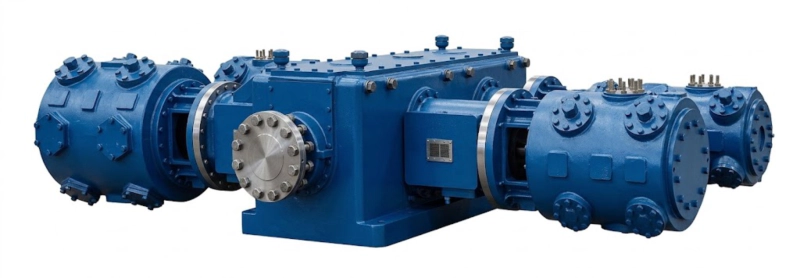
In the indirect glycol PHE system, the ammonia compressor does not directly cool the wort. Instead, the ammonia system chills a propylene glycol solution in a dedicated glycol chiller to −4°C to −6°C, and the chilled glycol is then pumped through a plate heat exchanger in the brewhouse where it cools the wort on the opposite side of the plates. The wort and glycol flow in counterflow — the hottest wort meets the coldest glycol at the wort outlet end — achieving a glycol-to-wort approach temperature of 2–4°C at the outlet. To cool wort to +10°C using glycol at −4°C, the ammonia system must maintain the glycol chiller evaporating temperature at approximately −8°C to −10°C.
✓
Advantages for small Russian breweries (below 500,000 hl/year): The glycol PHE system decouples the wort cooling event from the ammonia system operating conditions. The glycol buffer vessel (typically 5,000–15,000 litres) absorbs the peak wort cooling demand by discharging chilled glycol accumulated during the inter-brew interval, allowing the ammonia compressor to run at a steady load rather than surging to meet the 250–500 kW wort cooling peak. The glycol buffer also means the ammonia compressor sizing is based on the average glycol chilling rate rather than the peak wort cooling rate — potentially reducing the ammonia compressor size by 40–60%. Additionally, propylene glycol is a food-safe refrigerant approved under TR CU 021/2011 for contact with food equipment, and a glycol leak in the wort cooling PHE is a minor quality incident rather than an ammonia safety event.
×
Disadvantages: The indirect glycol system imposes two temperature penalties compared with direct ammonia cooling: the glycol-to-wort approach temperature (2–4°C) and the ammonia-to-glycol approach temperature in the glycol chiller (another 3–5°C). These combined penalties require the ammonia evaporating temperature to be 5–9°C lower than the target wort temperature, producing a higher compression ratio and lower COP than a direct system achieving the same wort outlet temperature. At higher production scales where this energy penalty compounds over 300–400 brew cycles per year, the energy cost difference becomes significant. The glycol buffer vessel, glycol pumps, and the secondary PHE also add capital cost and maintenance points that a direct system eliminates.
System 2: Ammonia Direct Expansion Wort Cooling — Higher Efficiency, Greater Complexity
In the ammonia direct expansion (DX) wort cooling system, liquid ammonia is fed directly to the evaporator plates of the wort cooling PHE. The ammonia evaporates on one side of the plates while the wort flows on the other side, with no intermediate glycol circuit. The evaporating temperature of the ammonia in the PHE is set 3–5°C below the target wort outlet temperature — for a +10°C wort outlet, the ammonia evaporating temperature is −2°C to +5°C, compared with −8°C to −10°C for the indirect glycol system. This 6–15°C improvement in evaporating temperature produces a substantially higher ammonia COP at the same condensing conditions.
| Parameter |
Indirect PHE (Glycol) |
Direct DX (NH₃) |
| Wort target temperature |
+10°C |
+10°C |
| NH₃ evaporating temperature |
−8°C to −10°C |
−2°C to +5°C |
| COP at +35°C condensing |
≈ 4.0–4.5 |
≈ 5.5–6.5 |
| Shaft power for 250 kW cooling |
55–63 kW |
38–45 kW |
| NH₃ in food processing area |
No (glycol boundary) |
Yes (PHE contains NH₃) |
| Compressor size for 250 kW peak |
Buffer reduces by 40–60% |
Full 250 kW required |
| TR CU 021 food safety risk |
Low (glycol leak is minor) |
Higher (NH₃ leak = safety event) |
Values are indicative for a 100 hl brewery with 60-minute wort cooling and +35°C summer condensing temperature. Site-specific calculations are required for each installation.
Ammonia Compressor Sizing for Russian Brewery Wort Cooling Duty
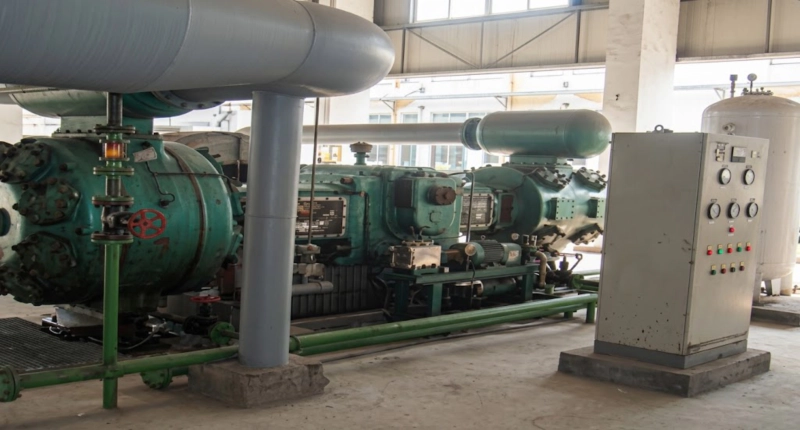
The ammonia compressor sizing for Russian brewery wort cooling follows a different approach for the indirect glycol system versus the direct expansion system, because the presence of the glycol buffer decouples the compressor duty from the wort cooling peak in the indirect system.
Indirect PHE System — Compressor Sized for Glycol Chiller Average Demand
For a brewery with a daily wort volume of 400 hl (four 100 hl brews) and a total wort cooling energy of 3,640 MJ per day, the ammonia compressor must supply this energy over the full 24-hour period rather than only during the 4 × 60 minutes of actual wort cooling. If the compressor charges the glycol buffer during the 20 hours when wort cooling is not occurring:
Average glycol chilling rate = 3,640 MJ ÷ (24 × 3,600 s) = 42.1 kW of refrigerating capacity at −8°C to −10°C evaporating. A DW series 55 kW shaft power machine operating at −8°C evaporating and +35°C condensing produces approximately 220–240 kW of refrigerating capacity — significantly more than the 42 kW average need. This size mismatch means the compressor runs intermittently at low duty cycle, suggesting that a smaller ZW series machine may be more appropriate for the glycol buffer system at this scale.
Direct DX System — Compressor Sized for Peak Wort Cooling Rate
For the same 100 hl per brew brewery using direct ammonia expansion, the compressor must deliver 253 kW of refrigerating capacity during the 60-minute wort cooling event. At −2°C to +5°C evaporating and +35°C condensing, a DW series machine at this refrigerating capacity requires approximately 38–45 kW shaft power. A DW-55 kW machine (the smallest standard DW frame) provides approximately 300–350 kW of refrigerating capacity at −2°C evaporating — adequate for the 253 kW wort cooling peak with margin. During the 23 hours per day when wort cooling is not occurring, this machine would run at approximately 20–30% load serving the fermentation and conditioning tank base loads, which is within the acceptable range for suction valve unloaded operation.
At larger brewery scales above 2 million hl per year with multiple simultaneous brew streams, a 4MW series machine or multiple DW machines in N+1 arrangement is required. The 4MW series provides the higher shaft power range (350–1,600 kW) needed for the compounded wort cooling and fermentation/conditioning loads at this scale.
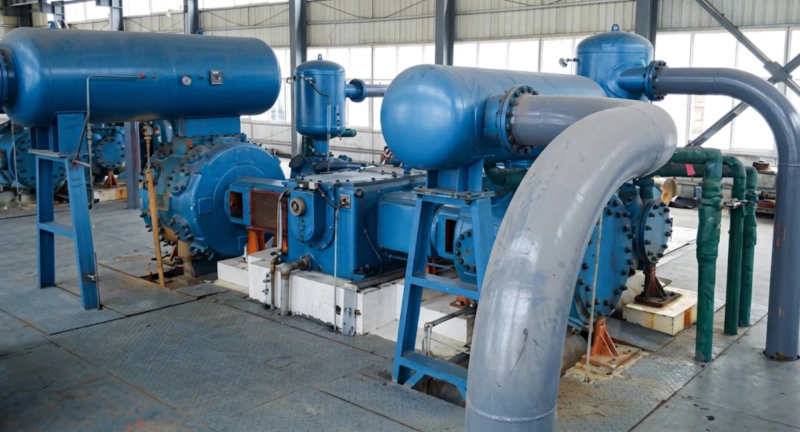
Food Safety Compliance Under TR CU 021/2011 and GOST R 52968
Russian food safety requirements under TR CU 021/2011 and GOST R 52968 impose specific constraints on the use of ammonia refrigeration in breweries that directly affect the wort cooling system design decision. Three requirements dominate the compliance picture:
A
Ammonia must not come into direct contact with food or food contact surfaces. TR CU 021/2011 prohibits ammonia as a food contact refrigerant. This requirement is fully satisfied by the indirect glycol PHE system, where a food-safe propylene glycol solution is the only fluid in contact with the PHE plates that touch the wort. For the direct DX system, the ammonia flows inside the PHE plates and the wort flows on the outside — separated by stainless steel plates. Provided the PHE plate integrity is maintained and there is no pinhole corrosion or seal failure, there is no ammonia contact with the wort. However, a plate failure in a direct DX wort cooler would result in ammonia entering the wort batch — requiring disposal of the entire batch and a reportable food safety incident under the brewery’s HACCP plan. This risk is the principal reason that Russian brewery engineers and food safety auditors prefer the indirect glycol system for wort cooling at all but the largest production scales.
B
Ammonia leak detection in food processing areas. Where ammonia pipework passes within 5 metres of an open food processing area (including the brewhouse), continuous ammonia detection with alarm at 20 mg/m³ and automatic ventilation activation at 60 mg/m³ is required. For a direct DX system where ammonia pipework runs to the wort cooling PHE in the brewhouse, this detection system must cover the brewhouse as a food processing area — an additional capital and maintenance cost that the indirect glycol system avoids entirely, since the ammonia boundary is terminated at the glycol chiller in the compressor room.
C
HACCP critical control point documentation for wort cooling. GOST R 52968 requires that wort cooling is identified as a critical control point (CCP) in the brewery’s HACCP plan, with monitoring of the wort outlet temperature at the PHE exit. The monitoring requirement is the same for both indirect and direct systems — a calibrated temperature sensor and data logger on the wort outlet, with corrective actions defined for the scenario where the wort outlet temperature exceeds the target. The direct DX system adds an additional monitoring requirement: the ammonia side pressure must be monitored in the wort cooling PHE to detect plate failure before ammonia reaches the wort at detectable concentrations.
Related Application · Plastics Manufacturing
Beer PET Bottles and the Wort Cooling Connection
Russian breweries that cool their wort effectively — reaching pitching temperature within the 45–90 minute target window — produce beer with more consistent fermentation profiles and lower wild yeast contamination risk than breweries whose wort cooling systems are undersized or poorly designed. This consistency in fermentation directly affects the carbonation level and dissolved oxygen content of the finished beer — the two quality parameters that most strongly influence the shelf life performance of beer packaged in PET bottles. A Russian brewery that packages beer in PET bottles produced on an ISBM machine is critically dependent on the wort cooling system’s ability to deliver consistently low dissolved oxygen levels: oxygen pickup during wort cooling and fermentation is the primary source of the staling reactions that limit PET beer shelf life to 3–6 months. An ammonia refrigeration compressor that maintains wort cooling rates within the target window, beer after beer, is therefore directly linked to the quality and shelf life of the PET-packaged product that the ISBM machine produces. The wort cooling system and the ISBM bottle blowing system are both parts of the same product quality chain.
FAQ — Wort Cooling and Ammonia Compressor Selection
Q1: We are designing a new Russian craft brewery at 20,000 hl per year with one brew per day of 80 hl. Should we use a glycol PHE or direct ammonia wort cooling, and what compressor size do we need?
At 20,000 hl per year and one 80 hl brew per day, the indirect glycol PHE system is the correct specification for four reasons. First, the food safety profile is better for a small operation without a dedicated refrigeration engineer to manage direct ammonia pipework in the brewhouse. Second, the glycol buffer allows a smaller compressor — the 80 hl wort cooling heat load is approximately 728 MJ, requiring 202 kW of instantaneous refrigerating capacity in 60 minutes but only 8.4 kW of average daily cooling capacity from the compressor over 24 hours. A ZW series machine at 22 kW shaft power providing 50–60 kW of refrigerating capacity at −8°C evaporating adequately charges the glycol buffer while also serving the fermentation and conditioning base loads at this small scale. Third, the capital cost of a ZW series machine plus a glycol buffer vessel is lower than a DW series machine sized for the 202 kW direct peak. Fourth, craft brewery production schedules are highly variable and a glycol buffer accommodates this variability better than a direct system sized for one specific brew cycle time. The total ammonia charge at this scale will be below 500 kg, keeping the installation below the OPO Category III threshold and simplifying the regulatory compliance requirements.
Q2: Our existing Russian brewery uses a glycol PHE for wort cooling and we consistently fail to reach pitching temperature within 90 minutes during summer. The glycol buffer is depleted before the brew is cooled. How do we solve this without replacing the whole system?
Glycol buffer depletion before the wort reaches pitching temperature during summer is caused by one or more of three conditions: the glycol buffer volume is undersized relative to the wort volume and target cooling time; the glycol supply temperature is too warm in summer because the ammonia compressor cannot maintain the glycol chiller evaporating temperature against the higher summer condensing pressure; or the PHE wort cooler is fouled and its heat transfer coefficient has degraded. Diagnosis begins with measuring the glycol supply temperature at the PHE inlet during the problematic summer brew: if it is above −2°C at the start of the wort cooling cycle, the buffer is being depleted at a higher rate than anticipated because the glycol is warmer than design. Check the ammonia compressor discharge pressure during summer peak ambient — if the condensing pressure is at or above the compressor’s rated maximum, the compressor cannot maintain the glycol chiller setpoint and the glycol warms. Solutions in order of cost: (1) Increase the glycol buffer volume to extend the buffer discharge time without requiring compressor changes — the cheapest fix if the glycol supply temperature is correct but the buffer runs out before the brew is complete. (2) Add a condenser fan or increase condenser water flow to reduce the summer condensing pressure and restore the compressor’s glycol chilling capacity — often the root cause of summer wort cooling failures at Russian breweries. (3) Clean the PHE wort cooler — CIP the wort side and backflush the glycol side to restore the design heat transfer coefficient. These three measures address the three failure modes in order of likelihood and cost before considering a compressor upgrade.
Q3: We plan to expand our Russian brewery from 500,000 hl to 2 million hl within three years. Our current indirect glycol wort cooling system uses a DW-75 kW compressor. Should we plan to switch to direct ammonia expansion at the expanded scale, or upgrade the indirect glycol system?
At 2 million hl per year with a typical brewhouse of 600–800 hl per brew and 5–6 brews per day, the wort cooling energy per day reaches 50,000–60,000 MJ, requiring an average glycol chilling rate of approximately 600–700 kW from the ammonia compressor. At this scale, the energy penalty from the indirect glycol system’s lower evaporating temperature (−8°C to −10°C versus 0°C for direct DX) amounts to approximately 80–100 kW of additional shaft power running 300 days per year — approximately 220,000–260,000 kWh per year of additional electricity consumption compared with a direct DX system. At a Russian industrial electricity tariff of 5–8 roubles per kWh this is 1.1–2.1 million roubles per year of additional energy cost for the indirect system. The capital cost difference between upgrading the indirect glycol system (larger glycol buffer, additional glycol pumps, larger DW machines) versus switching to direct ammonia DX (replacing the glycol PHE with a direct ammonia PHE, extending the ammonia pipework into the brewhouse, adding brewhouse ammonia detection) must be weighed against this annual energy saving. At 2 million hl scale the economics typically favour a hybrid approach: retain the indirect glycol system for the first wort cooling stage (from +98°C to +20°C using tap water or cooling tower water, which requires no ammonia), and switch to direct ammonia DX only for the second stage (from +20°C to pitching temperature), where the high COP of direct DX at the near-zero evaporating temperature provides maximum energy benefit with minimum ammonia charge in the brewhouse.
Brewery Ammonia Compressors
ZW, DW and 4MW Series NH₃ Compressors for Russian Brewery Wort Cooling
ZW series (2–75 kW) for craft and small-scale indirect glycol brewery systems. DW series (55–350 kW) for medium breweries up to 2 million hl. 4MW series (350–1,600 kW) for large-scale direct ammonia wort cooling systems. Provide your annual production volume, brew size, target wort cooling time, cooling system type (indirect or direct), and summer design ambient temperature for a complete compressor specification and sizing calculation within 48 hours.