Compliance Guide · CE Marking · GOST-R · EAC · Rostechnadzor · Russia
A significant number of industrial compressor procurement errors in Russia arise from a single misunderstanding: assuming that a CE mark provides legal authorisation to operate equipment at a Russian industrial facility. It does not. CE marking and Russian GOST-R or EAC certification are completely separate conformity systems with no mutual recognition. A compressor bearing a CE mark but lacking GOST-R or EAC certification cannot be legally imported for permanent installation, registered with Rostechnadzor, or put into service at a Russian hazardous production facility. This article explains exactly why, and what documentation is actually required.
✓ CE vs GOST-R vs EAC
✓ Rostechnadzor Requirements
✓ Import Clearance
✓ Required Documentation

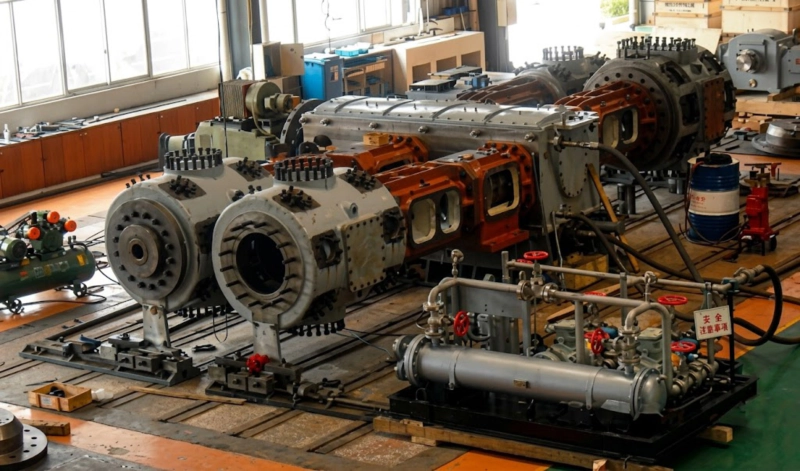
Industrial compressors undergoing final quality inspection before dispatch to Russia — every unit must carry a valid GOST-R certificate and EAC mark before it can be cleared through Russian customs for permanent installation. A CE mark on the nameplate is irrelevant to Rostechnadzor registration and does not substitute for any element of the Russian or EAEU certification requirement. Procurement engineers who specify CE-only equipment for Russian sites discover this problem at the customs border, not at commissioning — by which point the project delay and cost consequences are severe.
What CE Marking Actually Means — and What It Does Not
CE marking is a declaration by the manufacturer that the product meets the requirements of the applicable EU Directives — the Machinery Directive, the Pressure Equipment Directive, the ATEX Directive, and others depending on the product category. Affixing the CE mark to a product allows it to be placed on the market and put into service within the European Economic Area. The mark is not a certification issued by an independent third party in most cases — it is a self-declaration by the manufacturer, backed by a technical file and, for higher-risk products, a notified body assessment.
CE marking has no legal standing outside the European Economic Area. Russia is not a member of the European Economic Area and has not entered into any mutual recognition agreement with the EU for pressure equipment or machinery certification. A CE mark on an industrial compressor nameplate communicates nothing to a Russian customs inspector, nothing to a Rostechnadzor inspector, and nothing to the Russian court that would hear a liability claim following an industrial accident. It is a mark for the European market, applied by European rules, recognised by European authorities — and irrelevant in Russia.
Practical Consequence
Russian customs will not clear industrial pressure equipment for permanent import without documentation of EAEU EAC certification. A compressor arriving at a Russian port with CE marking and no EAC certificate will be held at customs pending either production of the correct certification or re-export of the equipment. Project delays of 3–12 months are common when this error is made. The equipment cannot be used on a temporary import basis for permanent installation; temporary import regimes in Russia do not cover hazardous industrial equipment intended for permanent operation.
The Three Certification Layers Russia Requires
Unlike the European CE system — which is a single self-declaration covering all EU member states — the Russian and EAEU framework for industrial pressure equipment operates at three distinct levels, each with a different issuing authority, scope, and legal consequence:
Layer 1
GOST-R Certificate of Conformity — Russian Type Approval
Issued by an accredited Russian certification body on the basis of type testing of the compressor model against applicable GOST standards (GOST 23941 for general compressor safety, GOST 12.2.052 for oxygen service, GOST 26790 for ammonia, and others). The GOST-R certificate is a type certificate covering all units of the specified model produced to the same design. It is required for all industrial compressors sold in Russia and is the first document a procurement engineer should request from a supplier before placing an order. Without a valid GOST-R certificate, the equipment cannot legally be sold in Russia.
Layer 2
EAC Certificate — Eurasian Conformity Mark
The EAC mark (Eurasian Conformity) applies across the Eurasian Economic Area — Russia, Belarus, Kazakhstan, Armenia, and Kyrgyzstan. For pressure equipment above the thresholds defined in Technical Regulation TR EAEU 032/2013, an EAC certificate of conformity from an accredited EAEU certification body is required in addition to the GOST-R certificate. The EAC certificate allows free movement of the certified product across all EAEU member states without additional national certifications. For compressors exported from China for installation in Russia, EAC certification is obtained through an accredited body in any EAEU member state; the certificate is then valid across all five states.
Layer 3
Rostechnadzor Registration — Individual Unit at Site
Even after GOST-R and EAC certification, each individual compressor unit above the Rostechnadzor pressure and power thresholds must be registered with the local Rostechnadzor territorial office before it can be placed into service at the specific Russian site. Registration requires the unit passport, GOST-R and EAC certificates, the commissioning protocol signed by a licensed engineer, and the site’s classification as a hazardous production facility (OPO) under Federal Law 116-FZ. Rostechnadzor registration is unit-specific and site-specific — a registered compressor cannot simply be moved to another site without a new registration at the new location.
Side-by-Side Comparison: CE vs GOST-R vs EAC
| Factor |
CE Mark |
GOST-R Certificate |
EAC Certificate |
| Issuing territory |
European Economic Area |
Russia only |
All 5 EAEU states |
| Issuing authority |
Manufacturer self-declaration (or notified body) |
Accredited Russian certification body |
Accredited EAEU certification body |
| Valid in Russia? |
No |
Yes |
Yes |
| Customs clearance |
Insufficient |
Required |
Required |
| Rostechnadzor registration |
Not supported |
Required basis |
Required basis |
| Documentation language |
EU language(s) |
Russian mandatory |
Russian mandatory |
| Validity period |
Indefinite (while design unchanged) |
3 years (with annual audit) |
3–5 years |
A compressor with both GOST-R and EAC certification satisfies all three layers when combined with the individual unit passport and Rostechnadzor site registration. A compressor with CE marking only satisfies none of them.
Common Procurement Errors and Their Consequences
1
Ordering CE-only equipment from a European supplier without requesting EAC certification: The European supplier may not offer EAC certification as a standard option — they may be unaware of the EAEU requirement, or they may offer it only as a paid extra that must be explicitly requested in the purchase order. The equipment arrives at a Russian port without EAC documentation and cannot be cleared. Resolution typically requires commissioning a Russian certification body to conduct a product assessment on the held equipment — a process that takes 2–6 months and costs 5–15% of the equipment value in testing and certification fees.
2
Accepting an expired GOST-R certificate from a supplier: GOST-R certificates are valid for 3 years; EAC certificates for 3–5 years. A supplier presenting a certificate that expired two years ago is presenting worthless documentation. The procurement engineer must check the certificate validity date against the date of the order and verify that the annual surveillance audit endorsements are present on the certificate. Rostechnadzor will not accept a registration application supported by an expired certificate.
3
Receiving certification documents in English or Chinese only: All documentation presented to Russian customs and to Rostechnadzor must be in Russian language. A GOST-R document is by definition in Russian; an EAC certificate is also issued in Russian. The equipment passport (pasport), operating manual, and spare parts catalogue must also be in Russian. A supplier who delivers equipment with documentation only in English or Chinese has not met their contractual obligations for Russian market supply, regardless of whether the underlying certification is valid.
4
Assuming that a GOST-R certificate for the series covers the specific gas service: A GOST-R certificate issued for a DW series nitrogen compressor does not cover the same model in oxygen service — oxygen service requires a separate certification explicitly referencing GOST 12.2.052. Similarly, ammonia service requires certification referencing GOST 26790. The gas service designation must appear on the certificate and must match the intended use. A certificate that does not specify the gas service, or that specifies a different gas service, does not provide the legal basis for Rostechnadzor registration of the unit in its intended oxygen or ammonia application.
Related Application · Plastics Manufacturing
ISBM Machine Certification for Russia: The Same CE vs EAC Problem
Injection stretch blow moulding (ISBM) machines exported from China or Europe to Russia face exactly the same certification challenge as industrial compressors. A CE-marked ISBM machine from a European manufacturer — or an ISBM machine from a Chinese manufacturer with no certification at all — cannot be legally placed into service at a Russian PET bottle production facility without EAC certification under TR EAEU 010/2011 (the machinery safety technical regulation) and, where the machine incorporates pressure equipment above the defined thresholds, under TR EAEU 032/2013 as well. The documentation set required for an ISBM machine — Russian-language technical documentation, risk assessment, EAC certificate, and unit-specific passport — mirrors the requirement for industrial compressors. Buyers of ISBM machines for Russian installation who do not explicitly specify EAC certification in their purchase contract face the same customs clearance problem that compressor buyers encounter: the machine is held at the border, the production line start-up is delayed, and the cost of retrospective certification is added to the project.
Related equipment: One-step three-station ISBM machines for PET bottle production — requiring EAC certification for legal operation in Russia, the same framework as GOST-R and EAC certified industrial compressors.
ISBM Machine ›injectionstretchblowmolding.com
FAQ — CE Marking, GOST-R, and Rostechnadzor
Q1: Can CE marking documentation be used as supporting evidence for a Russian EAC application?
The technical documentation produced for CE marking — risk assessments, test reports, technical files, notified body opinions — can be submitted as supporting technical evidence to an EAEU accredited certification body conducting the EAC assessment. The EAEU certification body may review and accept some of this documentation as partial evidence that the product meets relevant technical requirements, reducing the extent of independent testing required for the EAC certificate. However, this is at the certification body’s discretion and does not guarantee that the CE documentation will substitute for any specific EAEU test requirement. The CE documentation does not reduce the need for an EAC mark — it may reduce the time and cost of obtaining one if the product has been well-documented for the EU market.
Q2: What is the fastest way to obtain EAC certification for a compressor already purchased without it?
For equipment already purchased without EAC certification and held at the Russian border or at a bonded warehouse, the fastest route is to engage an accredited EAEU certification body (in Russia, Kazakhstan, or Belarus — whichever is closest to the equipment’s current location) to conduct an expedited product assessment. This typically involves a documentary review of the technical file plus an on-site inspection of the held equipment by a body expert. If the product can be shown to meet the applicable EAEU technical regulation requirements through this assessment, a certificate is issued — typical timeline 6–12 weeks for an expedited assessment, 12–24 weeks for standard. The equipment remains in bonded storage throughout this period. For compressors from established manufacturers with existing GOST-R certification in Russia, the supplier’s existing certificate covers the model — the issue is typically a document missing from the shipment rather than absent certification, which can be resolved by the supplier sending the certificate copy and the unit passport directly to the customs broker within days.
Q3: Does a compressor already operating at a Russian site without Rostechnadzor registration need to be shut down?
A compressor operating at a Russian hazardous production facility without Rostechnadzor registration is in violation of Federal Law 116-FZ and the associated Technical Regulations. If discovered during a Rostechnadzor inspection — which occurs periodically at all registered hazardous production facilities and can occur unannounced following an incident — the inspector can order immediate shutdown of the unregistered equipment and impose administrative penalties on the facility operator and the responsible individuals. The path to regularisation is to obtain the required GOST-R and EAC certification for the equipment (retroactively, if the model has never been certified, or by obtaining missing documents from the supplier if the model is certified) and then apply for Rostechnadzor registration with the full documentation set. Operating unregistered equipment is not a technical infringement that can be overlooked — it is a legal liability for the facility and its management that grows with every day of continued unregistered operation.
Full Compliance Package
GOST-R and EAC Certified Compressors for Russia — Complete Documentation Set
All ZW, DW, LW, and 4MW series compressors are supplied with valid GOST-R and EAC certificates, Russian-language equipment passport, operating manual, spare parts catalogue, material certificates, and factory acceptance test record. Rostechnadzor registration support available. No missing documents, no customs delays. Response within 48 hours.