Selection Guide · Reciprocating vs Screw · Nitrogen Pipeline · Industrial Gas · Russia
The choice between a reciprocating compressor and a screw compressor for nitrogen pipeline supply is one of the most common equipment selection questions in Russian industrial gas engineering. At first glance both types compress nitrogen — but their efficiency profiles, pressure capabilities, gas purity characteristics, and total cost of ownership diverge significantly depending on the flow rate, discharge pressure, and duty cycle of the specific installation. This guide explains where each technology leads and where each falls short, so the selection can be made on engineering merit rather than habit.
✓ Pressure Range
✓ Gas Purity
✓ Total Cost of Ownership
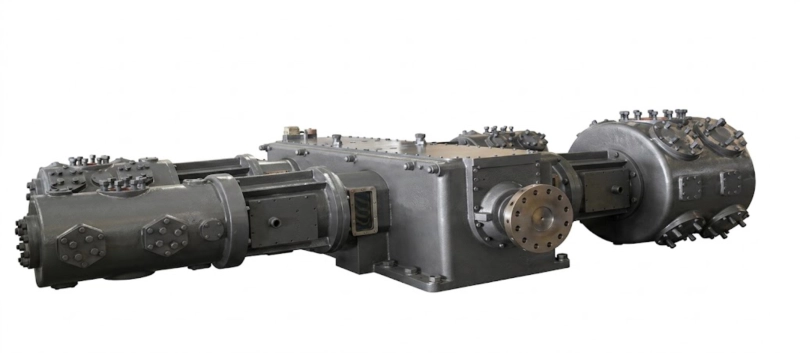
DW series reciprocating nitrogen compressor in permanent pipeline supply service — the opposed-balance frame eliminates primary vibration forces, making it the correct specification for rigidly-piped industrial nitrogen distribution systems above 55 kW. The reciprocating compressor’s efficiency advantage over screw technology becomes decisive above 1.0 MPa discharge pressure and grows further as pressure rises toward 10–30 MPa cylinder filling duties.
How the Two Technologies Compress Nitrogen Differently
A reciprocating compressor traps a fixed volume of nitrogen in a cylinder, then mechanically reduces that volume by advancing a piston — the gas pressure rises as the volume falls. Compression is intermittent and staged: each piston stroke delivers one cylinder volume of compressed gas to the discharge system, and multiple stages are arranged in series to reach high pressures efficiently. A screw compressor, by contrast, draws nitrogen continuously between two intermeshing helical rotors and progressively reduces the inter-rotor volume as gas travels along the rotor length — compression is continuous and effectively single-stage in each casing.
This mechanical difference directly determines the pressure, flow, and efficiency characteristics of each type. The reciprocating compressor’s staged cylinder architecture allows it to reach any discharge pressure by adding stages — from 0.5 MPa in a single stage to 30 MPa in four stages — while maintaining high thermodynamic efficiency at each stage through inter-stage cooling. The screw compressor’s single-stage rotor geometry limits its practical pressure ratio to approximately 4:1 to 8:1 per stage, restricting it to discharge pressures below 1.5–2.5 MPa in a single casing without significant efficiency loss.
Efficiency: Where Each Technology Wins
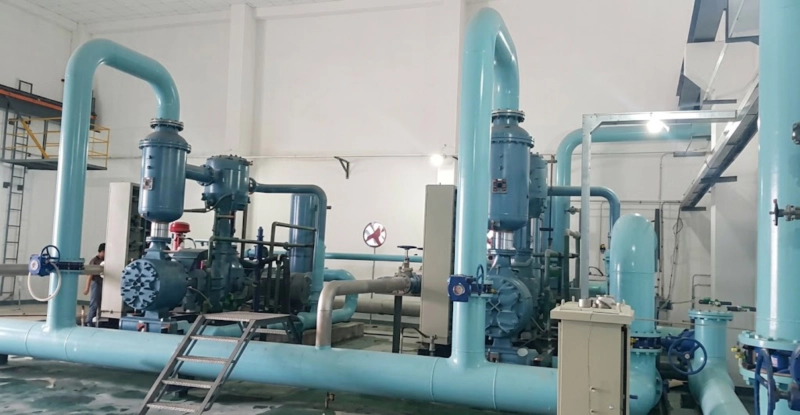
At discharge pressures below 0.8–1.0 MPa (8–10 bar), a flooded screw compressor — where oil injected into the rotor cavity provides sealing, cooling, and lubrication simultaneously — is competitive with a reciprocating compressor on specific energy consumption (kWh per Nm³ of nitrogen delivered). The oil injection allows the screw to achieve near-isothermal compression in a single stage, partially compensating for its higher intrinsic thermodynamic inefficiency at low pressure ratios. In this range, the screw compressor also has lower capital cost, smaller footprint, and lower maintenance frequency than an equivalent reciprocating machine, which makes it the rational choice for low-pressure nitrogen utilities at 0.5–0.8 MPa.
Above 1.0 MPa, the efficiency picture reverses decisively. The reciprocating compressor’s multi-stage architecture with inter-stage cooling approaches the isothermal compression ideal far more closely than the screw can achieve — each stage of a well-designed reciprocating machine operates at a modest pressure ratio of 3:1 to 5:1, with cooling returning the gas to near-ambient temperature between stages. A DW series two-stage reciprocating nitrogen compressor at 2.5 MPa discharge typically consumes 15–25% less energy per Nm³ than a two-stage screw compressor at the same duty. At 10–30 MPa for cylinder filling or high-pressure pipeline injection, no screw compressor is competitive — the reciprocating compressor is the only practical technology.
| Discharge Pressure | Reciprocating | Screw | Verdict |
|---|---|---|---|
| 0.5–0.8 MPa | Competitive | ≈ Equal or lower | Screw acceptable; lower capex and footprint |
| 1.0–3.0 MPa | 15–20% lower | Higher | Reciprocating preferred; energy cost gap grows with pressure |
| 3.0–10 MPa | 20–30% lower | Significantly higher | Reciprocating strongly preferred; screw struggles at these ratios |
| Above 10 MPa | Only viable option | Not available | Reciprocating only; screw cannot reach these pressures practically |
Gas Purity: The Oil Contamination Question
For nitrogen pipeline supply to applications that require oil-free gas — electronics fabrication (semiconductor fabs requiring nitrogen below 1 ppb total hydrocarbons), food packaging (modified atmosphere requiring food-grade nitrogen), and pharmaceutical manufacturing — the oil contamination characteristics of the two compressor types are a primary selection criterion.
Injects oil into the compression cavity as part of its operating principle. The discharge gas carries oil aerosol at 5–50 ppm by weight before downstream filtration. Even with a coalescing filter and activated carbon stage, the residual oil content of a screw compressor output at 0.01–0.1 ppm is not sufficient for semiconductor or pharmaceutical nitrogen without further purification. Oil-free screw compressors (dry screw) avoid injection oil but at the cost of 15–20% higher specific energy than the flooded equivalent at the same pressure, and they are only available up to approximately 1.0 MPa per stage.
The DW and LW series oil-free reciprocating compressors use PTFE self-lubricating piston rings and a labyrinth distance piece — no oil contacts the gas stream at any point in the compression process. The discharge nitrogen contains zero lubricant carry-over; residual hydrocarbon content is limited to trace levels from the PTFE ring wear and ambient air ingress, typically below 0.1 ppm without downstream filtration. This oil-free output at any discharge pressure up to 30 MPa is the defining advantage of oil-free reciprocating technology for high-purity nitrogen pipeline supply.
Vibration and Pipework: Why Frame Type Matters for Permanent Installation
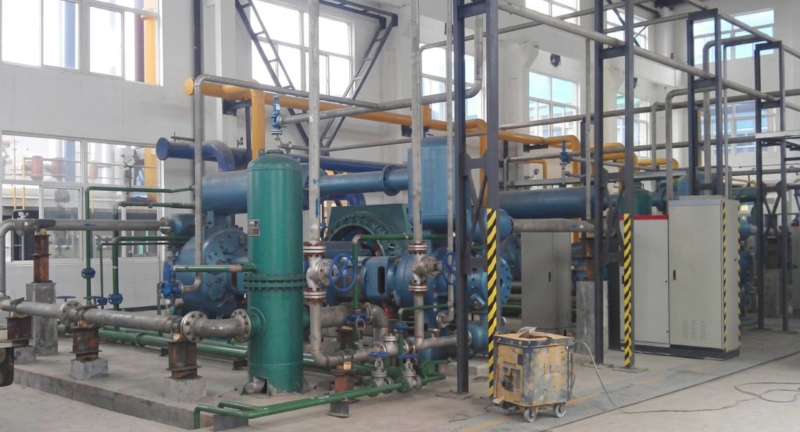
A screw compressor produces no significant alternating inertia forces — its rotary motion is inherently balanced — and can be connected to rigid pipework without concern for vibration-induced fatigue in the pipework joints. This is one area where the screw compressor has a genuine advantage over a single-cylinder or L-type reciprocating machine. However, the relevant comparison for permanent industrial nitrogen pipeline supply is not between a screw and an L-type ZW series reciprocating compressor — it is between a screw and an opposed-balance DW or LW series reciprocating compressor.
The DW and LW series opposed-balance frames cancel primary inertia forces through their geometry — pistons on opposite sides of the crankcase move in exactly opposing directions, producing zero net force at the compressor flanges. The residual secondary forces transmitted to the pipework are small enough that DW and LW series compressors are the standard Russian specification for permanently rigidly-piped industrial nitrogen systems from 55 kW upward. The vibration argument that favours screw compressors over L-type reciprocating machines does not apply to the opposed-balance frame: for rigidly-piped permanent nitrogen pipeline supply above 55 kW, the DW or LW series reciprocating compressor and the screw compressor are equivalent in their pipework vibration loading.
Total Cost of Ownership Over 20 Years
Capital cost comparisons between reciprocating and screw compressors at the same nominal flow and pressure typically show the screw at 10–30% lower purchase price. However, total cost of ownership over a 20-year plant life is dominated by energy cost for continuous-duty industrial nitrogen pipeline supply — not capital cost. At Russian industrial electricity tariffs, a 15% specific energy advantage for the reciprocating compressor at 2.5 MPa discharge translates to a payback of the capital cost premium within 3–6 years on a 110 kW compressor operating 8,000 hours per year, after which the reciprocating machine continues to deliver savings for the remaining 14–17 years of plant life.
Why ISBM Blow Air Uses Reciprocating, Not Screw, Compression
Injection stretch blow moulding (ISBM) machines for PET bottle production require blow air at 35–40 bar — a pressure far beyond what a screw compressor can practically achieve. The same selection logic that favours the reciprocating compressor over the screw for nitrogen pipeline supply above 1.0 MPa applies directly to the ISBM blow air system: at 35–40 bar, the reciprocating compressor is the only viable technology. The ISBM blow air compressor uses a three-stage oil-free reciprocating design with inter-stage cooling — the same thermodynamic principles and the same component technology (PTFE piston rings, inter-stage coolers, labyrinth distance piece) that characterise the industrial nitrogen compressors described in this article. Screw compressors serve the low-pressure utility air needs of an ISBM plant (instrument air, conveyor air) but not the high-pressure blow air circuit, for exactly the reasons that make the screw unsuitable for high-pressure nitrogen pipeline supply.
FAQ — Reciprocating vs Screw Compressor for Nitrogen Pipeline Supply
DW and LW Series Reciprocating Nitrogen Compressors
Oil-free DW series (55–350 kW) and LW series (160–500 kW) reciprocating nitrogen compressors for permanent pipeline supply at 0.5–30 MPa — opposed-balance frame, GOST-R certified, full Russian documentation. Send your flow rate and discharge pressure for a selection and quotation within 48 hours.