Two-Stage vs Single-Stage NH₃ Compression: When to Use Compound Compression in Industrial Refrigeration

Technical Knowledge · NH₃ Refrigeration · Stage Count · Compound Compression · Russia

This choice is one of the most consequential NH₃ refrigeration decisions in industrial refrigeration system design. Single-stage compression is simpler and less expensive; compound compression is more efficient and safer at evaporating temperatures below −25°C to −30°C. Getting this choice right affects the system COP, the discharge temperature, the compressor service life, and the energy cost of the refrigeration plant over its 20–30 year operating life. This guide explains the thermodynamic and practical engineering reasons behind the two-stage compression decision, and the temperature threshold at which compound compression becomes necessary in Russia and CIS industrial refrigeration practice.

✓ NH₃ Stage Selection
✓ COP Improvement
✓ −25°C Threshold
✓ DW / 4MW Series
4MW DW NH3 ammonia two stage compound compression industrial refrigeration evaporating temperature Russia

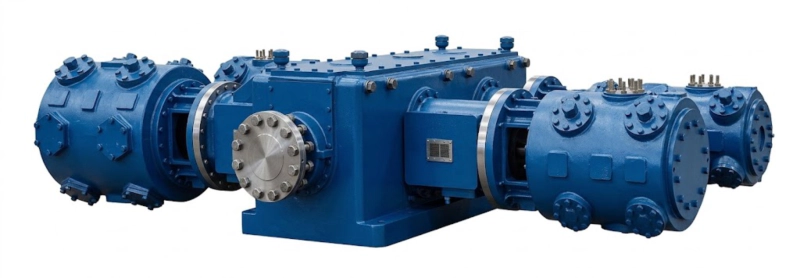
4MW series NH₃ refrigeration compressor configured for two-stage compound compression — the low-stage compressor takes suction from blast freezing evaporators at −43°C to −48°C, and the high-stage unit compresses to condensing pressure while also accepting suction from higher-temperature evaporators. The two-stage arrangement limits the per-stage compression ratio and discharge temperature to safe and efficient values at evaporating temperatures where single-stage compression would be thermodynamically inefficient and mechanically damaging.

−25°C to −30°C
Two-Stage Threshold
15–25%
COP Improvement
< 145°C
Discharge Temp Limit
Flash Vessel
Inter-Stage Economiser
DW / 4MW
Available Series

Single-Stage NH₃ Compression: Where It Works and Where It Fails

Single-stage NH₃ compression takes the ammonia vapour from the evaporator at suction pressure and compresses it directly to the condensing pressure in one step. This is the simplest possible refrigeration cycle — one compressor, one evaporating pressure, one condensing pressure — and it is entirely adequate for evaporating temperatures above approximately −25°C. At these conditions, the compression ratio from suction to discharge is modest (typically 6:1 to 10:1), the discharge temperature remains below 140°C, and the system COP is acceptable. The vast majority of brewery refrigeration, food chilling, and process cooling applications operate in this range and are correctly designed as single-stage arrangements.

As the evaporating temperature falls below −25°C, two problems emerge simultaneously that make single-stage compression increasingly unsuitable:

Problem 1: Discharge Temperature

At −40°C evaporating temperature and +35°C condensing, the theoretical single-stage NH₃ compression ratio is approximately 19:1. Compressing NH₃ at this ratio produces a theoretical adiabatic discharge temperature of approximately 180–200°C. In practice, discharge temperatures above 145–150°C degrade the cylinder lubricating oil, causing carbon deposits on valves, valve seats, and cylinder walls. Above 160–170°C, mineral oil decomposition becomes severe and can lead to valve fires in the worst cases. Single-stage compression at −40°C evaporating is thermally unsafe without significant design modifications.

Problem 2: Low Volumetric Efficiency

At high compression ratios, the clearance volume gas remaining in the cylinder at the end of the discharge stroke re-expands to occupy a large fraction of the cylinder swept volume before the suction valve opens. At a 19:1 compression ratio with a typical clearance volume of 5%, the clearance gas re-expands to approximately 60% of the cylinder swept volume, leaving only 40% of the cylinder effectively available for fresh suction gas. The volumetric efficiency of the compressor falls to 30–45%, meaning a machine physically capable of handling 100 units of gas per cycle is only delivering 30–45 units. The machine is oversized relative to what it actually compresses, wasting capital cost and floor space.

How Two-Stage Compression Solves Both Problems
two stage NH3 compound compression inter-stage flash vessel economiser 4MW DW series industrial refrigeration Russia

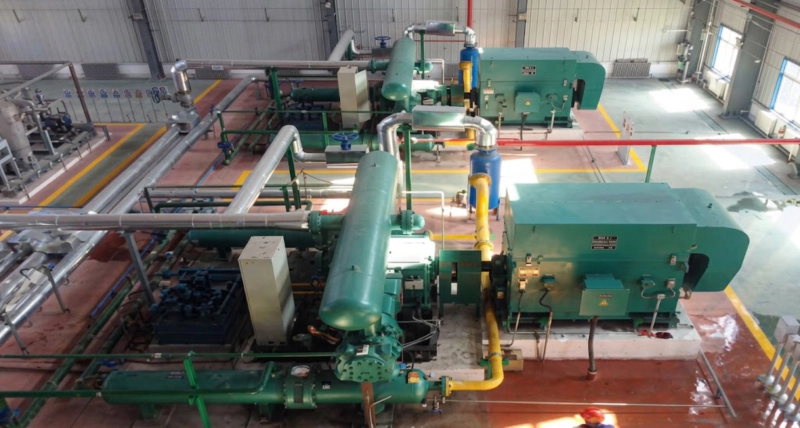
In a two-stage NH₃ compression system — also called compound compression — the total compression from evaporating pressure to condensing pressure is divided between two separate compressor stages. The low-stage compressor takes suction from the low-temperature evaporators and compresses to an intermediate pressure. The high-stage compressor takes suction at the intermediate pressure and compresses to the condensing pressure. Between the two stages, an inter-stage flash vessel (economiser) cools the high-pressure liquid NH₃ before it enters the low-temperature evaporators, while simultaneously de-superheating the low-stage discharge gas before it enters the high-stage suction.

The optimal intermediate pressure for a two-stage NH₃ system is approximately the geometric mean of the suction and condensing pressures: Pᵢₙᵗ = √(Pₛ€ₒᵗᵢₒₙ × Pϲₒₙₖₗ). At −40°C evaporating (0.72 bar) and +35°C condensing (13.5 bar), the optimal intermediate pressure is √(0.72 × 13.5) ≈ 3.1 bar, corresponding to a saturation temperature of approximately −5°C. Each stage then has a compression ratio of approximately 4.3:1, and the discharge temperature of each stage is approximately 100–115°C — well within the safe operating limit for cylinder lubrication and valve materials.

Single-Stage vs Two-Stage NH₃: Key Parameters at −40°C Evaporating / +35°C Condensing
Parameter Single-Stage Two-Stage
Overall compression ratio 19:1 4.3:1 per stage
Discharge temperature 180–200°C (unsafe) 105–115°C (safe)
Volumetric efficiency 30–45% 70–80% per stage
System COP (rel. to single-stage) 1.00 (reference) 1.15–1.25
Oil degradation risk High (carbon deposits) Low (normal operation)
Compressor count 1 2 (low + high stage)

The Inter-Stage Flash Vessel: Design and Function

The inter-stage flash vessel — also called the economiser or intercooler — is the key component that makes two-stage NH₃ compression significantly more efficient than simply putting two single-stage compressors in series. It performs two functions simultaneously:

Function 1: Liquid Sub-Cooling
High-pressure liquid NH₃ from the condenser enters the flash vessel through an expansion valve. A portion of the liquid flashes to vapour at the intermediate pressure, cooling the remaining liquid to the saturation temperature at intermediate pressure. This sub-cooled liquid then expands to the low evaporating pressure, carrying more refrigerating effect per kilogram than warm liquid expanded directly from the condensing pressure. The flash vessel liquid sub-cooling improves system COP by 5–10% compared with direct expansion from the condenser.
Function 2: Low-Stage De-Superheating
The low-stage compressor discharge gas arrives at the flash vessel superheated — at a temperature above the intermediate saturation temperature. This superheat adds no refrigerating effect but increases the work required in the high-stage compressor. The flash vessel absorbs this superheat by evaporating the flashed liquid into the low-stage discharge gas stream, cooling it to the intermediate saturation temperature before it enters the high-stage compressor suction. This de-superheating reduces the high-stage discharge temperature and improves the overall two-stage system efficiency by a further 5–10%.

Temperature Decision Guide: When to Specify Two-Stage
two stage NH3 compound compression temperature threshold decision guide single stage blast freezing Russia DW 4MW

The boundary between single-stage and two-stage NH₃ compression in Russian industrial refrigeration practice falls at approximately −25°C to −30°C evaporating temperature. Above this threshold, single-stage arrangement is standard. Below it, compound compression is required by both thermodynamic efficiency and equipment safety considerations. The exact crossover depends on the condensing temperature and the specific compressor model, but the following guide covers the most common Russian industrial refrigeration scenarios:

SINGLE-STAGE
Above −25°C
Brewery, food chilling, process cooling, cold store at −18°C to −22°C
Evaporating temperatures of −5°C to −25°C give compression ratios of 4:1 to 10:1, discharge temperatures of 80–140°C, and volumetric efficiencies of 60–85%. This arrangement is efficient, simple, and mechanically sound. The DW and 4MW series in single-stage configuration cover this full range. Two-stage would add capital cost and system complexity with no thermodynamic benefit at these temperatures.
BORDERLINE
−25°C to −30°C
Deep freeze cold store, some blast freezing anteroom duties
At −25°C to −30°C evaporating with a +35°C condensing temperature, the compression ratio is 12:1 to 15:1 and the single-stage discharge temperature approaches 145–160°C — at the limit for acceptable cylinder lubrication. The decision between single-stage and two-stage at these temperatures depends on the specific compressor model rating, the condensing temperature, and the client’s preference for simplicity vs efficiency. Russian industry practice generally specifies two-stage below −28°C for all new installations.
TWO-STAGE
Below −30°C
Blast freezing, fish processing, deep-freeze warehousing below −30°C
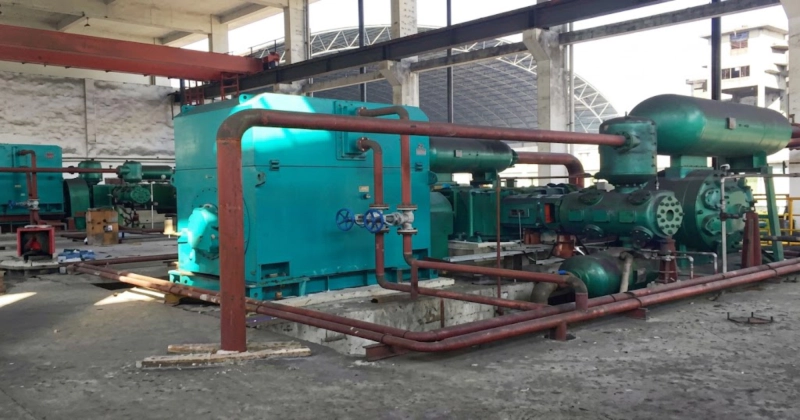
Below −30°C evaporating, two-stage compound compression is mandatory in all modern Russian industrial refrigeration designs. The DW or 4MW series low-stage compressor handles suction from the deep-freeze evaporators; the high-stage compressor handles the intermediate pressure and any additional higher-temperature evaporator loads. The 15–25% COP advantage of two-stage over single-stage at these temperatures represents a significant energy cost saving over the 20–30 year plant life, more than justifying the additional capital cost of the second compressor and flash vessel.

System Configurations in Russian Practice

Russian industrial refrigeration engineers use two main compound compression configurations, selected based on the facility’s load profile and the number of temperature levels served:

Simple Compound (Two-Stage)
One low-stage compressor, one high-stage compressor, one inter-stage flash vessel. The high-stage compressor handles only the low-stage discharge and any intermediate-temperature loads. Used when the facility has one or two distinct temperature levels. Typical for blast freeze tunnels combined with cold store at −18°C to −22°C. Each stage uses a separate DW or 4MW unit.
Multi-Temperature Two-Stage
One or two low-stage compressors for the deep-freeze duty, one high-stage compressor that accepts suction at both the intermediate pressure (from low-stage discharge) and from the medium-temperature evaporators at a separate suction connection. The high-stage unit handles multiple temperature levels simultaneously. Used for complex facilities with three or more temperature levels — typical for large Russian cold chain distribution centres with blast freezing, deep-freeze storage, and chilled storage in the same facility.
Related Application · Plastics Manufacturing

Staged Compression in ISBM Blow Air: A Parallel Principle

The principle of dividing a large compression ratio across multiple stages — to control inter-stage temperatures and improve overall efficiency — applies equally to the high-pressure blow air compression in injection stretch blow moulding (ISBM) machines. ISBM blow air compressors reach 35–40 bar from atmospheric pressure in three stages, with inter-stage cooling between each stage. Without inter-stage cooling and staged compression, a a machine compressing from 0.1 MPa to 4.0 MPa would produce discharge temperatures above 450°C — far exceeding the rating of any cylinder lubricant or piston ring material. The same thermodynamic principle that requires two-stage NH₃ compression at low evaporating temperatures requires three-stage inter-cooled compression for ISBM blow air: in both cases, staged compression with inter-stage cooling is the solution to the temperature and efficiency constraints of high compression ratios.

Related equipment: One-step three-station ISBM machines for PET bottle production — using three-stage intercooled blow air compression at 35–40 bar, the same staged compression principle applied to a different gas system.

ISBM Machine ›injectionstretchblowmolding.com

FAQ — Two-Stage vs Single-Stage NH₃ Compression

Q1: Can a single-stage compressor be modified to run at lower evaporating temperatures?
A compressor designed for single-stage duty cannot be safely operated at the compression ratios produced by very low evaporating temperatures without modification — and in most cases, modification is not the appropriate approach. The discharge temperature problem cannot be solved by modifying the compressor alone: it requires reducing the compression ratio by adding an intermediate compression stage. What can be done to extend the range of a single-stage machine is to reduce the condensing temperature — for example, by using an evaporative condenser or a cooling tower in winter rather than summer ambient air — which reduces the condensing pressure and therefore the compression ratio at the same evaporating temperature. This condensing temperature reduction can allow single-stage operation to −28°C or −30°C evaporating in the Russian climate during winter months, but not reliably year-round for a facility that must also operate at summer condensing temperatures of +35°C to +40°C.
Q2: Does the two-stage system require two separate compressor machines?
Yes, in standard Russian industrial refrigeration practice, the low-stage and high-stage functions are served by two separate compressor machines — two separate DW or 4MW units — each sized for its specific pressure level and flow rate. Some compressor designs allow a single compressor frame to serve both stages with separate low-stage and high-stage cylinders on the same crankshaft — this is called a compound compressor. The DW and 4MW series are available in compound configurations for some capacity ranges, where the low-stage and high-stage cylinders are integrated into a single machine. However, most large Russian two-stage NH₃ systems use separate machines for each stage, since separate units allow independent N+1 standby arrangements, independent maintenance scheduling, and greater flexibility to balance the stage loads when facility requirements change over the plant life.
Q3: What information is needed to design a two-stage NH₃ system?
To design a a two-stage system and choose the low-stage and high-stage compressors, our engineering team requires: the required refrigerating capacity at each temperature level (kW at each evaporating temperature); all evaporating temperatures in the system (low-stage deep-freeze level and any intermediate-temperature levels served from the high-stage suction); the site condensing temperature (based on ambient temperature and condenser type); whether a flash vessel economiser or a liquid sub-cooler type inter-stage is preferred; and the required availability arrangement (N+1 per stage or shared standby). Our engineering team performs a full two-stage NH₃ cycle calculation including flash vessel sizing, low-stage and high-stage compressor selection from the DW or 4MW series, and a system energy balance, with a quotation within 48 hours.
Engineering Enquiry

Request a Two-Stage NH₃ Compressor Selection

DW and 4MW series NH₃ compressors for single-stage and two-stage compound refrigeration systems — low-stage and high-stage configurations, flash vessel sizing, full system energy balance. GOST-R certified. Response within 48 hours.