
Application Guide · Cold Storage · Refrigerant Compressor · NH₃ · 350–1,600 kW · Russia
Large cold storage complexes in Russia — meat processing plants, fish handling facilities, vegetable and fruit distribution centres, and frozen food warehouses — operate continuous NH₃ refrigeration systems in the 350–1,600 kW range that must run reliably 24 hours per day for 20–30 year design lives. The 4MW series reciprocating refrigerant compressor is the standard specification for this duty. This guide explains why the opposed-balance and symmetrically balanced frame design is the correct engineering choice at this power level, and how it differs from smaller reciprocating refrigerant compressors used in regional cold stores.
✓ NH₃ / CO₂ · Industrial Refrigeration
✓ −18°C to −40°C · Cold Storage
✓ GOST-R Certified · Russia
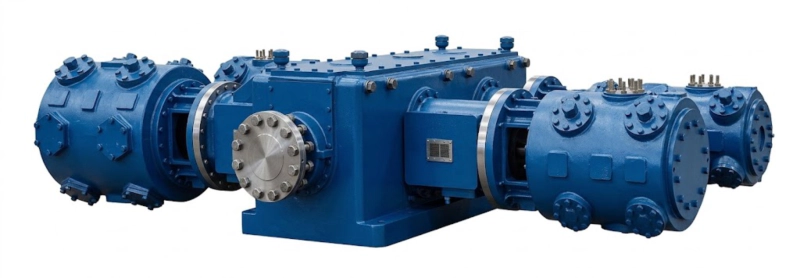
4MW series refrigerant compressor for large cold storage — symmetrically balanced four-column frame, 350–1,600 kW motor power, NH₃ service at −15°C to −40°C evaporating temperature. The 4MW frame cancels both primary forces and primary couples, producing near-zero foundation vibration at power levels where an unbalanced or partially balanced compressor would transmit tens of kilonewtons of alternating force to the refrigerant pipework and building structure.
Cold Storage Refrigeration in Russia: Scale and Technology
Russia operates one of the world’s largest cold storage infrastructure networks, supporting the logistics of a food supply chain that spans eleven time zones. Large refrigerated complexes in the industrial centres of Moscow, St Petersburg, Yekaterinburg, Novosibirsk, and the major port cities typically range from 10,000 to 50,000 tonnes of refrigerated storage capacity, operating cold rooms at −18°C to −22°C for frozen food, and blast freezing tunnels at −35°C to −40°C for rapid product freezing before transfer to long-term cold storage. These facilities represent installed refrigeration capacities of 1,000–5,000 kW per complex, served by large reciprocating refrigerant compressors in the 350–1,600 kW range.
Ammonia (NH₃) has been the dominant refrigerant in Russian industrial cold storage since the Soviet era and remains the overwhelmingly preferred refrigerant for large cold storage applications today. NH₃ has the highest refrigerating efficiency (COP) of any common industrial refrigerant, is available domestically at low cost, and is compatible with the extensive maintenance infrastructure and trained operating personnel established across the Russian cold chain industry over decades. The regulatory framework under Federal Law 116-FZ and GOST 12.2.052 governs NH₃ refrigeration system safety in Russia, requiring licensed design, construction, and operation of all NH₃ refrigerating plant above defined capacity thresholds.
Why the 4MW Frame Is Standard at Large Cold Storage Scale
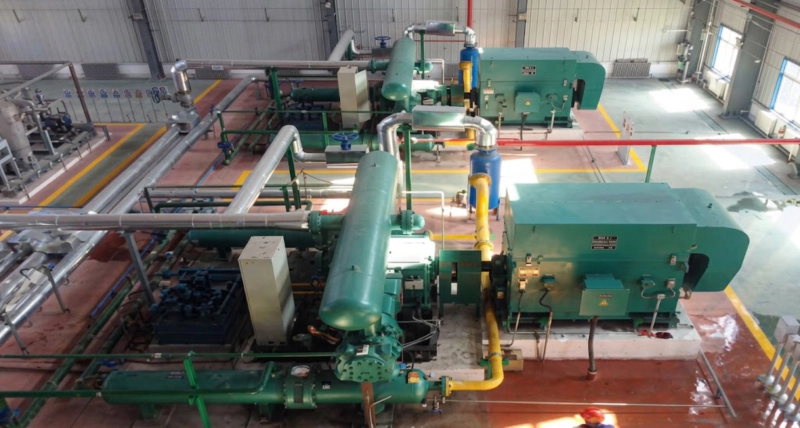
The 4MW series refrigerant compressor uses a symmetrically balanced four-column frame that cancels both the primary inertia forces and the primary couples generated by the reciprocating pistons. At 350–1,600 kW motor power — the range served by the 4MW series — the unbalanced alternating force that would be transmitted to the foundation and connected refrigerant pipework by a less well-balanced machine reaches tens of kilonewtons. This is not a vibration level that anti-vibration mounts can adequately manage: at 350+ kW, the mass of the compressor itself is several tonnes, and anti-vibration mounts sized to support this mass while also reducing a 30–50 kN alternating force would be impractically large and expensive. The 4MW frame resolves this by cancelling the alternating force at source.
For a large installation with 200–500 metres of NH₃ refrigerant pipework running from the machine room to distributed evaporator coils in multiple cold rooms and blast freezing tunnels, the consequence of transmitting a significant alternating force to the machine room refrigerant pipework connections is progressive fatigue accumulation at every welded joint and flanged connection in the ammonia circuit. Ammonia is toxic at concentrations above 25 ppm and has a strong odour detectable at 5–10 ppm — any joint leakage in the NH₃ circuit is immediately apparent to personnel and triggers a mandatory safety response under Russian NH₃ refrigeration regulations. The near-zero foundation force of the 4MW refrigerant compressor is therefore not merely a mechanical performance specification: in NH₃ service at large cold store scale, it is a safety and regulatory compliance specification that determines whether the refrigerant pipework joints require inspection every 18–24 months or every 5–8 years throughout the 20–30 year plant design life.
Cold Storage Refrigeration System Architecture
A large NH₃ refrigeration system for cold storage is not simply a refrigerant compressor connected to evaporators and condensers. It is a multi-temperature system that must simultaneously serve cold rooms at different temperature levels, blast freezing tunnels at deep-freeze temperatures, and potentially loading dock conditioning areas at near-atmospheric temperatures. This multi-temperature requirement typically drives the selection of a two-stage NH₃ compression system, where a low-stage compressor handles the suction from the deep-freeze evaporators and a high-stage compressor takes the discharge from the low stage and the suction from the normal-temperature evaporators, compressing to the condensing pressure.
4MW vs DW Refrigerant Compressor: Cold Storage Selection Guide
| Parameter | DW Series | 4MW Series | Use 4MW When |
|---|---|---|---|
| Motor power range | 55–350 kW | 350–1,600 kW | Refrigerating capacity above 800 kW |
| Cold store size | Up to 3,000 tonnes | 3,000–50,000+ tonnes | Large distribution centre or processing plant |
| Blast freezing | Limited (up to 200 kW) | Standard specification | Any facility with blast freezing tunnel |
| Foundation vibration | Near-zero (opposed-balance) | Near-zero (forces + couples) | Higher mass — full cancellation essential |
| NH₃ pipework flange interval | 5–8 years | 5–8 years | Longer runs of NH₃ pipework |
| Motor voltage | 380V / 6 kV | 6 kV / 10 kV standard | MV electrical infrastructure at site |
| Valve inspection interval | 2,000–3,000 h | 3,000–5,000 h | Lower RPM at large frame |
Cold store capacity and motor power are indicative. Actual refrigerating capacity depends on evaporating temperature, condensing temperature, refrigerant, and compressor model. Contact our engineering team for a capacity calculation at your operating conditions.
NH₃ Refrigerant Compressor Safety Requirements in Russian Cold Storage
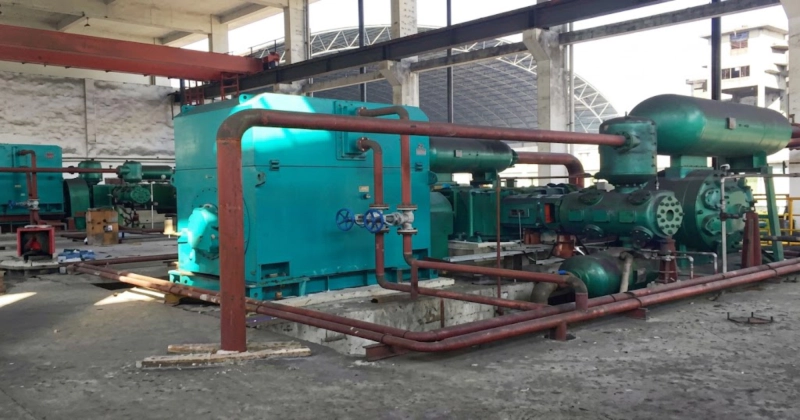
NH₃ refrigeration systems at large cold storage facilities in Russia are classified as hazardous production objects (HPos) under Federal Law 116-FZ when the ammonia inventory exceeds defined thresholds. Registration with Rostechnadzor and compliance with GOST 12.2.007 (electrical safety for ammonia systems), GOST 12.2.052 (oxygen equipment — referenced for valve and seal material requirements in multi-refrigerant facilities), and the Rostechnadzor safety rules for ammonia refrigerating systems govern the design, installation, and operation of the compressor and associated refrigerant plant.
For the refrigerant compressor specifically, the Russian regulatory requirements for large cold storage NH₃ service include: copper-free construction throughout all ammonia-wetted components per GOST material compatibility requirements; annual safety inspection of the refrigerant compressor by a Rostechnadzor-accredited inspection organisation; periodic pressure testing of the refrigerant circuit per the inspection schedule; and a documented preventive maintenance programme that covers valve inspection, piston rod packing replacement, and crankcase oil analysis at defined intervals. The 4MW series refrigerant compressor is supplied with the full documentation package required to support Rostechnadzor registration: equipment passport, technical data, material certificates for all ammonia-wetted components, and Russian-language maintenance manual.
Key Operational Specifications — 4MW Series in NH₃ Cold Storage Service
Sizing a 4MW Refrigerant Compressor for a Cold Storage Complex
Refrigerant compressor sizing for a cold storage complex requires a heat load calculation that accounts for: transmission heat gain through the insulated wall panels and roof of each cold room at the design external temperature; product heat load from the warm product entering the cold store; infiltration load from door openings during loading and unloading operations; internal heat gains from lighting, forklifts, and personnel; and defrost heat load if electric or hot-gas defrost is used on the evaporator coils. The sum of these heat loads at the design conditions defines the total refrigerating capacity required, to which a 15–20% safety factor is applied before sizing the refrigerant compressor.
At −20°C cold room temperature with a −30°C NH₃ evaporating temperature and +35°C condensing temperature, a 4MW unit at 500 kW motor power delivers approximately 1,800–2,200 kW of refrigerating capacity in single-stage NH₃ service. A 10,000-tonne installation at −20°C with a total heat load of 2,000 kW would therefore be served by a single 4MW unit on-load with one standby, or two smaller 4MW units with N+1 standby arrangements depending on the plant availability requirement and the preferred maintenance strategy.
Refrigeration for PET Preform and Bottle Logistics
Large injection stretch blow moulding (ISBM) facilities producing PET bottles for the food and beverage sector often include on-site cold storage for finished bottle distribution or for raw material (resin) conditioning. A facility producing 500 million PET bottles per year may operate a cold store of 1,000–3,000 tonnes for finished bottle buffer stock and returned product handling. At this scale, the cold store refrigeration system falls in the DW series range — 55–350 kW NH₃ or HFC refrigerant compressor — rather than the larger 4MW series. The DW series opposed-balance refrigerant compressor provides the same near-zero foundation force performance as the 4MW series at this smaller scale, making it the correct specification for a permanently piped refrigerant circuit in an ISBM production facility where the machine room is adjacent to the production floor.
FAQ — Refrigerant Compressor for Large Cold Storage
Request a Cold Storage Refrigerant Compressor Specification
4MW series refrigerant compressors for large NH₃ cold storage complexes — GOST-R certified, copper-free NH₃ service, full Rostechnadzor documentation, spare parts in Russia. DW series for medium cold store applications. Response within 48 hours.