Maintenance Guide · PTFE Piston Rings · Replacement Interval · Oil-Free Compressor · O₂ Service
The question of when to replace PTFE piston rings in an oil-free oxygen compressor does not have a single universal answer. The published range of 4,000–8,000 hours reflects real variation driven by four operating conditions that double or halve ring life depending on the specific installation. Replacing rings too early wastes money and introduces maintenance risk; replacing them too late allows ring gap to widen beyond the sealing limit, reducing compressor output and — in oxygen service — elevating discharge temperature toward the GOST 12.2.052 limit of 140°C. This guide explains what drives PTFE piston ring wear in oxygen service, how to monitor ring condition without opening the cylinder, and how to set the correct replacement interval for your specific operating conditions.
✓ Wear Rate Factors
✓ On-Line Monitoring
✓ Gap Measurement
✓ O₂ / N₂ / Ar Service
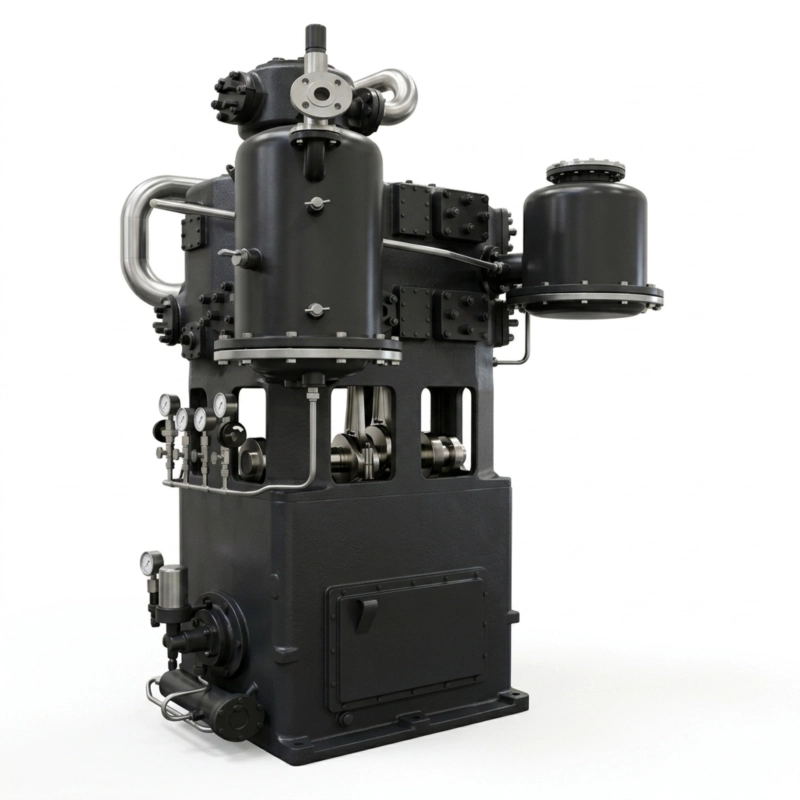
ZW series oil-free oxygen compressor — PTFE piston ring condition is the single most important maintenance variable determining both gas output and GOST 12.2.052 safety compliance. A worn piston ring allows gas bypass that raises discharge temperature toward the 140°C GOST limit; a ring replaced too early wastes parts cost and creates the handling contamination risk inherent in every cylinder access. The correct replacement interval is set by the actual wear rate of the specific installation, not by a single published number.
4,000 h
Dry Source, High Temp
8,000 h
PSA Source, Low Temp
140°C
GOST Discharge Limit
Gap Width
Definitive Wear Check
Virgin PTFE Only
O₂ Ring Grade
Why Oxygen Compressor PTFE Rings Wear Faster Than Nitrogen Rings
PTFE piston rings in an oil-free oxygen compressor wear by two mechanisms simultaneously, while rings in a nitrogen or argon compressor experience only one. This fundamental difference is why oxygen compressor ring replacement intervals are consistently 20–40% shorter than those for equivalent nitrogen service at the same operating conditions.
Mechanism 1: Abrasive wear (all gas services)
The piston ring face slides against the cylinder bore at 300 rpm, accumulating approximately 144 million contact cycles per year of continuous operation. Each cycle removes a microscopic layer of PTFE. The rate depends on contact pressure, bore surface roughness, and the quality of the PTFE transfer film on the bore. Both oxygen and nitrogen compressors experience this mechanism equally at the same piston speed and bore condition.
Mechanism 2: Chemical oxidation (oxygen service only)
Oxygen reacts with the PTFE surface at elevated temperature, weakening the molecular structure of the exposed layer and making it more susceptible to removal by the next abrasive cycle. Above 120°C discharge temperature, this oxidation component becomes significant. Above 140°C it becomes the dominant wear driver. This mechanism does not occur in nitrogen or argon service — it is unique to oxygen compression and explains the shorter replacement intervals for oxygen versus nitrogen service at identical physical conditions.
The Four Factors That Set Your Actual Replacement Interval

Factor 1: Discharge Temperature
— highest impact on oxygen compressor ring life
Every 10°C increase in discharge temperature above the design baseline approximately doubles the rate of chemical oxidation of the PTFE surface in oxygen. A compressor running at 130°C discharge will consume rings approximately twice as fast as the same machine running at 120°C. The single most effective way to extend PTFE piston ring life in an oxygen compressor is to keep the discharge temperature as far below the GOST 12.2.052 limit of 140°C as possible — ideally below 120°C — by maintaining full cooling water flow and replacing worn piston rings before they cause re-compression heating that drives temperature higher.
Below 120°C → 6,000–8,000 h interval
120–135°C → 4,000–6,000 h interval
Above 135°C → inspect before 4,000 h
Factor 2: Oxygen Source Moisture Content
— counterintuitive: some moisture extends ring life
Oxygen from a cryogenic ASU (air separation unit) is extremely dry — dew point below −60°C. Oxygen from a PSA (pressure swing adsorption) generator is moderately dry — dew point −40°C to −60°C, typically containing 100–500 ppm water vapour. The moisture present in PSA-sourced oxygen acts as a mild lubricant at the ring-bore interface, supplementing the PTFE transfer film and reducing abrasive wear by 15–25% compared with ASU-sourced oxygen at the same operating conditions. ASU-sourced oxygen compressors running on extremely dry gas should be planned for shorter ring replacement intervals (4,000–5,000 h) compared with PSA-sourced installations (5,000–8,000 h).
Factor 3: Cylinder Bore Surface Condition
— out-of-specification bore multiplies wear rate 3–5x
The specified cylinder bore surface roughness for PTFE ring service is Ra 0.4–0.8 μm. A bore within this range allows the PTFE transfer film to establish smoothly and provides controlled, slow abrasive wear. A bore roughened by rust from moisture carry-over, scored by a particle impact, or polished to below Ra 0.4 μm by previous ring wear causes the current ring set to wear 3–5 times faster than expected. Bore condition must be measured with a profilometer at every ring replacement — if out of specification, re-hone before installing new rings. A new ring set installed on a roughened bore will be consumed in 1,000–2,000 hours instead of the expected 5,000–8,000 hours.
Factor 4: Suction Gas Cleanliness
— particulate contamination causes step-change bore damage
A hard particle — rust flake from upstream pipework, scale from the suction filter housing, or particulate from the oxygen source — trapped between the ring face and the bore acts as a cutting tool, scoring the bore and simultaneously gouging the ring face. A single contamination event can destroy a ring set and roughen the bore to the point where re-honing is required before the next installation. Suction filter maintenance is the primary preventive measure: inspect and replace the suction filter element at the interval specified for the gas cleanliness level, and never bypass or leave the suction filter uninstalled even for a short test run.
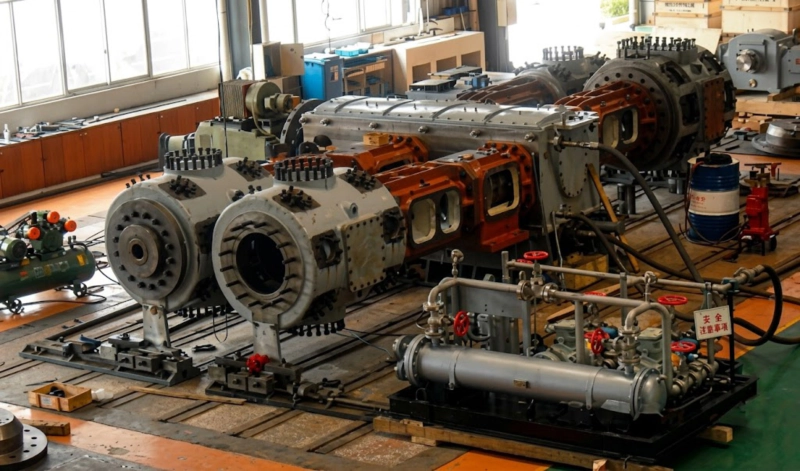
How to Monitor Ring Condition Without Opening the Cylinder
Opening a cylinder in an oxygen compressor is a significant maintenance event that requires degreasing, careful handling, and a new degreasing record entry in the equipment passport. It should not be done unnecessarily as a speculative inspection. The correct approach is to use on-line performance monitoring to determine when ring condition has deteriorated sufficiently to justify cylinder opening, rather than inspecting on a fixed calendar schedule regardless of condition:
Discharge temperature trend
As rings wear and the gap widens, gas bypasses the ring on each stroke, re-compressing in the next cycle and adding heat. The discharge temperature rises progressively above the commissioning baseline. A rise of +5°C to +8°C above baseline signals early ring wear; a rise of +10°C to +15°C indicates the rings are approaching their replacement limit. In oxygen service the GOST 12.2.052 140°C limit must not be reached by ring wear — schedule replacement before the rising trend approaches this absolute ceiling.
Delivery rate decline
At a cylinder filling station, fill time per cylinder increases as ring bypass reduces effective delivery. A 10–15% increase in fill time compared with the post-installation baseline indicates ring wear that warrants inspection at the next planned opportunity. For pipeline supply, track the compressor flow output against a fixed pressure differential — falling output at constant conditions indicates reduced volumetric efficiency from ring bypass.
Rising inter-stage pressure
In a multi-stage compressor, worn first-stage rings allow gas to bypass from the first stage back to suction, requiring the stage to work harder to build the inter-stage pressure. The inter-stage pressure rises above the commissioning baseline as ring wear progresses, providing a stage-specific indicator that complements the discharge temperature trend.
Ring gap measurement at inspection
When the on-line indicators warrant a cylinder opening, ring gap is measured with feeler gauges. A new ring gap is typically 0.5–1.0% of bore diameter; replacement is required when the gap reaches 1.5–2.0% of bore diameter. This measurement is definitive — it either justifies continued service (gap below limit) or mandates replacement (gap at or above limit). Never reinstall rings without measuring gap: visual inspection alone cannot determine wear adequacy.
PTFE Piston Ring Replacement Interval Summary — Oil-Free Oxygen Compressor
| Operating Condition |
Typical Interval |
Key Driver |
| ASU oxygen, discharge below 120°C, bore in spec |
4,000–6,000 h |
Very dry gas accelerates abrasive wear |
| PSA oxygen, discharge below 120°C, bore in spec |
5,000–8,000 h |
Moderate moisture reduces abrasive wear rate |
| Any source, discharge 120–135°C, bore in spec |
4,000–5,000 h |
Elevated temp accelerates chemical oxidation |
| Any source, discharge above 135°C |
Inspect before 4,000 h |
GOST 12.2.052 limit approach risk; investigate cause |
| Any source, bore out of specification |
Re-hone bore before new rings |
Roughened bore consumes new rings in 1,000–2,000 h |
Related Application · Plastics Manufacturing
ISBM Blow Air Compressor Rings: Same Material, Different Replacement Logic
The blow air compressor of an injection stretch blow moulding (ISBM) machine uses PTFE piston rings in its oil-free cylinder design — the same material as the oxygen compressor rings described in this guide. However, the replacement interval logic differs in one important respect: the ISBM blow air compressor operates on filtered atmospheric air at near-ambient moisture content (50–70% relative humidity before drying), not on dry oxygen. This moisture level — higher than either ASU or PSA oxygen sources — provides the best possible lubrication for the PTFE transfer film, resulting in lower abrasive wear rates than oxygen service at the same discharge temperature. The ISBM blow air compressor also operates at lower discharge temperatures than an oxygen cylinder filling compressor (typically 100–120°C vs 120–135°C for oxygen), further extending ring life. The practical result is that ISBM blow air compressor PTFE ring intervals tend toward the upper end of the 6,000–8,000 hour range rather than the lower end — but the monitoring approach is identical: track blow air delivery rate and compressor outlet temperature against the commissioning baseline, and open the cylinder when the trend indicates wear, not on a fixed calendar schedule.
Related equipment: One-step three-station ISBM machines for PET bottle production — with oil-free blow air compressors using PTFE piston rings with condition-based replacement intervals.
ISBM Machine ›injectionstretchblowmolding.com
FAQ — PTFE Ring Replacement Intervals for Oil-Free Oxygen Compressors
Q1: The compressor manufacturer specifies 6,000 hours as the ring replacement interval. My discharge temperature has been rising since 4,000 hours. Should I replace the rings now or wait until 6,000 hours?
Replace them now — or more precisely, open the cylinder and measure the ring gap. The manufacturer’s 6,000 hour interval is a design baseline based on nominal operating conditions. A rising discharge temperature above the commissioning baseline at 4,000 hours tells you that your actual wear rate is faster than the nominal baseline, driven by one or more of the four factors described in this guide. The on-line performance indicator — discharge temperature trend — is more reliable than the published interval for your specific installation. If the gap measurement at 4,000 hours shows the ring gap is within the acceptable limit, reinstall and continue monitoring more frequently — weekly discharge temperature readings rather than monthly. If the gap is at or approaching the replacement limit, install new rings regardless of the hours elapsed. The manufacturer’s interval is a starting point, not an override of the actual condition evidence your compressor is giving you.
Q2: How do I know if my cylinder bore needs re-honing before installing new PTFE rings?
Bore condition is assessed by two methods at ring replacement: visual inspection under good lighting for scratches, corrosion pits, scoring marks, and discolouration, followed by surface roughness measurement with a profilometer at three or more positions along the bore length. The specified bore surface roughness for PTFE ring service is Ra 0.4–0.8 μm. If the profilometer reads outside this range in either direction — rougher than 0.8 μm from particle damage or corrosion, or smoother than 0.4 μm from ring glazing — re-honing is required before ring installation. A bore that is visually clean but measures outside the Ra specification will still consume new rings at an accelerated rate. The profilometer measurement is not optional at a ring replacement in oxygen service — it is required as part of the maintenance record and is the basis for the re-honing decision.
Q3: What spare ring inventory should be held on-site for an oxygen compressor at a remote Russian facility?
For an oxygen compressor at a remote site — more than 72 hours from the nearest spare parts stocking point — the minimum on-site inventory is two complete ring sets per cylinder stage: one set for the next scheduled replacement and one emergency reserve. Each ring set must be stored in a sealed, clean polyethylene bag away from hydrocarbon products, marked with the stage number, bore diameter, and ring material specification. For oxygen service, the storage bag should contain a desiccant sachet to protect against moisture ingress during storage. In Russia, our spare parts facility stocks complete virgin PTFE ring sets for all ZW, DW, and LW series oxygen compressor stages, available for same-day emergency dispatch to major Russian airports and ports, and 24–72 hours for standard orders. Specify the compressor model designation, stage number, and bore diameter when ordering — two machines with the same model designation but different production years may have different bore dimensions.
Spare Parts
Virgin PTFE Piston Rings — Oxygen Service, ZW / DW / LW Series
OEM virgin PTFE piston rings for ZW, DW, LW oil-free oxygen, nitrogen, and argon compressor service. Material certificate included with every set. Stocked in Russia for same-day emergency and 24–72 hour standard dispatch. Specify model designation, stage number, bore diameter, and gas service (O₂, N₂, or Ar) when ordering.