Application Guide · Propylene Refrigeration · Ethylene Plant · Cold Train · Russia / CIS
Ethylene production by steam cracking requires a cold train — a series of refrigeration stages that progressively cool the cracked gas stream to condense and separate ethylene, propylene, and heavier hydrocarbons from methane, hydrogen, and light ends. Propylene refrigeration is the intermediate cooling stage of the cold train, serving the deethaniser and related separation columns at temperatures of −20°C to −45°C. This compressor handles a hydrocarbon refrigerant under continuous-duty petrochemical plant conditions for a 20–25 year plant design life. This guide covers the selection and operating requirements for this duty in Russia and the CIS.
✓ −20°C to −45°C Duty
✓ 4MW Series · 350–1,600 kW
✓ GOST-R Certified · Russia
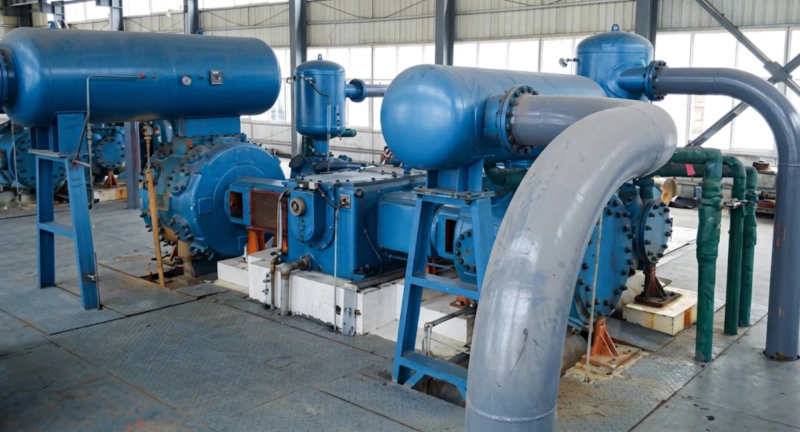
4MW series reciprocating refrigeration compressor at a petrochemical plant — symmetrically balanced frame, 350–1,600 kW, propylene (C₃H₆) refrigerant service for ethylene plant cold train intermediate cooling. The 4MW frame cancels primary forces and couples, producing near-zero foundation vibration essential for 20–25 year continuous-duty service on a rigidly-piped petrochemical refrigerant circuit.
The Ethylene Plant Cold Train: Where Propylene Refrigeration Fits
Steam cracking of naphtha, ethane, or LPG feedstocks produces a mixed cracked gas stream containing ethylene, propylene, methane, hydrogen, acetylene, and heavier hydrocarbons. Separating these components requires a sequence of distillation columns operating at progressively lower temperatures, collectively called the cold train. The cold train uses two or three refrigeration levels supplied by separate refrigerant circuits: propylene refrigeration covers the intermediate temperature range (−20°C to −45°C), and ethylene refrigeration handles the deepest cooling stage (−70°C to −100°C). In some plant designs, a third level using methane or a mixed refrigerant covers the gap between propylene and ethylene.
The propylene circuit at an ethylene plant serves the following process duties simultaneously at different temperature levels:
−20°C to −25°C
−35°C to −40°C
−42°C to −45°C
Why Propylene Is Used as the Intermediate Refrigerant
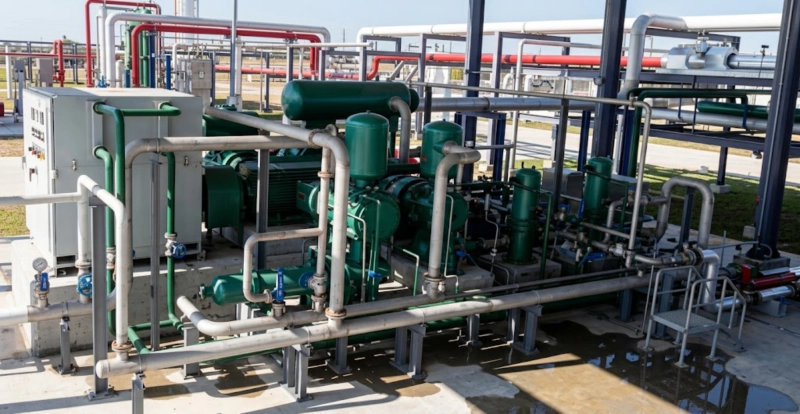
Propylene is chosen as the intermediate refrigerant in the ethylene plant cold train for a combination of thermodynamic and practical reasons. Its normal boiling point of −47.6°C allows it to provide refrigeration at evaporating temperatures down to approximately −45°C at near-atmospheric suction pressure — covering the full intermediate cooling range of the cold train without requiring vacuum suction conditions. Its thermodynamic properties (moderate condensing pressures at ambient temperature, moderate compression ratios per stage, and good volumetric efficiency at the operating conditions of the cold train) are well matched to reciprocating compressor technology at the 350–1,600 kW power level of the 4MW series.
A practical advantage specific to the ethylene plant environment is that propylene is already present on-site as a product of the cracking process. The propylene refrigerant circuit is charged with propylene drawn from the plant’s own propylene product stream — reducing the logistical complexity of refrigerant supply and making the propylene refrigerant circuit essentially self-contained within the plant inventory. Any small leakage of propylene refrigerant is absorbed into the plant’s own propylene handling and recovery systems rather than being released to atmosphere or requiring external refrigerant disposal.
4MW Series Propylene Refrigeration Compressor: Key Specifications
Propylene is a flammable hydrocarbon refrigerant (lower flammability limit 2.0% in air, autoignition temperature 458°C), which means the propylene refrigeration compressor and its associated pipework must meet the hazardous area electrical classification and petrochemical plant safety requirements applicable to flammable gas service at the installation site. In Russia, this is governed by the Rostechnadzor regulations for hazardous production objects (HPOs) under Federal Law 116-FZ, and by the electrical area classification requirements of GOST R IEC 60079 for Zone 1 and Zone 2 hazardous areas.
| Parameter | 4MW Propylene Service Specification |
|---|---|
| Refrigerant | Propylene (C₃H₆, R-1270), polymer-grade or chemical-grade; moisture below 10 ppm |
| Suction pressure range | 1.5–5.5 bar absolute (−45°C to −20°C saturation) |
| Discharge pressure | 14–20 bar absolute (condensing at +30°C to +50°C) |
| Compression stages | 2–3 stage with inter-stage cooling; multi-level suction for cold train duties |
| Lubrication | Hydrocarbon-compatible synthetic oil; oil-free option available for purity-critical duties |
| Seal system | Piston rod distance piece with buffer gas purge (N₂) preventing propylene migration to crankcase |
| Electrical area class | Ex d or Ex e motor; GOST R IEC 60079 Zone 1 or Zone 2 as specified by site |
| Motor voltage | 6 kV or 10 kV; MV explosion-proof motor standard for petrochemical installation |
| Foundation force | Near-zero; symmetrically balanced 4-column frame cancels primary forces and couples |
| GOST-R / regulatory | GOST-R certified; Rostechnadzor HPO documentation; Russian-language equipment passport |
Propylene refrigeration compressor specifications shown for ethylene plant cold train service at standard Russian petrochemical plant conditions. Actual sizing requires a refrigeration load calculation from the process heat and material balance. Contact our engineering team for a detailed specification.
The Piston Rod Distance Piece and Buffer Gas System
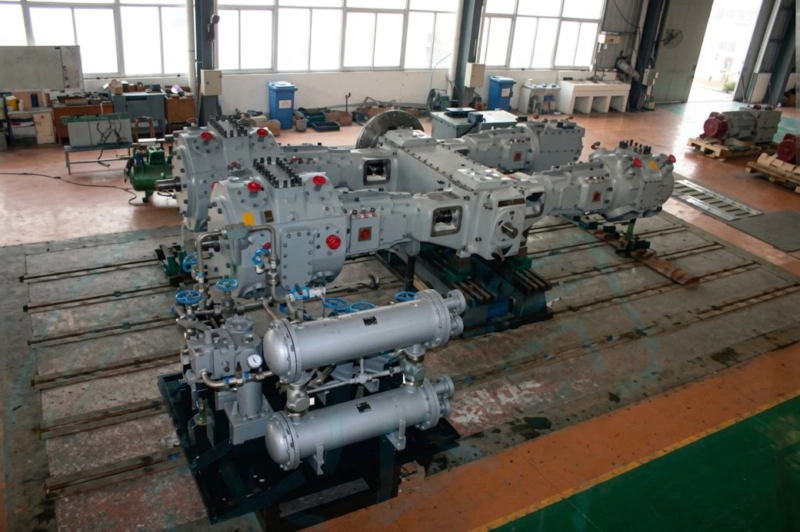
The piston rod seal system of the propylene compressor at an ethylene plant differs from the standard configuration used in nitrogen, oxygen, or NH₃ compressors. Propylene is a flammable gas: any migration of propylene vapour from the compression cylinder into the crankcase — which is at atmospheric pressure and communicates with the compressor enclosure atmosphere — would form a flammable mixture in the crankcase that presents an explosion risk. The standard solution for flammable gas compressors is the double-compartment distance piece with a nitrogen buffer gas purge.
The distance piece is the structural element connecting the cylinder to the crankcase through which the piston rod passes. In the double-compartment design, the piston rod passes through two separate seal chambers: the inner seal (nearest the cylinder) retains the propylene at cylinder pressure, and the outer seal (nearest the crankcase) provides a second barrier. The space between the two seals is continuously purged with nitrogen at a pressure slightly above atmospheric, so that any propylene leakage past the inner seal is swept away by the nitrogen purge flow before it can reach the crankcase. The nitrogen purge vent is directed to a safe location outside the compressor building, and the purge flow rate is monitored to detect inner seal deterioration — a rising purge gas hydrocarbon content signals impending inner seal replacement before any crankcase contamination occurs.
For the propylene refrigeration compressor at an ethylene plant, this nitrogen purge system requires a small continuous nitrogen supply of 1–5 Nm³/h per compressor, typically taken from the plant nitrogen header. The purge nitrogen must be dry (dew point below −40°C) to prevent moisture contamination of the propylene circuit. This is a minor but non-negotiable operating requirement that must be verified during the plant design stage when the nitrogen balance for the facility is being established.
Continuous Duty and Planned Maintenance in Petrochemical Service
The propylene refrigeration compressor at an ethylene plant is a continuous-duty machine that runs 24 hours per day, 330–350 days per year, for the 4–5 year period between planned plant turnarounds. If the propylene compressor trips unplanned, the cold train temperature rises, the deethaniser and C₃ splitter columns lose their reflux, and the ethylene plant must reduce production rate or shut down within hours. This makes the propylene compressor one of the critical rotating machines in an ethylene plant — alongside the cracked gas compressor and the refrigerant compressors at deeper cooling stages.
The maintenance philosophy for the propylene refrigeration compressor in petrochemical service reflects this critical-path status:
Propylene as Feedstock: From Ethylene Plant Product to PET Bottle Raw Material
The propylene in the cold train refrigerant circuit is the same chemical as the propylene monomer that is ultimately polymerised to produce polypropylene (PP) — one of the most widely used packaging materials in the food and beverage industry. PET (polyethylene terephthalate) used in stretch blow moulding is not propylene-based, but the ethylene from the same cold train is a precursor to ethylene glycol, one of the two monomers from which PET resin is produced. The ethylene plant whose propylene refrigeration compressor is described in this guide is therefore directly upstream in the chemical supply chain from the PET resin that feeds an injection stretch blow moulding (ISBM) facility. Reciprocating compressors at the ethylene plant enable the cold train separation that produces the ethylene feedstock from which PET resin — and the PET bottle — is ultimately derived.
FAQ — Propylene Refrigeration Compressor for Ethylene Plant
Request a Propylene Refrigeration Compressor Specification
4MW series propylene compressors for ethylene plant cold train service — multi-level suction, nitrogen buffer gas distance piece, Ex-rated motor, GOST-R certified, full Rostechnadzor HPO documentation. Response within 48 hours.