Selection Guide · Oil-Free Cylinder · Oxygen Compression · GOST 12.2.052 · Safety
The question of whether to specify an oil-free or lubricated cylinder compressor for oxygen service is not a technical trade-off with engineering arguments on both sides — it is a safety and legal requirement with a single correct answer. GOST 12.2.052, Russia’s national standard for equipment working with gaseous oxygen, prohibits the use of hydrocarbon lubricants in contact with the oxygen gas stream at any pressure above 0.5 MPa. Above this threshold, only an oil-free cylinder design complies. This article explains the ignition physics behind the prohibition, why downstream oil filters do not solve the problem, and what an oil-free cylinder design actually consists of in a ZW, DW, or LW series oxygen compressor.
✓ Diesel Effect Ignition
✓ PTFE Self-Lubrication
✓ ZW / DW / LW Series
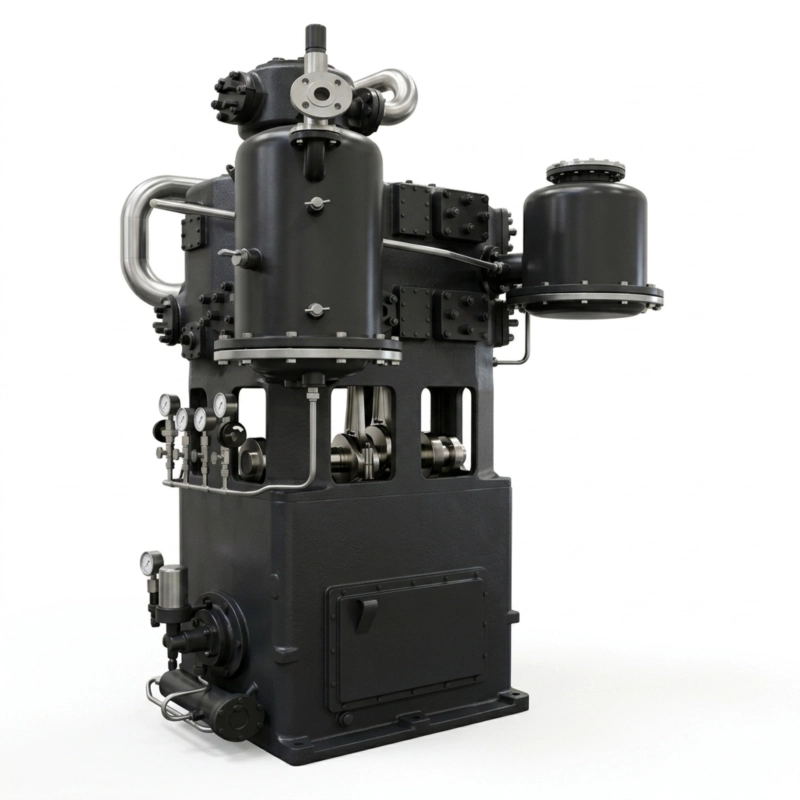
ZW series oil-free oxygen compressor — the cylinder bore, piston, and all components in contact with the oxygen gas stream contain no hydrocarbon lubricant at any point in the compression cycle. PTFE self-lubricating piston rings provide the cylinder bore seal without oil; a labyrinth distance piece with a vented intermediate cavity prevents crankcase oil from migrating along the piston rod. This design is the only configuration that complies with GOST 12.2.052 for oxygen compression above 0.5 MPa.
Why Hydrocarbon Oil and High-Pressure Oxygen Are Incompatible
Oxygen does not burn by itself — it supports combustion by allowing other materials to oxidise rapidly. In the presence of high-pressure oxygen, materials that are stable and non-flammable in air can ignite at temperatures far below their normal ignition point. Mineral oil and synthetic hydrocarbon lubricants are particularly susceptible: their auto-ignition temperature in air is typically 250–370°C, but in high-pressure oxygen the effective ignition threshold can fall below 100°C under certain conditions. The higher the oxygen pressure, the lower the temperature at which ignition can occur.
In a reciprocating compressor cylinder, three mechanisms can generate the local temperature needed to ignite oil in oxygen contact, even when the bulk gas temperature appears to be within normal limits:
Why a Downstream Oil Filter Does Not Solve the Problem

A question that arises in some procurement discussions is whether a lubricated-cylinder compressor can be made acceptable for oxygen service by installing a high-efficiency oil coalescing filter and activated carbon stage downstream of the compressor. The answer, under GOST 12.2.052, is no — and the reason is fundamental rather than bureaucratic.
The GOST 12.2.052 prohibition is on contact between hydrocarbon lubricant and the oxygen gas stream — not on oil content above a detectable limit in the discharge gas. The ignition mechanisms described above — diesel effect, particle impact, catalytic oxidation — occur inside the compressor cylinder, inside the cylinder valves, and in the pipework immediately downstream of the compressor, before any downstream filter. A fire or explosion initiated by diesel effect in the second-stage valve of a lubricated oxygen compressor occurs in the compressor itself, not in the downstream pipework where the filter is installed. A downstream filter that successfully removes all oil from the discharge gas cannot prevent the ignition event from occurring upstream of it.
Engineering Principle
Downstream filtration controls gas purity at the point of use. It does not control the safety of the compression process itself. An oil filter on the discharge of a lubricated oxygen compressor is a gas purity device, not a safety device. The ignition hazard exists in the cylinder, in the valves, and in the inter-stage system — all upstream of the filter. GOST 12.2.052 addresses the safety of the compression process, not only the cleanliness of the delivered gas; this is why the prohibition on hydrocarbon lubricant contact applies regardless of downstream filtration.
What an Oil-Free Cylinder Design Consists Of
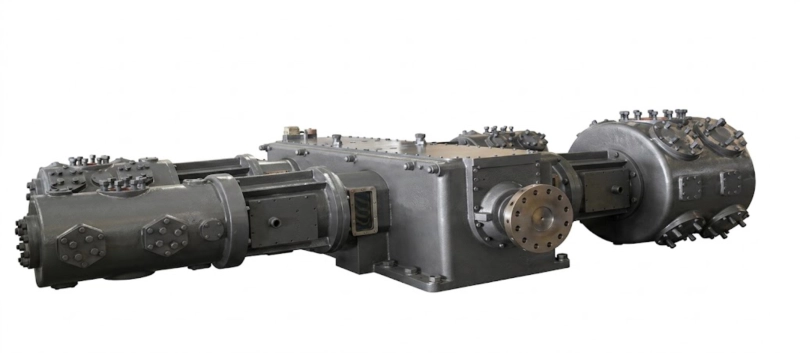
An oil-free cylinder design for oxygen compression achieves lubrication-free operation through two independent systems working together:
The piston rings that seal between the piston and the cylinder bore are made from virgin polytetrafluoroethylene (PTFE) — a polymer with an extremely low coefficient of friction (0.04–0.08 against steel) that self-lubricates through a PTFE transfer film deposited on the bore surface. No oil is required at the ring-bore interface; the PTFE ring provides both the gas-tight seal and its own lubrication throughout its 4,000–8,000 hour service life. For oxygen service, only virgin PTFE rings are acceptable per GOST 12.2.052 — carbon-filled, graphite-filled, and bronze-filled PTFE grades are prohibited.
The piston rod passes from the crankcase — where crankshaft bearings, connecting rod bearings, and crosshead guides are lubricated with mineral oil — into the compression cylinder. The labyrinth distance piece, mounted between the crankcase and the cylinder, houses wiper rings that scrape oil from the descending rod and an intermediate cavity vented to atmosphere. Any oil that passes the wiper rings is discharged to atmosphere at the vent rather than reaching the cylinder. The intermediate cavity acts as a pressure-neutral buffer zone that physically separates the oiled crankcase environment from the oil-free cylinder environment. As discussed in blog-26, this vented double-compartment design is the engineering basis of all compliant oil-free oxygen compressors.
| Design Feature | Lubricated Cylinder | Oil-Free Cylinder | O₂ Service (>0.5 MPa) |
|---|---|---|---|
| Piston ring material | Cast iron or chrome steel | Virgin PTFE | Oil-free only |
| Cylinder lubrication | Oil injected or splash | None — PTFE transfer film | Oil-free only |
| Distance piece | Single compartment or none | Double compartment, vented | Double vented required |
| Piston rod packing | Oil-lubricated metallic rings | Virgin PTFE packing rings | Oil-free only |
| GOST 12.2.052 compliant? | No | Yes | Oil-free mandatory |
The oil-free cylinder specification applies to all oxygen compression above 0.5 MPa without exception. There is no approved partial oil-free design — a compressor either has a fully compliant oil-free cylinder or it does not comply with GOST 12.2.052. The table above reflects the ZW, DW, and LW series oil-free design as standard for all oxygen service models.
The Same Oil-Free Principle in PTFE Ring Maintenance
Understanding the oil-free cylinder requirement has direct implications for maintenance practice. Any maintenance procedure that introduces hydrocarbon contamination to the oxygen-wetted surfaces of an oil-free cylinder — by using petroleum-based thread compounds on cylinder studs, by handling PTFE rings with ungloved oily hands, by using non-approved cleaning agents on the cylinder bore — voids the oil-free status of the cylinder until a full degreasing to GOST 12.2.052 standards (below 50 mg/m² residual hydrocarbon) is completed and documented. An oil-free cylinder that has been contaminated by a maintenance error is not an oil-free cylinder until it has been degreased — and must not be returned to oxygen service without that degreasing and a new degreasing record entry in the equipment passport.
Oil-Free Blow Air in ISBM: Same Prohibition, Different Reason
The requirement for oil-free compressed air in injection stretch blow moulding (ISBM) production of PET bottles is driven by a different concern than GOST 12.2.052 — not ignition risk but food-contact contamination. Blow air at 35–40 bar contacts the interior of the PET bottle preform during the blowing process, and any oil in the blow air is deposited on the food-contact interior surface of the bottle. ISO 8573-1 Class 1 oil content (0.01 mg/m³) is the specification for food-contact blow air — achievable only with a genuinely oil-free compressor design, not with a lubricated machine and downstream filtration. The parallel with the oxygen compressor prohibition is precise: in both cases, downstream filtration does not address the upstream source of contamination, and the only correct solution is an oil-free cylinder design that eliminates the contamination source. The engineering answer is the same — PTFE piston rings and a vented distance piece — even though the reason for requiring it differs between oxygen safety and food-contact purity.
FAQ — Oil-Free vs Lubricated Oxygen Compressor Cylinders
ZW, DW, and LW Series — GOST 12.2.052 Compliant
Oil-free oxygen compressors with virgin PTFE piston rings, double-compartment vented distance piece, copper-free wetted components, and factory degreasing to 50 mg/m² — supplied with full GOST 12.2.052 compliance documentation including akt obezzhirivaniya. GOST-R and EAC certified. Response within 48 hours.