Application Guide · Electronics Fabrication · High-Purity Nitrogen · Semiconductor · Russia
Semiconductor wafer fabrication, flat panel display manufacturing, and printed circuit board production consume large quantities of high-purity nitrogen as a process gas and as an inert atmosphere in diffusion furnaces, sputtering systems, reflow ovens, and wafer storage. The nitrogen compressor in an electronics fabrication facility must deliver N₂ at purity levels of 99.999% or above, at pressures matched to the distribution system, without introducing hydrocarbon or moisture contamination. This guide covers purity requirements, oil-free compressor design, and the ZW and DW series configurations appropriate for semiconductor and electronics manufacturing facilities in Russia and the CIS.
✓ Oil-Free PTFE Cylinders
✓ ZW / DW Series
✓ GOST-R Certified · Russia
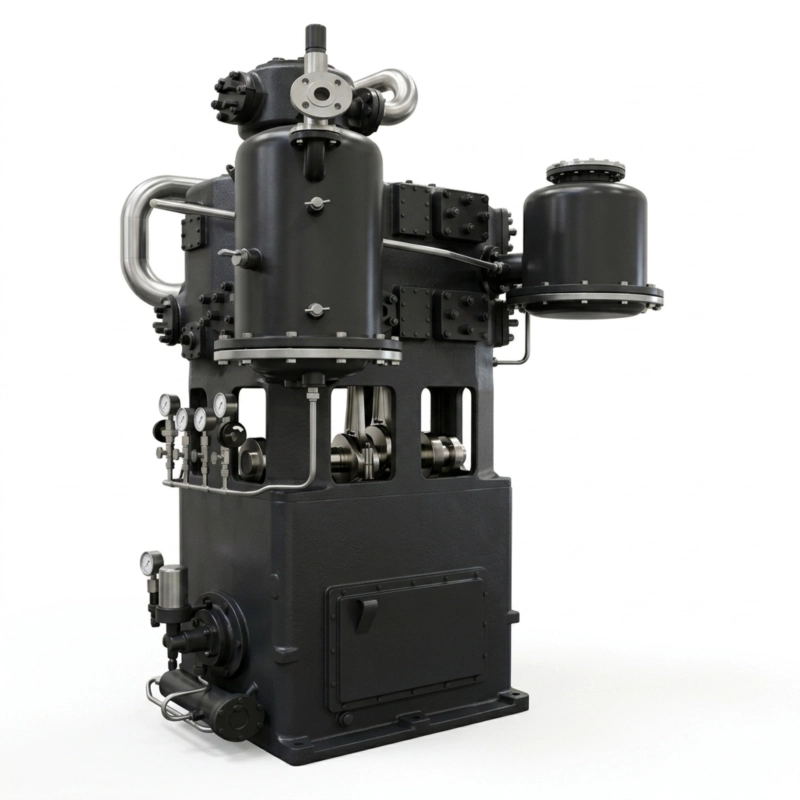
ZW series oil-free nitrogen compressor for electronics fabrication — PTFE self-lubricating piston rings, stainless steel inter-stage pipework, electropolished internal surfaces on request, discharge to 1.0–3.0 MPa distribution header. The oil-free design eliminates hydrocarbon contamination at the compression stage, preserving the 99.999%+ purity of the nitrogen source through to the process tool connection point.
Why Electronics Fabrication Demands 99.999% Nitrogen
Semiconductor and electronics manufacturing processes are uniquely sensitive to trace contamination in the nitrogen atmosphere used throughout the fabrication sequence. Oxygen at concentrations above 1–10 ppm in the nitrogen atmosphere of a diffusion furnace causes uncontrolled silicon oxide growth that degrades gate dielectric properties and alters dopant profiles. Moisture above 1–10 ppm causes similar oxidation effects and also degrades the bonding surfaces of wire bond pads. Hydrocarbon contamination from oil-lubricated compression equipment at concentrations above 0.1 ppm deposits on silicon wafer surfaces, causing photoresist adhesion failures, particle defects, and process yield loss that can reject entire wafer batches.
The purity requirement for nitrogen in semiconductor fabrication is typically expressed as 6N (99.9999%, one part per million total impurities) for the most critical front-end-of-line processes such as gate oxide growth and ion implantation, and 5N (99.999%, ten parts per million total impurities) for less critical back-end processes such as reflow soldering, conformal coating, and component storage blanketing. The nitrogen compression system must preserve this purity from the source — whether liquid nitrogen vaporiser, on-site PSA or VPSA generator, or pipeline nitrogen supply — through to the process tool point of use.
| Process | N₂ Purity | Max O₂ | Max H₂O | Max HC |
|---|---|---|---|---|
| Diffusion / oxidation furnace | 6N (99.9999%) | 1 ppm | 1 ppm | 0.1 ppm |
| Ion implantation | 6N (99.9999%) | 1 ppm | 1 ppm | 0.1 ppm |
| Sputtering / PVD deposition | 5N (99.999%) | 5 ppm | 5 ppm | 0.5 ppm |
| PCB reflow soldering | 5N (99.999%) | 10 ppm | 10 ppm | 1 ppm |
| Wafer storage blanketing | 5N (99.999%) | 10 ppm | 10 ppm | 1 ppm |
| Display panel blanketing (TFT-LCD / OLED) | 5N (99.999%) | 5 ppm | 5 ppm | 0.5 ppm |
Purity requirements shown are representative industry values. Specific tool and process requirements vary by equipment manufacturer and process node. The nitrogen compression system must not add any impurity to the nitrogen; source purity sets the ceiling, and the oil-free compressor design ensures the ceiling is maintained through to the distribution header.
Why Oil-Free Is Mandatory for Electronics Nitrogen Compression

Unlike the oil-free requirement for oxygen compression — which is driven by safety (GOST 12.2.052 prohibits hydrocarbon lubricants in oxygen service above 0.5 MPa to prevent ignition) — the oil-free requirement for electronics nitrogen compression is driven entirely by product purity and process yield. Nitrogen itself is inert and presents no safety hazard with hydrocarbon lubricants. But a conventional lubricated-cylinder nitrogen compressor introduces oil aerosol into the nitrogen stream at concentrations of 1–10 mg/m³ (1,000–10,000 ppb by mass) even with a high-efficiency coalescing oil separator downstream. This oil carry-over level is 10,000 to 100,000 times above the maximum hydrocarbon limit for critical semiconductor processes.
Downstream activated carbon filters can reduce oil carry-over further, but they cannot guarantee the sub-0.1 ppm hydrocarbon levels required for diffusion furnace and ion implantation nitrogen service throughout the filter service life. The filter must be replaced before breakthrough, but breakthrough monitoring for sub-ppm hydrocarbons requires continuous inline hydrocarbon analysers at every process tool — an instrumentation cost that exceeds the cost difference between a lubricated and an oil-free compressor many times over. The oil-free nitrogen compressor with PTFE self-lubricating piston rings eliminates this problem at the source: with no oil in the compression cylinder, there is no oil carry-over to filter, no filter to replace, and no breakthrough risk to monitor.
ZW and DW Series: Oil-Free Nitrogen for Electronics
The ZW and DW series nitrogen compressors in the oil-free PTFE cylinder configuration are the standard specification for electronics fabrication nitrogen supply in Russia and the CIS. The oil-free option uses virgin PTFE or food/pharmaceutical-grade PTFE compound piston rings that self-lubricate against the cylinder bore without mineral oil, and a single-compartment labyrinth distance piece that prevents crankcase oil from migrating into the compression space. The configuration is mechanically simpler than the double-compartment distance piece required for oxygen and flammable gas compression — nitrogen purity being the driver rather than safety — but the PTFE ring specification and assembly cleanliness requirements are stricter than for standard nitrogen service.
Nitrogen Flow and Pressure Requirements for Electronics Facilities
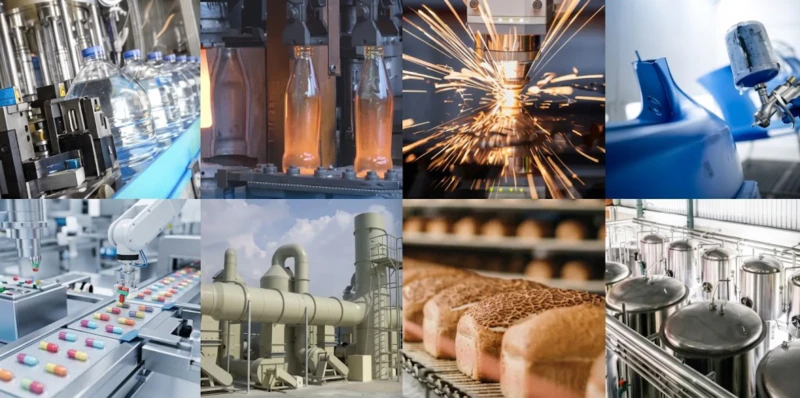
The nitrogen flow and delivery pressure for an electronics fabrication facility depend on the production scale and the range of processes served. A small PCB assembly facility may consume 20–50 Nm³/h of 5N nitrogen at 0.5–0.8 MPa for reflow ovens and selective soldering machines. A medium semiconductor wafer fabrication facility (8-inch wafer line at 10,000–20,000 wafer starts per month) may consume 200–500 Nm³/h of 6N nitrogen at 0.8–1.2 MPa for the distribution header serving diffusion, CVD, and implant tools. A large flat panel display facility may consume 1,000–3,000 Nm³/h of 5N nitrogen at 0.6–1.0 MPa for the panel processing atmosphere and robotic transfer systems.
| Facility Type | N₂ Flow (Nm³/h) | Purity | Delivery Pressure | Series |
|---|---|---|---|---|
| PCB assembly / SMT | 10–50 | 5N (99.999%) | 0.5–0.8 MPa | ZW series |
| LED / power device fab | 50–200 | 5N–6N | 0.8–1.5 MPa | ZW or DW |
| Semiconductor wafer fab | 200–500 | 6N (99.9999%) | 0.8–1.5 MPa | DW series |
| Flat panel display (TFT / OLED) | 500–3,000 | 5N (99.999%) | 0.6–1.2 MPa | DW or LW series |
All configurations oil-free PTFE cylinder, virgin PTFE for 6N semiconductor service. Source nitrogen purity must match or exceed the required process purity; the compressor does not upgrade purity, it compresses without degrading it. For source nitrogen below 5N purity (e.g. membrane or PSA generator), a purifier is required upstream of the compressor to meet semiconductor purity requirements.
Nitrogen Purity in ISBM Production: Electronics Grade vs Industrial Grade
The contrast between electronics-grade nitrogen (5N–6N, sub-ppm hydrocarbon) and the industrial-grade nitrogen used in injection stretch blow moulding (ISBM) resin handling systems illustrates how nitrogen purity requirements scale with process sensitivity. ISBM facilities use nitrogen at 99.5–99.9% purity (3N–4N) for resin blanketing and hopper padding — three to four orders of magnitude less pure than the nitrogen used in semiconductor furnaces, and supplied by PSA generators or liquid nitrogen at a cost per cubic metre that is a small fraction of electronics-grade nitrogen. What both applications share is the oil-free requirement at the compression stage: even in ISBM resin blanketing service, oil carry-over from a lubricated compressor would coat the resin pellets and cause processing defects. The oil-free PTFE cylinder ZW series is appropriate for both applications — at the low-purity end for ISBM resin blanketing, and at the high-purity end for electronics fabrication — with the PTFE ring grade and assembly cleanliness level adjusted to match the purity requirement.
FAQ — Nitrogen Compressor for Electronics Fabrication
Request an Oil-Free Nitrogen Compressor for Electronics
ZW and DW series oil-free nitrogen compressors for semiconductor, display, and PCB fabrication — virgin PTFE or pharmaceutical-grade rings, stainless steel gas path, electropolished option for 6N service. GOST-R certified, Russian-language documentation. Response within 48 hours.