
Application Guide · NH₃ Compressor · Fish Processing · Blast Freezing · −40°C · Russia
Russian fish processing plants in Murmansk, Vladivostok, Kamchatka, and Sakhalin operate under conditions that place extreme demands on the refrigeration compressor: evaporating temperatures of −38°C to −43°C for blast freezing tunnels, ambient temperatures that swing from −30°C in winter to +30°C in summer, remote locations far from service infrastructure, and safety requirements under GOST 26790 for ammonia systems in food production facilities. Getting the ammonia compressor selection and the two-stage system design right is not a minor engineering detail — it is the difference between a blast freeze tunnel that meets the −18°C product core temperature requirement in 4 hours versus one that takes 7 hours and reduces throughput by 40%. This guide covers the complete engineering and compliance picture for NH₃ blast freeze compressor selection at Russian fish processing plants.
✓ −40°C Evaporating
✓ GOST 26790 Compliance
✓ Remote Site Reliability
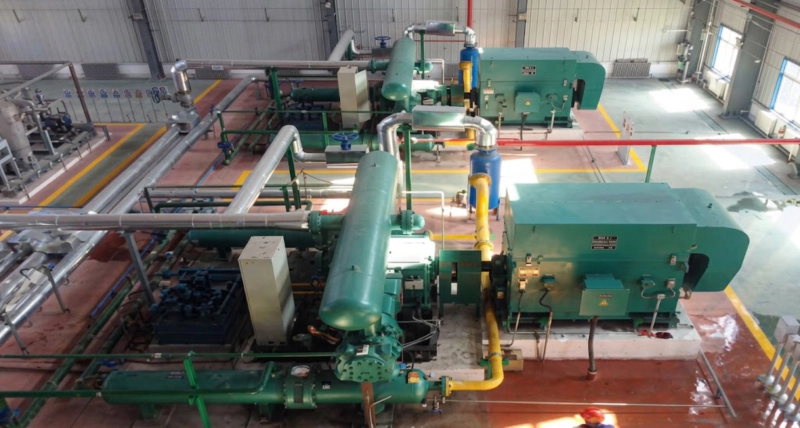
4MW series ammonia refrigeration compressor at a large Russian fish processing facility — the two-stage NH₃ system with low-stage and high-stage 4MW machines and a flash vessel is the standard configuration for blast freeze tunnel duty at −40°C to −43°C evaporating. The single-stage compression ratio at −40°C evaporating and +35°C condensing reaches 18.8:1, producing discharge temperatures above 185°C — far beyond the 145°C safe operating limit. Two-stage compression reduces each stage to approximately 4.3:1, limiting discharge temperatures to 105°C–115°C.
Evaporating
Mandatory
Required
Series
COP Gain
Why Fish Processing Demands the Deepest Blast Freeze Temperatures
Russian fish processing plants operating under TR CU 040/2016 and the fisheries-specific sanitary requirements (SanPiN 2.3.4.050-96 for fish processing) must achieve a product core temperature of −18°C or below before the product can be labelled as frozen fish and dispatched to retail or export. The time within which this core temperature must be reached is not directly specified in the Russian standard, but the commercial reality of fish processing — where catch processing must match the landing rate of vessels operating on 8–24 hour catch cycles — means that blast freeze cycle times must be short enough to clear the freeze tunnel between vessel landings.
For a 10 kg whole gutted pollock or cod block, achieving a product core temperature of −18°C requires a blast tunnel air temperature of at least −35°C to −40°C and an air velocity above 3 m/s, producing a freeze cycle time of 3.5–5 hours. A tunnel operating at only −28°C air temperature (achievable from single-stage ammonia compression) requires 7–9 hours for the same product — nearly double the cycle time. For a fishing port landing 500 tonnes of catch per day, this difference in blast tunnel cycle time translates directly into capital investment in tunnel capacity: two tunnels at −40°C evaporating replaces three or four tunnels at −28°C to achieve the same daily throughput. The deeper evaporating temperature is not a luxury but a throughput and capital efficiency requirement.
The practical consequence for the refrigeration system is that the blast freeze evaporating temperature must be −38°C to −43°C — set 5–8°C below the target tunnel air temperature to maintain the required temperature difference driving the heat transfer from the product. At −40°C evaporating temperature with ammonia, single-stage compression is thermodynamically impossible within safe discharge temperature limits, making two-stage NH₃ compression with a flash vessel the only compliant design option.
Two-Stage NH₃ System Design for Blast Freeze Duty
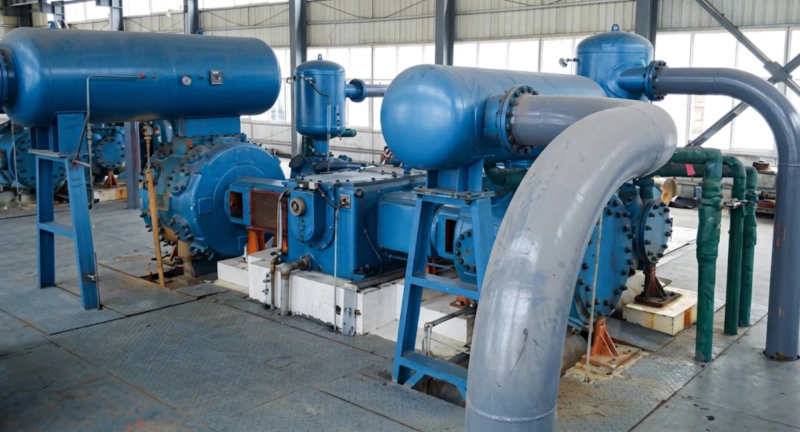
The two-stage NH₃ ammonia compressor system for blast freeze duty consists of three main compression and heat exchange components: the low-stage compressor, the flash vessel (intermediate pressure vessel), and the high-stage compressor. Understanding how these three interact determines the correct sizing of each component and the selection of the low-stage and high-stage machine models from the DW or 4MW series.
Compressor Sizing Example: 500 kW Blast Freeze at −40°C
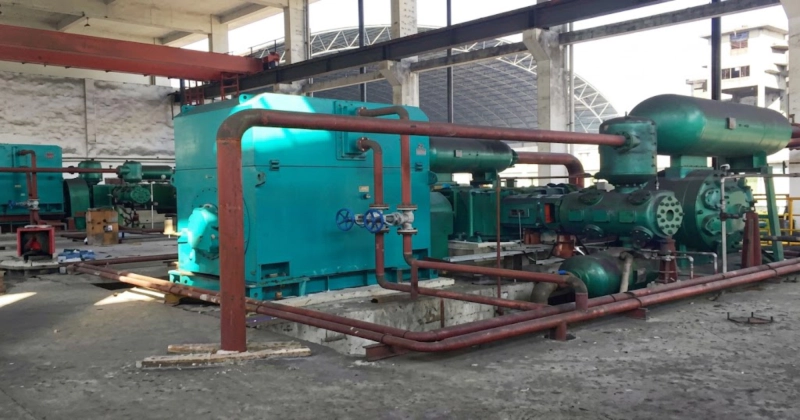
The following sizing example uses a reference blast freeze installation that is representative of a medium-scale Russian fish processing plant: two blast freeze tunnels at 250 kW each (500 kW total), operating at −40°C evaporating temperature, with a summer condensing temperature of +35°C and an intermediate flash vessel temperature of −5°C:
Discharge: −5°C / 0.31 MPa
Ratio: 4.3:1
Refrigerating capacity: 500 kW
Mass flow: ≈ 430 kg/h NH₃
Volumetric flow (suction): ≈ 11.2 m³/min
Series: 4MW series, 350–450 kW shaft
Saturation temperature: −5°C
Function: sub-cool + de-superheat
Flash gas fraction: ≈ 15%
Volume: 0.6–1.0 m³
GOST R 52630 pressure vessel
Design pressure: 1.8 MPa
Discharge: +35°C / 1.35 MPa
Ratio: 4.4:1
Mass flow: ≈ 495 kg/h NH₃
Volumetric flow (suction): ≈ 1.6 m³/min
Shaft power: ≈ 180–220 kW
Series: DW series, 200–250 kW shaft
Values calculated at standard NH₃ thermodynamic properties. Actual compressor selection requires a full heat balance at the site’s specific condensing conditions. Summer (+35°C) and winter (+5°C to −20°C) condensing conditions both require verification to ensure neither creates an off-design condition that exceeds compressor operating limits.
GOST 26790 Compliance at Fish Processing Sites
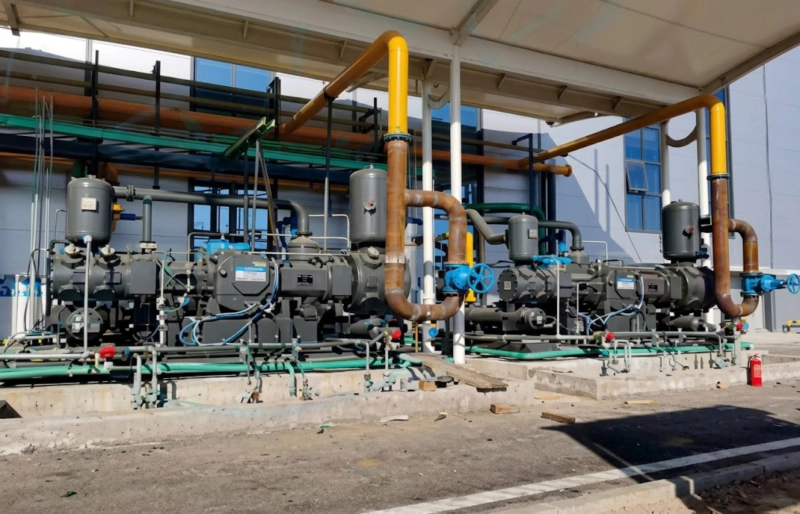
GOST 26790 governs the safety requirements for ammonia refrigeration systems at Russian food production and processing facilities. At a fish processing plant, several provisions of GOST 26790 have practical implications for the compressor room layout and the safety system specification that go beyond what is typically required at an industrial gas or chemical facility:
GOST 26790 requires continuous NH₃ concentration monitoring in the compressor room, the machine room, and any area where NH₃ pipework passes through a food production zone. Alarm threshold: 20 mg/m³ (approximately 26 ppm by volume). Automatic compressor trip and ventilation initiation: 60 mg/m³ (78 ppm). At fish processing plants where ammonia systems pass through or adjacent to raw fish handling areas, the ammonia sensor coverage must extend into the production floor as well as the plant room, with evacuation alarm capability covering the entire building zone served by the refrigeration system.
Minimum 8 air changes per hour in the compressor room under normal operation; minimum 12 air changes per hour on emergency ventilation activation. The emergency ventilation must activate automatically when the NH₃ sensor reaches the alarm threshold and must continue operating even after compressor trip, to clear any released ammonia from the compressor room before maintenance access is permitted. At northern Russian sites where the ambient temperature falls below −30°C in winter, the ventilation supply air must be pre-heated to prevent freezing of compressor cooling water and instrument lines.
GOST 26790 and the Russian Technical Regulations for food safety (TR CU 021/2011) together impose a requirement that ammonia pipework within food production zones (including blast freeze tunnels that also serve as temporary fish holding areas during the freeze cycle) must be designed to limit the maximum possible ammonia release from any single pipe failure to the level that can be safely dispersed by the emergency ventilation without requiring product recall. Modern Russian fish processing plants use secondary refrigerant systems (propylene glycol or CO₂ as secondary) for the tunnel evaporators, with the primary NH₃ system contained within the compressor room and plant room, specifically to satisfy this food-contact zone ammonia charge limitation requirement.
At Murmansk, Vladivostok, and Kamchatka sites, winter ambient temperatures fall to −25°C to −35°C. When the outdoor condenser operates in these conditions, the condensing pressure drops dramatically — at −20°C ambient with an evaporative condenser, NH₃ condensing pressure may fall to 0.3–0.5 MPa (+0°C to −10°C condensing temperature). At this low condensing pressure, the high-stage compression ratio falls below 1.5:1 and the high-stage compressor may not develop adequate pressure to keep the flash vessel at the correct intermediate pressure. The system design must include a minimum condensing pressure control strategy — typically a partial condenser bypass that maintains condensing pressure above 0.6 MPa in winter — to keep both compression stages operating within their design envelope.
Fish Processing and ISBM: Two Industries Linked by PET Packaging and Cold Chain
The fish processing industry and the PET packaging industry are directly linked in the Russian food supply chain: frozen fish products dispatched from Murmansk, Vladivostok, or Kamchatka for retail sale are packaged in PET trays, MAP bags, and portion containers that are produced on injection stretch blow moulding (ISBM) machines at packaging facilities closer to the distribution points. The blast freeze quality achieved by the NH₃ system described in this guide — which determines the ice crystal size in the frozen fish and therefore the drip loss and texture on thawing — is ultimately reflected in the retail product that the consumer evaluates. A fish processor who operates a correctly-sized two-stage NH₃ system achieving genuine −40°C evaporating temperature produces a product with smaller ice crystals and lower drip loss than a plant running at −28°C — a quality difference that supports a premium price point and justifies the investment in proper blast freeze infrastructure. The PET packaging that contains this premium product is produced on ISBM machines with the same engineering discipline — controlled process parameters, documented maintenance, certified materials — that distinguishes a correctly-operated NH₃ blast freeze system from an under-specified one.
FAQ — NH₃ Compressor for Fish Processing Blast Freezing
NH₃ Ammonia Compressors — 4MW and DW Series for Fish Processing Blast Freeze
4MW series (350–1,600 kW, low-stage) and DW series (55–350 kW, high-stage) ammonia refrigeration compressors for two-stage blast freeze systems at −38°C to −43°C evaporating — full ammonia compressor GOST 26790 and OPO compliance documentation, winter condensing pressure control specification, and remote site spare parts stocking included. Provide your blast freeze capacity, evaporating temperature, site location, and summer/winter ambient conditions for a complete two-stage system specification within 48 hours.