LNG Pre-Cooling Compressor: Propane Refrigeration for Liquefaction Train Feed Gas Cooling

Application Guide · LNG Pre-Cooling · Propane Refrigeration · Liquefaction Train · Russia / CIS

Natural gas liquefaction requires cooling the feed gas from ambient temperature down to approximately −162°C for storage and export as LNG. This large temperature range is divided among multiple refrigeration stages. The propane pre-cooling stage — the first and warmest refrigeration stage — cools the feed gas from ambient to approximately −30°C to −40°C before the cryogenic stages take over. The LNG pre-cooling compressor handles propane (C₃H₈) refrigerant at 300–1,600 kW for periods of continuous duty measured in years between planned maintenance shutdowns. This guide covers the selection and design requirements for this service in Russia and the CIS.

✓ Propane · C₃H₈ Refrigerant
✓ −30°C to −40°C Pre-Cooling
✓ 4MW / DW Series
✓ GOST-R Certified · Russia
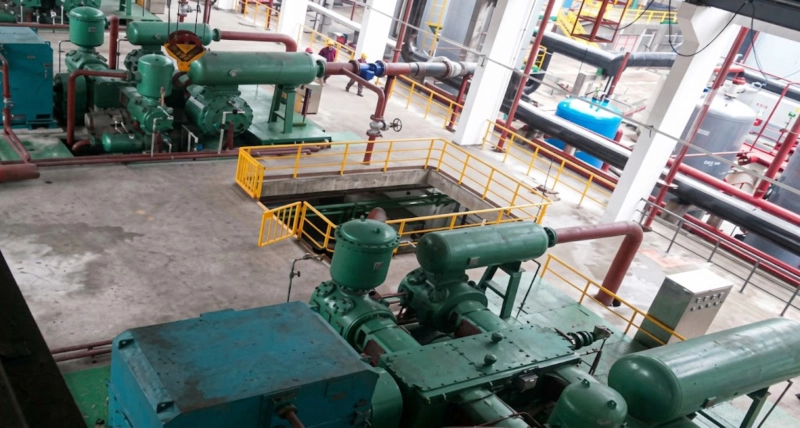
4MW series LNG pre-cooling compressor propane refrigeration liquefaction train Russia GOST-R opposed balance

4MW series reciprocating compressor in propane refrigeration service at a gas processing and liquefaction facility — symmetrically balanced four-column frame, 350–1,600 kW. This machine must run continuously for 3–5 years between planned turnarounds. Near-zero foundation force from the 4MW frame protects welded propane refrigerant pipework integrity throughout the plant design life of 25–30 years.

Propane (C₃H₈)
Refrigerant
−30°C to −40°C
Pre-Cooling Range
300–1,600 kW
Compressor Power
3–5 Years
Between Turnarounds
GOST-R
Certified · Russia

The LNG Liquefaction Process: Where Pre-Cooling Fits

Liquefied natural gas is produced by cooling purified natural gas (predominantly methane) from ambient temperature to approximately −162°C, at which point methane condenses to liquid at near-atmospheric pressure, reducing its volume by approximately 600:1 for efficient storage and marine transport. Achieving this 180–200°C temperature reduction economically requires dividing the cooling duty among multiple refrigeration stages, each operating at a different temperature level with an appropriate refrigerant. In the standard propane-precooled mixed refrigerant (C3MR) liquefaction process — the most widely used small and medium-scale LNG liquefaction technology — the three stages are:

1
Propane Pre-Cooling Stage (+ambient to −35°C)
The LNG pre-cooling compressor circulates propane refrigerant through heat exchangers that cool the feed gas from ambient (typically +15°C to +35°C at Russian Far East and Arctic LNG sites) down to −30°C to −40°C. This stage removes the largest heat duty per unit of temperature reduction, since the specific heat capacity of the gas is highest near ambient conditions. The propane pre-cooling stage also pre-cools the mixed refrigerant of the next stage before it enters the main cryogenic heat exchanger.
2
Mixed Refrigerant Stage (−35°C to −100°C)
A mixed refrigerant (MR) composed of nitrogen, methane, ethane, propane, and heavier components cools the pre-cooled feed gas from −35°C to approximately −100°C through the main cryogenic heat exchanger (MCHE). The MR composition is tuned to match the cooling curve of the gas stream, maximising thermodynamic efficiency across the temperature range. The mixed refrigerant compressor is a separate, larger machine from the propane pre-cooling compressor.
3
End-Flash Stage (−100°C to −162°C)
The final temperature reduction to −162°C is achieved by Joule-Thomson expansion of the partially liquefied gas across a control valve, producing the final LNG product. The flash gas generated in this step is recovered as fuel gas or recompressed for injection back into the liquefaction train. No separate refrigerant compressor is needed for this stage.

Propane vs Propylene for LNG Pre-Cooling
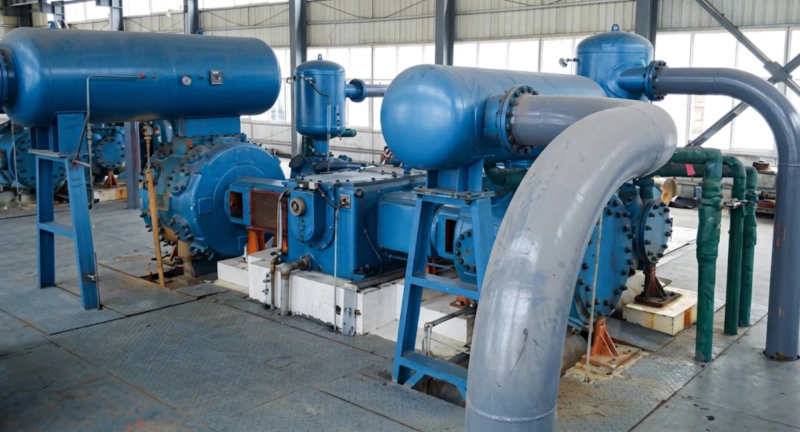
propane refrigeration compressor LNG pre-cooling vs propylene comparison 4MW series Russia natural gas liquefaction

Both propane (C₃H₈) and propylene (C₃H₆) are used as refrigerants in the pre-cooling stage of LNG and gas liquefaction plants, and their thermodynamic properties are similar enough that either can be used in the same temperature range. The selection between the two in any given project comes down to availability and cost at the specific installation site.

Property Propane (C₃H₈) Propylene (C₃H₆)
Normal boiling point −42.1°C −47.6°C
Condensing pressure at +35°C 13.7 bar abs 18.2 bar abs
Suction pressure at −40°C 1.0 bar abs 1.5 bar abs
Compression ratio at −40°C / +35°C ≈ 13.7:1 ≈ 12.1:1
Flammability limits in air 2.1–9.5% 2.0–11.1%
Preferred at LNG sites Standard choice (C3MR process) Where on-site supply available
Compressor specification Same as propylene; lubricated cylinder, N₂ buffer purge Same as propane; slightly higher discharge pressure

Pressures and properties at standard conditions. The 4MW series compressor configuration for propane and propylene pre-cooling service is identical in frame type and seal design; the cylinder sizing and motor power differ to account for the different thermodynamic properties of each refrigerant. Specify the intended refrigerant when requesting a quotation.

Multi-Level Suction: One Machine Serving Three Pre-Cooling Levels

The propane stage in the C3MR process typically operates at three evaporating temperature levels simultaneously, serving different heat exchangers in the liquefaction train at −5°C, −20°C, and −35°C (or similar, depending on plant design). Rather than installing three separate compressor machines for the three levels, the standard engineering practice is to use a single multi-stage reciprocating compressor with intermediate suction connections at the pressure corresponding to each evaporating level.

This multi-level suction arrangement is one of the key advantages of reciprocating compressor technology for LNG pre-cooling service at small to medium liquefaction plant capacities. A single 4MW series propane compressor with intermediate suction nozzles at the first and second stage inlet can serve all three temperature levels simultaneously — the warmest level gases enter at the third-stage suction, the middle level gases enter at the second-stage suction, and the coldest level gases enter at the first-stage suction — all compressed to the common condensing pressure in the final stage. This arrangement reduces installed equipment count, simplifies the refrigerant pipework, and reduces the total foundation area required in the compressor building compared with three separate machines.

Multi-Level Propane Pre-Cooling: Pressure and Temperature at Each Stage Suction
Suction Point Evap. Temp. Suction Pressure Process Duty
1st stage (coldest) −35°C to −40°C 1.0–1.3 bar Deepest pre-cooling of feed gas and MR pre-cooling
2nd stage inter. suction −18°C to −22°C 2.5–3.5 bar Intermediate feed gas cooling and MR sub-cooling
3rd stage inter. suction −3°C to −7°C 5.0–6.5 bar Warm pre-cooling of feed gas and C₃+ removal condensing

Discharge to condenser: +35°C condensing / 13.7 bar abs (propane). All three suction flows are mixed and compressed to condensing pressure in the final stage of the multi-stage machine.

LNG Pre-Cooling Compressor Operating Requirements
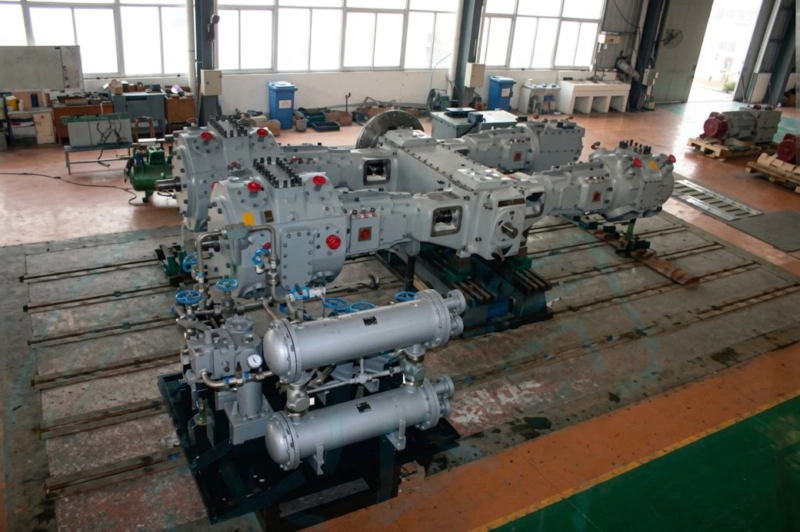
LNG pre-cooling compressor propane operating requirements N2 buffer purge explosion proof motor Russia 4MW series

The operating requirements for the LNG pre-cooling compressor are shaped by the combination of flammable refrigerant, continuous-duty process criticality, and the remote or harsh-environment locations of many Russian LNG and gas liquefaction facilities:

Explosion-Proof Motor
All electrical equipment on the LNG pre-cooling compressor — motor, local control panel, instrumentation — is specified for Zone 1 or Zone 2 hazardous area classification per GOST R IEC 60079. The 6 kV or 10 kV Ex d (flameproof) or Ex e (increased-safety) motors used on the 4MW series are rated for the specific gas group and temperature class of propane or propylene at the installation site.
Nitrogen Buffer Purge
The double-compartment distance piece with continuous nitrogen purge is mandatory for all flammable gas compressors at LNG facilities, as described for propylene service in blog-13. Purge gas consumption is 1–5 Nm³/h per compressor, taken from the plant nitrogen system. The purge vent hydrocarbon content is monitored continuously as an indicator of inner piston rod packing condition.
Low-Temperature Ambient Capability
LNG facilities in Russia’s Arctic and sub-Arctic regions — Yamal, Sakhalin, the Kola Peninsula — experience ambient temperatures down to −40°C to −55°C in winter. The LNG pre-cooling compressor must maintain reliable starting and operation at these temperatures. The 4MW series is available with cold-climate packages: low-temperature lubricating oil, pre-heating of the crankcase before start, trace heating of instrument lines, and motor winding pre-heating to prevent condensation during standby periods.
Anti-Surge and Capacity Control
Reciprocating LNG pre-cooling compressors use suction valve unloading for capacity control — reducing compressor output to 75%, 50%, or 25% of rated capacity without stopping the machine. This allows the pre-cooling duty to be matched to the liquefaction train throughput during start-up, planned rate reductions, and feed gas composition changes without requiring compressor shutdown. Capacity control signals come from the plant DCS via a 4–20 mA control interface.

LNG Pre-Cooling Compressor — Cold-Climate Specification Summary

Minimum ambient: −55°C (Yamal / Arctic specification); −40°C standard
Crankcase pre-heat: Electric immersion heater, thermostat-controlled, 240V or 380V
Lube oil grade: Synthetic PAO (polyalphaolefin) rated to −50°C pour point for cold-start capability
Instrument lines: Electrical trace heating on all propane-side instrument connections with freeze protection to −55°C
Motor winding heater: Anti-condensation heater active during standby in cold-climate service
Painting system: GOST corrosion-resistant coating system suitable for Arctic coastal environment
Related Application · Plastics Manufacturing

Natural Gas Supply Chain: From LNG to PET Bottle Production Energy

Russian gas liquefaction from facilities on Sakhalin, Yamal, and the Kola Peninsula supplies natural gas to markets across Asia and Europe, where it is used as a fuel source in power generation and industrial processes. Injection stretch blow moulding (ISBM) facilities in these export markets use electricity and heat generated from natural gas — the energy carrier whose liquefaction required the propane compressor described in this guide. There is also a direct material connection: natural gas (methane) is one of the feedstocks for the production of ethylene via steam cracking; ethylene is a precursor to ethylene glycol, which is copolymerised with terephthalic acid to produce PET resin, from which PET bottles are produced on ISBM machines. The LNG pre-cooling compressor sits at the beginning of the natural gas supply chain that ultimately enables both the energy supply and the chemical feedstock supply for PET bottle manufacturing.

Related equipment: One-step three-station ISBM machines for PET bottle production — powered by electricity from gas-fired generation and using PET resin derived from ethylene, both ultimately traceable to the natural gas supply chain where LNG pre-cooling compressors operate.

ISBM Machine ›injectionstretchblowmolding.com

FAQ — LNG Pre-Cooling Compressor

Q1: Why is propane the standard refrigerant for LNG pre-cooling rather than NH₃ or CO₂?
Propane is used for LNG pre-cooling for two reasons. First, it is chemically compatible with the natural gas environment of an LNG facility: a propane refrigerant leak mixes with the plant’s own gas handling systems rather than introducing a foreign chemical. NH₃ would contaminate the natural gas stream and the the liquefied gas product if it leaked into the process side, which is unacceptable at an gas export facility where product quality specifications are strict. CO₂ at the pressures required for pre-cooling service (13–70 bar) would require a very different compressor and piping specification from the propane circuit, with no advantage over propane in this temperature range. Second, propane is already present on-site at most natural gas processing facilities as a natural gas liquid (NGL) product — making refrigerant supply, top-up, and inventory management straightforward without external refrigerant logistics.
Q2: Can a DW series compressor handle the LNG pre-cooling duty at a small liquefaction plant?
Yes. The DW series covers LNG pre-cooling duty for small liquefaction plants producing below approximately 100,000 tonnes of LNG per year, where the propane refrigeration duty falls below 350 kW. Small-scale LNG plants — peak-load buffer facilities, isolated community gas supply, and marine bunkering supply — are a growing segment in Russia and the CIS, particularly in regions remote from the main gas pipeline network. A DW series propane compressor at 55–350 kW serves a small liquefaction train of 5,000–80,000 tonnes LNG per year, with the same opposed-balance frame design that makes it suitable for permanent rigidly-piped installation in a continuously operating gas facility. For larger plants, the 4MW series is standard.
Q3: What information is needed to specify an LNG pre-cooling compressor?
To specify a propane compressor for an LNG or gas liquefaction facility, our engineering team requires: Liquefaction plant capacity (tonnes per day or per year); refrigerant (propane or propylene); number of evaporating temperature levels and heat duty at each level (kW); site ambient design temperature (minimum and maximum, for condenser and cold-climate specification); whether multi-level suction from a single machine is required; site hazardous area classification (Zone 1 or Zone 2); motor voltage (6 kV or 10 kV); and whether a cold-climate package is needed (minimum ambient temperature at site). If a process design basis from the liquefaction plant licensor is available, it contains the refrigeration load and evaporating temperature data. Our engineering team responds within 48 hours with a compressor configuration and preliminary quotation.
Engineering Enquiry

Request an LNG Pre-Cooling Compressor Specification

4MW and DW series propane compressors for gas liquefaction pre-cooling — multi-level suction, nitrogen buffer purge, Ex-rated motor, Arctic cold-climate package, GOST-R certified. Response within 48 hours.