Technical Guide · Reciprocating Compressor Design · L-Type vs Opposed-Balance · Russia
The choice between an L-type and an opposed-balance reciprocating compressor frame is one of the most consequential decisions in compressor system engineering — yet it is frequently reduced to a simple price comparison. This guide explains the mechanical principles behind each frame type, quantifies the vibration difference, and demonstrates why the correct frame choice determines the long-term maintenance cost and service life of both the compressor and its connected pipework.
✓ Opposed-Balance · DW / LW / 4MW Series
✓ N₂ / O₂ / CO₂ / NH₂ / H₂
✓ GOST-R Certified · Russia
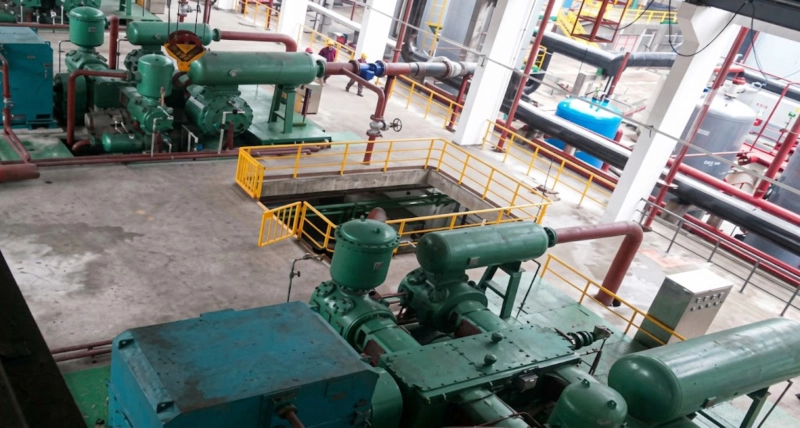
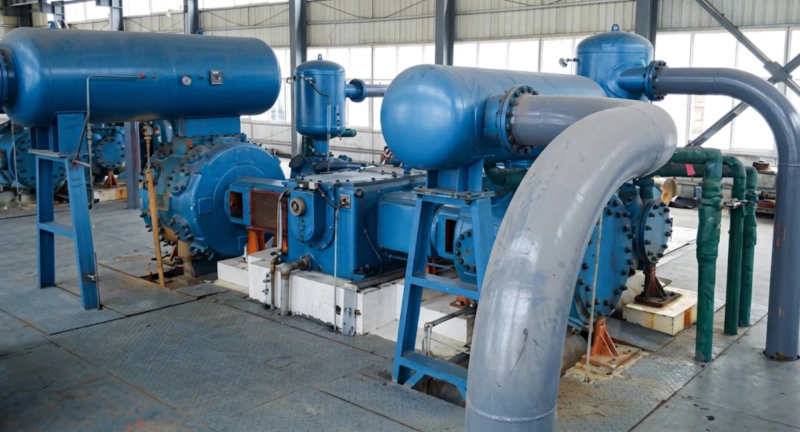
4MW series opposed-balance reciprocating compressor in service at an industrial gas facility — symmetrical balanced frame with near-zero primary force transmission to foundation and connected pipework. This design is the standard specification for permanent process plant installations requiring continuous duty over 20–30 year service lives.
The Inertia Force Problem in Reciprocating Compressors
Every reciprocating compressor — whether it compresses nitrogen, oxygen, CO₂, ammonia, hydrogen, or atmospheric air — works by accelerating and decelerating a mass (the piston, piston rod, and crosshead) back and forth inside a cylinder. By Newton’s second law, any mass undergoing acceleration produces a force. In a reciprocating compressor, this force alternates in direction with every stroke: the piston accelerates toward the cylinder head on the compression stroke, then decelerates and reverses toward the back end on the return stroke. The alternating force generated by this motion is called the primary inertia force, and it acts along the cylinder axis at twice the crankshaft rotation frequency in first-order terms.
This primary inertia force is transmitted from the piston through the crosshead, connecting rod, crankshaft, and crankcase to the machine foundation. It is also transmitted — via the cylinder nozzle connections — to every pipe flange, gasket, and bolted joint in the suction and discharge pipework connected to the reciprocating compressor. The magnitude of the primary inertia force is proportional to the reciprocating mass and the square of the crankshaft speed: a heavier piston running at higher RPM produces a larger force. In large industrial reciprocating compressors — those in the 100–500 kW range — the unbalanced primary force can reach tens of kilonewtons, producing measurable vibration at every structural connection point in the installation.
The engineering challenge is not to eliminate the reciprocating motion — it is fundamental to piston compression — but to arrange the cylinder geometry so that the primary inertia forces from different cylinders cancel each other before they reach the foundation. This is the core purpose of frame type selection, and it is why the choice between an L-type and an opposed-balance reciprocating compressor frame matters more than almost any other specification in a permanent industrial installation.
L-Type Frame: How It Works and What It Delivers
The L-type frame — used in the ZW series reciprocating compressor range — arranges one cylinder vertically and one cylinder horizontally at 90 degrees on a common crankcase. The two cylinders share a single crankshaft, with their cranks typically offset by 90 degrees. The primary inertia force from the vertical cylinder acts vertically; the primary inertia force from the horizontal cylinder acts horizontally. Since these two force vectors are perpendicular, they do not add directly — they combine as the hypotenuse of a right triangle. The net primary force transmitted to the foundation is therefore reduced compared to a single-cylinder machine, but a significant residual force remains in both the vertical and horizontal directions simultaneously.
The practical result is that an L-type reciprocating compressor transmits a rotating elliptical force pattern to its foundation and connected pipework. The force magnitude varies continuously as the crank rotates, and the direction rotates with it. This produces an omnidirectional vibration at every pipe flange and foundation bolt in the installation. The vibration is not large in absolute terms — it is within the limits set by GOST 12.2.007 and ISO 10816 for rotating machinery — but it is continuous and cyclic, and it accumulates fatigue damage at flange gaskets and bolted joints over time.
Opposed-Balance Frame: Complete Primary Force Cancellation
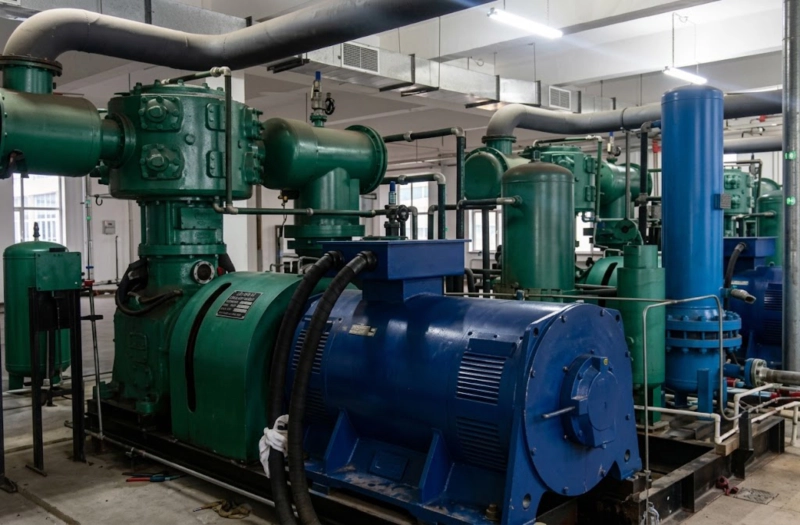
The opposed-balance reciprocating compressor — used in the DW, LW, and 4MW series — places two cylinders at exactly 180 degrees on a common crankshaft, so that the two pistons move in exactly opposite directions at every moment of the operating cycle. When piston A accelerates toward its cylinder head, piston B accelerates away from its cylinder head by the same amount. The primary inertia force from piston A points in one direction; the primary inertia force from piston B points in the exactly opposite direction. If the two pistons have equal mass — which the opposed-balance design ensures — these two forces are exactly equal and opposite, and they cancel completely. The net primary force transmitted to the foundation and connected pipework is theoretically zero, and in practice approaches zero within the manufacturing tolerance of the reciprocating mass balance.
The 4MW series extends this principle further by using a symmetrical arrangement of four cylinder pairs in a fully balanced layout — what the industry designates the symmetrically balanced or M-type configuration. This arrangement cancels not only primary forces but also the first-order couples (moment forces from cylinder offset), producing an exceptionally smooth running reciprocating compressor suitable for the largest industrial gas compression duties at 300–1,600 kW. At this power level, the difference in foundation vibration between an L-type and an opposed-balance or symmetrically balanced machine is not a matter of degree — it is a difference in kind.
In an opposed-balance installation at an air separation plant, the foundation block for a 200 kW LW series machine may be designed to carry the static weight of the machine only — no additional dynamic load factor is required because the primary alternating force is cancelled within the frame before it reaches the foundation bolts. The suction and discharge pipework can be connected with standard flanged joints and conventional gaskets without flexible pipe sections or special vibration-resistant connection hardware, because the force transmitted to the nozzle connections is near zero throughout the operating cycle.
Over a 25-year plant life, this means the pipework flanges connected to the opposed-balance reciprocating compressor accumulate negligible fatigue. The inspection interval for flanged joints in the nitrogen and oxygen circuit can be set on the same schedule as the rest of the plant — typically every 5–8 years — rather than the 18–24 month intervals that are prudent for rigidly piped L-type installations.
Quantitative Comparison: L-Type vs Opposed-Balance
| Parameter | L-Type (ZW Series) | Opposed-Balance (DW/LW) | Sym. Balanced (4MW) |
|---|---|---|---|
| Primary force cancellation | Partial (perpendicular) | Complete | Complete + couple |
| Net force to foundation | Moderate alternating | Near zero | Near zero |
| Pipework fatigue rate | Progressive accumulation | Negligible | Negligible |
| Flange inspection interval | 18–24 months | 5–8 years | 5–8 years |
| Anti-vibration mounts required | Yes (rigid piped install) | Not required | Not required |
| Flexible pipe connectors | Recommended | Not required | Not required |
| Capital cost premium over L-type | Baseline | +15–25% | +25–40% |
| Premium payback period | — | 3–5 years | 4–6 years |
| Best capacity range | 0.5–30 m³/h | 10–300 m³/h | 100–1,600 kW |
| GOST-R certified, Russia | ✓ | ✓ | ✓ |
Capital cost premium and payback period are indicative values for N₂ / O₂ / CO₂ service at 30–300 kW. Actual values depend on gas type, pressure, flow rate, and installation conditions. Contact our engineering team for project-specific analysis.
Service Life: How Frame Type Affects Long-Term Maintenance Cost
The long-term maintenance cost difference between L-type and opposed-balance reciprocating compressor installations is driven by two separate mechanisms: the fatigue of pipework components and the effect of foundation vibration on the machine itself.
Pipework fatigue: Every flanged joint in the suction and discharge circuit of an L-type installation experiences a small alternating bending moment at every crankshaft revolution. At 300 RPM — a typical reciprocating compressor speed — this is 300 load cycles per minute, or 157 million cycles per year. Over 10 years, a single flange gasket in a rigidly piped L-type installation accumulates over 1.5 billion fatigue cycles. The practical result is progressive gasket relaxation, increasing bolt load loss, and eventually joint leakage — first detectable as trace fugitive emissions at the gasket OD, then as a measurable leak requiring shutdown and regasketing. In nitrogen service this is a maintenance inconvenience; in oxygen service it is a safety event; in hydrogen service it is a potential ignition hazard governed by GOST 26099.
Machine self-vibration: The alternating force that an L-type frame transmits to its foundation also acts on the machine structure itself. Over time, this promotes loosening of internal fasteners, fretting wear at bearing housing contact surfaces, and accelerated fatigue of valve springs and gas valve assemblies. Valve failures — the most common cause of unplanned reciprocating compressor shutdown — occur 20–40% more frequently on L-type machines in rigidly piped permanent installations than on machines with opposed-balance frames of equivalent capacity running at the same load and speed, based on field maintenance data from Russian industrial gas facilities. The opposed-balance reciprocating compressor’s near-zero foundation force also reduces foundation anchor bolt fatigue, virtually eliminating the anchor bolt re-torquing cycles that are a routine maintenance item on L-type installations every 2–3 years.
When the L-Type Is the Right Choice
The L-type reciprocating compressor is not an inferior product — it is the correct choice for specific installation conditions where the vibration disadvantage is either irrelevant or manageable at acceptable cost. The L-type is the right specification when:
Frame Type Selection for Blow Moulding Plant Compressed Air Systems
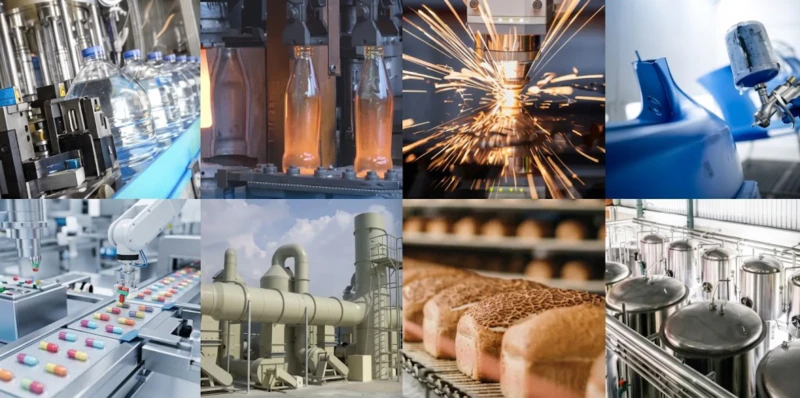
Injection stretch blow moulding (ISBM) facilities producing PET bottles require both high-pressure blow air (2.5–4.0 MPa) and low-pressure nitrogen for resin blanketing and mould cooling circuit purging. The blow air compressor on an ISBM line operates continuously during production shifts, connecting through rigid manifolds to each mould station. For multi-line plants where the blow air compressor runs 20–24 hours per day, the frame type selection follows the same logic as an industrial gas plant: the this balanced-frame configuration reduces maintenance intervention frequency on the pipework manifold connections at each blow station — joints that would otherwise require inspection every 12–18 months under the cyclic load of an L-type machine.
Frame Type Selection by Application
| Application | L-Type | Opposed-Balance | Reason |
|---|---|---|---|
| Laboratory gas supply, below 5 m³/h | Best | Oversized | Low absolute force; cost dominates |
| Portable / mobile cylinder filling | Best | Too large | Flexible hose isolates vibration; space constrained |
| Permanent plant, rigid piped, 15–100 m³/h | Acceptable | Best | OB eliminates pipework fatigue over 20–30 yr |
| Air separation plant product compression | Not specified | Standard | Industry standard for ASU product headers |
| Oxygen service, rigid piped, any capacity | Not recommended | Required | O₂ flange fatigue is a safety event (GOST 12.2.052) |
| CO₂ / NH₂ refrigerant, permanent plant | With mounts | Preferred | Refrigerant leak from fatigued flange is a safety event |
| Large capacity, above 300 kW | Not available | 4MW standard | 4MW sym. balanced covers 300–1,600 kW |
Discuss Frame Type for Your Reciprocating Compressor Project
Send our engineering team your gas type, required flow rate, discharge pressure, and installation description. We will recommend the appropriate frame type and series, and provide a preliminary quotation within 48 hours. All series GOST-R certified with Russian-language documentation.