Application Guide · Argon Compression · Air Separation · Ar Cylinder Filling · Russia
Argon is the third major product of cryogenic air separation, produced alongside nitrogen and oxygen in the low-pressure column. It is an inert noble gas with no flammability hazard and no oxidation reactivity — and these properties mean an Ar compressor at an air separation plant can use the same frame, cylinder design, and crankcase lubrication as a nitrogen compressor in equivalent service. This guide explains the compressor specification for air separation plant argon product compression and cylinder filling, and the DW and LW series configurations used across Russia and the CIS.
✓ DW / LW Series
✓ Up to 15 MPa Cylinder Fill
✓ GOST-R Certified · Russia
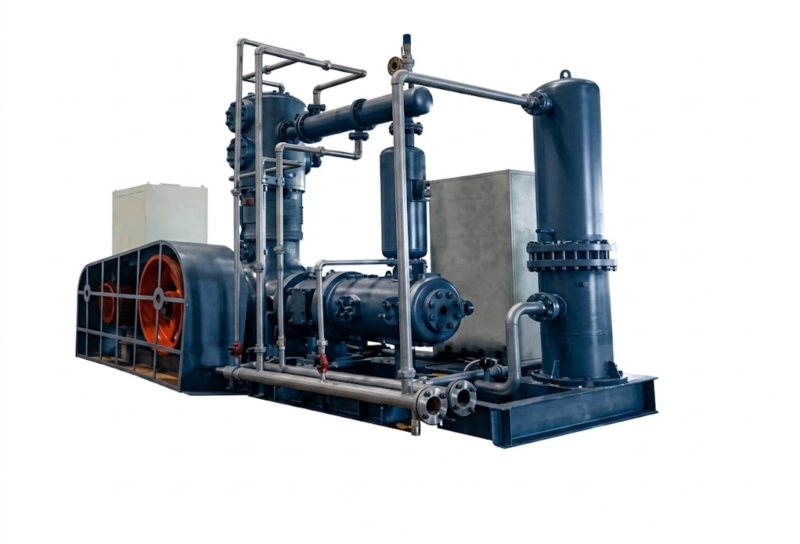
LW series argon compressor for air separation plant product gas compression and cylinder filling — the same opposed-balance frame, lubricated cylinder design, and multi-stage inter-stage cooling arrangement used for nitrogen service. Argon is chemically inert, making the argon compressor specification simpler than an oxygen compressor of equivalent capacity: no oil-free cylinder requirement, no copper-free materials mandate, and no GOST 12.2.052 safety documentation package.
Argon in Air Separation: Where It Comes From and Who Uses It
Atmospheric air is approximately 78% nitrogen, 21% oxygen, and 0.93% argon, with trace quantities of other noble gases and CO₂. In a cryogenic air separation unit, the argon is concentrated in the argon-rich liquid drawn from the low-pressure column at a point where the argon content is elevated by the column separation process — typically 8–12% Ar in the crude argon stream before further purification. The crude argon is processed in a separate argon distillation column within the ASU to produce high-purity argon (99.999% Ar or better), which is then compressed by the argon compressor to pipeline delivery pressure or cylinder filling pressure.
Industrial argon is used in several high-value applications where its chemical inertness makes it the preferred choice over nitrogen. Steel and stainless steel production uses argon in the argon oxygen decarburisation (AOD) process for stainless steel refining and in ladle metallurgy for steel stirring and degassing — applications where nitrogen is unsuitable because it dissolves into the steel melt and forms nitrides that degrade mechanical properties. Welding of titanium, aluminium, stainless steel, and other metals sensitive to atmospheric contamination uses argon as the shielding gas, because nitrogen reacts with some of these metals at welding temperatures. Electronics and semiconductor manufacturing uses argon in plasma etching, sputtering deposition, and ion implantation processes where an ultra-pure inert atmosphere is required. The common thread across all these applications is that argon must be delivered at high purity with no contamination from the compression system.
Why Argon Compression Is Simpler Than Oxygen Compression
The most important difference between compressing argon and compressing oxygen is that argon is chemically inert. It does not react with hydrocarbon lubricants, does not oxidise metal surfaces, and does not support combustion under any conditions. This fundamental chemical property means the argon compressor specification is significantly simpler than an oxygen compressor of equivalent pressure and flow capacity:
In practice, the DW and LW series argon compressor configuration is essentially identical to the nitrogen compressor configuration of the same model. The frame, crankcase, crankshaft, connecting rods, and crossheads are unchanged. The cylinders use the same cast iron piston rings and mineral oil lubrication as the nitrogen service variant. The gas valves use the same plate valve design and materials as nitrogen service. The only specifications that differ are those driven by the higher molecular weight of argon relative to nitrogen: argon has a molecular weight of 39.9 g/mol versus 28.0 g/mol for nitrogen, which means an argon compressor handling the same volumetric flow will compress a 42% greater mass flow and consume correspondingly more power per stage.
The Molecular Weight Effect on Argon Compressor Sizing
When sizing an argon compressor from a nitrogen compressor frame, the higher molecular weight of argon has two practical engineering consequences that must be accounted for in the selection calculation:
DW and LW Series Argon Compressor Configurations
At most Russian and CIS air separation plants, the argon product flow is a fraction of the nitrogen and oxygen flows — typically 1–3% of the processed air volume becomes sellable argon product, while 78% becomes nitrogen and 21% becomes oxygen. This means the Ar compressor at an air separation plant is almost always smaller than the nitrogen or oxygen compressors serving the same ASU. The DW series covers the majority of ASU argon applications in Russia, with the LW series required only at very large air separation plants producing more than 50–100 Nm³/h of argon product.
| ASU Argon Output | Ar Flow (Nm³/h) | Discharge Pressure | Recommended Series | Motor Power (kW) |
|---|---|---|---|---|
| Small ASU, pipeline delivery | 5–20 | 0.5–2.0 MPa | DW series, 1–2 stage | 15–55 |
| Medium ASU, cylinder filling | 10–50 | 15.0 MPa | DW series, 3-stage | 37–160 |
| Large ASU, pipeline and fill | 50–150 | 1.0–15.0 MPa | LW series, 2–3 stage | 110–400 |
| High-purity Ar, electronics grade | Any | Any | DW or LW, oil-free option | Per capacity |
Motor power shown is indicative for argon service at 20°C suction, 0.1 MPa suction. Actual power is 35–40% higher than an equivalent nitrogen compressor of the same volumetric flow and pressure due to argon molecular weight. Contact our engineering team for an argon-specific power and inter-stage temperature calculation.
Argon Cylinder Filling: GOST 949 and Purity Grades
Argon cylinders in Russia are filled under GOST 949 at the same 15 MPa working pressure as nitrogen and oxygen cylinders, and the machine for cylinder filling therefore has the same discharge pressure requirement as the nitrogen compressor for the same duty. The 40-litre GOST 949 argon cylinder contains 0.584 Nm³ of gas at 15 MPa (applying the argon compressibility factor of approximately 1.03 at these conditions — close to ideal gas behaviour). Filling throughput and compressor flow calculations follow the same methodology as the nitrogen cylinder filling sizing guide.
Russian industrial argon is produced and supplied to four purity grades under GOST 10157. Grade 1 (99.993% Ar, used for welding and metallurgy) is the most common commercial grade and does not require oil-free compression. Grade 2 and the higher-purity electronic grades require progressively stricter hydrocarbon limits — and for the highest-purity electronics-grade argon (99.999% Ar, total hydrocarbons below 0.5 ppm), the oil-free PTFE cylinder option is specified, following the same principle as high-purity nitrogen compression.
Key Point: The Oil-Free Argon Compressor Decision
Unlike oxygen compression — where the oil-free cylinder design is mandatory above 0.5 MPa for safety reasons under GOST 12.2.052 — the oil-free argon compressor decision is driven by product purity requirements, not safety. For standard industrial argon grades (GOST 10157 Grade 1, 99.993% Ar, total hydrocarbons below 10 ppm), the lubricated cylinder with a downstream oil separator is the standard and sufficient specification. Only when the argon purity requirement reaches the level needed for electronics fabrication or high-purity laboratory supply — total hydrocarbons below 1 ppm — does the oil-free PTFE cylinder become the appropriate specification.
Argon vs Nitrogen in ISBM Tooling and Mould Atmosphere Applications
Argon and nitrogen are both used as inert shielding gases in plastics manufacturing, though their roles differ. Nitrogen is the standard choice for PET resin blanketing and hopper padding in injection stretch blow moulding (ISBM) facilities because it is significantly less expensive than argon. Argon is used in the more specialised application of mould core cooling in complex ISBM tooling — where a separate argon circulation circuit cools the stretch rod and core tooling at points that cannot be reached by water cooling channels — and in the surface treatment of ISBM moulds by plasma nitriding or plasma spray processes where an argon atmosphere is required for consistent surface quality. These argon applications in plastics manufacturing are small-scale — typical argon consumption for a large ISBM facility is 0.5–5 Nm³/h — and are normally supplied from high-pressure argon cylinders rather than from a dedicated argon compressor. The compressor enters the picture only at the cylinder filling station that fills the supply cylinders delivered to the ISBM plant.
FAQ — Argon Compressor for Air Separation
Request an Argon Compressor Specification
DW and LW series compressors for air separation plant argon product compression and cylinder filling — lubricated standard configuration for industrial argon grades, oil-free PTFE option for electronics and high-purity applications. GOST-R certified. Response within 48 hours.