Application Guide · High-Pressure Nitrogen · 30 MPa Cylinder Filling · Stage Count · Russia
The standard GOST 949 industrial gas cylinder in Russia is filled to 15 MPa (150 bar) working pressure. High-pressure service — breathing apparatus cylinders, fire suppression systems, CNG vehicle cylinders, and specialised industrial applications — requires filling to 20, 25, or 30 MPa. At 30 MPa, the nitrogen compressor operates at twice the discharge pressure of a standard 15 MPa cylinder filling machine, with corresponding implications for stage count, inter-stage pressure ratios, cylinder wall thickness, and safety requirements. This guide covers the specific engineering considerations for high-pressure nitrogen compressors filling to 30 MPa in Russia and the CIS.
✓ 3 – 4 Stage Compression
✓ ZW / DW Series
✓ GOST-R Certified · Russia
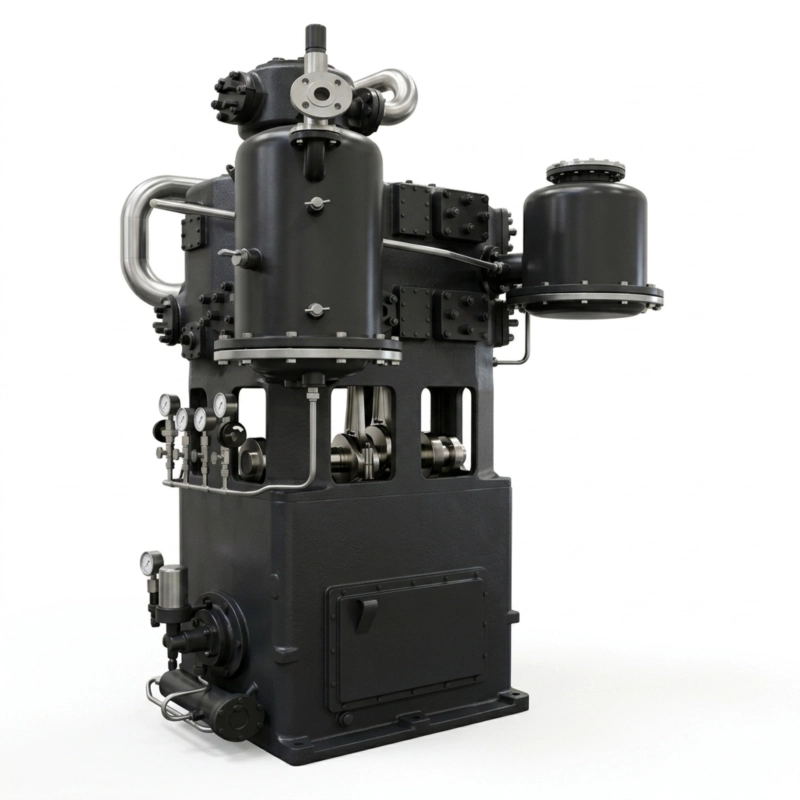
ZW series high-pressure nitrogen compressor configured for 30 MPa cylinder filling — four-stage compression from atmospheric suction (0.1 MPa) to 30 MPa discharge, each stage delivering a pressure ratio of approximately 4:1. The fourth-stage cylinder is the smallest in the machine, with the thickest walls and the most highly-stressed components. Special attention to inter-stage safety valves, final-stage high-pressure pipework, and cylinder burst disc protection is mandatory at 30 MPa service in Russia.
High-Pressure Cylinder Standards in Russia: 15 MPa, 20 MPa, and 30 MPa
GOST 949 governs the design, testing, and filling of industrial gas cylinders in Russia and specifies working pressures of 1.0, 1.6, 2.0, 4.0, 6.4, 10.0, 15.0, and 20.0 MPa. The 15.0 MPa class is by far the most common for nitrogen, oxygen, argon, and other industrial gases in Russia — the familiar 40-litre cylinder used across virtually all Russian industrial and medical gas applications. The 20.0 MPa class serves some applications where the higher fill pressure reduces the number of cylinders required for a given gas inventory.
Cylinders for breathing apparatus and firefighting service — self-contained breathing apparatus (SCBA), emergency escape devices, and fire suppression systems — operate at 30 MPa (300 bar) under GOST standards for these applications, which follow international practice (EN 12245, ISO 11119 composite cylinder standards referenced in Russian technical regulations). CNG (compressed natural gas) vehicle cylinders also operate at 20–25 MPa. The nitrogen compressor filling these high-pressure cylinders must achieve 30 MPa discharge pressure reliably and safely in continuous filling station service.
Stage Count: Why 30 MPa Requires Four Stages

The number of compression stages required to reach a given discharge pressure from atmospheric suction is determined by the per-stage pressure ratio limit. In a reciprocating piston compressor, the per-stage pressure ratio is constrained by discharge temperature: as the pressure ratio increases, the adiabatic discharge temperature rises. For nitrogen (γ = 1.4), compressing from 0.1 MPa suction to a pressure ratio of 4:1 produces a theoretical discharge temperature of approximately 175°C — within the safe operating range for steel cylinder components and mineral oil lubricant. A pressure ratio of 6:1 would produce approximately 260°C — above the thermal limits of piston ring materials and crankcase lubricant.
With a per-stage pressure ratio of approximately 4:1, the number of stages required to reach each target pressure from 0.1 MPa atmospheric suction is:
| Stages | Max Discharge Pressure | Ratio per Stage | Typical Application |
|---|---|---|---|
| 2 | 1.6 MPa | 4:1 | Pipeline supply, blanketing header |
| 3 | 6.0–15.0 MPa | 3.9–5.3:1 | Standard GOST 949 15 MPa cylinder filling |
| 4 | 20–30 MPa | 3.7–4.2:1 | SCBA / fire suppression / high-pressure industrial |
Pressure ratios shown are approximate geometric ratios for equal-ratio staging. Actual stage pressure ratios are optimised by the manufacturer to balance inter-stage temperatures and cylinder bore sizes. Suction conditions: 20°C, 0.1 MPa. Adding a nitrogen booster from a pressurised source reduces the stage count required.
From 0.1 MPa atmospheric suction to 30 MPa discharge, four stages at approximately 4.2:1 per stage (0.1 × 4.2⁴ = 31.1 MPa) achieves the target discharge pressure while keeping per-stage discharge temperatures within safe limits. The standard 15 MPa cylinder filling compressor uses three stages; adding a fourth stage to the same ZW or DW series frame extends the discharge pressure capability to 20–30 MPa without requiring a fundamentally different machine design. The fourth stage cylinder is significantly smaller in bore than the first stage — the gas is now at 7–8 MPa entering the fourth stage, so the cylinder volume required to handle the same mass flow is roughly 70–80 times smaller than the first-stage cylinder.
High-Pressure Design Requirements: 20–30 MPa Service
The fourth-stage cylinder of the nitrogen compressor and the final-stage discharge system of a 30 MPa nitrogen compressor operate at pressures that require specific design provisions beyond the standard three-stage 15 MPa machine:
Filling Station Layout and Throughput Calculation
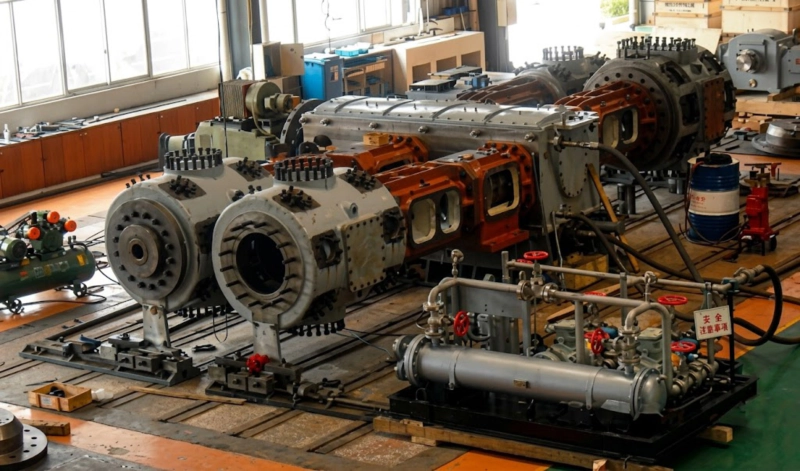
A 30 MPa nitrogen compressor cylinder filling station serves a fixed number of cylinders per shift, determined by the compressor flow rate, the cylinder volume, and the initial pressure of the cylinders at the start of each fill. A standard 6-litre SCBA cylinder at 30 MPa contains 0.178 Nm³ of nitrogen at ideal-gas conditions (applying a compressibility factor of approximately 1.07 for nitrogen at 300 bar, 20°C, the actual content is approximately 0.166 Nm³). Filling this cylinder from empty (0.1 MPa) requires delivering 0.166 Nm³ of gas at standard conditions through the compressor.
In practice, SCBA cylinders are rarely filled from zero pressure — they arrive at the filling station with residual pressure of 2–10 MPa from the previous use. The residual gas is retained in the cylinder; only the difference between residual and fill pressure must be delivered by the compressor. A cascading fill system — where cylinders at different pressure levels are filled sequentially from a high-pressure buffer vessel charged by the compressor — further improves compressor utilisation by filling to each intermediate cascade pressure before resorting to the compressor for the final pressure increment. This reduces the effective compressor work per cylinder filled by 20–35% compared with filling all cylinders from zero pressure directly from the compressor.
| Station Type | Cylinder Type | Fill Pressure | Throughput | Series |
|---|---|---|---|---|
| Small SCBA station | 6–9 L SCBA | 30 MPa | 20–60 cyl/shift | ZW, 4-stage |
| Fire brigade / MES station | 6.8–9 L composite | 30 MPa | 60–200 cyl/shift | ZW or DW, 4-stage |
| Industrial SCBA centre | Mixed 6–50 L | 20–30 MPa | 200–600 cyl/shift | DW, 3–4 stage |
| CNG vehicle filling | Vehicle tank | 20–25 MPa | Continuous | DW, 3–4 stage |
Throughput estimates assume 6 L SCBA cylinders filled from 5 MPa residual to 30 MPa with cascade buffer system. Actual throughput depends on cylinder volume, residual pressure, cascade buffer vessel volume, and compressor flow rate. Contact our engineering team for a station-specific throughput calculation.
Russian Regulatory Requirements for 30 MPa Filling Stations
High-pressure cylinder filling stations in Russia operating above 6.4 MPa are classified as hazardous production objects under Federal Law 116-FZ and must be registered with Rostechnadzor. The 30 MPa nitrogen filling station falls under this classification and requires a design approval (ekspertiza promyshlennoy bezopasnosti — industrial safety examination) before construction, Rostechnadzor registration before commissioning, and annual safety inspections by an accredited inspection organisation.
Key regulatory requirements specific to 30 MPa filling stations include: all pressure-containing components (cylinders, high-pressure pipework, manifolds, safety valves, burst discs) must carry GOST-R certification and be registered in the Rostechnadzor equipment register; the filling building must have blast-resistant walls and roof panels on the high-pressure side; a minimum separation distance between the high-pressure manifold and any permanent occupied structure is specified; filling personnel must hold a Rostechnadzor certificate for high-pressure vessel operations; and the filled cylinders must carry a GOST-compliant test certificate and be within their periodic inspection date before being charged to 30 MPa.
Safety Note: Nitrogen at 30 MPa
Nitrogen at 30 MPa (300 bar) stores approximately 300 times its volume of gas at atmospheric pressure. A catastrophic failure of a 40-litre cylinder at 30 MPa releases the equivalent of 12,000 litres of nitrogen instantaneously — sufficient to cause lethal overpressure in a confined filling room. Nitrogen is also an asphyxiant: a sudden large release in an enclosed space rapidly displaces oxygen to below the minimum concentration for consciousness. The filling station design, building construction, personnel exclusion zones, and safety valve and burst disc sizing must all account for these hazards per the Rostechnadzor-approved design. Never fill cylinders beyond their rated working pressure; never fill cylinders that are past their hydrostatic test date; never operate a high-pressure filling station without the required Rostechnadzor registration and operating personnel certification.
High-Pressure Blow Air vs High-Pressure Nitrogen: Pressure Levels in ISBM
Injection stretch blow moulding (ISBM) uses high-pressure compressed air — at 35–40 bar (3.5–4.0 MPa) — to expand the PET preform into the bottle mould in the blow cycle. This blow air pressure is well below the 30 MPa discussed in this guide but is still the highest-pressure air system in most manufacturing facilities, requiring appropriate safety systems (pressure-rated pipework, pressure-relief valves, certified pressure vessels for the blow air accumulator). The parallel between the ISBM blow air system and a 30 MPa nitrogen filling station lies in the common principle: high-pressure gas systems require purpose-designed, pressure-rated components throughout, and the safety factor applied to each component determines the margin between normal operating pressure and the energy-release boundary. An ISBM facility with blow air at 40 bar and a nitrogen filling station at 300 bar are on the same engineering continuum — separated by a factor of 7.5 in pressure, but governed by the same fundamental principles of pressure system design and safety.
FAQ — High-Pressure Nitrogen Compressor
Request a High-Pressure Nitrogen Compressor Specification
ZW and DW series four-stage nitrogen compressors rated to 20–30 MPa cylinder filling — forged steel fourth-stage cylinder, high-pressure piston rod packing, burst disc and safety valve protection, full Rostechnadzor HPO documentation. Response within 48 hours.