CO₂ Refrigerant Compressor: Subcritical vs Transcritical Operation — When to Choose Each for Russian Industrial Applications

Technical Guide · CO₂ Refrigerant Compressor · Subcritical · Transcritical · Russia · Industrial Refrigeration

Carbon dioxide (R-744) refrigeration is undergoing a significant expansion in Russian industrial applications driven by the Kigali Amendment phase-down of high-GWP HFCs and the emergence of CO₂ as the technically and economically superior refrigerant for medium- and low-temperature cold chain and industrial cooling duty. But CO₂ refrigeration operates in two fundamentally different thermodynamic regimes — subcritical and transcritical — that require different compressor specifications, different high-side pressure ratings, and different system control strategies. A CO₂ refrigerant compressor specified for subcritical operation at −30°C to −50°C duty is a different machine from one specified for transcritical operation at ambient condensing temperatures above +31°C, even though both handle the same refrigerant. This guide explains the thermodynamic boundary between the two regimes, how Russian climate conditions affect which regime applies at different sites, and what the compressor specification must include for each.

✓ Subcritical vs Transcritical Boundary
✓ Russian Climate Conditions
✓ Compressor Pressure Ratings
✓ High-Side Pressure Control
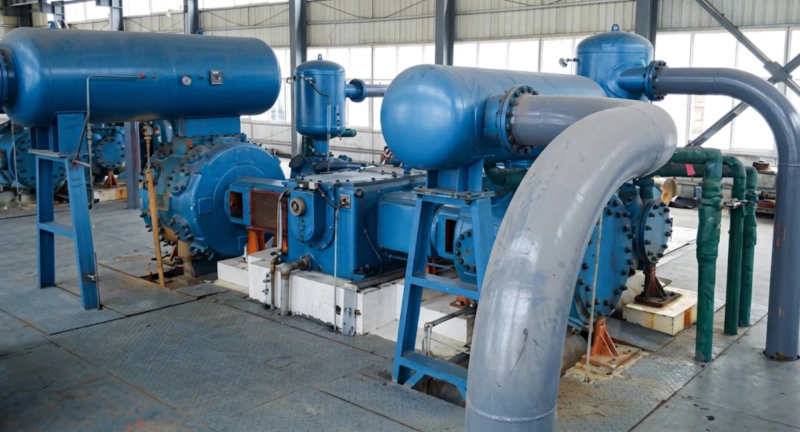
CO2 refrigerant compressor subcritical transcritical Russia industrial 4MW series R-744 cold storage

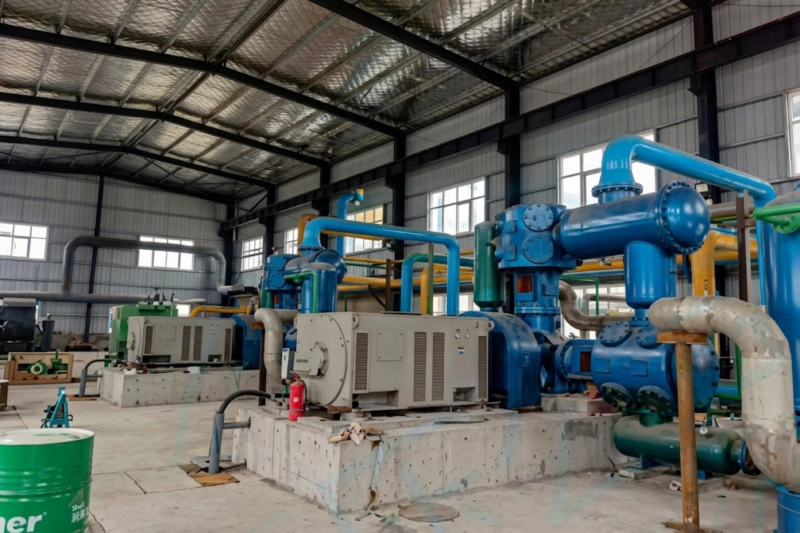
4MW series CO₂ refrigerant compressors at a Russian industrial cold chain facility — CO₂ refrigerant operation in Russia spans both subcritical and transcritical regimes depending on the ambient temperature. In winter at −20°C outdoor, the system operates well below the CO₂ critical temperature of +31.1°C and the gas cooler functions as a condenser — subcritical operation with moderate high-side pressures. In summer at +35°C outdoor, the condensing temperature exceeds the critical point and the system must operate transcritically, with high-side pressures of 85–130 bar and a gas cooler instead of a condenser. The CO₂ compressor and the high-side piping must be rated for the transcritical maximum, even if the system spends most of its operating hours in subcritical mode.

+31.1°C
Critical Temp
CO₂ Critical Point
73.8 bar
Critical Press.
R-744 Critical
Up to 130 bar
Transcritical High-Side
40–60 bar
Subcritical High-Side
GWP = 1
CO₂ Climate Impact

The CO₂ Critical Point and What It Means for Refrigeration System Design

Every pure substance has a critical point — a specific combination of temperature and pressure above which the distinction between liquid and vapour ceases to exist and the substance exists as a supercritical fluid with properties intermediate between those of a liquid and a gas. For CO₂, the critical temperature is +31.1°C and the critical pressure is 73.8 bar. These numbers are fundamental to understanding why CO₂ refrigeration behaves so differently from conventional refrigerants like NH₃ (critical temperature +132.4°C) or R-134a (critical temperature +101.1°C).

With NH₃ or R-134a, the maximum ambient temperature encountered in even the hottest Russian summer (+40°C in Krasnodar) is far below the refrigerant’s critical temperature. The condenser can always cool the high-side gas to a temperature below the critical point, producing liquid refrigerant that expands through the expansion valve as a conventional vapour-compression cycle. With CO₂, the situation is fundamentally different: +31.1°C critical temperature means that any installation where the heat rejection occurs at or above +31.1°C ambient cannot condense the CO₂ — the substance cannot form a liquid at any pressure above its critical pressure when the temperature exceeds the critical temperature. The system must operate transcritically: the compressor compresses CO₂ to a supercritical pressure (above 73.8 bar, in practice 85–130 bar), the gas cooler rejects heat at supercritical conditions without condensation, and the high-pressure CO₂ expands through a high-pressure expansion valve (not a conventional expansion device) to the evaporating pressure.

The transition between subcritical and transcritical operation in a CO₂ refrigeration system is therefore determined entirely by whether the ambient temperature at the heat rejection point exceeds +31.1°C. In Russia, this boundary has significant geographic and seasonal variation that determines the system design requirements:

Subcritical only — Northern Russia year-round

In Murmansk, Arkhangelsk, Norilsk, Yakutsk, and all locations above approximately 60°N latitude, summer ambient temperatures rarely exceed +25°C and never reach +31°C. A CO₂ refrigeration system at these sites operates in subcritical mode year-round — the gas cooler functions as a true condenser, CO₂ liquid forms at high-side pressures of 45–65 bar, and the system behaves as a conventional vapour-compression cycle with the exceptional thermodynamic efficiency of CO₂ at low and medium evaporating temperatures.

Compressor specification: High-side pressure rating 80 bar is sufficient. Full-flow safety valve at 80 bar. Discharge temperature moderate at the subcritical compression ratios involved. No transcritical pressure control required.

Transcritical in summer — Central and Southern Russia

In Moscow, Yekaterinburg, Novosibirsk, Krasnodar, Rostov-on-Don, and all locations south of approximately 60°N, summer ambient temperatures regularly reach +30°C to +40°C — above the CO₂ critical temperature. A CO₂ system at these sites transitions from subcritical in winter to transcritical in summer as the ambient temperature crosses +31°C. The system must be designed for transcritical operation during the summer months, even if subcritical operation predominates for most of the year.

Compressor specification: High-side pressure rating 130 bar minimum. Full-flow safety valve at 130 bar. High-pressure expansion valve with active pressure control. Transcritical pressure optimisation control strategy to maximise COP at each ambient temperature.

The CO₂ Refrigerant Compressor Specification: Subcritical vs Transcritical
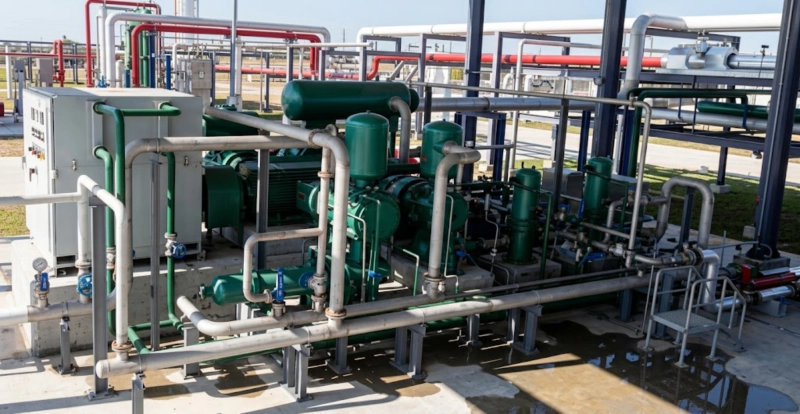
CO2 compressor specification subcritical transcritical high side pressure rating 130 bar 4MW series Russia

The compressor specification for CO₂ refrigerant duty differs from NH₃ or HFC refrigerant specification in three critical areas that determine whether the machine is safe and effective at both subcritical and transcritical operating conditions:

1. Cylinder and valve pressure rating

CO₂ refrigerant compressors for transcritical duty must be designed and pressure-tested for a maximum allowable working pressure (MAWP) of at least 130 bar on the high-pressure side. This is 3–4 times the maximum discharge pressure of an equivalent NH₃ compressor at the same condensing temperature — NH₃ at +35°C condensing operates at 13.5 bar discharge, while transcritical CO₂ at a gas cooler exit temperature of +35°C requires 90–100 bar high-side pressure to achieve acceptable COP.

The cylinder walls, valve seats, valve plates, and all high-pressure gaskets and seals must be designed for 130 bar service with an appropriate safety factor (typically 4:1 in Russian pressure vessel practice under GOST R 52630). The valve plate material must have sufficient fatigue strength to withstand the higher closing impact velocities associated with the higher pressure differential across the valve — conventional spring-loaded valve plates used in NH₃ service may not be suitable for CO₂ at 130 bar without material and geometry review. Our CO₂ refrigerant compressor range is designed, pressure-tested, and GOST-R certified specifically for 130 bar transcritical service.

2. Seal and gasket materials for CO₂ compatibility

CO₂ at high pressure has a strong affinity for elastomeric seal materials — it permeates into the seal material under operating pressure and then expands rapidly when the pressure is released, causing explosive decompression that destroys the seal. This failure mode, known as rapid gas decompression (RGD), is the most common cause of seal failure in CO₂ compressors that were designed for lower-pressure refrigerants or gases. Standard NBR (nitrile butadiene rubber) seals that perform well in NH₃ service are particularly susceptible to RGD failure in CO₂ transcritical service.

CO₂ refrigerant compressor rod packing and piston rod seals must use CO₂-resistant elastomers — specifically HNBR (hydrogenated nitrile) or EPDM compounds with RGD-resistant formulations, or PTFE-based seals that avoid the elastomeric permeation mechanism entirely. All CO₂ compressors in our range use PTFE-based rod packing as standard for transcritical duty, eliminating the RGD risk regardless of the decompression rate during pressure relief or shutdown events.

3. Oil system design for CO₂ lubricant compatibility

CO₂ is highly miscible with many compressor lubricating oils at elevated pressure — the CO₂ dissolves into the oil, reducing its viscosity and lubricating effectiveness, and then foams the oil severely when the pressure drops. Mineral oils used in NH₃ compressors are not suitable for CO₂ refrigerant compressor service. PAG (polyalkylene glycol) oils formulated for CO₂ service are the standard lubricant for CO₂ compressors, providing adequate viscosity at operating temperature and pressure and limited CO₂ solubility that prevents the foaming-on-decompression failure mode.

The crankcase oil system must include a CO₂-purge function that vents dissolved CO₂ from the crankcase before the compressor starts from a cold or standing condition — without this purge, the CO₂ dissolved in the cold oil flashes as the crankcase reaches operating temperature, causing oil foam that starves the bearings. Our CO₂ compressor range includes a crankcase heater and purge sequence as standard to manage dissolved CO₂ during startup.

Transcritical Pressure Optimisation: The Key to Transcritical COP
CO2 transcritical pressure optimisation high side pressure control COP gas cooler Russia industrial

In subcritical CO₂ operation, the high-side pressure is determined by the condensing temperature in the same way as any conventional refrigerant — set the condensing temperature and the saturation pressure is fixed. In transcritical operation there is no condensing — the high-side CO₂ is a supercritical fluid and its enthalpy at the gas cooler exit depends on both temperature and pressure independently. This means that unlike subcritical operation, the transcritical high-side pressure can be varied independently of the gas cooler exit temperature — and the optimal high-side pressure that maximises the COP at a given gas cooler exit temperature must be found and maintained by the system controller.

The optimal transcritical high-side pressure for a given gas cooler exit temperature can be calculated from CO₂ thermodynamic property tables and is approximately linear in the range of practical operation. A commonly used approximation for the optimal gas cooler pressure Pᵐₒᵐ (in bar) as a function of gas cooler exit temperature Tᵋᵘ (in °C) is:

Optimal Transcritical Pressure — CO₂ Gas Cooler Exit Temperature to Optimal High-Side Pressure
Pᵐₒᵐ ≈ 2.8 × Tᵋᵘ + 12 (bar)
Gas Cooler Exit Temp (°C) Optimal High-Side Pressure Operation Mode COP (−10°C evap)
+25°C 55–60 bar (subcritical) Subcritical 3.8–4.2
+31°C 73.8 bar (critical point) Transitional 2.9–3.2
+35°C 90–96 bar Transcritical 2.3–2.6
+38°C 98–106 bar Transcritical 2.0–2.3
+40°C 104–112 bar Transcritical 1.7–2.0

COP values at −10°C evaporating (medium-temperature cold chain). The sharp COP reduction in the transcritical regime near the critical point (+31°C to +35°C) is the main disadvantage of CO₂ at moderate ambient temperatures. At evaporating temperatures below −25°C, the CO₂ low-side COP advantage over NH₃ partially compensates for the high-side transcritical penalty.

The practical implication for Russian CO₂ refrigerant compressor installations is that a system located at a site with summer ambient temperatures above +31°C must include a high-pressure expansion valve with a pressure controller that continuously adjusts the high-side pressure to the optimal value at the current gas cooler exit temperature. Operating at fixed high-side pressure in the transcritical regime — either too high or too low relative to the optimum — reduces COP by 5–15% compared with optimised pressure control. This control requirement is part of the CO₂ system specification and is not a feature of the compressor itself, but the compressor must be capable of operating stably across the full transcritical pressure range of 80–130 bar as the pressure controller adjusts the operating point.
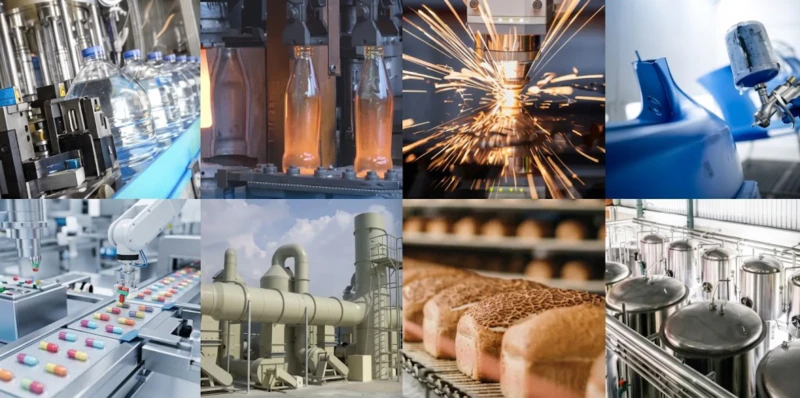
CO2 refrigerant compressor industrial applications Russia subcritical cascade NH3 food beverage

Where CO₂ Refrigerant Compressors Excel in Russian Industrial Applications

The CO₂ refrigerant compressor is not the universal choice for all Russian refrigeration duties — NH₃ remains superior for large-scale single-stage cold storage above 500 kW at −18°C to −25°C evaporating in northern Russia where subcritical CO₂ operation is available but the scale does not justify the CO₂ system complexity premium. However, CO₂ refrigerant compressors are the technically superior specification for four specific Russian industrial applications:

1
Northern fishing port blast freeze — subcritical CO₂ at −40°C to −55°C evaporating. In Murmansk, Arkhangelsk, and Kamchatka, the year-round subcritical CO₂ operation and the exceptional volumetric refrigerating capacity of CO₂ at very low evaporating temperatures (CO₂ has a specific refrigerating effect 5–8 times larger per m³ of suction volume than NH₃ at −40°C) produce a blast freeze system that is more compact, simpler, and lower in capital cost than the equivalent two-stage NH₃ system. The CO₂ refrigerant compressor for this duty operates subcritically year-round, requiring only 80 bar high-side pressure rating and a conventional suction valve unloading capacity control strategy.
2
Cascade system low-stage in NH₃/CO₂ systems at central Russian food industry sites. A CO₂ refrigerant compressor used as the low-stage in an NH₃/CO₂ cascade system operates subcritically with CO₂ as the low-stage refrigerant (evaporating at −40°C to −55°C CO₂) and NH₃ as the high-stage refrigerant condensing the CO₂ at −10°C to −15°C. This cascade arrangement eliminates the need for NH₃ pipework in the blast freeze tunnels and product handling zones while retaining the efficiency of NH₃ at the high-stage. The CO₂ compressor in this application always operates subcritically — the NH₃ condenser keeps the CO₂ high side well below +31°C — and requires only 40–60 bar high-side pressure rating.
3
HFC replacement in existing cold chain infrastructure. Russian cold stores and food processing facilities that currently use R-404A or R-134a refrigerant face increasing pressure from the Kigali phase-down and rising HFC prices. CO₂ is the technically and economically preferred replacement refrigerant for these systems in northern Russia, where subcritical operation eliminates the transcritical COP penalty. A CO₂ refrigerant compressor retrofitted into an existing R-404A cold store at a northern Russian site operates at lower high-side pressures than a comparable transcritical system and achieves better COP than the HFC it replaces at temperatures below −10°C evaporating.
4
Industrial process cooling and CO₂ recovery at food and beverage facilities. Food and beverage production facilities that generate CO₂ as a process by-product — breweries, soft drink carbonation plants, fermentation facilities — use CO₂ refrigerant compressors for the CO₂ recovery and liquefaction system that produces food-grade liquid CO₂ for carbonation and packaging. This application always operates subcritically (condensing CO₂ to liquid at approximately −20°C to −30°C in the CO₂ liquefier) and requires a CO₂ refrigerant compressor with a moderate high-side pressure rating of 40–60 bar, combined with the oil-free cylinder design required for food-grade CO₂ purity.
Related Application · Plastics Manufacturing

CO₂ in ISBM Blow Air: Why R-744 Never Reaches the Critical Point in the Blowing Circuit

Injection stretch blow moulding (ISBM) machines use compressed air — not CO₂ — for the blowing circuit. However, CO₂ enters the ISBM value chain in a different and important way: the carbonated beverage bottles produced on ISBM machines contain CO₂ dissolved in the product at 2–6 volumes of gas per volume of liquid, and the PET bottle must be strong enough to contain the carbonation pressure without deformation. The bottle’s pressure resistance is determined in part by the blow air pressure used in the ISBM blowing cycle — higher blow air pressure (35–40 bar) produces a bottle with greater orientation and better CO₂ barrier properties than lower blow air pressure. The CO₂ that the bottle must contain is not a refrigerant but a dissolved gas at beverage temperature — it never approaches the +31.1°C critical temperature in the bottle — but the thermodynamic properties of CO₂ that make it a challenging refrigerant (high solubility in polymers, strong pressure sensitivity near the critical point) are also what make high-barrier PET bottle design an engineering challenge. The ISBM blow air pressure and the CO₂ refrigerant compressor high-side pressure are both shaped by the physical properties of R-744, approached from different directions in different applications.

Related equipment: One-step three-station ISBM machines for carbonated PET bottle production — with high blow air pressure producing the CO₂-barrier bottle structure required for carbonated beverage applications.

ISBM Machine ›injectionstretchblowmolding.com

FAQ — CO₂ Refrigerant Compressor: Subcritical vs Transcritical

Q1: We are in Novosibirsk (summer peak +35°C). Our CO₂ system was installed assuming subcritical operation year-round. It now shows high-side pressure reaching 85–90 bar in summer. Is this a fault or expected behaviour?
This is expected behaviour for Novosibirsk, not a fault — but it indicates that the original system design assumption of year-round subcritical operation was incorrect for your location. Novosibirsk summer ambient temperatures regularly reach +33°C to +38°C, well above the CO₂ critical temperature of +31.1°C. When the ambient exceeds +31°C the system automatically transitions to transcritical operation, with the high-side pressure rising to 85–100 bar as the pressure controller attempts to maintain the optimal gas cooler pressure for the current temperature. At 85–90 bar on a system designed for subcritical-only operation (typically rated to 80 bar maximum working pressure), the system is approaching or exceeding its design pressure limits — this is a safety issue that requires engineering assessment. The immediate actions are to check the high-pressure relief valve setpoint and condition, verify that all high-side piping, fittings, and pressure vessels are rated for the observed operating pressure, and if not, reduce the operating pressure by increasing the gas cooler fan speed or adding supplementary gas cooler capacity to bring the CO₂ temperature below the critical point. A system for Novosibirsk must be retrofitted or redesigned with 130 bar high-side pressure rating to safely operate through summer transcritical conditions.
Q2: For a northern Russian blast freeze application at −40°C evaporating with year-round subcritical CO₂, what is the efficiency advantage over a two-stage NH₃ system at the same duty?
At −40°C evaporating in subcritical CO₂ operation with a summer condensing temperature of +25°C (achievable at a Murmansk or Arkhangelsk site with evaporative cooling), the CO₂ refrigerant compressor system achieves a COP of approximately 2.8–3.4 depending on the specific system design and the degree of internal heat exchange used. A two-stage NH₃ system at the same evaporating temperature and condensing conditions achieves a COP of approximately 2.6–3.0. The subcritical CO₂ system is therefore 8–15% more efficient than the two-stage NH₃ alternative at northern Russian blast freeze conditions — primarily because CO₂ has a much higher volumetric refrigerating capacity at low evaporating temperatures (5–8 times more refrigerating effect per m³ of suction volume than NH₃ at −40°C), requiring a much smaller compressor for the same refrigerating capacity, with lower internal pressure losses and better volumetric efficiency at the smaller cylinder sizes. Additionally, the subcritical CO₂ system is single-stage — no flash vessel, no inter-stage piping, no second compressor — while the NH₃ alternative requires two-stage compression with all the associated capital cost and maintenance complexity. For northern Russian blast freeze applications above approximately 200 kW refrigerating capacity, subcritical CO₂ is increasingly the technically and economically preferred specification over two-stage NH₃.
Q3: What GOST-R certification does a CO₂ refrigerant compressor for transcritical duty require that differs from a standard NH₃ compressor?
A CO₂ refrigerant compressor for transcritical duty operating above 73.8 bar is classified as a high-pressure vessel under Russian technical regulations and requires GOST-R certification under TR CU 032/2013 (Technical Regulations of the EAC Technical Regulations on the Safety of Equipment Operating Under Excessive Pressure) in addition to the standard GOST-R machinery certification. TR CU 032/2013 applies to pressure equipment with maximum allowable working pressure above 0.05 MPa (0.5 bar) — both subcritical and transcritical CO₂ compressors fall within its scope, but the transcritical 130 bar machine is subject to the highest risk category provisions of the regulation (Category IV pressure equipment), requiring third-party conformity assessment by a notified body rather than self-declaration. The equipment passport for a transcritical CO₂ compressor must include the TR CU 032/2013 conformity certificate, the hydrostatic test protocol at 1.5 times the maximum allowable working pressure (195 bar for a 130 bar machine), and the materials certification for all high-pressure components. Our CO₂ refrigerant compressor range for transcritical duty carries full TR CU 032/2013 certification and all required pressure vessel documentation as standard, provided with the equipment passport at delivery.
CO₂ Refrigerant Compressors

4MW Series CO₂ Compressors — Subcritical and Transcritical Duty

4MW series CO₂ refrigerant compressors for subcritical (80 bar) and transcritical (130 bar) industrial refrigeration duty in Russia — PTFE rod packing, PAG oil system, crankcase heater and purge, TR CU 032/2013 certified. Provide your site location, evaporating temperature, summer ambient temperature, and required refrigerating capacity for a subcritical vs transcritical assessment and compressor specification within 48 hours.