Application Guide · CO₂ Refrigerant · Subcritical · Transcritical · Industrial Refrigeration · Russia
Carbon dioxide (R-744) is attracting renewed industrial interest as a refrigerant because it is non-toxic, non-flammable, has zero ozone depletion potential, and a global warming potential of 1 — the reference point for all other refrigerants. In industrial refrigeration, CO₂ is used in two distinct circuit configurations: subcritical (as the low-temperature stage in a cascade system with NH₃ or HFC on the high stage) and transcritical (as the sole refrigerant in a circuit that operates above its critical point on the high-pressure side). The CO₂ refrigerant compressor specification differs significantly between these two configurations and from the compressors used for nitrogen, oxygen, or NH₃ refrigerant service. This guide explains both and covers the DW and 4MW series configurations available for Russia and CIS industrial refrigeration.
✓ Subcritical · Transcritical
✓ DW / 4MW Series
✓ GOST-R Certified · Russia
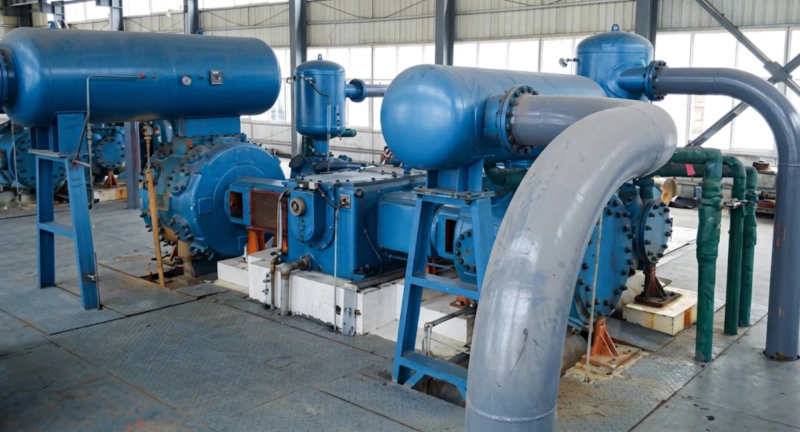
CO₂ refrigerant compressor in subcritical cascade service — the low-stage compressor of an NH₃/CO₂ cascade system for cold storage at −35°C to −55°C. CO₂ at these temperatures operates at suction pressures of 10–20 bar absolute and condensing pressures of 30–40 bar absolute — approximately 3–4 times higher than NH₃ at the same conditions — requiring a compressor with cylinder materials, valve design, and piston rod packing rated for the substantially higher CO₂ operating pressures.
CO₂ as a Refrigerant: Properties and Critical Point
CO₂ (R-744) has thermodynamic properties that distinguish it from every other common industrial refrigerant. Its critical point is at 31.1°C and 73.8 bar absolute — a temperature near ambient and a pressure far above the operating range of standard refrigerant circuits. NH₃, for comparison, has a critical point at 132.4°C and 113.5 bar: well above any practical condensing condition, so NH₃ refrigerant circuits always operate in the subcritical regime where the refrigerant condenses to liquid. CO₂, in contrast, can operate either subcritically (when the heat rejection temperature is below 31.1°C, as in a cascade system or a cold climate) or transcritically (when the heat rejection temperature exceeds 31.1°C, as in most ambient-temperature industrial applications).
This distinction matters enormously for the CO₂ refrigerant compressor specification. In subcritical operation, the compressor condenses CO₂ to liquid at the discharge, and the refrigerant circuit behaves similarly — at higher pressure — to a conventional NH₃ or HFC circuit. In transcritical operation, the high-pressure side does not condense — CO₂ gas is cooled in a gas cooler but remains supercritical — and the compressor discharge pressure must be controlled by a high-pressure valve rather than by a condensing temperature, reaching 80–130 bar absolute in warm-climate or high ambient-temperature transcritical systems.
Subcritical CO₂: The NH₃ / CO₂ Cascade System
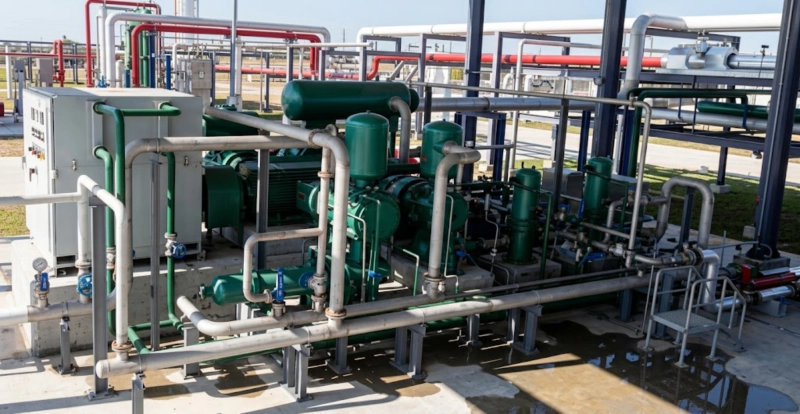
The most established industrial application of CO₂ refrigerant in Russia is the NH₃/CO₂ cascade system used for deep-freeze cold storage and blast freezing at −35°C to −55°C. In this arrangement, CO₂ is the low-stage refrigerant whose evaporator provides the refrigeration duty at the deep-freeze temperatures. The CO₂ condenses in a cascade heat exchanger that is itself the evaporator of the NH₃ high-stage circuit. The NH₃ high-stage compressor rejects heat to the ambient-temperature condenser in the normal way.
The advantage of this arrangement over a single-refrigerant NH₃ two-stage system at the same deep-freeze temperatures is twofold. First, the CO₂ low-stage circuit operates at suction pressures of 10–20 bar absolute at −40°C to −55°C evaporating temperature — significantly above atmospheric, unlike an NH₃ low-stage circuit which would operate at 0.4–0.8 bar absolute at the same temperatures, creating a partial-vacuum suction condition that increases the risk of air ingress through shaft seals. Second, the CO₂ low-stage circuit can be distributed across a large facility without the safety regulatory burden of NH₃ piping on the processing floor, since CO₂ is non-toxic. Only the NH₃ high-stage circuit, which remains in the machine room, falls under the Federal Law 116-FZ hazardous production object regime.
| Parameter | NH₃ Two-Stage | NH₃ / CO₂ Cascade |
|---|---|---|
| Low-stage suction at −50°C | 0.41 bar abs (sub-atm) | 13.8 bar abs (CO₂) |
| Air ingress risk at shaft seals | High (vacuum suction) | None (above atm) |
| NH₃ on processing floor | Yes (full circuit) | No (CO₂ only on floor) |
| COP at −50°C / +30°C | 1.1–1.3 | 1.0–1.2 (similar) |
| System complexity | Lower (single refrigerant) | Higher (two refrigerants) |
CO₂ Compressor Specification: High-Pressure Design Requirements
The defining characteristic of a CO₂ refrigerant compressor — whether subcritical or transcritical — is the substantially higher operating pressure compared with NH₃ or HFC compressors at the same temperature conditions. This pressure difference drives the most significant specification departures from the standard refrigerant compressor design:
Transcritical CO₂: Industrial Refrigeration at Ambient Temperature
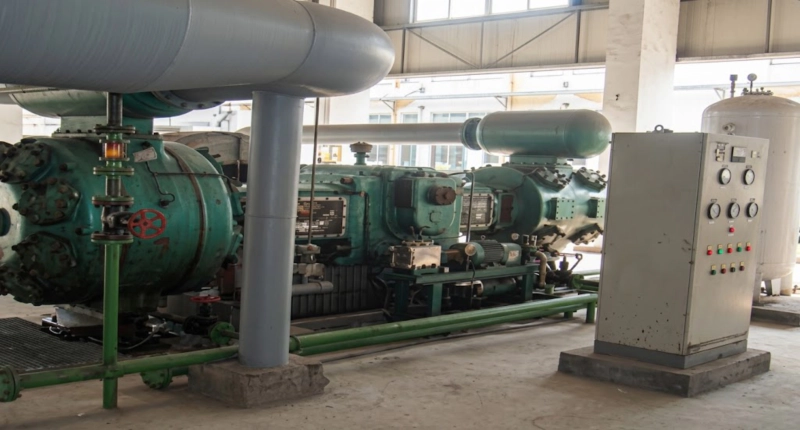
Transcritical CO₂ systems operate the high-pressure side above the critical point (73.8 bar, 31.1°C), delivering heat to ambient air in a gas cooler rather than a condenser. This allows a CO₂ refrigerant system to operate without a secondary refrigerant at any ambient temperature, making it a true single-refrigerant system with the environmental credentials of R-744 (GWP = 1, ODP = 0).
The tradeoff is compressor discharge pressure. At a gas cooler outlet temperature of +40°C (typical for a warm ambient installation), optimal transcritical CO₂ system efficiency is achieved at a gas cooler pressure of approximately 90–100 bar — which becomes the compressor discharge pressure. At +50°C gas cooler outlet (hot climate or high-load conditions), optimal pressure rises to 110–120 bar. These discharge pressures are achievable in a reciprocating compressor but require the full high-pressure CO₂ specification: forged steel cylinders and heads, high-pressure-class gas valves, forged piston rod packing housing, and a high-pressure-class safety valve and discharge pipework system.
Transcritical CO₂ refrigeration in Russia is primarily adopted at large supermarket chains and food distribution centres where the environmental credentials and EU-equivalent regulatory alignment of R-744 are valued for corporate sustainability reporting. The technology is at an earlier adoption stage in Russia than in Western Europe, where transcritical CO₂ is already the dominant new-installation technology for supermarket refrigeration. The DW series CO₂ compressor covers the transcritical duty range for most Russian supermarket and food distribution applications at 55–350 kW.
| Application | Configuration | Suction (bar) | Discharge (bar) | Series |
|---|---|---|---|---|
| Deep-freeze cascade (low stage) | Subcritical | 10–20 | 28–40 | DW series |
| Cold store cascade (large scale) | Subcritical | 14–25 | 30–45 | DW or 4MW |
| Supermarket / food retail | Transcritical | 25–40 | 80–110 | DW series |
| Industrial transcritical (large) | Transcritical | 30–45 | 90–130 | 4MW series |
All CO₂ configurations use PAG or POE synthetic lubricant; high-pressure-rated cylinders and piston rod packing; CO₂-specific valve design. Subcritical DW and 4MW series use the same opposed-balance frame as standard refrigerant compressors. Contact our engineering team for a CO₂ compressor specification at your operating conditions.
CO₂ Compressor Safety in Russia: GOST and Regulatory Framework
CO₂ is non-toxic and non-flammable, which means a CO₂ refrigerant system does not fall under the Federal Law 116-FZ hazardous production object regime that applies to NH₃ refrigeration plants above defined inventory thresholds. This simplifies the regulatory pathway for CO₂ refrigeration significantly: no Rostechnadzor HPO registration, no licensed operating personnel requirement specific to CO₂, and no mandatory emergency response plan for toxic gas release. The CO₂ refrigerant compressor must still comply with GOST pressure vessel and pressure equipment requirements (GOST R 53674 for pressure vessels, GOST standards for reciprocating compressors) and must carry GOST-R certification, but the regulatory burden is comparable to a standard compressed air or nitrogen system rather than an NH₃ plant.
One safety consideration specific to CO₂ that does not apply to NH₃ or HFC refrigerants is asphyxiation risk. CO₂ at concentrations above 5% by volume in air causes rapid loss of consciousness without warning odour. Unlike NH₃, which gives intense olfactory warning at 5–10 ppm — far below the dangerous concentration — CO₂ is odourless and its physiological effects become severe before most people notice unusual breathing. CO₂ gas detectors in the machine room and in any enclosed space where CO₂ piping is routed are therefore a standard safety provision for CO₂ refrigerant installations, regardless of the absence of the NH₃-equivalent toxicity classification.
CO₂ in PET Bottle Production: Carbonation and Cold-Fill Refrigeration
CO₂ appears in PET bottle production at two distinct points in the value chain. First, the beverage itself: carbonated soft drinks and mineral water filled into PET bottles contain dissolved CO₂ at 3–8 bar, and the filling line refrigeration system keeps the beverage chilled during filling to maintain carbonation. This filling line refrigeration — typically at +2°C to +5°C — may use an NH₃/CO₂ cascade or a transcritical CO₂ system for the CO₂ refrigerant compressor duty described in this guide. Second, the PET bottle itself is produced on an injection stretch blow moulding (ISBM) line, where the stretch-blow air contacts the interior of the bottle during the forming cycle. The ISO 8573-1 Class 1 oil-free blow air requirement for food-contact PET bottles — bottles that will be filled with carbonated beverages — parallels the zero-contamination philosophy of the CO₂ beverage filling refrigeration system: both protect the product in the bottle from any compromise of the packaging integrity or beverage quality.
FAQ — CO₂ Refrigerant Compressor
Request a CO₂ Refrigerant Compressor Specification
DW and 4MW series CO₂ refrigerant compressors for subcritical cascade and transcritical service — high-pressure-rated cylinders, CO₂-specific valve design, PAG / POE synthetic lubricant, GOST-R certified. Response within 48 hours.