Selection Guide · NH₃ Refrigeration · Two-Stage Compression · Evaporating Temperature · Russia
The threshold between single-stage and two-stage NH₃ compression is one of the most consequential design decisions in Russian industrial refrigeration. Get it wrong in either direction and the cost is significant: specify two-stage too early and you pay for unnecessary equipment and complexity; specify single-stage too late and you destroy compressor valves and piston rings with high discharge temperatures while wasting energy at a 19:1 compression ratio. This guide identifies the exact evaporating temperature threshold, explains the physics that drives it, and shows how to apply it to the most common Russian refrigeration scenarios.
✓ −25°C to −30°C Threshold
✓ Discharge Temp Limits
✓ Russian Application Guide
✓ DW / 4MW Series
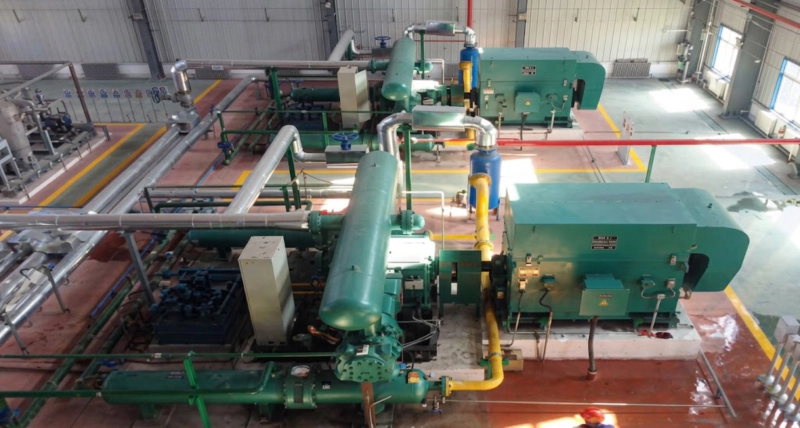
4MW series two-stage NH₃ refrigeration system at a large Russian cold chain facility — the low-stage compressor takes suction from blast freeze evaporators at −40°C to −43°C. At these evaporating temperatures, single-stage NH₃ compression would produce discharge temperatures above 180°C — far beyond the 145°C safe limit for cylinder lubrication and valve materials. Two-stage compression, with an inter-stage flash vessel reducing each stage to a 4:1–5:1 ratio, limits discharge temperature to 105°C–115°C at both stages.
−25°C
First Caution Point
−28°C
Russian Practice Boundary
19:1
Single-Stage at −40°C
15–25%
Two-Stage COP Gain
The Two Problems That Make Single-Stage NH₃ Fail at Low Temperatures
Single-stage NH₃ compression is thermodynamically and mechanically sound at evaporating temperatures above approximately −25°C. Below this threshold, two independent problems emerge that become progressively more severe as the evaporating temperature falls:
Problem 1 — Discharge Temperature
NH₃ has a high isentropic exponent (γ ≈ 1.32) compared with most refrigerants, meaning that adiabatic compression produces a larger temperature rise per unit of pressure ratio in NH₃ than in most HFC alternatives. At −40°C evaporating and +35°C condensing, the single-stage NH₃ compression ratio is approximately 19:1, producing a theoretical adiabatic discharge temperature of 180–200°C. Above 145–150°C, cylinder lubricating oil degrades rapidly, depositing carbon on valve seats, valve plates, and cylinder walls. Above 160–170°C, oil decomposition becomes severe and can lead to valve fires.
Problem 2 — Volumetric Efficiency Collapse
At a 19:1 compression ratio with a 5% cylinder clearance volume, the clearance gas re-expands to occupy approximately 60% of the cylinder swept volume before the suction valve opens. Only 40% of the cylinder is available for fresh suction gas — meaning the machine is physically capable of compressing 100 units per cycle but actually delivering 30–45 units. Capital is wasted on cylinder capacity that is consumed by clearance gas re-expansion rather than productive compression. Energy consumption per unit of delivered refrigerating effect rises sharply.
The Exact Numbers: Compression Ratio vs Evaporating Temperature
The following table shows the single-stage NH₃ compression ratio and theoretical discharge temperature at a fixed condensing temperature of +35°C — the standard summer design condition for Russian industrial refrigeration — across the evaporating temperature range relevant to cold chain and industrial process cooling:
| Evaporating Temp (°C) |
Suction Pressure (bar) |
Single-Stage Ratio |
Discharge Temp (°C) |
Stage Count |
| −5°C |
3.46 |
3.9:1 |
85–95°C |
Single |
| −15°C |
2.36 |
5.7:1 |
108–118°C |
Single |
| −25°C |
1.51 |
8.9:1 |
138–148°C |
Borderline |
| −30°C |
1.20 |
11.2:1 |
152–162°C |
Two-Stage |
| −35°C |
0.93 |
14.5:1 |
168–178°C |
Two-Stage |
| −40°C |
0.72 |
18.8:1 |
185–200°C |
Two-Stage |
Condensing temperature fixed at +35°C (summer design, evaporative condenser). Discharge temperatures are theoretical adiabatic; actual values are 10–20°C lower with effective inter-stage cooling but the relative progression across evaporating temperatures holds. At −25°C the discharge temperature sits at the borderline of acceptable cylinder lubrication.
The −28°C Russian Industry Boundary
Russian industrial refrigeration engineering practice, as reflected in the widely used design reference texts (Stoecker, Margolis, and the VNIHHOLODMASH compressor selection guides), places the practical two-stage boundary at −28°C evaporating temperature for new installations with summer condensing temperatures at +35°C. The reasoning:
1
At −25°C, the discharge temperature at +35°C condensing is 138–148°C — borderline acceptable. In winter when Russian outdoor condensing temperatures fall to +5°C to +15°C and the condensing pressure drops, the same −25°C evaporating system may produce discharge temperatures of only 115–125°C and run comfortably in single-stage. The system spends 6–8 months of the year in the safe zone. Single-stage is defensible at −25°C if the system designer accepts the borderline summer condition and monitors discharge temperature closely.
2
At −28°C, summer discharge temperature reaches 148–158°C — above the safe limit for sustained operation. Even with good cooling water supply and careful suction superheat control, the machine spends significant hours above 150°C in summer. Carbon deposits accumulate on the valves, valve service intervals shorten, and the compressor runs inefficiently for 3–4 months each year. Russian industry standard practice for new installations specifies two-stage below −28°C evaporating.
3
Below −30°C, two-stage is mandatory without exception. No compressor manufacturer or system designer of record in Russia specifies single-stage NH₃ compression at or below −30°C evaporating for a new installation. The discharge temperature is above the safety limit at all condensing conditions that occur in Russian summer. The capital cost premium of the second compressor and flash vessel is returned in energy savings within 4–6 years at the 15–25% COP improvement that two-stage achieves at these temperatures.
Application Guide: Russian Refrigeration Scenarios
SINGLE-STAGE
−5°C to −25°C
Brewery refrigeration, food chilling, process cooling, cold store at −18°C to −22°C
The majority of Russian food industry refrigeration operates in this range. Cold stores at −18°C to −22°C, dairy processing, beverage cooling, and chemical process cooling at −5°C to −20°C are all comfortably within the single-stage NH₃ operating envelope. The DW series (55–350 kW) and 4MW series (350–1,600 kW) in single-stage configuration are the standard specification.
BORDERLINE
−25°C to −28°C
Deep-freeze cold storage at −25°C, blast freeze ante-rooms
At exactly −25°C with a +35°C summer condensing temperature, single-stage operation produces discharge temperatures at the edge of the safe range. The decision depends on the specific compressor model’s rated discharge temperature limit, the cooling water reliability at the site, and the operator’s preference for simplicity vs safety margin. Russian practice recommends two-stage for all new installations in this range when the condensing temperature reaches +35°C in summer.
TWO-STAGE MANDATORY
Below −28°C
Blast freezing (−35°C to −43°C), fish processing, deep-freeze distribution
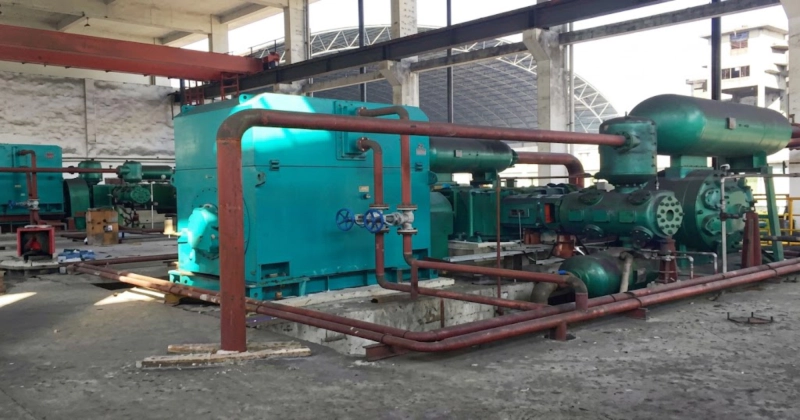
All blast freeze tunnel duty in Russia operates at −35°C to −43°C evaporating — mandatory two-stage NH₃ territory. Fish processing plants in Murmansk, Vladivostok, and Sakhalin; meat freezing facilities; frozen food distribution centres with blast freeze capacity — all use two-stage NH₃ systems with DW or 4MW series low-stage and high-stage compressors. The 15–25% COP improvement at these temperatures represents a substantial annual energy saving that pays for the second compressor within 4–6 years.
What Two-Stage Adds to a System
Moving from single-stage to two-stage NH₃ compression adds three physical components to the refrigeration system: a low-stage compressor (DW or 4MW series), a high-stage compressor (DW or 4MW series, typically larger displacement), and an inter-stage flash vessel. The flash vessel performs two simultaneous functions: it sub-cools the high-pressure liquid NH₃ from the condenser before it expands to the low evaporating pressure (improving refrigerating effect per kilogram), and it de-superheats the low-stage discharge gas before it enters the high-stage suction (reducing the high-stage discharge temperature and improving high-stage efficiency). The optimal inter-stage pressure is the geometric mean of the evaporating and condensing pressures: Pᵢₙᵗ = √(Pᵉᵐᵃ × Pϲₒₙₖ). At −40°C evaporating and +35°C condensing, this gives an intermediate pressure of approximately 3.1 bar, corresponding to −5°C saturation temperature — each stage then operates at a comfortable 4.3:1 compression ratio.
Related Application · Plastics Manufacturing
Why ISBM Blow Air Also Uses Three Stages — Not One
The same thermodynamic constraint that makes single-stage NH₃ compression unsafe at −40°C evaporating also makes single-stage compression of atmospheric air to 40 bar physically impossible. Compressing air from 0.1 MPa to 4.0 MPa in a single stage would produce an adiabatic discharge temperature above 500°C — destroying the cylinder and igniting the lubricant. Injection stretch blow moulding (ISBM) machines address this by using three-stage intercooled compression for their blow air circuits, exactly as two-stage NH₃ compression addresses the same constraint in industrial refrigeration. The physics is identical: the compression ratio per stage is the key variable, and it must be kept below approximately 4:1 to 6:1 per stage to keep discharge temperatures within safe and efficient limits. The ISBM engineer who understands why NH₃ compression must be two-stage at low evaporating temperatures already understands why blow air compression must be three-stage at 35–40 bar.
Related equipment: One-step three-station ISBM machines for PET bottle production — with three-stage blow air compression applying the same staged compression principle as two-stage NH₃ industrial refrigeration.
ISBM Machine ›injectionstretchblowmolding.com
FAQ — Two-Stage NH₃ Compression Threshold
Q1: Can the evaporating temperature threshold be extended below −28°C by using a lower condensing temperature?
Yes, in principle. The discharge temperature is a function of both the evaporating temperature (suction pressure) and the condensing temperature (discharge pressure). If the condensing temperature can be reduced below +35°C — for example, by using an evaporative condenser rather than an air-cooled condenser, or by operating in the winter season when Russian outdoor temperatures allow lower condensing pressures — the single-stage discharge temperature at a given evaporating temperature falls accordingly. A system condensing at +20°C rather than +35°C can extend the single-stage operating range down to approximately −30°C to −32°C evaporating before the discharge temperature becomes unsafe. However, a system that operates year-round in Russia must be designed for the worst-case summer condensing temperature, not the average or winter condition. A system that is single-stage at +20°C condensing but produces unsafe discharge temperatures at +35°C condensing is not correctly designed — it will damage valves and oil every summer until redesigned with two-stage compression.
Q2: What compressor series are used for the low-stage and high-stage in a two-stage NH₃ system?
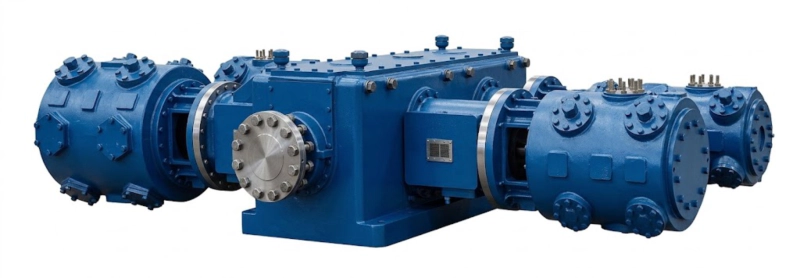
In Russian industrial refrigeration practice, both the low-stage and high-stage compressors are typically DW or 4MW series machines — the same series used for single-stage duty. The low-stage compressor handles the larger volumetric flow at the low suction pressure and typically requires a larger displacement than the high-stage machine, even though it operates at a lower pressure ratio. At −40°C evaporating with a −5°C intermediate temperature and +35°C condensing, the low-stage suction specific volume is approximately 7 times larger than the high-stage suction specific volume at the intermediate pressure — so the low-stage machine is typically 2–3 times larger in displacement than the high-stage machine for the same refrigerating capacity. Our engineering team calculates the low-stage and high-stage compressor specifications from the system evaporating temperature, intermediate temperature, condensing temperature, and required refrigerating capacity, and provides a model recommendation from the DW or 4MW series for each stage.
Q3: Is it possible to convert an existing single-stage NH₃ system to two-stage without replacing the existing compressor?
Converting an existing single-stage system to two-stage is feasible and is a common retrofit in Russian refrigeration facilities that are expanding their blast freeze capacity or lowering their evaporating temperature below the original design point. The existing single-stage compressor becomes the high-stage machine; a new low-stage compressor is added to handle the new lower evaporating temperature. The inter-stage flash vessel and the low-stage suction and discharge pipework are new additions. The existing compressor must be re-evaluated for its suitability as a high-stage machine: its displacement must match the required high-stage flow at the intermediate pressure, and its rated discharge pressure must be sufficient for the condensing pressure at summer design conditions. In many cases the existing single-stage machine is well-matched for high-stage duty because it was sized for the full system load at a higher evaporating temperature — at the intermediate pressure, the required volumetric flow is lower, and the existing machine may operate at a partial load condition that suits its capacity control range. Our engineering team provides a conversion feasibility assessment from the existing compressor model number and the new evaporating temperature requirement.
NH₃ Compressor Selection
DW and 4MW Series for Single-Stage and Two-Stage NH₃
DW series (55–350 kW) and 4MW series (350–1,600 kW) ammonia refrigeration compressors for single-stage and two-stage compound systems — low-stage and high-stage sizing, flash vessel specification, system energy balance. GOST-R and EAC certified. Send your evaporating temperature, condensing temperature, and required refrigerating capacity for a stage count recommendation and compressor selection within 48 hours.