Maintenance Safety · Labyrinth Seal · Distance Piece · Blocked Vent · Oil Contamination · Oxygen Compressor
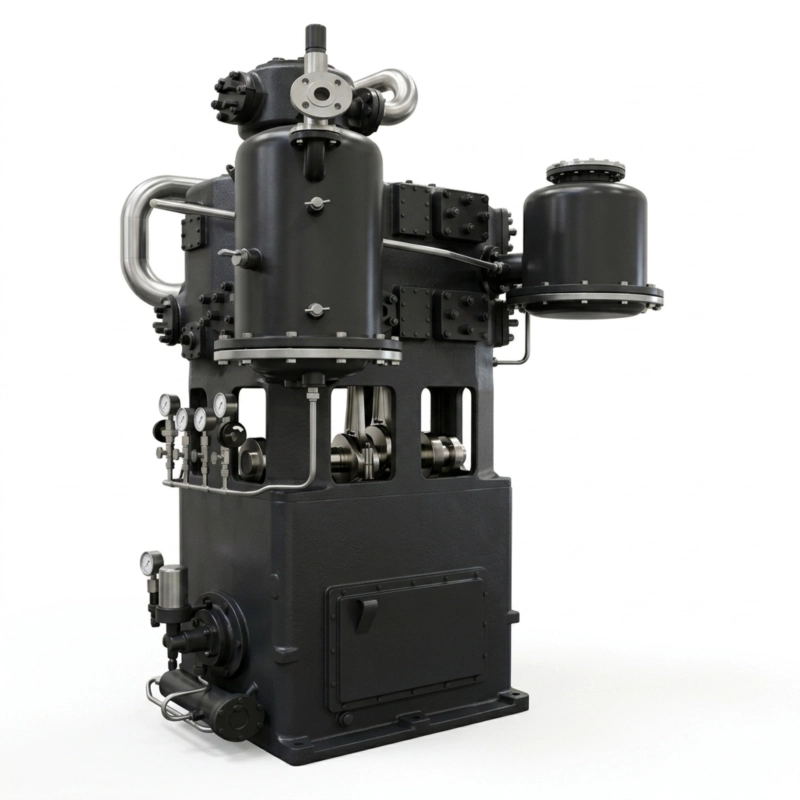
The distance piece on an oil-free reciprocating compressor is the physical and functional barrier between the crankcase oil environment and the process gas cylinder. It is one of the most safety-critical components on an oxygen compressor and one of the least understood. When the distance piece vent becomes blocked — by ice, rust flakes, oil sludge, or simply a closed valve left closed after maintenance — the pressure equilibrium that keeps crankcase oil on the crankcase side of the piston rod seal is destroyed. Oil migrates through the piston rod packing, enters the cylinder, and contacts oxygen at elevated pressure and temperature. This blocked-vent oil migration is one of the specific failure sequences that causes oxygen compressor fires. This guide explains the distance piece mechanism, how a blocked vent produces oil migration into the cylinder, the warning signs that appear before the migration reaches a dangerous level, and the inspection and maintenance protocol that prevents it.
✓ Distance Piece Function
✓ Blocked Vent Failure Mode
✓ Warning Signs
✓ Inspection Protocol
What the Distance Piece Does and Why It Exists
In a reciprocating compressor, the piston rod travels back and forth between the crankcase — which contains the lubricating oil for the crankshaft, connecting rod bearings, and crosshead — and the cylinder, which contains the process gas. In a lubricated machine this rod movement between oil environment and process gas is acceptable and the rod seal simply prevents gross leakage in either direction. In an oil-free machine handling oxygen or other purity-sensitive gases, even trace oil vapour migration from the crankcase along the rod surface would contaminate the process gas. The distance piece is the engineering solution to this problem.
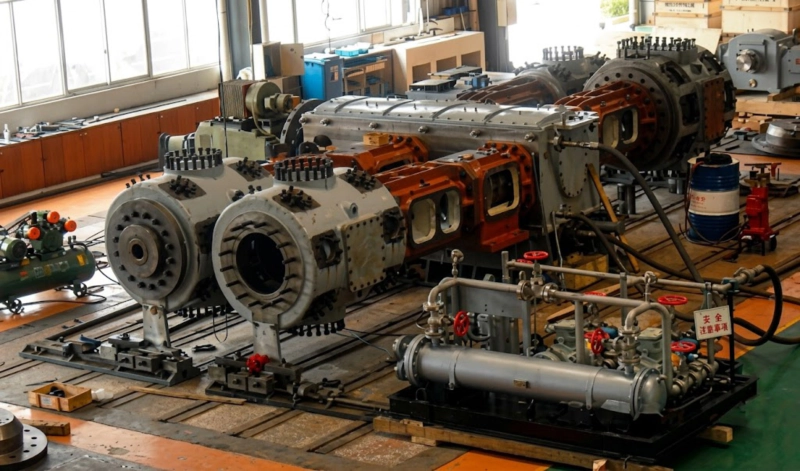
The distance piece is an enclosed housing positioned between the crankcase and the cylinder assembly, through which the piston rod passes on its reciprocating travel. It is long enough that no single point on the piston rod surface enters both the crankcase oil environment and the cylinder gas environment during the same stroke — the rod section that is in the crankcase at top dead centre is still within the distance piece at bottom dead centre, never reaching the cylinder. The distance piece accomplishes separation through its length alone, without relying on seals to be perfect.
Within this length, the distance piece is divided into two compartments by an intermediate partition through which the piston rod passes with a labyrinth seal or a PTFE packing ring. The two compartments serve different functions and are connected to different external systems:
Inner compartment (gas-side)
Located adjacent to the cylinder packing. Connected to a vent line that leads to a safe outdoor location or to a low-pressure process gas return header. The inner compartment collects any process gas that leaks past the piston rod packing from the cylinder — preventing it from accumulating inside the distance piece where it could mix with crankcase atmosphere. For the oxygen compressor inner compartment vent is routed to the outdoor atmosphere at a safe distance from ignition sources, and the vent line is monitored for gas flow that would indicate packing leakage.
Pressure: slightly above atmosphere (gas-side positive sealing)
Outer compartment (oil-side)
Located adjacent to the crankcase. Connected to a vent line open to the crankcase atmosphere or to a crankcase ventilation system. The outer compartment provides a buffer zone that prevents crankcase oil mist from reaching the intermediate partition seal. Any oil mist that enters the outer compartment from the crankcase side is collected in a drain at the bottom of the outer compartment and returned to the crankcase sump. The outer compartment vent connection to the crankcase maintains pressure equilibrium between the outer compartment and the crankcase.
Pressure: equals crankcase pressure (typically near atmospheric)
The intermediate partition separates the inner compartment (gas-side) from the outer compartment (oil-side). The intermediate seal at this partition — a labyrinth seal or PTFE ring set — sees a pressure differential equal to the difference between the inner compartment pressure and the outer compartment pressure. When both vent lines are functioning correctly this pressure differential is very small — both compartments are near atmospheric — and the intermediate seal is lightly loaded. This is the normal operating condition.
How a Blocked Outer Compartment Vent Drives Oil Into the Cylinder
The blocked vent failure mode in an oxygen compressor is one of the most insidious failure sequences in oxygen compressor maintenance because it develops slowly, shows no immediate visible symptom, and reaches a dangerous condition before the operator is aware that anything has changed. The sequence proceeds in four stages:
1
Vent
Blocks
The outer compartment vent becomes restricted or fully blocked.
The blockage may be caused by: ice formation in the vent line during winter at Russian outdoor installations where the vent exits through an external wall; rust scale from corroded vent piping accumulating at an elbow; oil sludge migrating from the crankcase into the vent line and solidifying; a maintenance technician closing the vent isolation valve during a purge procedure and failing to reopen it before returning the machine to service; or an insect nest in an outdoor vent termination. Once blocked, the outer compartment is no longer pressure-equalised with the crankcase.
2
Pressure
Builds
Crankcase pressure pulsations pump gas into the sealed outer compartment.
The crankcase is not at a perfectly steady pressure — the reciprocating piston creates small pressure pulsations in the crankcase atmosphere as it compresses and expands the gas trapped below the piston. In a normally-vented outer compartment these pulsations are simply transmitted to atmosphere through the vent line. When the vent is blocked, each pressure pulsation from the crankcase side pushes a small increment of crankcase atmosphere (including oil mist) through the intermediate partition labyrinth into the sealed outer compartment. Over many operating cycles the outer compartment pressure builds above the crankcase pressure and above the inner compartment pressure.
3
Oil
Migrates
The pressure reversal across the inner compartment seal drives oil toward the cylinder.
With the outer compartment at higher pressure than the inner compartment, the pressure differential across the intermediate partition seal is now reversed from its normal direction. Instead of the small positive pressure of the inner compartment (gas side) pushing any gas leakage back toward the outer compartment, the elevated outer compartment pressure pushes oil mist from the outer compartment through the intermediate seal into the inner compartment. From the inner compartment, the oil mist reaches the piston rod packing on the cylinder side. The piston rod packing is designed to seal against process gas pressure from the cylinder — it is not designed to seal against oil pressure from the distance piece side. The oil mist passes through the packing rings and enters the cylinder.
4
Fire
Risk
Oil contacts oxygen at elevated pressure and temperature.
Hydrocarbon oil in contact with high-pressure oxygen (above 0.5 MPa) at elevated temperature (above 120°C discharge temperature) presents a fire ignition risk. The auto-ignition temperature of mineral compressor oil in oxygen is significantly lower than in air — some oil formulations can spontaneously ignite in oxygen at temperatures as low as 180–220°C, well within the range of a compressor discharge temperature during normal operation. A compressor fire in an oxygen cylinder or on an oxygen pipeline is extremely difficult to extinguish and typically causes catastrophic damage to the machine and its surroundings. This is the specific failure sequence that GOST 12.2.052 is designed to prevent through its degreasing requirements, maximum discharge temperature limits, and oil-free cylinder specifications.
Warning Signs That Appear Before Dangerous Oil Migration
The blocked vent failure develops slowly enough that several warning signs appear before the oil migration reaches dangerous levels — if the operator knows what to look for and checks the relevant indicators at the correct frequency. The following warning signs should be incorporated into the weekly inspection checklist for every oxygen compressor with a distance piece:
⚠ No airflow at outer compartment vent outlet
Hold a piece of tissue paper or a lit incense stick near the vent outlet while the compressor is running. There should be a slight but perceptible airflow out of the vent as the crankcase pulsation purges the outer compartment. No airflow, or airflow that is significantly lower than at the previous inspection, indicates partial or complete blockage. This check takes under 30 seconds and is the earliest possible indication of a developing problem.
⚠ Oil in outer compartment drain more than expected
The outer compartment drain should produce small quantities of oil — typically a few millilitres per hour of operation — as crankcase oil mist condenses in the outer compartment. An unusually large quantity of oil at the drain, or oil that appears emulsified or discoloured, indicates that the outer compartment is accumulating pressure and condensing oil at an abnormal rate. Record the drain quantity at each inspection to track trends.
⚠ Rising discharge temperature above baseline
If oil has begun to enter the cylinder, it acts as a minor lubrication agent that initially reduces friction heat — but as it accumulates in the cylinder and undergoes partial oxidation in the oxygen environment, it adds a heat load that raises the discharge temperature slightly above the baseline. A +3°C to +8°C rise above the commissioning baseline that is not explained by cooling water temperature change or ring wear should prompt an investigation of the distance piece as well as the ring condition.
⚠ Darkening or odour at inner compartment vent
The inner compartment vent should discharge clean process gas (nitrogen or oxygen, depending on the service) with no visible discolouration or hydrocarbon odour. Any visible yellow-brown discolouration at the vent termination, or a detectable hydrocarbon smell, indicates that oil mist has migrated through the intermediate partition into the inner compartment and is being discharged through the inner vent. At this point the migration is already occurring and the machine must be stopped and the distance piece inspected.
⚠⚠ Oil visible at piston rod packing drain or in cylinder
Any oil visible at the oxygen compressor piston rod packing drain (located between the distance piece and the cylinder) or any oil detected in the cylinder during a visual inspection constitutes an immediate shutdown requirement. The machine must not be restarted until the distance piece has been fully disassembled, cleaned, and inspected, the vent blockage has been cleared, the intermediate seal and piston rod packing have been inspected and replaced as required, the cylinder has been degreased to GOST 12.2.052 requirements, and the akt obezzhirivaniya has been issued before restart.
⚠⚠ Total hydrocarbon (THC) alarm on discharge gas analyser
Oxygen compressors serving purity-critical downstream applications should be equipped with a total hydrocarbon analyser on the discharge line. An alarm on this analyser — triggered by any reading above the baseline (which should be below 0.1 ppm for a correctly operating oil-free machine) — is the most direct indication that oil has reached the gas stream and must be treated as an immediate shutdown trigger. This instrument provides real-time protection against the blocked vent failure mode and is strongly recommended for oxygen compressors at Russian industrial gas and medical oxygen filling facilities.
The Distance Piece Inspection and Maintenance Protocol
The following protocol applies to all oil-free reciprocating compressors handling oxygen or other purity-sensitive gases where the distance piece separation is a safety-critical function. It incorporates the requirements of GOST 12.2.052 and the standard maintenance practices of Russian industrial gas producers for ZW and DW series oxygen compressors:
WEEKLY
check
Vent flow check at outer compartment vent outlet. Tissue paper or smoke test at the vent termination while the machine is running. Record result as «normal flow» or «reduced flow» or «no flow». Any reading other than normal flow triggers immediate investigation of the vent line before the next scheduled run. Also check outer compartment drain quantity and inner compartment vent condition. Record all findings in the maintenance log.
MONTHLY
check
Vent line probe with flexible rod or wire. Remove the vent connection fitting at the outer compartment and probe the vent line with a flexible rod or wire to the first bend, clearing any soft blockage (oil sludge, rust scale) before it can build to a full blockage. Inspect the outer compartment drain valve for correct position (open) and free draining. Record in maintenance log.
ANNUAL
service
Distance piece full disassembly and inspection. Open the distance piece, inspect both compartments for oil accumulation or corrosion, inspect the intermediate partition labyrinth or PTFE seal for wear or damage, replace the intermediate seal if any wear is visible, verify that all drain and vent connections are clear and correctly routed, and redress all gasket faces. If the intermediate seal is replaced or if any oil accumulation is found in the inner compartment, perform full degreasing of the inner compartment and the cylinder piston rod packing zone, and issue a new akt obezzhirivaniya before restart.
AFTER ANY
maintenance
Mandatory vent valve open-position check before restart. After any maintenance that required closing the outer compartment vent valve (for purge procedures, pressure testing, or distance piece access), add a mandatory restart checklist item: «outer compartment vent valve open position verified by name and date.» This single line in the restart checklist prevents the most common cause of acute vent blockage — a valve closed during maintenance and not reopened before restart.
Related Application · Plastics Manufacturing
ISBM Blow Air Purity and the Distance Piece Lesson
The distance piece separation principle described in this guide — using physical length and compartmented venting to prevent oil from reaching the process gas — is directly analogous to the sealing and separation design in the blow air compressor of an injection stretch blow moulding (ISBM) machine. In an ISBM blow air compressor, the oil-free cylinder design must prevent crankcase oil from reaching the blow air circuit that contacts the interior of PET preforms. The separation between the crankcase oil and the blow air is achieved by a distance piece on the piston rod in exactly the same way as the oxygen compressor — the same inner and outer compartment arrangement, the same vent function, and the same maintenance requirement to keep the vent clear. A maintenance technician who has learned to inspect the distance piece vent on an oxygen compressor — weekly airflow check, monthly probe, annual full disassembly — already knows the maintenance protocol for the ISBM blow air compressor’s distance piece. The safety stakes are different (oxygen fire versus food contamination) but the engineering and maintenance principles are identical.
Related equipment: One-step three-station ISBM machines for PET bottle production — with oil-free blow air compressors using the same distance piece separation principle as the oxygen compressor described in this guide.
ISBM Machine ›injectionstretchblowmolding.com
FAQ — Distance Piece Vent and Oil Migration Prevention
Q1: We found oil in the inner compartment of the distance piece during the annual service. The outer compartment vent was clear when we checked it. What else could have caused the oil migration?
Oil in the inner compartment with a clear outer compartment vent indicates that the intermediate partition seal — the labyrinth or PTFE seal between the outer and inner compartments — has deteriorated to the point where it no longer provides adequate separation between the compartments even at normal (equal) pressures. The normal pressure differential across this seal is very small, so a degraded seal can still allow oil mist to migrate through by simple diffusion and convection even without a pressure reversal from a blocked vent. Causes of intermediate seal degradation include: normal wear of the PTFE ring contact surfaces over the seal’s service life (typically 4,000–8,000 hours), labyrinth clearances opening up due to thermal cycling that causes differential expansion between the rod and the labyrinth housing, and corrosion of the labyrinth housing that enlarges the nominal clearances. The corrective action is to replace the intermediate seal with new components, degrease the inner compartment and cylinder piston rod packing zone, and issue a new akt obezzhirivaniya. The seal replacement interval should be reduced to the next shorter standard interval (e.g. from 8,000 hours to 5,000 hours) at this machine.
Q2: The winter outdoor temperature at our site reaches minus 35 degrees Celsius. The outer compartment vent is routed through an external wall. What is the risk of ice blockage and how do we prevent it?
Ice blockage of the outer compartment vent at a northern Russian site is a real and documented failure mode, particularly for machines that are started cold after a weekend or maintenance shutdown when the vent line has been at ambient temperature. The moisture in the crankcase atmosphere — introduced through the crankcase breather during normal operation — condenses in the vent line during shutdown and freezes when the outdoor temperature falls below zero. When the machine restarts, the vent line may be partially or fully blocked by ice before the machine heat has reached the vent. Prevention measures in order of effectiveness: (1) Reroute the vent termination to inside the heated compressor room rather than to the outdoor atmosphere — this eliminates the ice risk but requires a safe indoor vent termination with appropriate explosion-proof electrical classification if the gas service is flammable. For oxygen service, indoor venting is not recommended due to oxygen enrichment risk; a heated outdoor vent termination is the better solution. (2) Insulate and heat-trace the vent line from the outer compartment to the outdoor termination, maintaining the pipe wall temperature above +5°C throughout the winter. Heat tracing must be thermostatically controlled to avoid excessive heating that would accelerate oil degradation in the vent line. (3) Install a low-point drain at the lowest point of the vent line to collect and drain condensate before it can freeze. The drain must be manually checked and opened at each startup in winter conditions. (4) Increase the weekly vent check frequency to daily during winter months when ice formation risk is high.
Q3: Our oxygen compressor has been running for 6 months since the last annual service. The weekly vent checks have been normal. Today the discharge temperature alarm triggered at 138 degrees Celsius, 12 degrees above the baseline. The outer compartment vent is flowing normally. Should we stop the machine and open the distance piece?
A 12°C discharge temperature rise is a significant excursion that warrants immediate investigation, but the normal vent flow indicates the distance piece is not the primary cause. The most likely causes in order of probability at 6 months after an annual service are: piston ring wear that has advanced faster than expected due to elevated discharge temperature operating conditions or a bore surface condition issue — the ring gap has widened and re-compression heating is raising the discharge temperature; cooling water flow reduction from a fouled inter-stage cooler or a partially closed cooling water valve; or elevated suction gas temperature from a warm ambient condition or a suction line heat source. The distance piece can be ruled out as the primary cause in this case because the outer compartment vent is flowing normally, which means the outer compartment pressure is correctly equalised with the crankcase. However, a 12°C temperature rise at 138°C is approaching the GOST 12.2.052 limit of 140°C for oxygen service. Stop the compressor, check the cooling water flow rate and inlet temperature, check the inter-stage cooler differential pressure for fouling, and if these checks are normal, open the first-stage cylinder to measure ring gap and inspect ring condition. Do not restart at the 138°C condition without identifying and correcting the cause — if the temperature reaches 140°C during operation in oxygen service the machine must be stopped immediately regardless of the cause.
Oil-Free Oxygen Compressors
ZW and DW Series with Distance Piece Safety Documentation
Oil-free ZW series (2–75 kW) and DW series (55–350 kW) oxygen compressors with double-compartment distance piece, PTFE intermediate seal, vent and drain connections, and complete GOST 12.2.052 compliance documentation — including distance piece inspection protocol, akt obezzhirivaniya template, and weekly/monthly/annual maintenance checklist. Spare intermediate seal sets held in Russia for 24–72 hour dispatch. Specify compressor model and serial number when ordering.