
Application Guide · NH₃ Refrigeration · Brewery · Beverage · Russia · Capacity Control · Winterization
Russian breweries and beverage plants present a refrigeration compressor specification challenge that industrial cold stores do not: the cooling load varies not by season but by the production schedule, which changes week to week as brands shift, seasonal products enter the line, and tank capacity is re-allocated between fermentation, conditioning, and bright beer storage. A Russian brewery with a 2 million hectolitre annual capacity may need 800 kW of refrigerating capacity during peak summer lagering and only 250 kW during a winter shutdown turnaround. The ammonia refrigeration compressor selected for this facility must handle this 3:1 load variation efficiently, operate through Russian winters that can bring outdoor temperatures to −35°C, and comply with the GOST 26790 and food safety requirements that govern ammonia systems in Russian food production facilities. This guide covers every dimension of that specification challenge.
✓ Capacity Control Strategy
✓ Winterization
✓ GOST 26790 Food Safety
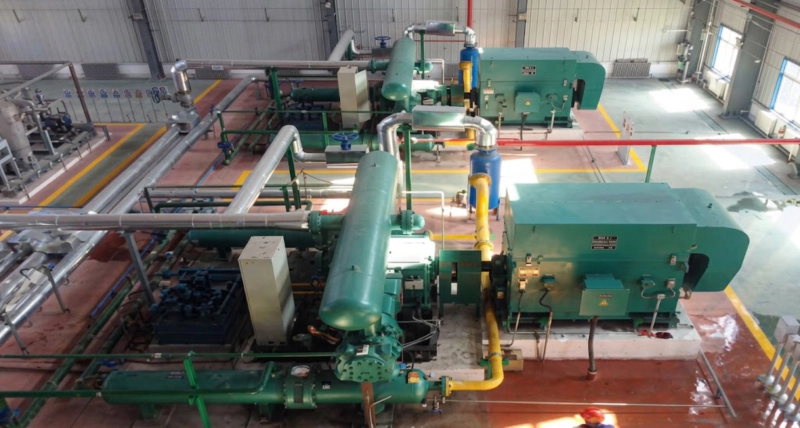
4MW series ammonia refrigeration compressor in beverage production service — Russian breweries require refrigerating capacity across multiple evaporating temperatures simultaneously: fermentation tanks at +8°C to +12°C, conditioning tanks at −2°C to 0°C, wort cooling at −2°C, and glycol chilling at −8°C to −10°C. The ammonia compressor system must serve all these duties simultaneously from a single refrigerant circuit, while handling the 3:1 load variation between peak summer production and winter minimum, and operating safely and efficiently through Russian winters that may bring condensing temperatures below +5°C.
variation
−2°C
only
pressure
food zones
The Russian Brewery Refrigeration Load Profile
A Russian brewery is not a simple cold store with a single evaporating temperature and a seasonally-varying outdoor temperature as the only load driver. It is a multi-temperature process facility whose refrigerating load distribution across evaporating temperatures changes continuously with the production schedule. Understanding this load distribution is the starting point for every ammonia refrigeration compressor specification decision at a Russian brewery.
The brewery cooling loads divide into four temperature levels, each served by a different evaporator circuit but typically all served by the same ammonia compressor system through a common refrigerant circuit:
Capacity Control Strategy for Brewery NH3 Compressors
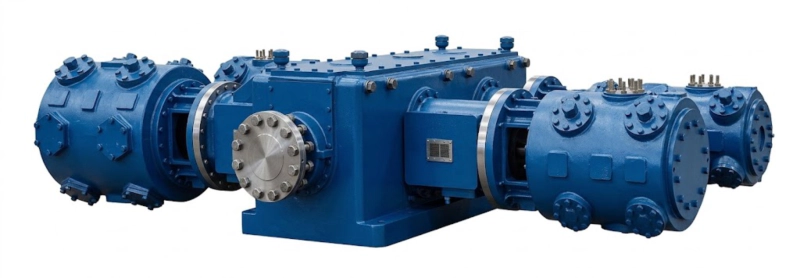
The 3:1 load variation between peak summer production and winter minimum at a Russian brewery demands a capacity control approach that is more sophisticated than the simple suction valve unloading applied to a cold store compressor running at a steadier load. The brewery refrigerating system typically uses a combination of N+1 compressor arrangement and suction valve unloading on each machine to cover the full load range efficiently:
| Load Condition | Approx. Load | Compressor Status | Capacity Control Action |
|---|---|---|---|
| Peak summer production | 800 kW | 2 × running, 1 standby | Both machines 100% loaded; standby on auto start |
| Active production, summer | 500–650 kW | 2 × running | Primary at 100%; secondary at 50–75% (unloaded) |
| Normal production, autumn | 350–500 kW | 1 running, 1 standby | Single machine at 75–100%; standby ready |
| Low production, winter | 200–350 kW | 1 running, 1 standby | Single machine at 50–75% with unloading |
| Shutdown minimum (bright beer only) | 250 kW | 1 running, 1 standby | Single machine at 50%; unloaded 2 of 4 cylinders |
Example based on a 2 million hl/year lager brewery with three DW series machines at 400 kW shaft power each, serving all temperature levels from a common NH₃ circuit.
The brewery operator’s most common frustration with NH₃ compressor capacity control is that the 50% minimum load (with 2 cylinders unloaded on a 4-cylinder DW machine) often does not match the actual minimum cooling demand at the facility. During a scheduled production shutdown that lasts 3–7 days — common at Russian breweries during annual maintenance periods — the refrigerating demand may fall to 20–30% of the single-machine rating as only the bright beer tanks and finished product cold store require continuous cooling. At this low load, the compressor cycles on and off through the suction valve unloading sequence, producing thermal cycling of the valve assemblies that shortens valve life. The solution for Russian breweries is either a VFD on one of the compressor motors (providing continuous adjustment from 60–100% speed) or a small auxiliary ZW series compressor for shutdown minimum load, allowing the main DW machines to be stopped completely during the maintenance shutdown period.
Winterization: Operating NH3 Compressors Through Russian Winters
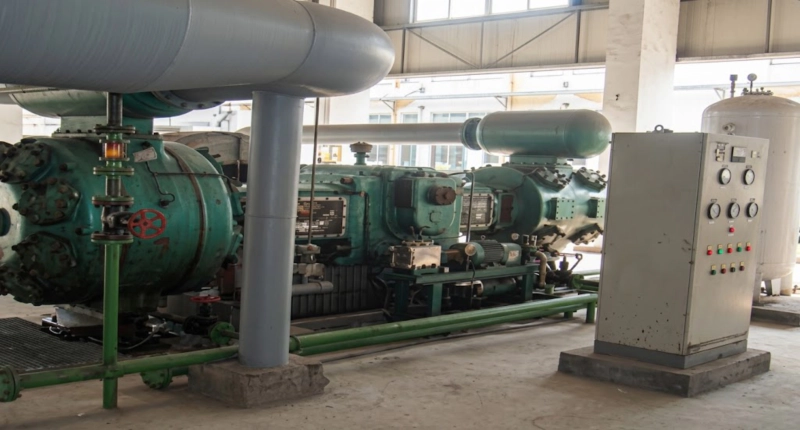
Russian winters present a specific challenge for brewery NH₃ refrigeration systems that is different from the challenge they present for industrial cold stores. At a cold store, the lower winter condensing temperature simply improves the compressor COP and reduces energy consumption — a welcome benefit. At a brewery, the lower condensing temperature can cause operational problems if the system is not designed to manage the condensing pressure through the full ambient temperature range from −35°C to +40°C.
The problem manifests in two ways that are specific to the brewery application. First, as the outdoor temperature falls below −10°C, the NH₃ condensing pressure at an evaporative condenser drops below 0.4 MPa (approximately −10°C condensing temperature). At this low condensing pressure the pressure differential across the expansion valves for the fermentation and conditioning circuits falls significantly, reducing the refrigerant flow to these evaporators and causing the evaporating temperature to rise above the setpoint — fermentation temperature control deteriorates and the beer quality may be affected. Second, at very low condensing pressures the compressor runs at very low compression ratios and high volumetric efficiency, potentially delivering more refrigerating capacity than the brewery demand, causing short-cycling behaviour that damages valves and motor starting equipment.
A minimum condensing pressure of 0.4–0.5 MPa (−10°C to −5°C condensing temperature) must be maintained year-round regardless of outdoor temperature. The standard approach for Russian brewery evaporative condensers is a condenser bypass valve that partially bypasses the condenser water circuit or a condenser fan speed controller that reduces the air-side heat rejection rate in winter, maintaining the refrigerant condensing temperature above the minimum setpoint. Some Russian breweries use a flooded condenser design that maintains liquid refrigerant level in the condenser at a regulated pressure, allowing the condensing pressure to be maintained at setpoint regardless of the outdoor temperature by regulating the active heat transfer area. The minimum condensing pressure specification is one of the most commonly overlooked design requirements in Russian brewery NH₃ system specifications and is responsible for a significant proportion of winter production quality problems at plants that were not designed with this control strategy.
At Russian brewery sites in Siberia, the Urals, and northern regions where winter ambient temperatures reach −25°C to −40°C, the compressor room itself must be heated to maintain the compressor, instruments, and oil system above their minimum operating temperatures. The DW series compressor oil viscosity must remain within the acceptable range for startup — typically ISO VG 68 mineral oil with a pour point below −25°C, but the oil must be above approximately −15°C to −10°C for the viscosity to fall within the startup range. The compressor room minimum temperature specification for an extreme cold site is −10°C at the floor level where the crankcase is located, requiring either building heating or crankcase heaters (preferred because they heat the oil directly rather than the whole room). Crankcase heaters sized at 300–500 W are standard on DW series machines for Russian extreme-climate applications.
NH₃ refrigerant pipework carrying liquid refrigerant through unheated sections of the brewery building or through outdoor pipe bridges is at risk of freezing in extreme winter conditions — not the NH₃ itself (which freezes at −77.7°C) but the moisture that accumulates in the pipework over time if the system is not kept absolutely dry. More commonly, the inter-stage cooler cooling water supply is at risk of freezing in unheated compressor rooms at temperatures below −10°C. The inter-stage cooler water circuit must be drained or replaced with a glycol solution at the appropriate concentration for the minimum expected temperature at the compressor room location. This is another requirement that is frequently missed in standard-specification NH₃ compressor packages supplied to Russian brewery projects without site-specific winterization engineering.
Restarting a brewery NH₃ compressor after a winter shutdown — either a planned maintenance shutdown or an emergency stop — requires a specific cold-start sequence that allows the system to reach operating temperature before the compressor is loaded. The crankcase oil must be above the minimum startup temperature (crankcase heater preheat for 1–4 hours), the condensing pressure must be checked and adjusted if below the minimum setpoint, the suction superheat must be verified to ensure no liquid NH₃ carry-over from cold suction conditions, and the load should be applied progressively through the unloading steps rather than starting fully loaded. A brewery that restarts its NH₃ compressor cold without this sequence risks liquid slugging damage to the first-stage valves and piston rings from liquid NH₃ that has migrated to the suction header during the cold standby period.
GOST 26790 Compliance at Russian Food Production Facilities
GOST 26790 and TR CU 021/2011 together impose a requirement that NH₃ systems at Russian food production facilities — including breweries and beverage plants — must be designed to limit the maximum credible ammonia release in the food production zone to a level that does not constitute a food safety risk. For a brewery this requirement affects three specific design decisions:
Beer Bottles, PET, and the Brewery Cold Chain
Russian breweries package an increasing proportion of their production in PET bottles, particularly for the 1.5 litre and 2.0 litre retail formats that dominate the off-trade channel outside the premium segment. PET beer bottles are produced on ISBM machines that are typically operated at packaging plants adjacent to or within the brewery complex, using preforms produced at centralised preform manufacturing facilities and transported to the brewery. The carbonation level in beer — typically 2.5–3.5 volumes of CO₂ per volume of beer — requires that the PET bottle be blown at sufficient pressure and orientation ratio to develop the CO₂ barrier properties necessary for a 3–6 month shelf life. The NH₃ refrigeration system at the brewery that maintains the bright beer at +2°C to +4°C before packaging also maintains the carbonation level in the beer that the PET bottle must contain — warming the beer during packaging reduces CO₂ solubility, producing excessive foaming in the filler and variable fill levels in the bottles. The ammonia refrigeration compressor’s ability to maintain stable +2°C bright beer temperature through the summer peak production period directly determines the filler performance and the consistency of the CO₂ level in the PET-packaged beer. A brewery engineer who understands the NH₃ compressor capacity control requirements described in this guide also understands why the ISBM blow air pressure for beer PET bottles is specified at the high end of the standard range — the CO₂ barrier requirement that the blow pressure must achieve is set by the same carbonation level that the NH₃ system preserves in the bright beer.
FAQ — NH₃ Compressor for Brewery and Beverage Production
DW Series NH₃ Compressors for Russian Breweries and Beverage Plants
DW series (55–350 kW) and 4MW series (350–1,600 kW) ammonia refrigeration compressors for Russian brewery and beverage facility applications — suction valve unloading capacity control, crankcase heating for arctic-site commissioning, minimum condensing pressure control specification, GOST 26790 and OPO compliance documentation. Provide your annual production volume, peak refrigerating capacity, evaporating temperatures required, winter ambient temperature, and site location for a complete system specification within 48 hours.