Engineering Economics · NH₃ vs R-404A · Cold Storage · Russia · 20-Year Cost Analysis
The choice between ammonia (NH₃, R-717) and R-404A for a large Russian cold storage facility is ultimately an economic question, not a purely technical one. Both refrigerants work. The difference appears in the 20-year total cost of ownership — where the capital cost premium of the ammonia system is recovered within 3–6 years through lower energy cost and lower refrigerant purchase cost, leaving 14–17 years of net cost advantage. This article builds the comparison from first principles with numbers relevant to Russia, so that a procurement engineer or facility manager can make the decision with full visibility of the cost drivers on both sides.
✓ Capital Cost Comparison
✓ Annual Energy Cost
✓ Refrigerant Cost
✓ 20-Year NPV
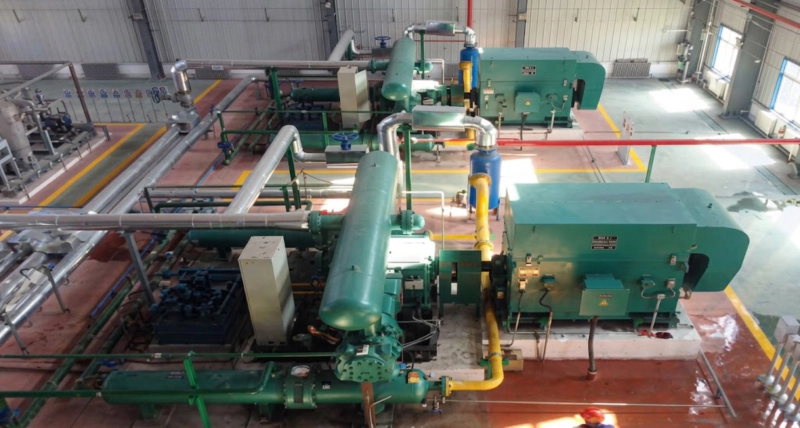
4MW series ammonia refrigeration compressor at a large Russian cold chain facility — the capital cost premium of the NH₃ system compared with R-404A is typically recovered within 3–6 years through energy cost savings alone. Over a 20-year plant life at current Russian industrial electricity tariffs, the net cost advantage of ammonia over R-404A for cold storage above 1,000 tonnes capacity is several million roubles.
The Reference Installation: 5,000 Tonne Cold Store at −22°C
The cost comparison below uses a specific reference installation to make the numbers concrete and checkable: a new 5,000 tonne frozen food storage facility in central Russia operating at −22°C storage temperature, with a peak refrigerating load of 500 kW, condenser design point of +35°C (summer), and 8,000 operating hours per year. This scale — the most common new-build cold storage specification in current Russian logistics investment — is large enough that a 4MW series ammonia compressor is the standard specification, but not so large that the site requires multiple compressor units for the comparison to remain tractable.
NH₃ System Specification
One 4MW series compressor, 500 kW at −22°C evaporating / +35°C condensing. Evaporative condenser. Plate evaporators with direct expansion. Ammonia refrigerant charge approximately 800–1,200 kg. GOST 26790 compliant system with NH₃ detection, ventilation, and emergency scrubbing. Capital cost premium over R-404A system: approximately 15–25% of system cost.
R-404A System Specification
Two or three semi-hermetic or open screw compressors at 500 kW total refrigerating capacity. Air-cooled or evaporative condenser. Plate evaporators with direct expansion. R-404A charge approximately 5,000–8,000 kg (6–8x the ammonia charge by mass for equivalent capacity). No specialist safety infrastructure required. Lower capital cost; higher running cost.
Capital Cost: Where R-404A Starts Ahead
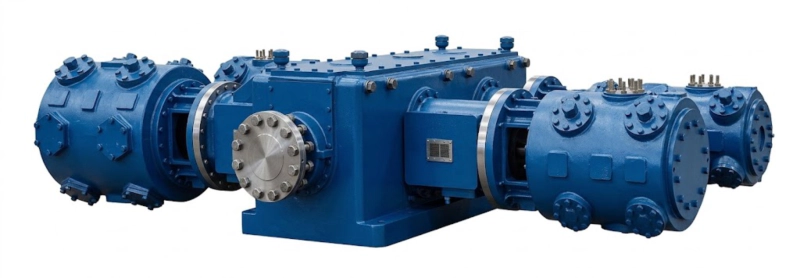
The ammonia system carries a capital cost premium over R-404A driven by three factors:
↑
Safety infrastructure: NH₃ leak detection system, forced ventilation of the compressor room, emergency scrubbing or water curtain, and the civil engineering for an isolated compressor room meeting GOST 26790 requirements. For a 500 kW system this adds approximately 1.5–3 million roubles to the system capital cost compared with an R-404A installation that needs none of this.
↑
Steel pipework vs copper pipework: Ammonia attacks copper and copper alloys, requiring steel pipework throughout. R-404A systems typically use copper pipework, which is cheaper to purchase and install for the smaller pipe diameters used in HFC systems. For a 5,000 tonne cold store the pipework cost difference adds 500,000–1,500,000 roubles.
↓
Compressor unit count: A single 4MW series ammonia compressor covers 500 kW refrigerating capacity at −22°C. The same duty in R-404A typically requires two or three screw compressor units at 170–250 kW each. The ammonia single-unit configuration saves compressor room space and control system cost, partially offsetting the safety infrastructure premium.
Net capital cost premium for NH₃ over R-404A: approximately 10–20% of the total refrigeration system installed cost for a 5,000 tonne cold store. At a total system cost of 25–40 million roubles, this represents a capital cost premium of 2.5–8 million roubles. This is the gap that must be recovered through lower operating costs.
Annual Operating Cost: Where NH₃ Wins Decisively
Annual Operating Cost Comparison — 5,000 Tonne Cold Store, 500 kW Refrigerating Capacity
| Cost Item |
NH₃ System |
R-404A System |
NH₃ Annual Saving |
| Energy cost (6 ₽/kWh, COP advantage 8%) |
≈ 8.1M ₽ |
≈ 8.8M ₽ |
+700,000 ₽ |
| Refrigerant top-up (2% annual leak) |
≈ 20,000 ₽ |
≈ 600,000 ₽ |
+580,000 ₽ |
| Maintenance (parts + labour) |
≈ 400,000 ₽ |
≈ 350,000 ₽ |
−50,000 ₽ |
| Total annual operating cost |
≈ 8.52M ₽ |
≈ 9.75M ₽ |
+1.23M ₽/year |
Energy calculation: 500 kW refrigerating capacity, COP 2.8 (NH₃) vs 2.6 (R-404A) at −22°C evap / +35°C cond, 8,000 h/year. Refrigerant top-up: NH₃ at 25 ₽/kg, 1,000 kg charge, 2% annual loss = 500 kg × 25 ₽ = 12,500 ₽; R-404A at 500 ₽/kg, 6,000 kg charge, 2% annual loss = 120 kg × 500 ₽ = 60,000 ₽. These are indicative figures; actual values depend on site-specific leak rates and current refrigerant prices.
The annual operating cost saving of approximately 1.2 million roubles for the NH₃ system over R-404A is dominated by the refrigerant cost difference — not the energy saving. R-404A at 400–600 roubles per kilogram versus ammonia at 20–30 roubles per kilogram means that even a low annual leak rate of 2% per year generates a large refrigerant cost difference when the HFC charge is 6–8 times larger by mass. As HFC prices continue rising under the Kigali Amendment phase-down schedule, this refrigerant cost gap will widen further.
The 20-Year Total Cost Comparison
Year 0 (Capital)
NH₃ system costs 5 million roubles more than R-404A at installation. This is the deficit that the annual operating cost saving must recover. At 1.23 million roubles saved per year, the break-even point is reached in approximately 4 years.
Years 1–4 (Payback)
The NH₃ system accumulates annual savings that progressively reduce the initial capital cost premium. By year 4, the cumulative savings equal the capital cost premium and the two systems have equal total cost. From year 5 onward, every year the NH₃ system produces a net advantage of approximately 1.23 million roubles.
Years 5–20 (Net Advantage)
Over 16 years of net advantage at 1.23 million roubles per year, the NH₃ system accumulates approximately 19.7 million roubles in total operating cost savings versus R-404A. The net 20-year advantage of NH₃, after subtracting the 5 million rouble capital premium, is approximately 14.7 million roubles. This is a very conservative estimate that does not account for rising HFC prices under the Kigali phase-down.
20-Year Net Advantage
≈ 14–20 million roubles
in favour of NH₃
Before discounting. Conservative estimate. Actual advantage grows with rising HFC prices.
Related Application · Plastics Manufacturing
Why PET Bottle Producers Choose the Cold Chain That Uses Ammonia
PET bottle producers using injection stretch blow moulding (ISBM) machines do not themselves operate ammonia refrigeration — the mould cooling water at +8°C to +12°C is served by small HFC or HFO chillers at 20–200 kW, well below the scale where ammonia’s cost advantage materialises. However, the food and beverage products that ISBM-produced PET bottles contain — water, juice, dairy drinks, carbonated beverages — are stored and distributed in the cold chain facilities that this article describes. A beverage brand that stores its product in a cold store with an ammonia refrigeration system benefits from the lower operating cost of that system compared with an R-404A facility: lower cold chain costs translate to lower delivered product cost. The ISBM packaging producer is upstream of the cold chain operator in the value chain, but the economics of the cold chain — and which refrigerant it uses — affect the total supply chain cost of the food and beverage products their bottles contain.
Related equipment: One-step three-station ISBM machines for PET bottle production — packaging the food and beverage products stored in the ammonia cold chain facilities described in this article.
ISBM Machine ›injectionstretchblowmolding.com
FAQ — Ammonia vs R-404A for Russian Cold Storage
Q1: At what cold storage capacity does the ammonia system become cost-competitive with R-404A within a 5-year payback?
The ammonia system capital cost premium as a percentage of total system cost is relatively fixed regardless of system size — the safety infrastructure, specialist engineering, and steel pipework add a roughly proportional premium. The annual operating cost saving also scales with system size. The payback period therefore does not change dramatically with scale for large systems. For very small systems below 100–150 kW refrigerating capacity, the fixed costs of the ammonia safety infrastructure dominate and the payback period extends beyond 10 years, making R-404A or HFO alternatives more attractive. Above 200–300 kW refrigerating capacity at −18°C to −25°C evaporating, the ammonia system typically achieves a 3–6 year payback at current Russian electricity and refrigerant prices. This threshold corresponds roughly to a cold storage capacity of 500–1,000 tonnes of frozen product, which is why ammonia dominates the large cold storage segment while small facilities below 500 tonnes more commonly use HFC alternatives.
Q2: How does the Kigali Amendment affect the R-404A cost projections in this comparison?
The comparison above uses current Russian R-404A prices of approximately 400–600 roubles per kilogram. R-404A has a GWP of 3,922 and is one of the highest-GWP refrigerants targeted by the Kigali Amendment phase-down schedule. Russia’s Kigali commitments require a cumulative 35% reduction in HFC consumption by 2036 and an 85% reduction by 2045. As R-404A production and imports are restricted, its price will rise. The European experience of the F-Gas Regulation phase-down — which preceded the Kigali implementation — shows that high-GWP HFC prices increase by 3–10 times relative to pre-restriction levels as availability tightens. If R-404A prices in Russia rise to 1,500–3,000 roubles per kilogram by 2035 (consistent with the European trajectory), the annual refrigerant top-up cost for the R-404A system increases to 180,000–360,000 roubles per year, and the 20-year total cost advantage of ammonia grows by an additional 2–5 million roubles beyond the base case. The ammonia system is not exposed to this regulatory price risk: ammonia has a GWP of zero and is outside the scope of all HFC phase-down regulations.
Q3: What compressor does a 500 kW ammonia cold store installation require?
A 500 kW refrigerating capacity ammonia cold store at −22°C evaporating and +35°C condensing is served by a single 4MW series ammonia compressor in the 500–600 kW shaft power range, or by two DW series units at 250–300 kW each in an N+1 arrangement (one operating, one standby). The 4MW single-machine configuration reduces the compressor room footprint and minimises control system complexity; the DW two-machine N+1 arrangement provides full redundancy at the cost of additional capital for the standby unit. For facilities that cannot tolerate any interruption to refrigeration — high-value frozen product, pharmaceutical cold chain — the N+1 DW arrangement is the standard specification. For facilities where a brief shutdown for compressor maintenance is acceptable, the single 4MW machine is simpler and lower in capital cost. Our engineering team sizes both options from your refrigerating capacity, evaporating temperature, and condensing temperature, and provides a cost comparison for the two configurations.
Cold Storage Refrigeration
4MW and DW Series NH₃ Compressors for Cold Storage
4MW series (350–1,600 kW) and DW series (55–350 kW) ammonia refrigeration compressors for single-stage cold storage at −18°C to −25°C and two-stage blast freeze systems below −28°C. GOST-R and EAC certified, full Russian documentation. 20-year cost comparison and compressor sizing provided on request. Response within 48 hours.