Engineering Economics · Capacity Control · Suction Valve Unloading · VFD · Energy Saving?
A DW series reciprocating compressor running at 70% average capacity for 7,000 hours per year is drawing significantly more power than it needs to — the question is which capacity control method closes that gap more efficiently. Suction valve unloading costs almost nothing to add and is reliable, but it reduces power non-linearly: at 50% capacity it still draws 55–65% of full-load power. A VFD costs 600,000–900,000 roubles installed on a 110 kW machine but reduces power nearly proportionally to speed reduction. This article calculates both methods’ energy saving at real Russian electricity tariffs and shows when the VFD payback period falls inside the 3–5 year criterion most Russian industrial facilities use.
✓ Payback Period
✓ Russian Tariff Basis
✓ DW / LW / 4MW Series
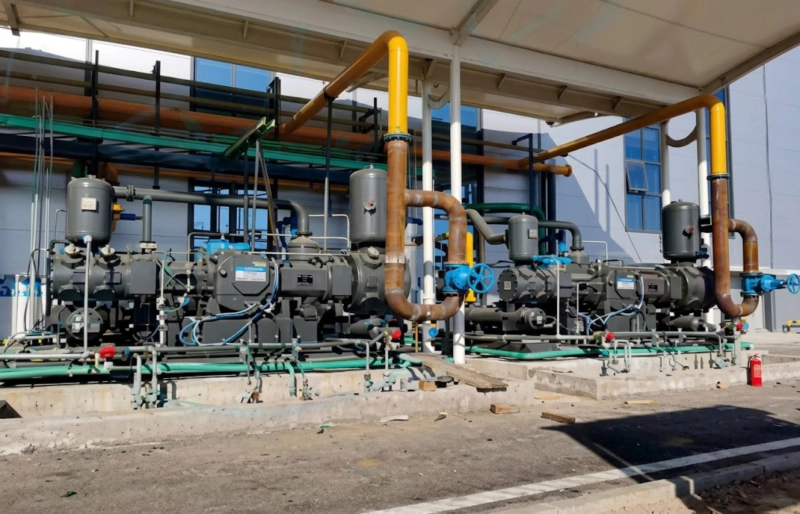
DW series reciprocating compressor in service — suction valve unloading finger assemblies on the cylinder head allow stepwise capacity reduction to 50% or 0% without reducing motor speed. A VFD drive cabinet reduces motor speed continuously from 100% to 60% of rated speed, achieving near-proportional power reduction in that range. The correct method depends on the load profile distribution across the operating year and the capital budget available for the control system.
The Core Difference: Why Power Does Not Fall Proportionally with Unloading
When a suction valve unloader holds the suction valve open throughout the compression stroke, the piston moves but does no useful compression work on the gas — the gas simply flows back through the open valve. It might appear that the compressor should use zero power in this condition, but the reality is that the motor continues to drive the crankshaft, connecting rods, crossheads, piston, and the valve mechanism through their full travel. The friction in all these mechanical components still generates heat and consumes power. Additionally, the unloaded cylinder still compresses the gas slightly on the early part of the compression stroke before the suction valve is fully returned to the cylinder by the unloader mechanism — a small but non-zero compression work component remains.
The practical result is that a DW series compressor at 50% capacity — one cylinder loaded, one unloaded — draws approximately 55–65% of its full-load power consumption. Delivering half the gas costs 55–65% of the energy. The specific energy consumption per unit of gas delivered increases by 10–30% compared with full-load operation. For an installation that spends half its operating hours at 50% capacity, this inefficiency accumulates to a significant annual energy cost premium.
The VFD Advantage: Near-Proportional Power Reduction
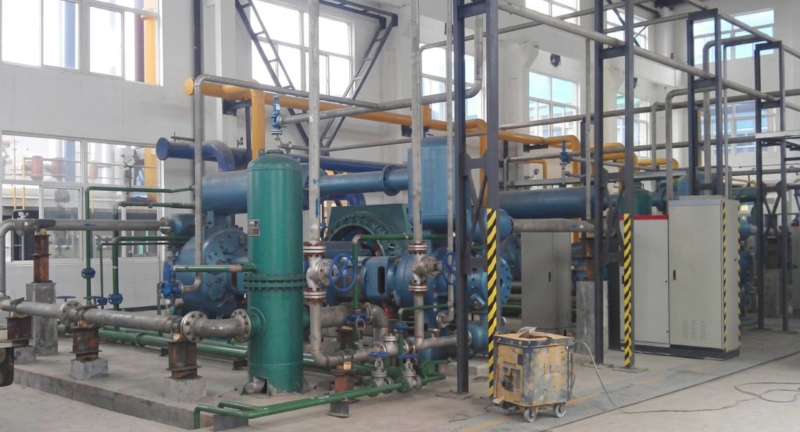
A VFD reduces motor speed by reducing the frequency of the electrical supply. At 70% of rated speed, the compressor delivers approximately 70% of its rated volumetric flow (the relationship is approximately linear in a reciprocating compressor). The power consumed scales with speed approximately as the cube law at very low loads, but in the 60–100% speed range relevant to reciprocating compressors — which have a minimum speed floor at approximately 60% of rated to maintain adequate bearing lubrication — the power-speed relationship is more nearly linear. A DW series 110 kW compressor running at 70% speed to deliver 70% capacity draws approximately 70–75% of full-load power — compared with 55–65% power for the unloaded machine delivering only 50% capacity.
| Capacity | Unloading Power (kW) | VFD Power (kW) | VFD Saving (kW) |
|---|---|---|---|
| 100% | 110 | 110 | 0 |
| 75% | 86–90 | 80–84 | +6–+8 kW |
| 70% | 86–90 (step at 50%) | 76–82 | +10–+14 kW |
| 60% (VFD min) | 61–72 (step at 50%) | 64–70 | ≈ Equal |
The unloading column shows step values — a DW two-cylinder machine jumps from 100% to 50% with no intermediate step. VFD provides continuous adjustment. The VFD advantage is largest at 65–85% capacity, where unloading has snapped to the next lower step but VFD tracks the actual demand.
The Energy Saving Calculation at Russian Industrial Tariffs
The annual energy saving from a VFD compared with suction valve unloading depends on the load profile — what fraction of the year the compressor spends at each capacity level. The calculation below uses a realistic load profile for a nitrogen pipeline supply installation with daily and weekly demand variation:
70–80%: 3,500 h (50%)
50%: 1,400 h (20%)
= 231,000 + 308,000 + 91,000
= 630,000 kWh
= 231,000 + 273,000 + 91,000
= 595,000 kWh
≈ 175,000–245,000 ₽/year
at 5–7 ₽/kWh
When Suction Valve Unloading Remains the Better Choice
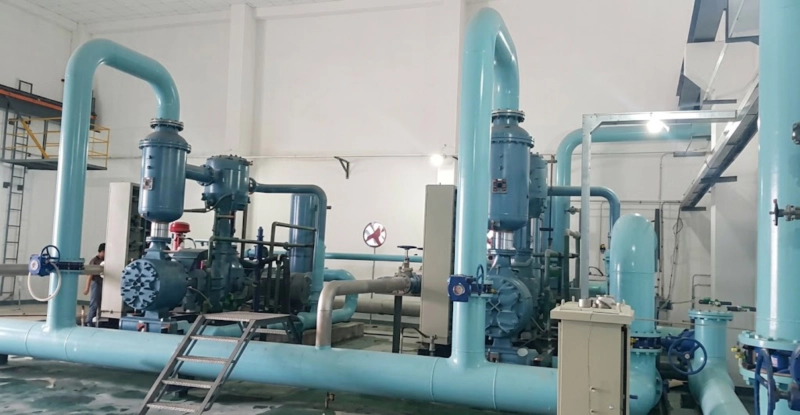
The VFD energy saving is real and the payback calculation above shows it is often justified. However, suction valve unloading remains the better choice in four specific situations where the VFD’s advantages do not materialise or where the unloading approach is specifically superior:
ISBM Blow Air Compressor Capacity Control: Variable Speed as the Default
The blow air compressor of an injection stretch blow moulding (ISBM) machine faces a capacity control requirement that is more dynamic than a nitrogen pipeline compressor — blow air demand changes with every moulding cycle as the machine transitions between injection, conditioning, and blowing. A fixed-speed blow air compressor with suction valve unloading cannot respond fast enough to the cycle-by-cycle variation in blow air demand; the blow air reservoir pressure would fluctuate unacceptably. Modern ISBM machines therefore use variable-speed blow air compressors as the default — the compressor speed follows the blow air demand cycle continuously, maintaining constant blow pressure in the reservoir regardless of the instantaneous demand spike during the blowing stroke. This is the context in which VFD control on a reciprocating compressor is not merely an energy-saving option but a functional requirement for the application. The analysis that favours suction valve unloading for continuous nitrogen pipeline supply with slow demand variation does not apply to the ISBM blow air system, where the demand variation is fast, cyclic, and machine-specific.
FAQ — Suction Valve Unloading vs VFD Energy Saving
DW, LW, and 4MW Series with Suction Valve Unloading or VFD
All DW, LW, and 4MW series compressors are available with suction valve unloading as standard. VFD configuration is available for nitrogen, argon, CO₂, and refrigerant services. Provide your load profile and electricity tariff for a payback calculation. GOST-R and EAC certified. Response within 48 hours.