Selection Guide · Refrigerant Compressor · 4MW vs DW Series · NH₃ / CO₂ / Freon · Russia
Both the 4MW and DW are opposed-balance horizontal reciprocating refrigerant compressors manufactured to GOST-R standards in Russia. They compress the same refrigerants — ammonia (NH₃), carbon dioxide (CO₂), and fluorocarbon refrigerants — and share the same opposed-balance frame geometry that cancels primary inertia forces. What separates them is capacity, power range, and the installation scale they are designed for. This guide explains when each series is the right specification.
✓ DW · 55–350 kW
✓ NH₃ / CO₂ / Freon
✓ GOST-R Certified · Russia
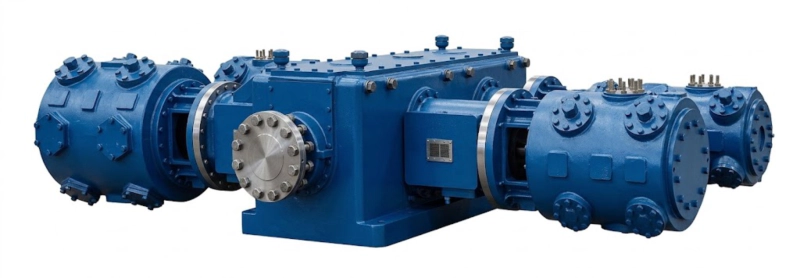
4MW series refrigerant compressor — symmetrically balanced frame, 350–1,600 kW, NH₃ / CO₂ / fluorocarbon refrigerant service. The 4MW series is the standard specification for large-scale industrial refrigeration at cold storage complexes, food processing plants, and petrochemical pre-cooling systems where continuous duty over 20–30 year plant lives is the design basis.
What the Two Series Share
Before examining the differences, it is worth stating clearly what the two series have in common — because the shared features cover the majority of the technical specification that a refrigeration plant engineer needs to verify.
Both are horizontal reciprocating piston compressors with an opposed-balance frame: the pistons on each side of the crankcase move in exactly opposite directions, cancelling primary inertia forces and producing near-zero net force to the foundation and connected refrigerant pipework. Both use the same refrigerant-compatible cylinder materials — cast iron or steel cylinder bores, copper-free wetted components for ammonia service per GOST 12.2.007, and fluorocarbon-compatible seal materials for HFC refrigerant service. Both are water-cooled via internal cylinder water jackets and external inter-stage coolers, and both include a lubricated crankcase with circulating mineral oil or synthetic refrigeration oil. Both series are available for NH₃, CO₂, and fluorocarbon refrigerants, and both carry GOST-R certification with Russian-language documentation as standard.
The mechanical design principles of both refrigerant compressor series follow the same engineering logic. Suction and discharge gas valves are the plate valve type designed for refrigerant service, with valve lift limiters to prevent impact damage at high differential pressures. Piston rod packing is of the laminated ring type with oil scraper rings on the crankcase side and gas-tight packing on the cylinder side. Both series include inter-stage moisture separators and oil separators on the discharge side, and are available with automatic capacity control through suction valve unloading on individual cylinders, allowing refrigeration capacity to be stepped down to 75%, 50%, or 25% of rated capacity without stopping the machine.
Technical Comparison: 4MW vs DW Refrigerant Compressor
| Parameter | DW Series | 4MW Series |
|---|---|---|
| Motor power range | 55–350 kW | 350–1,600 kW |
| Frame type | Opposed-balance, 2-column | Symmetrically balanced, 4-column |
| Primary force cancellation | Complete (primary forces) | Complete (forces + couples) |
| Refrigerating capacity (NH₃, −15°C / +30°C) | 200–1,200 kW | 1,000–5,000+ kW |
| Evaporating temperature range | −40°C to +5°C | −40°C to +5°C |
| Two-stage (booster) option | ✓ Available | ✓ Available |
| Capacity control steps | 100% / 75% / 50% / 25% | 100% / 75% / 50% / 25% |
| NH₃ service (copper-free) | ✓ Standard | ✓ Standard |
| Cooling | Water-cooled | Water-cooled |
| Motor voltage (standard) | 380V / 6 kV | 6 kV / 10 kV |
| Foundation area (approx.) | 6–18 m² | 18–60 m² |
| GOST-R certified, Russia | ✓ Standard | ✓ Standard |
Refrigerating capacity at −15°C evaporating / +30°C condensing in NH₃ single-stage service is indicative. Actual capacity depends on evaporating temperature, condensing temperature, superheat, subcooling, and specific refrigerant. Contact our engineering team for capacity calculations at your operating conditions.
The Symmetrical Balance Advantage of the 4MW Frame
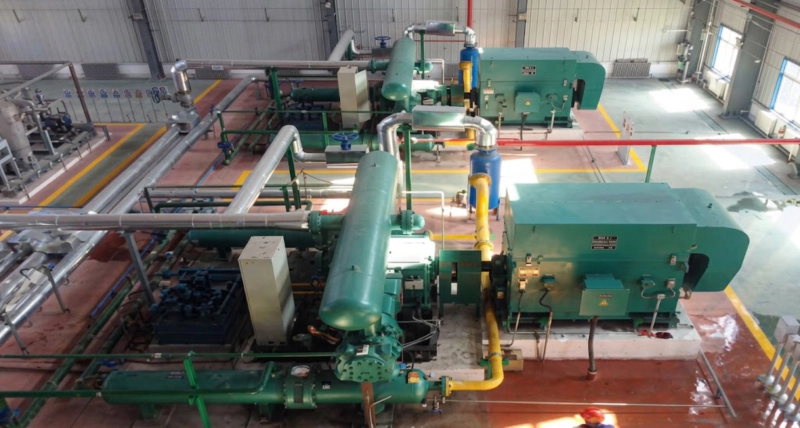
The designation “4MW” in the series name refers to the four-column symmetrically balanced frame architecture — what Russian compressor engineering practice designates the M-type (symmetrically balanced, as distinct from the W-type opposed-balance two-column frame used in the DW series). The 4MW frame places four cylinder columns around the crankcase in a symmetric arrangement: two on each side, with the pistons of each opposing pair moving in exactly opposite directions. This configuration cancels not only the primary inertia forces (which the DW two-column frame also cancels) but also the primary couples — the moment forces that arise from the axial offset between cylinder pairs along the crankshaft.
In practical terms, the 4MW frame transmits an even smaller alternating force to its foundation and connected refrigerant pipework than the DW series, despite operating at two to four times the power level. For a large NH₃ refrigeration system at a cold storage complex where the refrigerant pipework runs for hundreds of metres to distributed evaporator coils in multiple cold rooms, this near-zero foundation force is the engineering justification for the 4MW specification: the joint fatigue accumulation at every flange in the refrigerant circuit is negligible over the 25–30 year plant design life, regardless of the larger refrigerant inventory and higher operating pressures involved.
The 4MW frame also accommodates more cylinders per machine than the DW frame — typically 4, 6, or 8 cylinders depending on the model — which gives the refrigerant compressor a wide range of single-machine capacity options without requiring multiple parallel units. A single 4MW unit at 800 kW motor power provides more refrigerating capacity than five DW units at 160 kW each, at significantly lower total installation cost, maintenance requirement, and floor space per kW of refrigerating capacity delivered.
Application Scenarios: When Each Refrigerant Compressor Series Fits
Capacity Overlap: The 350 kW Zone
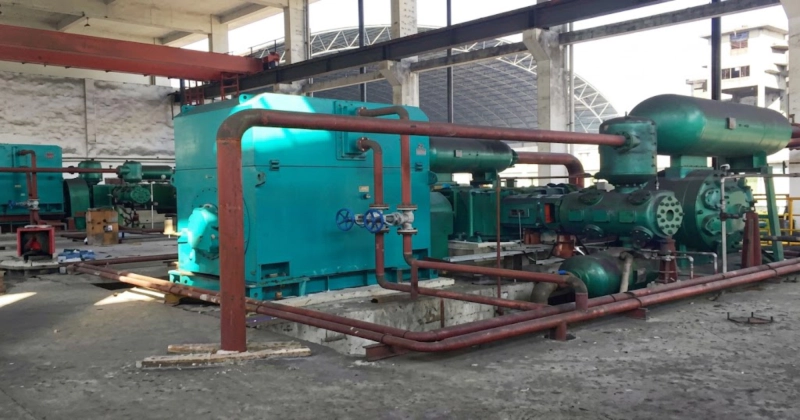
At approximately 350 kW motor power, both the DW series and the 4MW series offer viable refrigerant compressor models. The DW series reaches its maximum capacity at this level, and the 4MW series begins at its minimum. This overlap zone is the most nuanced part of the selection decision, and the answer depends on factors beyond nameplate power.
- This is the full installed capacity — no future expansion planned
- Installation space is limited — DW footprint is smaller
- 380V electrical supply — avoids MV switchgear cost
- Multiple smaller units are preferred over a single large machine
- Budget favours lower capital cost at equivalent capacity
- Future capacity expansion is planned — 4MW scales higher
- Installation is a permanent process plant with 25+ year design life
- 6 kV electrical infrastructure is already installed
- Refrigerant pipework is extensively rigid-welded (petrochemical)
- Single machine preferred over two parallel DW units
Refrigeration for PET Preform Cooling in ISBM Production
Injection stretch blow moulding (ISBM) facilities require refrigeration at two points in the production cycle: chilled water for mould cooling during the blow cycle (typically +8°C to +12°C supply, served by a water chiller rather than a direct refrigeration circuit), and in larger plants, a separate NH₃ or HFC refrigeration circuit for conditioning the preform storage area and the production hall ambient temperature during summer operation. For ISBM plants producing above 50 million bottles per year, where the production hall cooling load exceeds 300–500 kW, a DW refrigerant compressor at 55–200 kW is the appropriate specification for the production hall cooling duty — providing the opposed-balance vibration performance needed for a permanently piped refrigerant circuit in a food-contact production environment.
FAQ — 4MW vs DW Refrigerant Compressor
Request a 4MW or DW Refrigerant Compressor Proposal
Our engineering team supplies DW and 4MW series refrigerant compressors for NH₃, CO₂, and HFC service across Russia and the CIS. GOST-R certified with Russian-language documentation. Spare parts stocked in Russia for 24–72 hour dispatch.