Technical Guide · Oxygen Compression · Oil-Free vs Lubricated · GOST 12.2.052 · Russia
Oxygen and hydrocarbon lubricants are an extremely hazardous combination at elevated pressure and temperature. In reciprocating compressor design, the choice between an oil-free and a lubricated cylinder in oxygen service is not a cost-optimisation decision — it is a safety engineering decision governed by GOST 12.2.052 and international oxygen system codes. This guide explains the mechanisms behind oxygen-hydrocarbon ignition, the design requirements for oil-free oxygen compressor cylinders, and when lubricated cylinders can and cannot be used in oxygen compression service.
✓ Labyrinth Distance Piece
✓ GOST 12.2.052 Compliant
✓ ZW / DW / LW · Russia
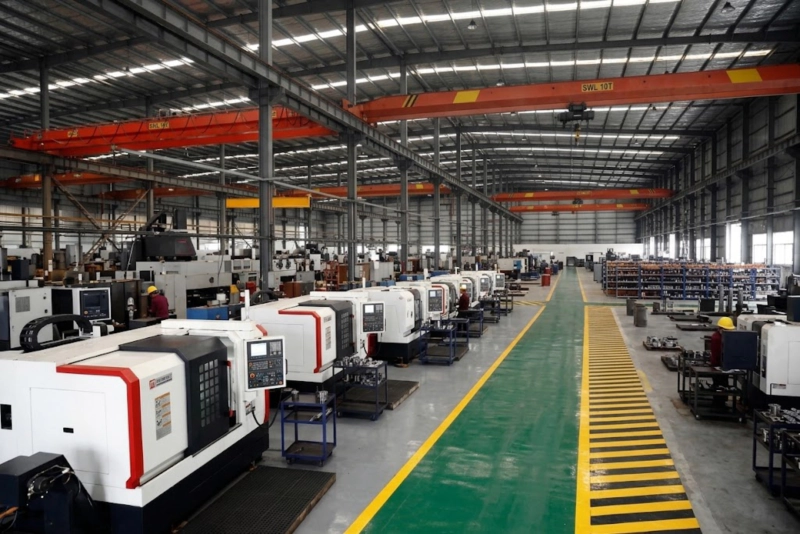
Machining and assembly of oil-free oxygen compressor cylinders — PTFE self-lubricating piston rings, copper-free wetted components, and labyrinth distance piece sealing to prevent crankcase oil migration. All ZW, DW, and LW series oxygen compressors are available with the oil-free cylinder specification meeting GOST 12.2.052.
Why Oxygen and Hydrocarbon Lubricants Must Not Contact
Oxygen is a powerful oxidising agent that dramatically accelerates the combustion of organic materials — including the mineral oil lubricants used in standard reciprocating compressor cylinders. At ambient pressure, hydrocarbon oils ignite in pure oxygen at temperatures well below their flash point in air, because the oxygen partial pressure at the oil surface is approximately five times higher than in air. At the elevated pressures encountered in oxygen compressor cylinders — 1.0 MPa at the first stage, rising to 15–30 MPa at the final stage of a multi-stage machine — the oxygen concentration at pressure is sufficient to ignite even the thin oil film that remains on a freshly lubricated cylinder wall.
The ignition mechanism in an oxygen compressor is not always a single dramatic event. More commonly, it begins as a micro-combustion of hydrocarbon residue on the cylinder wall surface, producing a local hot spot that initiates oxidative degradation of the lubricant film. This degradation produces carbonaceous deposits — carbon black and higher-molecular-weight hydrocarbon polymers — that coat the cylinder bore and piston ring surfaces. These deposits are themselves combustible in high-pressure oxygen, and their accumulation progressively reduces the thermal ignition threshold of the system. The end result is a runaway oxidation event that can breach the cylinder wall, the piston, or the discharge valve assembly at operating pressure — a catastrophic failure with both personnel and plant safety consequences.
GOST 12.2.052 — the Russian standard governing oxygen equipment safety — reflects this hazard by prohibiting the use of hydrocarbon lubricants in contact with oxygen at pressures above 0.5 MPa in any oxygen compressor used in industrial service. The equivalent international standard, ASTM G88 and the CGA G-4 series, establishes similar prohibitions. For any oxygen compressor operating above 0.5 MPa — which includes every industrial oxygen compression application from medical cylinder filling to air separation plant product compression — the the oil-free design is not optional: it is a regulatory requirement.
Safety Requirement
No hydrocarbon lubricant — mineral oil, synthetic oil, or grease — may contact the oxygen gas stream in any oxygen compressor cylinder operating above 0.5 MPa. This applies regardless of the oil quantity, the lubrication interval, or the use of ostensibly “oxygen-compatible” lubricant grades. GOST 12.2.052 does not permit exceptions for low-lubrication designs or periodic lubrication schemes above this pressure threshold. Non-lubricated cylinder design is the only compliant specification.
How the Oil-Free Oxygen Compressor Cylinder Works
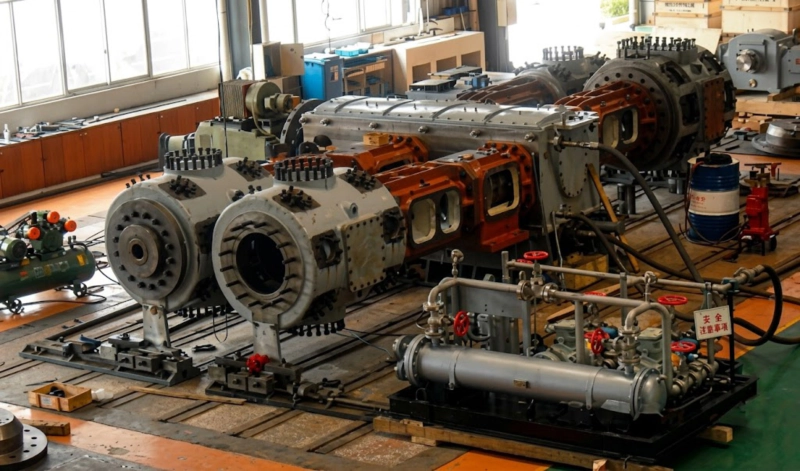
The oil-free cylinder design eliminates hydrocarbon lubricant from the compression chamber entirely. Lubrication of the piston-cylinder sliding interface — which is essential to manage friction and wear — is provided by self-lubricating solid polymer piston rings rather than injected oil. The piston rings are machined from PTFE (polytetrafluoroethylene) or PEEK (polyether ether ketone), both of which have extremely low coefficients of friction against the cast iron or stainless steel cylinder bore and transfer a thin solid lubricant film to the bore surface during the running-in period. This solid film provides lubrication without introducing any hydrocarbon material into the oxygen compression space.
PTFE is the most widely used piston ring material for oil-free oxygen compressor service. It is chemically inert to oxygen at the temperatures and pressures encountered in multi-stage oxygen compression up to 30 MPa, has a coefficient of friction against metal of approximately 0.04–0.10 (depending on filler and surface condition), and wears at a controlled rate that is predictable and well-characterised. PTFE ring sets are replaced on a scheduled interval — typically every 4,000–8,000 operating hours depending on discharge pressure and cylinder running temperature — as part of the planned maintenance programme. PEEK rings are used in applications requiring higher mechanical strength — particularly at high discharge pressures above 10 MPa — where PTFE ring dimensional stability under pressure loading is insufficient.
The Distance Piece: The Critical Oil Barrier
In a standard reciprocating compressor, the piston rod passes through the crankcase frame in close proximity to the crankshaft and connecting rod bearings, which are lubricated with circulating mineral oil. Oil mist from the crankcase can migrate along the piston rod toward the cylinder end, contaminating the compression space. In nitrogen or air compressors, this migration produces minor oil carry-over into the gas stream. In an oil-free design, even nanogram quantities of hydrocarbon oil reaching the oxygen compression space constitute a safety hazard.
The double-compartment labyrinth distance piece is the mechanical barrier that prevents this migration. It consists of a sealed housing surrounding the section of piston rod between the crankcase and the cylinder packing. The housing is divided into two compartments: the crankcase-side compartment is vented to atmosphere, allowing any oil mist from the crankcase to escape to the atmosphere rather than migrating further along the rod; the cylinder-side compartment is either vented to atmosphere or purged with a small nitrogen flow, ensuring that any gas leaking past the cylinder packing does not accumulate oxygen at the rod seal. This double-compartment design ensures that for oil to reach the oxygen compression space, it would have to traverse two vented barriers — a physical impossibility under normal operating and transient conditions.
When Lubricated Cylinders Are Permitted: The 0.5 MPa Threshold
GOST 12.2.052 permits lubricated cylinders in oxygen compressor service below 0.5 MPa discharge pressure, provided the lubricant quantity and type meet specific requirements. Below this pressure threshold, the oxygen concentration at the lubricant surface is lower, the ignition energy required is higher, and the consequence of a localised oxidation event is less severe than at the multi-megapascal pressures of industrial cylinder filling and air separation plant product compression.
In practice, very few industrial oxygen compression applications operate below 0.5 MPa. The threshold encompasses only the suction stages of very low-pressure oxygen boosters, small oxygen enrichment systems feeding atmospheric burners, and certain medical oxygen therapy delivery systems. All oxygen cylinder filling applications — which require discharge pressure above 10 MPa for GOST 949 cylinder filling — require oil-free cylinder design throughout every compression stage, including the first stage even though its discharge pressure may be only 0.3–0.5 MPa, because the gas flowing into the first stage contains the full oxygen concentration of the source supply and any ignition event at the first stage propagates immediately to the higher-pressure stages downstream.
| Application | Discharge Pressure | Cylinder Requirement | GOST 12.2.052 |
|---|---|---|---|
| Medical O₂ cylinder filling (GOST 949) | 15.0 MPa | No lubricant — required | Required |
| Air separation plant O₂ product | 1.0–5.0 MPa | No lubricant — required | Required |
| Industrial O₂ for steel-making (BOF) | 1.5–3.5 MPa | No lubricant — required | Required |
| O₂ booster for gasifier feed | 3.0–8.0 MPa | No lubricant — required | Required |
| Low-pressure O₂ enrichment below 0.5 MPa | Below 0.5 MPa | Permitted with limits | Conditional |
| Oxygen therapy delivery (atmospheric) | Atmospheric | Standard design | Not applicable |
All ZW, DW, and LW series oxygen compressors above 0.5 MPa are supplied with this cylinder configuration as standard. Lubricated cylinder variants for sub-0.5 MPa applications are available on request.
PTFE Ring Maintenance and Service Life in Oxygen Compression
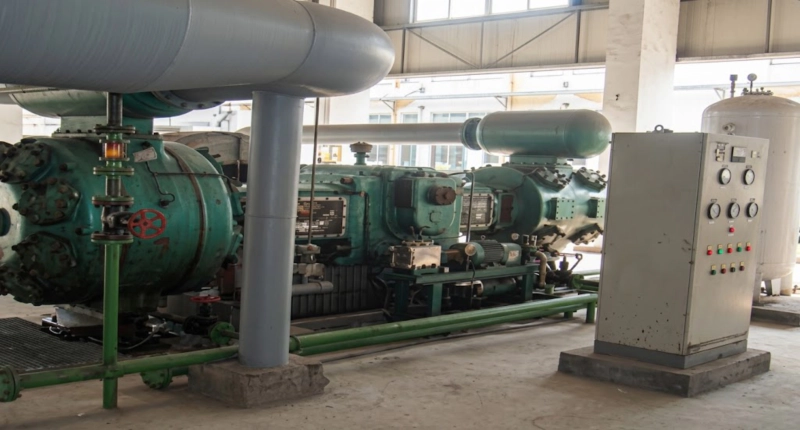
PTFE piston rings in an oil-free oxygen compressor wear at a predictable rate that depends on three primary factors: the cylinder bore surface finish and hardness, the ring running temperature (which is dominated by the stage discharge temperature and cooling water temperature), and the suction gas moisture content. Properly maintained oil-free cylinders with clean gas supply typically achieve ring lives of 6,000–10,000 hours before ring sets require replacement. In practice, most operators schedule PTFE ring replacement at every planned shutdown, typically every 4,000–6,000 hours, to maintain a conservative wear margin.
The primary early warning indicator of PTFE ring degradation is elevated discharge temperature at the affected stage. As rings wear thin and the gas blow-by past the ring set increases, the compression efficiency of that stage decreases and the discharge temperature rises above its normal operating value. All ZW, DW, and LW series machines include per-stage discharge temperature monitoring with high-temperature shutdown setpoints that trigger automatic compressor shutdown before ring failure can reach a condition that risks hydrocarbon ingestion from accelerated PTFE degradation into the oxygen stream.
Oil-Free Compressed Air for ISBM Blow Moulding: Same Principle, Lower Pressure
The oil-free cylinder principle that governs oxygen compression also applies — for different reasons — to the high-pressure blow air compressors serving injection stretch blow moulding (ISBM) production lines. In ISBM, the blow air contacts the PET preform interior and must not deposit oil on it. Food-contact regulations in most markets require hydrocarbon-free blow air at the mould cavity. While the safety stakes are lower than in oxygen service — mineral oil in blow air does not produce a combustion hazard — the product contamination consequences are severe: oil-contaminated bottles fail organoleptic testing and must be scrapped. ISBM facilities routinely specify oil-free blow air supply or alternatively a non-lubricated final stage with downstream coalescing filtration to achieve ISO 8573-1 Class 1 oil content at the blow mould inlet.
FAQ — Oil-Free Oxygen Compressor Cylinders
Request an Oxygen Compressor Specification
All ZW, DW, and LW series oxygen compressors are available with oil-free PTFE cylinder configuration meeting GOST 12.2.052. Provide your required flow rate, discharge pressure, and oxygen purity grade and our engineering team will return a full specification and quotation within 48 hours.