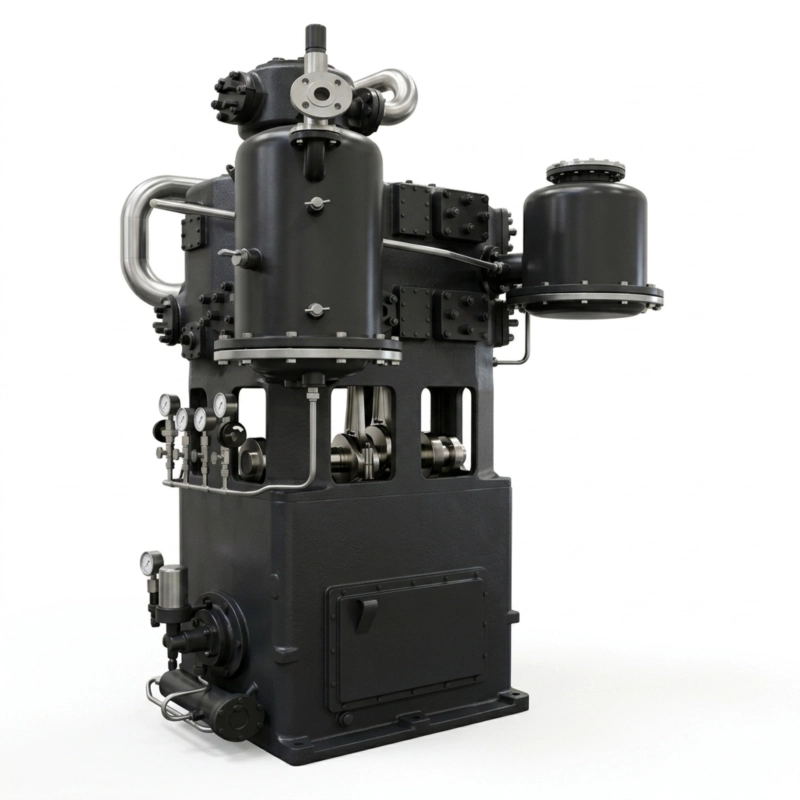
Product Overview: ZW Series Nitrogen and Oxygen Compressors
The ZW series nitrogen and oxygen compressor is the standard Russian-manufactured L-type two-column vertical-horizontal reciprocating piston compressor designed for the compression of nitrogen (N₂), oxygen (O₂), and argon (Ar) in air separation plants, industrial gas filling stations, nitrogen pipeline supply systems, and medical oxygen distribution networks. The L-type frame places one vertical cylinder and one horizontal cylinder on a common crankcase at 90 degrees, producing a configuration where the primary inertia forces partially cancel, giving better dynamic balance than a simple single-column vertical or horizontal machine at the same bore size. Multi-stage models cover two, three, and four compression stages. The ZW series nitrogen and oxygen compressor to raise gas pressure from atmospheric suction (0.10 MPa) to final discharge pressures up to 30.0 MPa — the pressure required to fill high-pressure nitrogen cylinders and medical oxygen bottles for distribution and storage.
Oxygen service demands materials and cleanliness standards that differ fundamentally from nitrogen or general industrial gas compression. Oxygen at elevated pressure in contact with hydrocarbon lubricating oil is a deflagration hazard — the energy of compression alone can ignite oil vapour in the presence of high-pressure oxygen if any hydrocarbon contamination is present in the cylinder. The ZW series nitrogen and oxygen compressor addresses this with an oil-free cylinder variant for oxygen service: PTFE-filled self-lubricating piston rings eliminate the need for oil in the compression space, while a labyrinth distance piece prevents crankcase oil from migrating into the cylinder bore. This design allows the ZW series nitrogen and oxygen compressor to operate safely in oxygen service at pressures up to 15.0 MPa with GOST-compliant oxygen cylinder filling standards.
Nitrogen compression in the ZW series nitrogen and oxygen compressor uses conventionally lubricated cylinders at all pressures, as nitrogen is chemically inert and does not impose the ignition risk, allowing conventionally lubricated cylinders with cast iron rings and standard mineral oil lubrication at all pressures within the ZW series range. Argon, also inert, uses the same lubricated cylinder design as nitrogen. Both cylinder configurations of the ZW series nitrogen and oxygen compressor — oil-free for oxygen and lubricated for nitrogen — are available from our production facility with identical lead times. Each ZW series nitrogen and oxygen compressor unit is from our Russian manufacturing facility, GOST-R certified, with all pressure vessels — inter-stage coolers and separators — certified under Russian pressure vessel regulations for the specific gas service of each unit.
Technical Specifications — ZW Series Nitrogen and Oxygen Compressor: Nitrogen Range
The ZW series nitrogen and oxygen compressor models in this table cover nitrogen compression from atmospheric or low-pressure suction to high-pressure cylinder filling. Standard lubricated cylinders; cast iron piston rings; mineral oil lubrication. All models L-type two-column reciprocating frame.
| Model |
Stages |
Flow (m³/h) |
Suction (MPa) |
Discharge (MPa) |
Speed (rpm) |
Power (kW) |
Voltage |
| ZW-0.6/0.1~15 |
3 |
0.6 |
0.10 |
15.0 |
740 |
7.5 |
380 |
| ZW-1.0/0.1~15 |
3 |
1.0 |
0.10 |
15.0 |
740 |
11 |
380 |
| ZW-2.5/0.1~15 |
3 |
2.5 |
0.10 |
15.0 |
740 |
22 |
380 |
| ZW-5.0/0.1~20 |
3 |
5.0 |
0.10 |
20.0 |
740 |
37 |
380 |
| ZW-10/0.1~20 |
3 |
10.0 |
0.10 |
20.0 |
740 |
75 |
380/6K |
| ZW-20/0.1~20 |
3 |
20.0 |
0.10 |
20.0 |
740 |
132 |
380/6K |
| ZW-30/0.1~20 |
3 |
30.0 |
0.10 |
20.0 |
740 |
185 |
380/6K |
Flow rated at suction (atmospheric) conditions, m³/h free gas. All models L-type two-column vertical-horizontal frame. 740 rpm standard; 380 V for motors up to 132 kW; 380 V / 6 kV option for larger models. Nitrogen and argon service: lubricated cylinders standard.
Technical Specifications — ZW Series Nitrogen and Oxygen Compressor: Oxygen and High-Pressure Range
The ZW series nitrogen and oxygen compressor oil-free cylinder models for oxygen service and high-pressure models for cylinder filling at 20.0–30.0 MPa. Oil-free PTFE piston rings; labyrinth distance piece; oxygen-compatible materials throughout. High-pressure 4-stage models for nitrogen cylinder filling to 30 MPa.
| Model |
Gas |
Stages |
Flow (m³/h) |
Suction (MPa) |
Discharge (MPa) |
Power (kW) |
Cylinder Type |
| ZW-0.5/0.1~15(O₂) |
O₂ |
3 |
0.5 |
0.10 |
15.0 |
7.5 |
Oil-Free PTFE |
| ZW-1.0/0.1~15(O₂) |
O₂ |
3 |
1.0 |
0.10 |
15.0 |
11 |
Oil-Free PTFE |
| ZW-3.0/0.1~15(O₂) |
O₂ |
3 |
3.0 |
0.10 |
15.0 |
22 |
Oil-Free PTFE |
| ZW-6.0/0.1~15(O₂) |
O₂ |
3 |
6.0 |
0.10 |
15.0 |
45 |
Oil-Free PTFE |
| ZW-5.0/0.1~30 |
N₂ |
4 |
5.0 |
0.10 |
30.0 |
37 |
Lubricated CI |
| ZW-10/0.1~30 |
N₂ |
4 |
10.0 |
0.10 |
30.0 |
75 |
Lubricated CI |
| ZW-20/0.1~30 |
N₂ |
4 |
20.0 |
0.10 |
30.0 |
132 |
Lubricated CI |
O₂ models: oil-free PTFE piston rings; labyrinth distance piece; no hydrocarbon lubricant in oxygen contact. N₂ 30 MPa models: 4-stage compression for high-pressure cylinder filling. CI = cast iron piston rings. All flows at suction (atmospheric) conditions, m³/h free gas.
General Series Parameters — ZW Series Nitrogen and Oxygen Compressor (All Models)
| Parameter |
ZW Series Nitrogen and Oxygen Compressor |
| Gas Media |
Nitrogen (N₂); oxygen (O₂); argon (Ar) |
| Suction Pressure |
0.10 MPa (atmospheric) to 3.0 MPa (booster models) |
| Discharge Pressure |
2.5 MPa to 30.0 MPa (model-dependent) |
| Volume Flow |
0.5–30.0 m³/h at suction conditions |
| Motor Power |
7.5–250 kW |
| Drive Voltage |
380 V (standard); 380 V / 6 kV (larger models) |
| Frame Type |
L-type two-column vertical-horizontal reciprocating |
| Number of Stages |
2, 3, or 4 stages (model and pressure-dependent) |
| Cylinder Lubrication — N₂ / Ar |
Conventional lubrication; cast iron piston rings; mineral oil |
| Cylinder Lubrication — O₂ |
Oil-free; PTFE self-lubricating piston rings; labyrinth distance piece |
| Cooling |
Water-cooled inter-stage coolers and after-cooler; moisture separators at each stage |
| Design Standard |
GOST-R; pressure vessels per GOST R 52857; oxygen equipment per GOST 12.2.052 |
| Certification |
ISO 9001:2015, GOST-R, Pressure Vessel License, Oxygen Equipment Certificate |
Working Principle: Multi-Stage L-Type Compression for N₂ and O₂
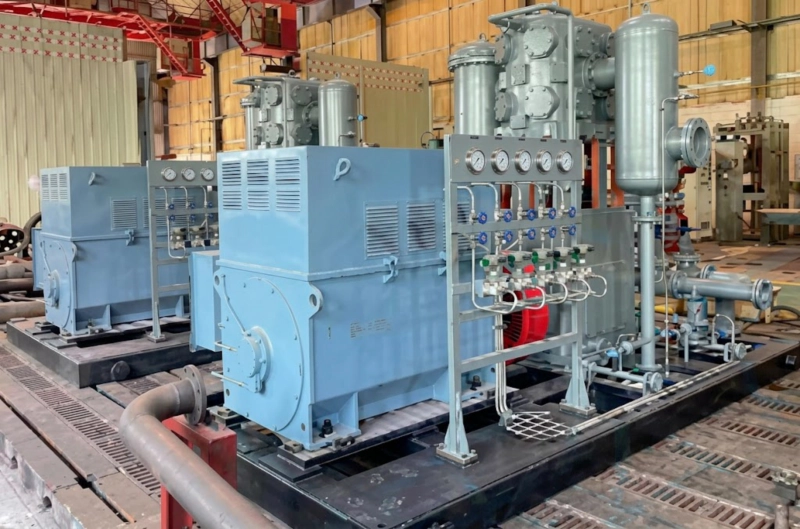
The ZW series nitrogen and oxygen compressor operates on the multi-stage reciprocating compression principle using an L-type two-column frame. This principle allows the ZW series nitrogen and oxygen compressor to achieve discharge pressures up to 30.0 MPa from atmospheric suction in a compact, field-maintainable machine. using an L-type two-column frame. In every ZW series nitrogen and oxygen compressor unit, the L-type frame places one cylinder column vertically and one horizontally on a common crankcase, connected to a single crankshaft by connecting rods and crossheads. The vertical cylinder typically handles the first compression stage at the largest bore and lowest pressure ratio, and the horizontal cylinder handles one or more subsequent stages at progressively smaller bore and higher pressure. This arrangement partially cancels the primary inertia forces from the two moving columns — the vertical component of one and the horizontal component of the other do not act in the same direction simultaneously, producing better inherent balance than a purely vertical or purely horizontal single-column machine.
In the ZW series nitrogen and oxygen compressor, gas compression takes place in three or four stages with inter-stage cooling between each stage. Each ZW series nitrogen and oxygen compressor stage is sized to achieve the maximum safe pressure ratio for the specific gas and piston ring materials. At the first stage, gas enters the large-bore low-pressure cylinder at suction pressure and is compressed to the first intermediate pressure. The compressed gas then passes through a water-cooled inter-stage cooler that removes the heat of compression, reducing the gas temperature to near-suction conditions before it enters the second stage. This isothermal-approach cooling at each inter-stage reduces the specific work of compression at the next stage, improves volumetric efficiency, and keeps cylinder discharge temperatures within the safe operating limit for the piston ring materials — critical for oxygen service where PTFE ring degradation temperature must not be approached. After the final compression stage, the gas passes through an after-cooler and moisture separator before entering the downstream high-pressure header or cylinder filling manifold.
L-Type Two-Column Frame
One vertical and one horizontal cylinder column on a common crankcase at 90 degrees. Primary inertia forces from the two columns act in perpendicular directions and partially cancel, giving better balance than a single-column machine. Compact footprint relative to total pressure ratio achieved.
Oil-Free Cylinder for O₂ Service
In the ZW series nitrogen and oxygen compressor oxygen variant, PTFE self-lubricating piston rings in all three stages eliminate hydrocarbon lubricant from oxygen-wetted surfaces. This is the key design feature that makes the ZW series nitrogen and oxygen compressor suitable for oxygen service under GOST 12.2.052. A labyrinth distance piece with atmospheric vent between the crankcase and the cylinder prevents crankcase oil vapour from reaching the compression space. This is the only design approach that reliably prevents oil-oxygen contact at pressures above 2.0 MPa.
Inter-Stage Cooling and Separation
The ZW series nitrogen and oxygen compressor inter-stage cooling system uses shell-and-tube water-cooled coolers between each compression stage remove heat of compression. Knock-out separators downstream of each cooler remove condensed moisture before the gas enters the next stage. This keeps gas entering each stage of the ZW series nitrogen and oxygen compressor dry, protecting piston rings, valves, and the downstream high-pressure gas distribution system from moisture contamination.
High-Pressure Valves and Cylinder Design
In the ZW series nitrogen and oxygen compressor high-pressure final stage, cylinders at 15.0–30.0 MPa use forged alloy steel cylinder bodies with precision-ground bores, stainless steel plate or ring valves with low-lift design to minimise valve velocity and wear at high pressure differential, and positive-retention valve guards. All high-pressure components are hydraulically tested to 1.5 times maximum allowable working pressure before assembly.
Application Scenarios
🏭Air Separation Plant — N₂ and O₂ Product Compression
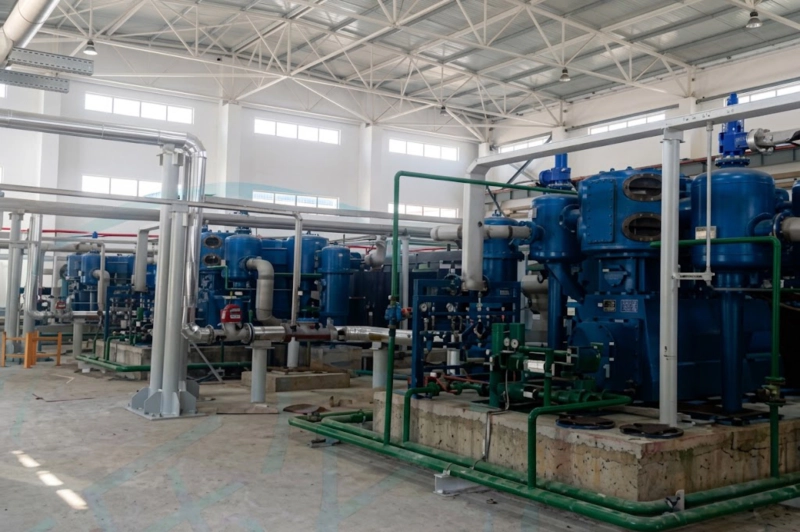
Air separation units (ASU) produce nitrogen and oxygen at low pressure, and the ZW series nitrogen and oxygen compressor raises this product gas to distribution or filling pressure. The ZW series nitrogen and oxygen compressor is the standard equipment for this duty from the distillation column overhead and liquid product vaporisers, typically at 0.10–0.15 MPa. The ZW series nitrogen and oxygen compressor raises this low-pressure product gas to pipeline or cylinder filling pressure. The ZW series nitrogen and oxygen compressor serves pipeline distribution pressure (0.5–1.5 MPa) or high-pressure cylinder filling pressure (15.0–30.0 MPa) depending on the downstream requirement. Russian and CIS metallurgical complexes, chemical plants, and industrial gas distributors operate the ZW series nitrogen and oxygen compressor in continuous service in continuous service as the primary product gas compression stage downstream of the ASU cold box. The oil-free oxygen models are used for O₂ product compression where purity must be maintained to GOST 6331 medical or industrial oxygen standards; the lubricated nitrogen models serve N₂ product compression at all pressure levels.
🏪Medical Oxygen Cylinder Filling — Hospital and Emergency Supply
Medical oxygen distribution in Russia depends on a network of cylinder filling stations that receive liquid oxygen from bulk tankers, vaporise it, and compress the gaseous oxygen to 15.0 MPa for filling Type 1 and Type 2 medical oxygen cylinders (GOST 949 and GOST 5583). The ZW series nitrogen and oxygen compressor oil-free oxygen variant — specifically models — specifically ZW-0.5/0.1~15(O₂) through ZW-6.0/0.1~15(O₂) — are designed for this duty. The oil-free PTFE cylinder design maintains oxygen purity at GOST 6331 medical grade (99.5% minimum O₂) throughout the compression process, and the absence of any hydrocarbon lubricant in the compression space eliminates the deflagration risk that would be present with a conventionally lubricated compressor at these oxygen pressures. Russian regional hospitals, medical gas distributors, and emergency service organisations specify the ZW series nitrogen and oxygen compressor for their primary oxygen cylinder filling needs.
⚙️Nitrogen Blanketing and Purging — Chemical and Petrochemical Plant
Chemical and petrochemical plants in Russia use nitrogen at 0.5–2.0 MPa for tank blanketing, reactor purging, transfer line pressure maintenance, and catalyst regeneration inert atmosphere requirements. A ZW series nitrogen and oxygen compressor in the 5.0 to 20.0 m³/h capacity range (ZW-5.0/0.1~20 or ZW-10/0.1~20) covers the typical continuous nitrogen supply duty for a medium-scale chemical plant receiving liquid nitrogen from bulk delivery and distributing gaseous nitrogen to point-of-use at process pressure. The lubricated cylinder design is standard for nitrogen service at all pressures within the ZW series range — nitrogen is chemically inert to all standard cylinder materials and lubricants, and there is no restriction on oil type or oil concentration in the compressed gas for inert atmosphere applications.
🔨Nitrogen Cylinder Filling — High-Pressure 30 MPa Industrial Distribution
Industrial nitrogen cylinder filling for the welding, cutting, and fabrication industries requires compression to 20.0–30.0 MPa — the standard fill pressure for Type 1 high-pressure seamless steel cylinders (GOST 949). The four-stage ZW series nitrogen and oxygen compressor at 30.0 MPa discharge, starting from model ZW-5.0/0.1~30, ZW-10/0.1~30, and ZW-20/0.1~30 are designed for this duty, providing final discharge pressures of 30.0 MPa with atmospheric suction from a liquid nitrogen vaporiser or direct air separation source. Russian industrial gas distributors supplying nitrogen to fabrication, electronics, and food packaging industries operate the ZW series nitrogen and oxygen compressor 30 MPa models as their standard cylinder filling equipment (MAP), and pharmaceutical industries operate ZW series 30 MPa nitrogen compressors as their standard cylinder filling equipment, valued for the low capital cost, simple maintenance, and in-country GOST-R documentation that eliminates the delays associated with imported high-pressure filling equipment.
Core Advantages
☀
Oil-Free O₂ Cylinders — Safe at 15.0 MPa
In the ZW series nitrogen and oxygen compressor oil-free oxygen variant, PTFE self-lubricating piston rings and labyrinth distance piece eliminate all hydrocarbon lubricant from the oxygen compression space. This is the engineered safety solution required by GOST 12.2.052 for oxygen equipment above 0.05 MPa. No reliance on oil-wash procedures or periodic cleaning to maintain safe oxygen service — the design is inherently oil-free in the compression space by construction.
📈
N₂, O₂, Ar — Single Frame Family
The ZW series nitrogen and oxygen compressor shares a common L-type frame across nitrogen, oxygen, and argon variants. This commonality is a practical advantage for facilities operating both N₂ and O₂ ZW series nitrogen and oxygen compressor units. Facilities operating both nitrogen and oxygen compression — as is typical in an air separation plant — benefit from shared frame dimensions, common spare parts for running gear components (crankshaft bearings, crosshead pins, connecting rods), and unified operator training. Only the cylinder assembly and piston ring specification differ between N₂ and O₂ models.
🛡
30.0 MPa Capability — Full Cylinder Fill Pressure
The four-stage 30 MPa ZW series nitrogen and oxygen compressor models fill Type 1 seamless steel cylinders to the standard GOST 949 working pressure in a single compressor without a booster stage. This eliminates the secondary booster compressor and associated pipework and instrumentation that would be required if the primary compressor could only reach 20 MPa. A single ZW series 30 MPa unit covers the full filling cycle from empty cylinder to service pressure.
📄
Full GOST-R and Oxygen Equipment Certification
Every ZW series nitrogen and oxygen compressor delivered to Russia comes with a complete GOST-R certificate, technical passport, pressure vessel certification, and oxygen equipment certificate per GOST 12.2.052 as standard. Oxygen equipment in Russia requires specific certification that imported compressors often lack, leading to customs and commissioning delays. ZW series oxygen compressors ship with complete Russian documentation from our facility.
🌎
Russia-Based Spare Parts
PTFE piston ring sets, gas valve elements, piston rod packing, and cylinder sleeve sets for all ZW series nitrogen and oxygen compressor variants are stocked at our Russian facility. are stocked at our Russian facility. Dispatch within 24–72 hours. For medical oxygen cylinder filling stations and hospital supply systems, a compressor shutdown has direct patient care implications — local spare parts availability is a system reliability requirement, not a preference.
🕑
8–16 Week Delivery
Standard delivery from order receipt to factory acceptance test is 8–16 weeks for ZW series nitrogen and oxygen compressor models — substantially shorter than imported alternatives and without foreign currency exposure or import logistics risk. For medical gas infrastructure projects and industrial gas distribution capex programmes in Russia, a guaranteed domestic delivery within the construction schedule is a project management requirement that imported equipment cannot reliably meet.
Material Specifications — ZW Series Nitrogen and Oxygen Compressor: N₂ vs. O₂ Service
Material requirements for the ZW series nitrogen and oxygen compressor oxygen variant differ from the nitrogen variant in every gas-contacting component. The table below details the standard materials for both service types across the ZW series nitrogen and oxygen compressor range.
| Component |
N₂ / Ar Service |
O₂ Service |
| Frame / Crankcase |
Cast iron HT250; standard finish |
Same; no oil-contaminated surfaces in gas path |
| Low-Pressure Cylinders |
Cast iron HT250; lubricated |
Cast iron or nodular iron; degreased; oil-free |
| High-Pressure Cylinders |
Forged alloy steel; lubricated |
Forged stainless steel or alloy steel; oxygen-cleaned |
| Piston Rings |
Cast iron; oil-lubricated |
PTFE self-lubricating; no oil in compression space |
| Distance Piece |
Standard; vented |
Labyrinth seal; atmospheric vent prevents oil migration to cylinder |
| Gas Valves |
Carbon steel or stainless steel; standard |
Stainless steel AISI 316; oxygen-degreased; no hydrocarbon residue |
| Gaskets and Seals |
Nitrile or PTFE; standard lubricant-compatible grades |
PTFE or oxygen-compatible fluoroelastomer; no hydrocarbon-based seals |
| Lubricating Oil |
Standard mineral oil (ISO VG 68 compressor oil) |
No oil in compression space. Crankcase oil isolated by labyrinth distance piece. |
ZW Series vs. Alternative N₂ and O₂ Compressor Types
Transparency Notice: Sauer, Bauer, and Ingersoll Rand are referenced for product category comparison only. We do not manufacture or claim affiliation with these brands. All ZW series nitrogen and oxygen compressor models are original designs manufactured at our Russian facility.
| Factor |
ZW Series
L-Type Reciprocating |
High-Pressure Piston
(Sauer / Bauer) |
Membrane Compressor
(For O₂ to 30 MPa) |
| Max discharge pressure |
30.0 MPa |
Up to 40 MPa |
Up to 40 MPa |
| O₂ oil-free design |
✓ PTFE standard |
Model-dependent |
✓ Inherently oil-free |
| Capital cost |
Lowest; Russian manufacture |
Medium-high (EUR / USD) |
High; membrane replacement cost |
| GOST-R O₂ certification |
✓ Included standard |
Case by case; import delays |
Case by case |
| Maintenance complexity |
Low; field-replaceable rings and valves |
Low-medium |
Medium; membrane is consumable |
| Russia spare parts |
In-house; 24–72 h |
Import; weeks |
Import; weeks |
| Lead time |
8–16 weeks |
16–28 weeks |
20–36 weeks |
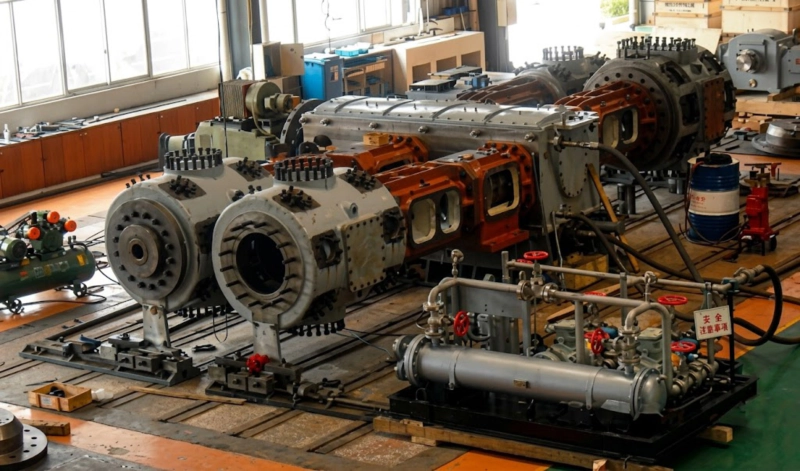
Factory acceptance test — every ZW series nitrogen and oxygen compressor is tested at rated suction and discharge conditions; oxygen ZW series nitrogen and oxygen compressor models are verified for oil-free compression space integrity, PTFE ring performance, and high-pressure valve function before shipment from our Russian facility
Frequently Asked Questions — ZW Series Nitrogen and Oxygen Compressors
Q1: Why must oxygen compressors use oil-free cylinders?
High-pressure oxygen in contact with hydrocarbon lubricating oil is a well-documented deflagration hazard. The energy released by compressing oxygen to 10–15 MPa in a reciprocating cylinder is sufficient to raise the temperature of the gas at the end of the compression stroke to several hundred degrees Celsius under adiabatic conditions. If any oil vapour or aerosol is present in the compression space, this temperature in the presence of high-concentration oxygen is above the auto-ignition point of hydrocarbons, leading to a deflagration event inside the cylinder. Russian and international standards for oxygen equipment — GOST 12.2.052 in Russia, EN 13175 / CGA G-4.1 internationally — prohibit hydrocarbon lubricants in oxygen compression spaces above 0.05 MPa for this reason. The ZW series nitrogen and oxygen compressor oil-free oxygen cylinder design eliminates this risk by using PTFE self-lubricating piston rings, which require no hydrocarbon lubricant, and a labyrinth distance piece that physically separates the crankcase oil from the cylinder gas space.
Q2: Can the same ZW series frame be used for both nitrogen and oxygen service?
The L-type frame, crankshaft, connecting rods, crossheads, and running gear are common to all variants of the ZW series nitrogen and oxygen compressor. The differences lie in the cylinder assembly and compression space components. For oxygen service, the cylinders are supplied in a degreased and oxygen-cleaned condition, PTFE piston rings replace the cast iron rings used in nitrogen models, the distance piece includes a labyrinth seal with atmospheric vent, and all valves and gaskets are supplied in oxygen-compatible materials. A facility operating both nitrogen and oxygen compression can use the same operator skillset for maintenance across both variants, and common crankcase components can be shared in the spare parts stock. Only the cylinder-specific components — piston rings, valves, and gaskets — differ between the two ZW series nitrogen and oxygen compressor service variants.
Q3: Why are three or four compression stages needed for nitrogen and oxygen at 15–30 MPa?
In the ZW series nitrogen and oxygen compressor, the practical compression ratio per stage is typically 3:1 to 5:1. This limit is set by the discharge temperature — compressing nitrogen from 0.10 MPa to 0.50 MPa (5:1) raises the gas temperature from 20°C to approximately 130–160°C adiabatically, which is approaching the safe operating limit for cast iron piston rings and mineral oil. Compressing from atmospheric to 30 MPa in a single stage would involve a 300:1 pressure ratio, producing discharge temperatures above 1,000°C — physically impossible with standard materials. Three stages at approximately 5:1 per stage achieve 125:1 total ratio (0.10 MPa to 12.5 MPa), and four stages achieve approximately 625:1 (0.10 MPa to 62 MPa, comfortably covering the 30 MPa requirement). Inter-stage cooling between each stage returns the gas temperature to near ambient before the next stage, allowing safe operation of all piston ring and valve materials throughout the pressure range.
Q4: What GOST standards apply to oxygen compression equipment in Russia?
The primary Russian standard applicable to the ZW series nitrogen and oxygen compressor oxygen variant is GOST 12.2.052 (oxygen equipment — general safety requirements), which specifies that oxygen compression equipment above 0.05 MPa must use materials and designs that exclude hydrocarbon lubricants from all oxygen-wetted surfaces, that all oxygen-wetted components must be manufactured, cleaned, and assembled under conditions that prevent hydrocarbon contamination, and that pressure vessels in oxygen service must be designed with appropriate safety factors and certified under Russian pressure vessel regulations (GOST R 52857 series). The oxygen purity standard for medical gas is GOST 6331, which specifies 99.5% minimum O₂ content and limits on moisture and total hydrocarbons in the product. All ZW series nitrogen and oxygen compressor oxygen service models are designed and manufactured to satisfy GOST 12.2.052 and, where specified, to produce product meeting GOST 6331 medical oxygen quality at the compressor outlet.
Q5: What maintenance does the ZW series nitrogen and oxygen compressor require?
Routine maintenance intervals for the ZW series nitrogen and oxygen compressor: annual tasks for every ZW series nitrogen and oxygen compressor include crankcase oil and oil filter replacement every 2,000–3,000 hours; gas valve element inspection and replacement at 4,000–8,000 hours depending on operating pressure and gas purity; PTFE piston ring inspection at 3,000–5,000 hours and replacement when wear exceeds the dimensional allowance (PTFE rings wear faster than cast iron rings but are easier to replace and do not contaminate the gas on failure); inter-stage cooler tube-side water flushing annually and shell-side leak test at each major maintenance; and high-pressure connection torque re-check at 1,000-hour intervals for all cylinder head and valve cover fasteners on stages operating above 10.0 MPa. Oxygen models require additional checks: labyrinth distance piece vent path must be clear at all times, and any maintenance on oxygen-wetted components requires degreasing of all replacement parts before assembly to maintain oil-free status.
Q6: Can the ZW series compress argon from air separation?
Yes. Argon is chemically inert, and the ZW series nitrogen and oxygen compressor lubricated cylinder design is fully suitable for argon service at all pressures within the ZW series range. Argon has a higher molecular weight than nitrogen (39.9 g/mol vs. 28.0 g/mol) and a different ratio of specific heats (1.67 vs. 1.40), which affects the adiabatic discharge temperature and the volumetric flow rate per stage. The cylinder bore for argon service may differ from the equivalent nitrogen model at the same rated m³/h flow because of the density difference. Provide the argon suction and discharge conditions at enquiry; our engineering team will verify the cylinder sizing and advise whether a standard nitrogen model or a modified bore specification is required for the argon duty.
Q7: What is the difference between the ZW series and the LW series nitrogen compressor?
The ZW series uses an L-type two-column frame (one vertical cylinder, one horizontal cylinder at 90 degrees on a common crankcase). The LW series uses an opposed-balance two-column frame where both cylinders are horizontal and positioned at 180 degrees, cancelling primary inertia forces completely. The ZW series L-type configuration is more compact and lower-cost for applications where vibration is manageable with standard anti-vibration mounts. The LW series opposed-balance configuration is preferred for larger capacities or installations where vibration transmission to connected pipework is a concern — for example, nitrogen pipeline systems in chemical plants where the compressor is rigidly connected to process pipework over long distances. For most air separation product gas compression and cylinder filling applications, the ZW series nitrogen and oxygen compressor L-type configuration provides the required pressure range at the most economical capital cost. The ZW series nitrogen and oxygen compressor is therefore the most widely specified N₂ and O₂ compressor type in Russia for air separation downstream compression and cylinder filling applications.
Q8: What spare parts should be stocked on-site for a ZW series oxygen compressor?
The recommended two-year on-site spare parts stock for the ZW series nitrogen and oxygen compressor oxygen variant includes: one complete set of PTFE piston ring assemblies for all three stages (PTFE rings are a higher-frequency replacement item than cast iron rings and must be pre-degreased before storage for oxygen service; all ZW series nitrogen and oxygen compressor PTFE rings must meet this requirement before installation); one complete set of gas valve elements for all six valve positions (three suction and three discharge across the three stages); one set of piston rod packing rings (PTFE or oxygen-compatible grade); one set of inter-stage cooler and separator gaskets; and high-pressure connection sealing elements for the final stage cylinder head and valve cover. All oxygen service spare parts must be stored in sealed, clean packaging and handled with clean, oil-free gloves. All ZW series nitrogen and oxygen compressor spare parts are available from our Russian facility within 24–72 hours. ZW series nitrogen and oxygen compressor parts are supplied pre-degreased for immediate use in oxygen service.
Q9: Can the ZW series nitrogen and oxygen compressor be used as a booster from an existing low-pressure nitrogen header?
Yes. The ZW series nitrogen and oxygen compressor booster configuration is available where the suction pressure is above atmospheric. A ZW series nitrogen and oxygen compressor booster takes nitrogen from a 0.5 MPa pipeline header and raises it to 20.0 MPa for ZW series nitrogen and oxygen compressor cylinder filling duty for cylinder filling, or taking oxygen from a 0.3 MPa PSA generator outlet and boosting to 15.0 MPa for cylinder filling. In a booster configuration, the number of compression stages required and the cylinder bore at each stage differ from the atmospheric-suction standard models, because the overall pressure ratio (20.0/0.5 = 40:1 rather than 200:1 from atmospheric) can be achieved in fewer stages. Specify the suction pressure and gas source at enquiry. Our engineering team will calculate the required stage count, cylinder sizing, and motor power for the booster duty and advise whether a standard ZW series model or a modified configuration is more appropriate.
Q10: What information is needed to obtain a proposal for a ZW series nitrogen and oxygen compressor?
Standard delivery from order receipt to factory acceptance test is 8–16 weeks for ZW series nitrogen and oxygen compressor models. To obtain a technical and commercial proposal, provide: gas type (N₂, O₂, or Ar); gas purity requirement if relevant (medical O₂ to GOST 6331, or industrial grade); suction pressure and temperature; required discharge pressure; required volume flow in m³/h at suction conditions or at standard conditions (0°C, 0.101325 MPa); continuous or intermittent duty; available electrical supply voltage; site location; and whether GOST-R, oxygen equipment certificate, or Rostechnadzor registration documentation is required. For cylinder filling applications, also state the cylinder working pressure and filling rate (cylinders per hour) to allow us to size the storage buffer volume and filling manifold alongside the compressor. Response within 48 hours of complete enquiry submission.
Request a Technical Proposal
Our engineering team supplies the ZW series nitrogen and oxygen compressor to air separation plants, medical gas distributors, industrial gas cylinder filling stations, and chemical facilities across Russia and the CIS. The ZW series nitrogen and oxygen compressor is available with oil-free PTFE cylinders for oxygen service and lubricated cylinders for nitrogen and argon. Every ZW series nitrogen and oxygen compressor delivery includes GOST 12.2.052 and GOST-R documentation included as standard. Spare parts manufactured in Russia, dispatched within 24–72 hours. Contact us to discuss ZW series nitrogen and oxygen compressor requirements for your specific N₂, O₂, or Ar application.
ZW Series Nitrogen and Oxygen Compressor — Technical Enquiry
Discuss Your N₂, O₂, or Ar Compression Project
Gas compression engineers respond to all enquiries. GOST-R and oxygen equipment certification included. Response within 48 hours.
Request a Technical Quote
Include in Your ZW Series Enquiry
✓ Gas type (N₂ / O₂ / Ar) and purity requirement
✓ Required flow (m³/h at suction or standard conditions)
✓ Suction pressure and temperature
✓ Required discharge pressure (MPa)
✓ Continuous or intermittent duty cycle
✓ Available electrical supply voltage
✓ GOST-R / oxygen equipment certification required
✓ Cylinder filling application: cylinder WP and fill rate
✓ Required delivery date