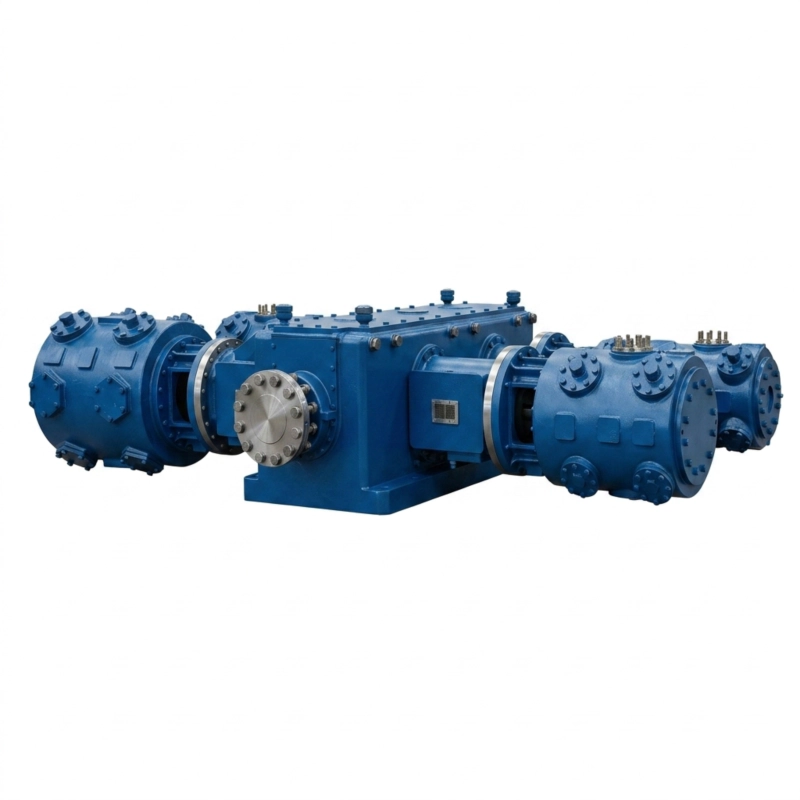
Product Overview: 4MW Series Refrigerant Compressors
The 4MW series refrigerant compressor is the large-frame member of our reciprocating refrigerant compressor range. This 4MW series refrigerant compressor uses a four-column horizontal balanced-opposed reciprocating piston compressor for large-scale industrial refrigerant service in applications where the capacity requirements exceed the practical range of two-column DW series units. It covers 28–96 m³/min of refrigerant gas flow at discharge pressures from 0.10 to 1.80 MPa in 8 standard models from 1,000 to 2,300 kW, serving ethylene plant refrigeration circuits, petrochemical cold utility trains, large-scale industrial NH₃ refrigeration, and LNG pre-cooling facilities across Russia and the CIS. Motor voltage is 6 kV or 10 kV (YAKK / YAKS high-voltage asynchronous motors), operating at 333 or 428 rpm.
The four-column balanced-opposed layout is the defining engineering characteristic of the 4MW series refrigerant compressor. Four cylinder columns are arranged horizontally in two opposing pairs, so that pistons moving outward on one side are matched by pistons moving inward on the opposite side. This opposition of moving masses eliminates first-order free inertia forces and substantially reduces second-order free forces — the net primary force transmitted to the foundation, pipework, and connected process equipment is near zero at all crank angles. In a large petrochemical refrigeration train or ethylene plant cold utility system, where the compressor is connected by rigid insulated pipework to condensers, evaporators, and process vessels over decades of continuous operation, this near-zero dynamic force is a fundamental engineering advantage: it eliminates the progressive pipe joint fatigue that is the primary cause of long-service refrigerant leak events in high-capacity reciprocating compressor installations.
The 4MW series refrigerant compressor is available in single-stage or two-stage configurations for services with moderate pressure ratios, and in two-stage or compound configurations where a single machine provides low-stage and high-stage compression within a common crankcase. This compound arrangement — the primary choice for large NH₃ cold storage, ethylene plant propylene circuits, and LNG pre-cooling duties — eliminates the need for two separate compressor trains, reducing capital cost, plot area, civil foundation scope, and the number of running items requiring operational maintenance. All models are GOST-R certified and manufactured at our production facility in Russia.
Technical Specifications — Standard Refrigeration Range (0.10–1.20 MPa Discharge)
The 4MW series refrigerant compressor models in this table are the primary selection for large-scale cold storage refrigeration, ethylene plant refrigeration, and industrial process cooling with NH₃, propylene, or propane. All models driven by 6 kV or 10 kV high-voltage motors at 333 or 428 rpm. Suction and discharge pressures are stated at the compressor nozzle flange.
| Model |
Stages |
Flow (m³/min) |
Suction (MPa) |
Discharge (MPa) |
Speed (rpm) |
Power (kW) |
Voltage |
| 4MW-28.4/0.1~1.2 |
Single |
28.4 |
0.10 |
1.20 |
428 |
1,000 |
6K/10K |
| 4MW-40.6/0.1~1.2 |
Single |
40.6 |
0.10 |
1.20 |
428 |
1,250 |
6K/10K |
| 4MW-58.2/0.1~1.2 |
Single |
58.2 |
0.10 |
1.20 |
333 |
1,600 |
6K/10K |
| 4MW-76.0/0.1~1.2 |
Single |
76.0 |
0.10 |
1.20 |
333 |
2,000 |
6K/10K |
| 4MW-96.5/0.1~1.2 |
Single |
96.5 |
0.10 |
1.20 |
333 |
2,300 |
6K/10K |
0.10 MPa suction / 1.20 MPa discharge: typical NH₃ service at −40°C evaporating to +40°C condensing. Flow rated at suction conditions. All models 4-column balanced-opposed 4MW series refrigerant compressor frame; single-stage compression. 6 kV or 10 kV YAKK / YAKS motor.
Technical Specifications — Higher Pressure Range (0.20–1.80 MPa)
Higher discharge pressure 4MW series refrigerant compressor models for propylene petrochemical service, propane LNG pre-cooling, and NH₃ systems requiring condensing at higher ambient temperatures (+40°C to +50°C). Two-stage configurations available for these models on request.
| Model |
Stages |
Flow (m³/min) |
Suction (MPa) |
Discharge (MPa) |
Speed (rpm) |
Power (kW) |
Voltage |
| 4MW-34.6/0.2~1.8 |
Single |
34.6 |
0.20 |
1.80 |
428 |
1,250 |
6K/10K |
| 4MW-52.8/0.2~1.8 |
Single |
52.8 |
0.20 |
1.80 |
333 |
1,600 |
6K/10K |
| 4MW-68.4/0.2~1.8 |
Single |
68.4 |
0.20 |
1.80 |
333 |
2,000 |
6K/10K |
0.20 MPa suction / 1.80 MPa discharge: typical propylene petrochemical service or high-ambient NH₃ service. Two-stage compound configurations available for all 4MW series refrigerant compressor models — specify evaporating temperature range and refrigerant at enquiry. All dimensions and weights supplied with technical proposal after order.
General Series Parameters — 4MW Series Refrigerant Compressor
| Parameter |
4MW Series Refrigerant Compressor |
| Refrigerant Media |
NH₃ (ammonia / R717); propylene (R1270); propane (R290); CO₂ (R744); ethylene |
| Discharge Pressure |
0.10–1.80 MPa (model-dependent) |
| Refrigerant Gas Flow |
28–96 m³/min at suction conditions |
| Motor Power |
1,000–2,300 kW |
| Drive Voltage |
6 kV or 10 kV (YAKK / YAKS high-voltage asynchronous motor) |
| Speed |
333 rpm or 428 rpm (motor pole count dependent) |
| Frame Configuration |
4-column horizontal balanced-opposed; single-stage or two-stage compound |
| Dynamic Balance |
Primary and most secondary inertia forces cancelled — balanced-opposed standard on all models |
| Piston Rings |
PTFE-filled compound rings; self-lubricating; copper-free |
| Capacity Control |
Suction valve unloading (25%–50%–75%–100%) standard; VFD option |
| Cooling |
Shell-and-tube inter-stage coolers and after-coolers; oil cooler standard |
| Design Standard |
GOST-R; API 618 design principles; pressure vessels per GOST R 52857 |
| Certification |
ISO 9001:2015, GOST-R, Pressure Vessel License |
Working Principle: Four-Column Balanced-Opposed Refrigeration Compression
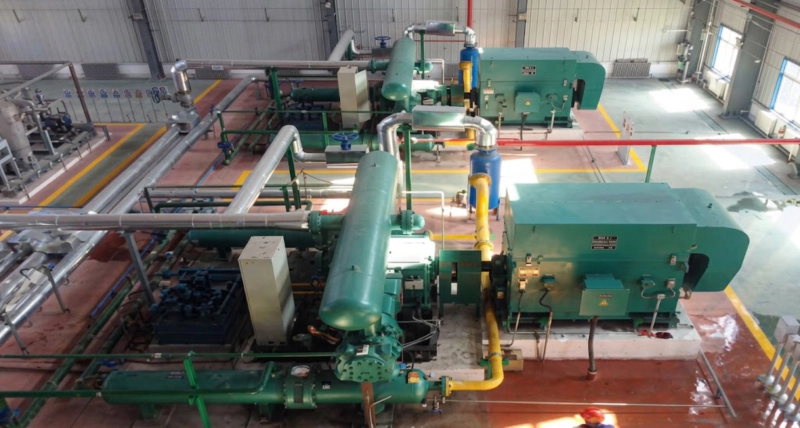
The 4MW series refrigerant compressor operates on the double-acting reciprocating compression principle with a four-column balanced-opposed frame configuration. Refrigerant gas in the 4MW series refrigerant compressor — typically NH₃ vapour from the evaporators or propylene vapour from the deethaniser overhead in an ethylene plant — enters the cylinder suction ports through self-acting plate or ring valves at the suction condition, is compressed to discharge pressure as the piston traverses the cylinder bore, and exits through the discharge valves into the discharge header. Each cylinder operates double-acting: compression takes place on both the front and rear faces of the piston on each crankshaft revolution, maximising volumetric output per unit of crankshaft length. At 333–428 rpm with four double-acting cylinders, the 4MW series achieves the high refrigerant mass flow rates needed for 1,000 to 2,300 kW drive duties without the elevated piston speeds and associated valve wear of smaller, faster-running machines.
In the 4MW series refrigerant compressor, the four-column balanced-opposed crankshaft positions the four cylinder columns in two opposed pairs at 180 degrees to each other. Pistons in columns 1 and 3 move outward while pistons in columns 2 and 4 move inward, and vice versa. The primary inertia forces generated by one pair of pistons at any crank angle are exactly cancelled by the equal and opposite primary forces from the opposing pair. The net primary force transmitted to the frame, foundation, and connected pipework is near zero throughout the operating cycle. Second-order inertia forces — which are not cancelled by the opposed arrangement alone — are substantially reduced by the phasing of the four crank throws and are small relative to the primary forces. In ethylene plant and petrochemical installations where the compressor is permanently connected to process columns, heat exchangers, and suction drums by rigid pipework, this near-zero dynamic force is a quantifiable engineering advantage: it eliminates the progressive fatigue at pipe flanges and expansion valve bodies that requires escalating inspection frequency as a reciprocating refrigerant compressor installation ages.
Four-Column Balanced-Opposed Frame
In the 4MW series refrigerant compressor, four cylinder columns in two opposed pairs share a common rigid cast-iron crankcase. Primary inertia forces cancelled internally at source. Net dynamic force to foundation and connected pipework near zero at all crank angles — the lowest vibration of any reciprocating refrigerant compressor configuration at 1,000–2,300 kW.
Two-Stage Compound Configuration
The four-column layout of the 4MW series refrigerant compressor allows cylinder pairs to be grouped as low-stage and high-stage compression sections within a single crankcase. One 4MW series refrigerant compressor replaces two separate compressor trains for NH₃ blast freezing at −40°C or ethylene plant propylene cold circuits serving multiple evaporating temperature levels.
PTFE Piston Rings — Copper-Free
The 4MW series refrigerant compressor uses PTFE-filled compound piston rings in all cylinders. Self-lubricating; no copper, copper alloys, or zinc in any refrigerant-wetted component — essential for NH₃ compatibility. Copper contamination in an NH₃ system accelerates valve wear, blocks oil separators, and causes compressor valve failure within hundreds of operating hours.
High-Voltage Motor Integration
The 4MW series refrigerant compressor uses direct coupling to 6 kV or 10 kV YAKK / YAKS high-voltage asynchronous motors. Matches the medium-voltage distribution standard in Russian and CIS petrochemical plants and large industrial facilities. Eliminates the losses and capital cost of step-down transformers required with low-voltage motors at 1,000–2,300 kW.
Application Scenarios
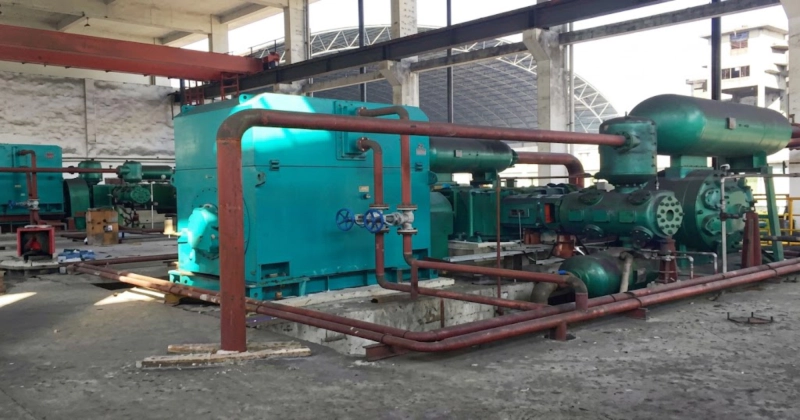
⚽Ethylene Plant Refrigeration Circuit — Propylene Cold Train
The 4MW series refrigerant compressor is the standard selection for ethylene cracker cold trains, which require refrigeration at temperatures from −20°C to −45°C to condense the deethaniser and demethaniser column overhead streams and provide cold utility to the cold box feed. A two-stage compound 4MW series refrigerant compressor in the 1,600 to 2,300 kW range is the standard selection for the propylene refrigeration circuit of a large ethylene plant — serving the deethaniser condenser, demethaniser condenser, and multiple process chillers at two or three evaporating temperature levels simultaneously — requires a compound 4MW series refrigerant compressor in the 1,600 to 2,300 kW range. The four-column balanced-opposed configuration is specified for this duty precisely because of the low vibration transmitted to adjacent process columns and interconnecting process pipework: propylene cracker installations operate for 8–12 year campaigns between major turnarounds, and dynamic fatigue at refrigerant pipework flanges is the failure mode that terminates campaigns prematurely. Russian ethylene complexes at Tobolsk, Salavat, Kazan, and Novokuibyshevsk have operated 4MW series refrigerant compressors in propylene cold train service for multiple decades.
❄Large-Scale Industrial NH₃ Cold Storage and Blast Freezing
Large cold storage facilities above 50,000 m³ require NH₃ refrigeration compressor capacity; the 4MW series refrigerant compressor provides this in a single unit from 1,000 to 2,300 kW to maintain −18°C to −25°C in frozen food stores and to supply blast freezing tunnels at −35°C to −40°C evaporating temperature. At this capacity level, the 4MW series refrigerant compressor is the standard single-machine solution. One compound 4MW series refrigerant compressor unit provides both the low-stage suction from the blast freezing tunnel evaporators and the high-stage suction from the conventional freezer evaporators, eliminating the cost and footprint of two separate compressor trains. The balanced-opposed low-vibration characteristic provides the same long-service benefit to NH₃ cold storage pipework that it provides to petrochemical refrigerant circuits — at a facility intended to operate for 30–40 years without major structural work, near-zero compressor vibration at the machine feet is the difference between a 3-year and a 15-year pipework hanger inspection cycle.
⚙️Petrochemical Cold Utility Train — Propane and Propylene
Petrochemical complexes producing aromatics, butadiene, propylene oxide, or high-octane alkylate require central refrigeration utility trains providing cooling at −15°C to −45°C to multiple process consumers simultaneously. A single 4MW series refrigerant compressor unit at 1,250 to 2,000 kW covers the full refrigeration duty of most single-train petrochemical cold utility applications with propylene or propane as the refrigerant. The high-voltage motor compatibility (6 kV / 10 kV) is essential for these installations: petrochemical plants in Russia operate medium-voltage distribution as standard, and low-voltage motors at 1,000–2,000 kW require step-down infrastructure that increases both capital cost and substation footprint. The balanced-opposed frame reduces dynamic loads at flanged connections in the propylene refrigerant circuit — particularly important because propylene is flammable, and every reduction in joint fatigue rate in a 4MW series refrigerant compressor installation directly reduces long-term leak probability.
💦LNG Pre-Cooling and Baseload Refrigeration
Small-to-medium scale LNG facilities and peak-load natural gas liquefaction plants in Russia and Central Asia use propane or mixed-refrigerant pre-cooling before the cryogenic liquefaction section. The propane pre-cooling circuit of a small LNG plant requires a 4MW series refrigerant compressor in the 1,000 to 1,600 kW range, operating as the sole 4MW series refrigerant compressor in a baseload continuous duty, operating continuously at constant load for months between planned maintenance stops. The 4MW series refrigerant compressor two-stage compound configuration reduces the pre-cooling circuit to a single machine, with low-stage suction at −40°C propane evaporation and high-stage discharge at the propane condensing condition. The four-column balanced-opposed frame is specified for LNG pre-cooling because the machines run at baseload with no shutdown, and dynamic fatigue in propane refrigerant pipework is a safety event rather than a maintenance inconvenience.
Core Advantages
⚖
Balanced-Opposed — Lowest Vibration at 1,000–2,300 kW
The 4MW series refrigerant compressor four-column opposed layout cancels primary inertia forces at source. Net dynamic force at machine feet is near zero — the lowest achievable from any reciprocating refrigerant compressor at this power level. In petrochemical and cold storage installations, the 4MW series refrigerant compressor operates 25–40 years without structural modification, near-zero compressor vibration is a direct reduction in long-term maintenance cost and leak risk at refrigerant pipework flanges.
🔌
Two-Stage Compound — One Machine, Two Temperature Levels
In the 4MW series refrigerant compressor, the four-column layout allows cylinder pairs to be configured as low-stage and high-stage sections within a single crankcase, serving two evaporating temperature levels from one machine. This 4MW series refrigerant compressor advantage eliminates the capital cost, plot area, and operational complexity of a second compressor train for large NH₃ blast freezing, ethylene plant propylene circuits, and LNG pre-cooling duties requiring refrigeration from −40°C to −5°C.
🌀
Multi-Refrigerant — NH₃, Propylene, Propane, CO₂, Ethylene
In every 4MW series refrigerant compressor unit, cylinder bore, valve geometry, piston ring material, packing, and cooler sizing are all engineered for the specific refrigerant of each project. Copper-free wetted parts standard on all models — mandatory for NH₃ service and good practice for hydrocarbon refrigerant services where copper contamination accelerates valve wear. Propylene variants handle flammable service with the same low-vibration flange loading benefit as NH₃ models.
📈
6 kV / 10 kV — Russian Medium-Voltage Standard
YAKK and YAKS high-voltage motors matched to the medium-voltage distribution systems standard in Russian petrochemical plants and large industrial facilities. No step-down transformer required at 1,000–2,300 kW. Eliminates transformer capital cost, transformer room footprint, and the additional loss source that reduces overall refrigeration train efficiency in low-voltage motor configurations.
📄
GOST-R and Rostechnadzor Documentation Included
Every 4MW series refrigerant compressor delivered to Russia is supplied with a GOST-R certificate of conformity, technical passport, pressure vessel certification for intercooler and refrigerant separator, factory test report, and Russian-language operating and maintenance documentation are supplied as standard. NH₃ refrigeration systems in Russia above the exemption threshold require Rostechnadzor registration under Federal Law 116-FZ — the documentation package is structured to support this registration directly.
🕑
16–24 Week Delivery from Russia
Standard 4MW series refrigerant compressor delivery from order receipt to factory acceptance test is 16–24 weeks depending on motor specification and project-specific requirements — substantially faster than equivalent imported machines and without foreign currency procurement exposure. For ethylene plant turnaround projects specifying a 4MW series refrigerant compressor with fixed commissioning dates, a guaranteed domestic delivery is a practical project management advantage.
Material Specifications for Refrigerant Service
All wetted components of every 4MW series refrigerant compressor are specified for the individual refrigerant of each project. The table below lists standard material specifications for NH₃ service and notes modifications applicable to propylene, CO₂, and ethylene variants. All material data in this table applies exclusively to the 4MW series refrigerant compressor and should not be assumed to apply to other compressor types in the product range.
| Component |
NH₃ Service Specification |
Propylene / CO₂ Notes |
| Frame / Crankcase |
Cast iron GG25 / HT250; precision-machined bearing bores |
Same for all refrigerant variants |
| Crankshaft |
Forged 42CrMo alloy steel; induction-hardened journals; dynamically balanced |
Same |
| Cylinders |
HT250 grey cast iron; no copper, zinc, or copper alloys in refrigerant contact |
Alloy steel option for high-pressure CO₂ service |
| Piston Rings |
PTFE-filled compound; self-lubricating; copper-free |
Material grade verified per refrigerant |
| Piston Rods |
42CrMo; hard chrome plated running surface in packing contact zone |
Same |
| Gas Valves |
Carbon steel or stainless steel; no brass seats or copper-alloy discs; spring-loaded, field-replaceable |
Stainless steel AISI 420 standard for CO₂ |
| Rod Packing |
PTFE / bronze composite rings; copper-free for NH₃; lantern ring with vent |
Elastomers verified per refrigerant |
| Refrigerant Connections |
Carbon steel flange connections — no copper tubing or fittings |
Stainless steel for CO₂ and ethylene |
| Lubricating Oil |
NH₃-compatible refrigeration mineral oil (HL-NH3 grade); forced-pressure system with oil cooler and filter |
Oil grade verified per refrigerant and operating temperature |
4MW Series Refrigerant Compressor vs. Alternative Types at 1,000–2,300 kW
Transparency Notice: Grasso, Mycom, Howden, and Bitzer are referenced for product category comparison only. We do not manufacture or claim affiliation with these brands. All 4MW series refrigerant compressors are original designs. We do not sell counterfeit or unlicensed products.
| Factor |
4MW Balanced-Opposed
Reciprocating |
Twin-Screw Refrigerant
(Howden / Grasso) |
Large Reciprocating
(Mycom / Grasso) |
| Power range |
1,000–2,300 kW |
Typically up to ~1,500 kW |
Comparable range |
| Vibration at foundation |
Near zero (balanced-opposed) |
Low (rotary) |
Varies by frame type |
| Pressure ratio per stage |
Up to 8:1 |
3:1 to 5:1 typical |
Up to 8:1 |
| Part-load efficiency |
Good (step unloading) |
Moderate (slide valve loss) |
Good |
| 6 kV / 10 kV motor |
✓ Standard |
Available |
Available |
| GOST-R standard |
✓ Included |
Case by case |
Case by case |
| Capital cost |
30–45% below import |
Medium-high |
Very high (JPY / EUR) |
| Russia spare parts |
In-house; 24–72 h |
Import; weeks |
Import; weeks |
| Lead time |
16–24 weeks |
8–14 months |
12–18 months |
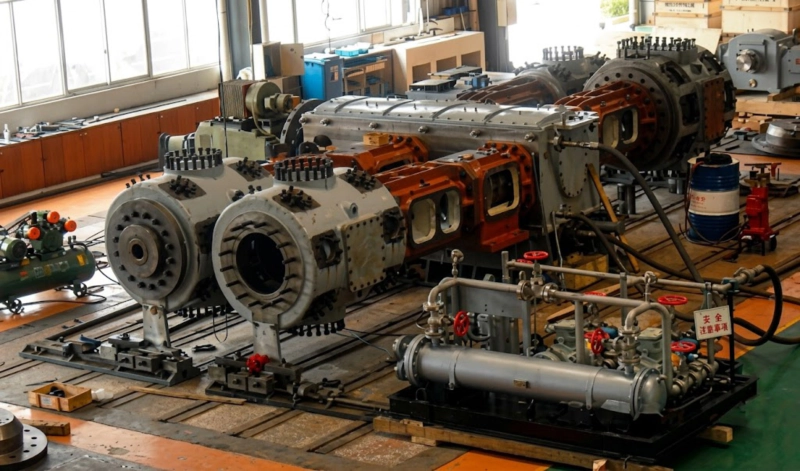
Factory acceptance test — every 4MW series refrigerant compressor is operated at rated suction and discharge conditions; vibration levels measured at main bearing housings verifying balanced-opposed performance; suction valve unloader response tested at all load steps; and all safety devices calibrated before shipment from our Russian facility
Frequently Asked Questions — 4MW Series Refrigerant Compressors
Q1: Why choose the four-column 4MW series over the two-column DW series for large-capacity refrigerant service?
The DW series two-column frame covers 90 to 1,600 kW of refrigerant compressor duty with opposed-balance cancellation of primary inertia forces. Above 1,600 kW, the DW frame reaches its practical upper size limit for a two-column configuration. The 4MW series extends the balanced-opposed reciprocating refrigerant compressor range to 1,000–2,300 kW using four cylinder columns, which also provides a second structural benefit: the four throws of the crankshaft can be phased to further reduce second-order inertia forces, which are not cancelled by simple two-column opposition. For installations above 1,600 kW where a single balanced-opposed machine is required — ethylene plant propylene cold trains, large NH₃ cold storage compressor stations, petrochemical propane cold utility trains — the 4MW series refrigerant compressor is the natural extension of the DW product family into the 1,000 to 2,300 kW range. For duties above 2,300 kW, contact our engineering team to discuss multi-machine 4MW series refrigerant compressor configurations.
Q2: What refrigerants are compatible with the 4MW series and what material changes are required per refrigerant?
The 4MW series refrigerant compressor is designed for NH₃ (R717), propylene (R1270), propane (R290), CO₂ (R744), and ethylene. The frame, crankshaft, and connecting rod assembly are shared across refrigerant variants. Material changes per refrigerant are: cylinder bore adjusted for the molecular weight and vapour density of the refrigerant at the specified suction condition; gas valve lift height and spring rate matched to the refrigerant physical properties; piston ring compound verified for chemical compatibility; rod packing elastomers verified for each refrigerant (NH₃ requires specific elastomers different from hydrocarbon refrigerants); and cylinder oil grade specified for the refrigerant and operating temperature range. For CO₂ and ethylene, alloy steel cylinders and stainless steel valve bodies are specified. Provide the refrigerant identity, suction and discharge conditions, and site hazardous area classification at enquiry; our engineering team will verify material suitability for the proposed 4MW series refrigerant compressor configuration and return a written material specification.
Q3: How does the two-stage compound configuration work in a four-column 4MW unit?
In the two-stage compound configuration of the 4MW series refrigerant compressor, two of the four cylinder columns are assigned to low-stage duty and two to high-stage duty. This 4MW series refrigerant compressor configuration are assigned to low-stage compression and two to high-stage compression within the same crankcase. Low-stage cylinders receive refrigerant vapour from the evaporators at suction pressure — for NH₃ at −35°C evaporation, this is approximately 0.095 MPa — and compress it to an intermediate pressure of approximately 0.30–0.40 MPa. The intermediate-pressure gas passes through a water-cooled intercooler that removes the heat of compression and returns the gas temperature to near-suction conditions before it enters the high-stage cylinders. The high-stage cylinders then compress from intermediate pressure to final condensing pressure (0.80–1.20 MPa for NH₃ at +30°C to +40°C condensing). The two-stage cycle maintains discharge temperatures at the high-stage outlet below 120°C, keeping the operating conditions within the safe envelope for refrigerant oil, valve elements, and cylinder liner materials at −40°C to −5°C evaporating temperature.
Q4: Why is the balanced-opposed layout particularly important for propylene and propane refrigerant service in petrochemical plants?
Propylene (R1270) and propane (R290) are flammable hydrocarbons. In a petrochemical refrigeration circuit, a refrigerant leak at any flanged joint, valve gland, or threaded connection in the vicinity of ignition sources constitutes a fire and explosion hazard. The progression from a developing leak to a hazardous event depends on how long the leak source remains undetected — which depends on how rapidly the leak grows. Progressive fatigue failure at pipe flanges and expansion valve bodies is driven by the alternating dynamic force from the compressor. The balanced-opposed 4MW series reduces this alternating force to near zero, slowing the fatigue accumulation rate at every refrigerant circuit joint by an order of magnitude compared to an unbalanced single-column machine at the same power level. This is an engineering reduction in long-term flammable refrigerant leak probability, not a marginal improvement. Russian petrochemical plants specify the balanced-opposed 4MW series refrigerant compressor for propylene and propane refrigerant service as standard practice. This is the reason the 4MW series refrigerant compressor is specified by process engineers rather than alternative compressor types at this power range.
Q5: How does the 6 kV / 10 kV motor drive work and why is it preferred at this power range in Russia?
Russian and CIS industrial plants operate medium-voltage distribution as standard. Every 4MW series refrigerant compressor motor specification matches this exactly: YAKK / YAKS motors at 6 kV or 10 kV are standard at petrochemical, metallurgical, and large food processing facilities operate medium-voltage electrical distribution at 6 kV or 10 kV as the site standard for large motors. This is a consequence of the original Soviet industrial electrical standards (GOST 21128 and related standards) that specified medium-voltage distribution for industrial facilities with large rotating equipment. At 1,000–2,300 kW, a low-voltage (380 V) motor draws 1,500–3,500 A at rated load — cable cross-sections and switchgear at these current levels are physically large, costly, and lossy over the cable runs typical in a large petrochemical plant. A 6 kV motor at the same power draws 100–230 A, requiring much smaller switchgear, cabling, and busbars. The 4MW series refrigerant compressor is configured with YAKK or YAKS high-voltage motors as standard — these are Russian-manufactured motors specifically designed for the 6 kV and 10 kV industrial supply standard, with readily available spare parts and service across Russia and CIS.
Q6: What maintenance schedule applies to the 4MW series refrigerant compressor?
Annual maintenance for the 4MW series refrigerant compressor covers: crankcase oil and oil filter replacement (every 2,000–3,000 operating hours or annually); gas valve inspection and element replacement at 8,000–12,000 hours determined by inspection condition; piston ring inspection at 6,000–8,000 hours and replacement when wear exceeds the dimensional limit; rod packing inspection and replacement at 8,000–10,000 hours; suction valve unloader actuator function test and solenoid valve service; and inter-stage cooler tube bundle inspection. The balanced-opposed four-column frame of the 4MW series refrigerant compressor has inherently lower main bearing loads than comparable single-column or unbalanced machines because the primary inertia force is cancelled internally — main bearing and crankshaft journal wear rates are correspondingly lower, extending the time between major crankcase overhauls. Gas valve elements are the highest-frequency replacement item and the highest-priority on-site spare — a valve failure reduces compression efficiency on that cylinder immediately, and replacement requires 4–6 hours of planned work per cylinder position.
Q7: What GOST-R and Rostechnadzor documentation is supplied with the 4MW series for Russian installations?
Every 4MW series refrigerant compressor delivered to Russia or EEU member states is supplied with: GOST-R certificate of conformity for the compressor unit; technical passport documenting all rated operating conditions; pressure vessel certification for the inter-stage cooler and liquid refrigerant separator under Russian pressure vessel regulations (GOST R 52857 series) applicable to vessels above 0.07 MPa containing hazardous refrigerants; factory acceptance test report with signed vibration, performance, and safety device data; and Russian-language operation and maintenance documentation covering startup, normal operation, shutdown, and full maintenance procedures. NH₃ refrigeration systems above the Rostechnadzor exemption threshold require registration under Federal Law 116-FZ (hazardous production facilities) and periodic technical examination of the pressure equipment. The documentation set for each 4MW series refrigerant compressor is structured and indexed to support Rostechnadzor registration directly. Documentation dispatch precedes machine shipment by 2–3 weeks.
Q8: What spare parts should be stocked on-site for a 4MW series refrigerant compressor?
The recommended two-year on-site spare parts stock for each 4MW series refrigerant compressor unit includes: one complete set of piston rings for all 4MW series refrigerant compressor cylinder column positions (first-stage bore and second-stage bore if two-stage); one complete set of gas valve elements for all cylinder positions (suction and discharge valves for each of the four columns); one set of rod packing rings and lantern ring seals; crankcase oil for one complete change (approximately 80–120 litres depending on model); oil filter elements for two changes; suction valve unloader solenoid valves and actuator seals; and inter-stage cooler tube plugging material. Gas valve elements are the highest-priority on-site stock for the 4MW series refrigerant compressor — in continuous 4MW series refrigerant compressor process service, a valve failure on any cylinder causes an immediate reduction in compression output on that column, and the operating condition deteriorates progressively until the valve is replaced. All 4MW series refrigerant compressor parts are available from our Russian facility within 24–72 hours of order.
Q9: Can the 4MW series handle CO₂ (R744) refrigerant service?
Yes. The 4MW series refrigerant compressor can be configured for subcritical or transcritical CO₂ refrigerant service. CO₂ at refrigeration conditions operates at substantially higher pressures than NH₃ or hydrocarbon refrigerants — CO₂ condensing at +25°C is at 6.4 MPa (supercritical) in transcritical operation, and even in subcritical cascade service the high-stage pressure is 2–4 MPa. The CO₂ variant of the 4MW series uses alloy steel cylinders (rather than cast iron), stainless steel AISI 420 gas valves, upgraded rod packing rated for the CO₂ pressure range, and all carbon steel and stainless steel refrigerant connections — copper and copper alloys are not used in CO₂ service regardless of pressure, as CO₂ forms carbonic acid in the presence of moisture and attacks copper. Specify the CO₂ suction and discharge pressure at enquiry; our engineering team will size the 4MW series refrigerant compressor cylinder swept volume and valve geometry for the specific duty condition.
Q10: What information is required to prepare a technical and commercial proposal for a 4MW series refrigerant compressor?
Standard delivery for a 4MW series refrigerant compressor from order placement to factory acceptance test is 16–24 weeks. To prepare a proposal, provide for the 4MW series refrigerant compressor: refrigerant type and purity specification; suction pressure and temperature at the compressor nozzle flange; discharge pressure required; required volume flow at suction conditions in m³/min, or refrigeration duty in kW of cooling; single-stage or two-stage compound requirement; available site electrical supply voltage (6 kV or 10 kV) and frequency; hazardous area classification if the installation is in a classified zone (for ATEX or GOST ATEX compliance); whether Rostechnadzor registration is required (mandatory for NH₃ systems above the exemption threshold under Federal Law 116-FZ); and the required delivery and commissioning date. If refrigeration capacity in kW is not known but the process duty — ethylene plant deethaniser condenser duty, cold store volume and target temperature, or LNG pre-cooling capacity — is available, our engineering team can calculate the required 4MW series refrigerant compressor size from the process data. Response within 48 hours of complete 4MW series refrigerant compressor enquiry submission.
Request a Technical Proposal
Our engineering team supplies 4MW series refrigerant compressors — the 4MW series refrigerant compressor is our highest-capacity single-machine reciprocating refrigerant option — to ethylene producers, petrochemical plant operators, industrial cold storage developers, and LNG facility owners across Russia and the CIS. Four-column balanced-opposed frame for the lowest vibration at 1,000–2,300 kW, multi-refrigerant design for NH₃, propylene, propane, CO₂, and ethylene service, 6 kV / 10 kV motor standard. GOST-R and Rostechnadzor documentation included. Spare parts manufactured in Russia and dispatched within 24–72 hours.
4MW Refrigerant Compressor — Engineering Enquiry
Discuss Your 4MW Series Refrigerant Compressor Project
Refrigeration engineers respond to all enquiries. GOST-R and Rostechnadzor documentation included. Response within 48 hours.
Request a Technical Quote
Include in Your 4MW Series Refrigerant Compressor Enquiry
✓ Refrigerant type (NH₃ / propylene / propane / CO₂ / ethylene)
✓ Required cooling capacity (kW) or process duty description
✓ Suction pressure (MPa) or evaporating temperature (°C)
✓ Discharge pressure (MPa) or condensing temperature (°C)
✓ Single-stage or two-stage compound requirement
✓ Available voltage (6 kV / 10 kV) and site frequency
✓ Hazardous area classification (if applicable)
✓ GOST-R / Rostechnadzor registration requirement
✓ Required delivery and commissioning date