
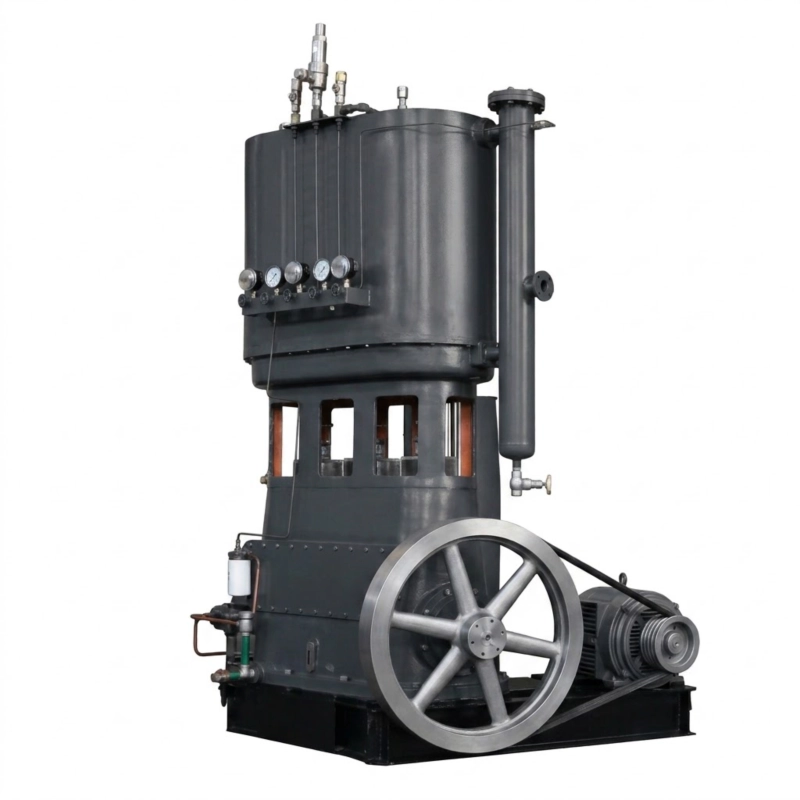
3Z Series Acetylene Compressor
3Z series acetylene compressor: 200–270 Nm³/h, 2.5 MPa, 3-column, ATEX Group IIC, oil-free, water-cooled. GOST-R certified. Russia manufacturer. Get a quote.
Dissolved Acetylene Compression · Three-Column Design · Russia Manufacturer
3Z Series Acetylene Compressor
Three-column vertical reciprocating compressor for medium-to-large dissolved acetylene production plants. Covering 200–270 Nm³/h at 2.5 MPa discharge pressure, the 3Z series delivers approximately 35% higher throughput than the equivalent two-column 2Z series in the same Z-type vertical frame architecture — with the same mandatory safety requirements: oil-free cylinders, water cooling, and ATEX Group IIC explosion-proof construction. Manufactured and GOST-R certified at our production facility in Russia.
✓ ATEX Group IIC
✓ Oil-Free Cylinders
✓ GOST-R Certified
✓ Water-Cooled
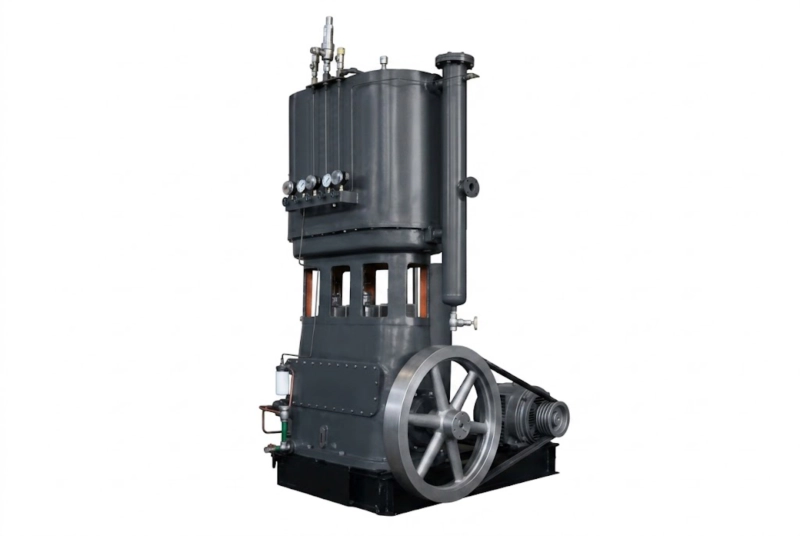
3Z Series — Three-column vertical reciprocating acetylene compressor. The additional third cylinder column delivers 200–270 Nm³/h at 2.5 MPa, making the 3Z the preferred machine for medium-to-large dissolved acetylene filling plants in Russia and the CIS.
Product Overview: 3Z Series Acetylene Compressor
The 3Z series acetylene compressor is a three-column vertical (Z-type) reciprocating piston compressor for dissolved acetylene production in medium-to-large cylinder filling plants. The 3Z designation identifies the three-cylinder configuration: one dedicated low-pressure stage cylinder and two high-pressure stage cylinders arranged vertically on a common crankshaft. By adding a third cylinder column to the two-column architecture of the 2Z series, the 3Z achieves a 35% increase in throughput — from 200 Nm³/h (2Z-3.34/25) to 270 Nm³/h (3Z-4.5/25) — within the same Z-type vertical frame and within the same plant floor area envelope.
The three-column configuration also improves the dynamic balance of the machine compared to the two-column 2Z design. With two high-pressure stage pistons sharing the compression load, the peak force on any single crank throw is reduced, which lowers vibration transmitted to the foundation and extends the service life of crankshaft bearings and connecting rods under the sustained high-cycle loading of continuous production operations.
All safety requirements that apply to the 2Z series apply without modification to the 3Z: oil-free cylinder design using PTFE piston rings and packing, water cooling of all hot surfaces including cylinder jackets, the interstage cooler, and the aftercooler, ATEX Zone 1 Group IIC explosion-proof electrical equipment throughout, and copper-free materials in every wetted component. The 3Z series is manufactured at our production facility in Russia to GOST-R and GOST 5457 requirements, with full Rostechnadzor registration documentation provided as standard for the Russian and CIS market.
Applications: Dissolved acetylene cylinder filling plants with daily output of 300–600 cylinders per shift, larger oxy-acetylene welding gas supply operations, acetylene gas recovery systems in chemical plants, and acetylene feed compression for chemical synthesis including BDO, vinyl acetylene, and acetaldehyde production.
3Z Series vs. 2Z Series: When to Choose Three Columns
The decision between the 2Z and 3Z series is determined primarily by the required cylinder output and the acetylene generator capacity of the plant. The following comparison assists in selecting the correct series for a new plant or a capacity expansion.
| Characteristic | 2Z Series | 3Z Series |
|---|---|---|
| Number of cylinder columns | 2 (1 LP + 1 HP) | 3 (1 LP + 2 HP) |
| Flow range | 120–200 Nm³/h | 200–270 Nm³/h |
| Cylinders per shift (40L, 1.9 MPa) | 160–265 cyl/shift | 265–360 cyl/shift |
| Dynamic balance | Good (2-column vertical) | Better (shared HP load) |
| HP piston rod load per cylinder | Full HP load on 1 cylinder | HP load shared across 2 cylinders |
| Footprint vs throughput | Compact | Moderate; best throughput-per-m² |
| Drive configuration | Direct or belt-drive | Belt-drive standard |
| Safety requirements | Oil-free, water-cooled, ATEX IIC | Identical — oil-free, water-cooled, ATEX IIC |
Technical Specifications — 3Z Series Acetylene Compressor
Both 3Z models share the same three-column belt-drive vertical frame. The model number encodes the flow capacity: 3Z-3.34/25 delivers 3.34 Nm³/min (200 Nm³/h) and 3Z-4.5/25 delivers 4.5 Nm³/min (270 Nm³/h) at 2.5 MPa discharge pressure.
| Model | Configuration | Flow (Nm³/h) | Flow (Nm³/min) | Discharge (MPa) | Drive | Voltage | Application |
|---|---|---|---|---|---|---|---|
| 3Z-3.34/25 | 3-col 2-stage, belt-drive | 200 | 3.34 | 2.50 | V-belt | 380 V | Dissolved acetylene plant |
| 3Z-4.5/25 | 3-col 2-stage, belt-drive | 270 | 4.5 | 2.50 | V-belt | 380 V | Dissolved acetylene plant |
Note: Flow rates are stated at standard conditions (0°C, 0.101325 MPa). Discharge pressure 2.50 MPa is the standard for dissolved acetylene cylinder filling per GOST 5457 and equivalent international standards. Custom configurations for chemical synthesis and process gas duties at different pressures and flows are available on request.
General Series Parameters
| Parameter | 3Z Series Specification |
| Compression Medium | Pure acetylene (C₂H₂); acetylene-nitrogen mixtures |
| Discharge Pressure | 2.50 MPa standard (GOST 5457); up to 4.0 MPa for chemical synthesis |
| Flow Range | 200–270 Nm³/h (3.34–4.5 Nm³/min) |
| Frame / Cylinders | 3-column vertical (Z-type): 1 LP cylinder + 2 HP cylinders |
| Stages | 2-stage compression (LP stage then HP stage × 2 parallel) |
| Cylinder Lubrication | Oil-free mandatory — PTFE piston rings and packing throughout all 3 cylinders |
| Cooling Method | Water-cooled mandatory — all cylinder jackets, interstage cooler, aftercooler |
| Drive Configuration | V-belt and pulley (belt-drive) standard; adjustable output via pulley change |
| Electrical Classification | ATEX Zone 1, Group IIC, Temperature Class T3 (200°C surface limit) |
| Drive Voltage | 380 V, 50 Hz explosion-proof motor (ATEX Group IIC) |
| Max Discharge Temperature | ≤ 100°C interstage; ≤ 80°C aftercooler outlet (mandatory safety limits) |
| Materials (wetted parts) | Copper content below 70% mass — no brass, copper gaskets, or silver valve parts |
| Safety Standard | GOST 5457, GOST-R, Acetylene Safety Regulations, Federal Law 116-FZ |
| Certification | ISO 9001:2015, GOST-R, ATEX Group IIC, Pressure Vessel License |
Why Three Columns: The Engineering Rationale
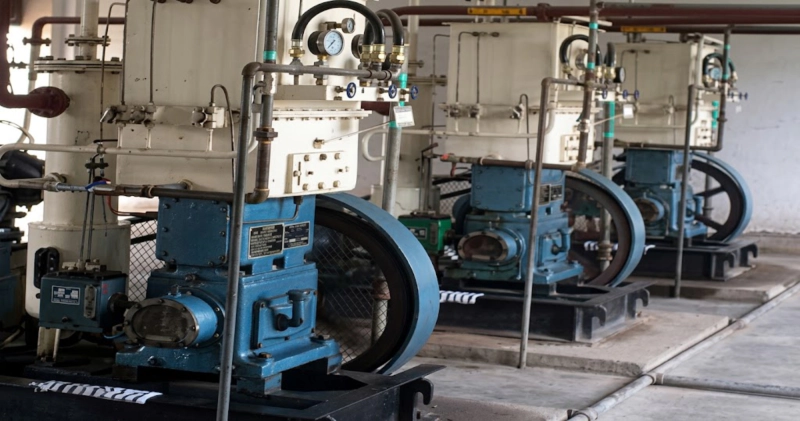
Splitting the High-Pressure Load
In a two-stage acetylene compressor, the high-pressure stage is where the greatest mechanical stress concentrates: the piston, piston rod, connecting rod, and crankpin all bear the maximum force at top dead centre of the HP stroke. In the two-column 2Z series, a single HP cylinder handles the entire second-stage compression load. In the three-column 3Z series, two HP cylinders share this load — each handling half the HP gas flow. This arrangement reduces the peak rod load on each individual HP cylinder by approximately 50% compared to a single HP cylinder handling the same total flow. The result is lower stress on HP cylinder components, longer service life of HP piston rings and valves, and reduced vibration from the HP stroke impulse.
The Role of Belt Drive in Three-Column Configuration
The 3Z series uses belt drive as standard rather than the direct-drive option available on some 2Z models. The belt-drive configuration serves two important functions in the three-column machine: first, the pulley ratio can be adjusted to change the compressor speed without modifying the motor, allowing the output to be matched to different acetylene generator capacities without electrical changes. Second, the belt provides a degree of mechanical isolation between the motor and the crankshaft, absorbing torsional shock loads that would otherwise be transmitted directly to the motor bearings during start-up and load transients. For a machine running continuously at the high-cycle rates required in a production filling plant, this isolation extends motor service life under realistic operating conditions.
Capacity Economics: One 3Z vs. Two 2Z Units
For a plant requiring 200–270 Nm³/h of acetylene compression, the alternative to a single 3Z unit is two parallel 2Z units (e.g. two 2Z-3.34/25 machines at 200 Nm³/h each, running one fully loaded and one at reduced load). While the two-2Z arrangement provides redundancy, it requires twice the cooling water connections, twice the ATEX electrical panels, twice the maintenance scope, and approximately 40–60% more floor area. For plants with a single production shift and no requirement for standby redundancy, the single 3Z unit provides the required throughput at significantly lower total installed cost and ongoing maintenance expense. For plants requiring 24-hour operation with no planned downtime, two 2Z units in parallel — one duty, one standby — remains the preferable configuration.
Working Principle and Structural Composition
The 3Z series operates on the reciprocating piston principle with a three-column vertical Z-type frame. The belt-driven crankshaft converts the motor’s rotational motion into the upward and downward reciprocating motion of three vertical pistons. The first-stage (low-pressure) piston draws purified acetylene from the generator at near-atmospheric pressure and compresses it to the interstage pressure of approximately 0.6–0.8 MPa. After passing through the interstage cooler (maintaining temperature below 100°C), the gas splits equally into two second-stage (high-pressure) cylinders, each of which compresses the gas from interstage pressure to the final discharge pressure of 2.5 MPa. The discharge flows from both HP cylinders recombine and pass through the aftercooler to deliver acetylene below 80°C to the filling manifold.
Key Structural Components and Safety Features
Core Advantages of the 3Z Series
Material Specifications for Acetylene Service
| Component | Material | Compliance |
|---|---|---|
| Frame / Crankcase | HT250 grey cast iron | ✓ Copper-free; compliant |
| Cylinders and Heads (all 3) | HT250 cast iron with integral water jackets | ✓ Copper-free; compliant |
| Pistons | Cast iron or aluminium alloy (Cu below 70%) | ✓ Compliant |
| Piston Rings / Packing (all stages) | PTFE — oil-free mandatory in all 3 cylinders | ✓ No metallic copper; compliant |
| Piston Rods (all 3) | 42CrMo alloy steel, hard chrome plated | ✓ Copper-free; compliant |
| Gas Valve Bodies | 316L stainless steel | ✓ Copper-free; compliant |
| Valve Elements | PTFE or PEEK polymer | ✓ Non-metallic; compliant |
| Gas-Side Piping | Carbon steel or 316L SS — no brass fittings | ✓ Copper-free; compliant |
| Gaskets and Seals | PTFE flat gaskets; no copper or silver gaskets | ✓ Copper-free; compliant |
Selection Guide: When to Specify the 3Z Series
Confirm your plant requires 200–360 cylinders per 8-hour shift
The 3Z-3.34/25 fills approximately 265–320 cylinders per shift; the 3Z-4.5/25 fills approximately 285–360 cylinders per shift (40L cylinders, 1.9 MPa / 20°C, allowing for normal filling cycle time). If your requirement is below 265 cylinders per shift, the 2Z series is more economical. If it exceeds 360 cylinders per shift, consider parallel 3Z units or the larger DW series acetylene configurations.
Confirm acetylene generator capacity matches 3Z throughput
The 3Z-3.34/25 requires a generator delivering at least 210 Nm³/h of raw acetylene before purification losses; the 3Z-4.5/25 requires at least 285 Nm³/h. Sizing the compressor to a flow the generator cannot sustain wastes capital. Confirm the generator nominal and peak output at the enquiry stage.
Confirm cooling water availability for three cylinder stages
The 3Z series requires cooling water for three cylinder jackets plus the interstage cooler and aftercooler — somewhat more than the 2Z series. Typical cooling water consumption is 2–4 m³/h per unit depending on inlet temperature and ambient conditions. Confirm available flow rate, maximum inlet temperature (30°C recommended), and water quality at the enquiry stage.
Verify hazardous area classification: ATEX Zone 1, Group IIC mandatory
All acetylene compressor installations are Zone 1, Group IIC. The 3Z series motor, control panel, and all sensors are supplied with IIC certification as standard. Confirm this with your site safety engineer and verify that the installation building ventilation and layout meet the requirements of GOST 5457 and applicable fire safety codes for acetylene handling facilities.
State GOST-R and Rostechnadzor requirements at enquiry
GOST-R certification and the full Rostechnadzor registration documentation package are provided as standard for all 3Z units delivered to the Russian Federation and EEU member states. State this explicitly at enquiry so that the correct documentation scope is confirmed in the commercial offer.
3Z Series vs. Alternatives: Objective Comparison
| Factor | 3Z Series (Our Make) | Two Parallel 2Z Units | European Equivalents |
|---|---|---|---|
| Throughput (200–270 Nm³/h) | ✓ Single machine | Requires 2 machines | ✓ Single machine |
| ATEX Group IIC | ✓ Standard | ✓ Standard (each unit) | ✓ Standard |
| GOST-R and GOST 5457 | ✓ Standard | ✓ Standard (each unit) | Case by case; added cost |
| Capital Cost (200–270 Nm³/h) | Single-machine economics | Higher (two machines) | 30–50% above our pricing |
| Lead Time | 3–5 months | 3–5 months (each) | 8–14 months |
| Installation Complexity | Single connection set | Two sets of connections | Single connection set |
| Standby Redundancy | None (add 2Z as standby) | ✓ Built-in (1 duty + 1 standby) | None (separate standby) |
| Spare Parts | In-house; rapid dispatch | In-house; rapid dispatch | OEM only; import delays |
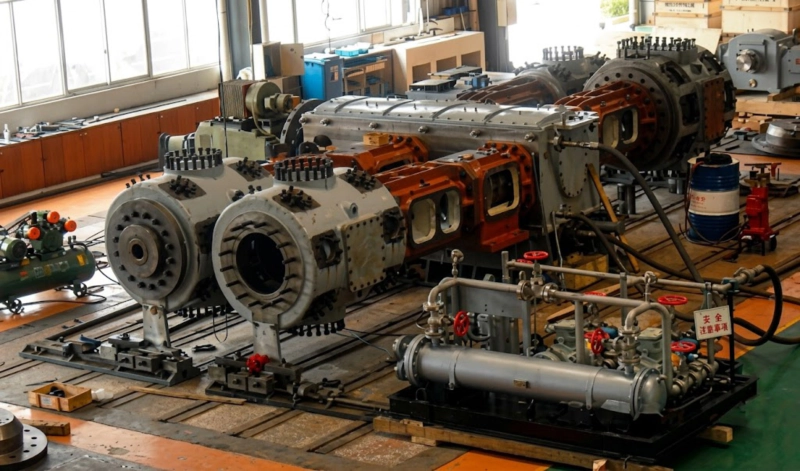
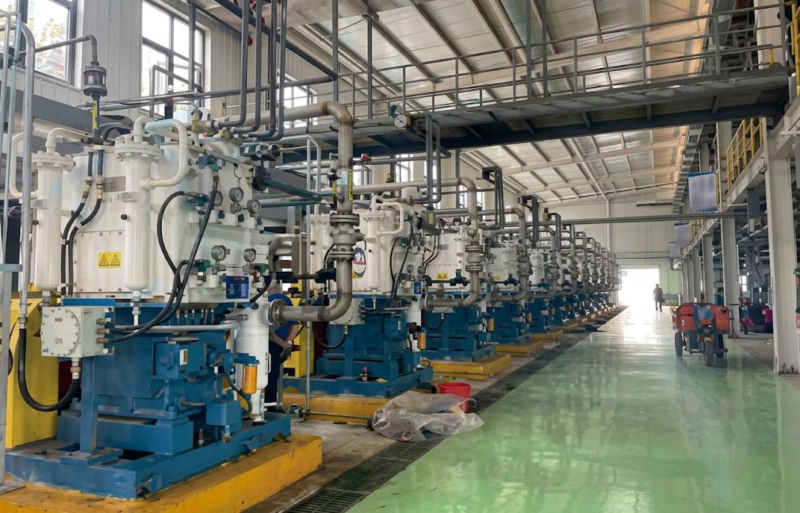
Factory acceptance test — every 3Z unit is mechanically tested at design conditions with all three cylinders operating, and all automatic safety shutdown functions are simulated and verified before shipment
Frequently Asked Questions — 3Z Series Acetylene Compressor
Request a Technical Proposal for Your Acetylene Plant
Our engineering team has over 70 years of experience manufacturing acetylene compressors for dissolved acetylene plants across Russia and the CIS. Whether you are expanding an existing 2Z-equipped plant or specifying a new medium-to-large facility from the ground up, the 3Z series acetylene compressor delivers the throughput increase your plant needs in a single machine with complete GOST-R, GOST 5457, and Rostechnadzor compliance documentation as standard.
Discuss Your Medium-to-Large Acetylene Plant Requirements
Enquiries answered by process engineers with acetylene plant experience. Full GOST-R, GOST 5457, and Rostechnadzor documentation included. Response within 48 hours.