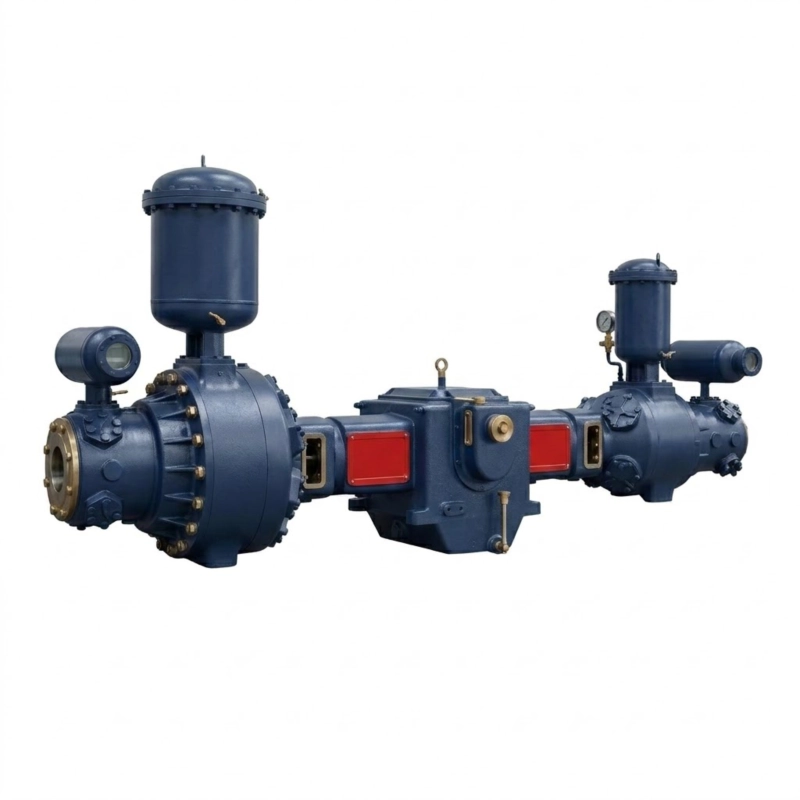
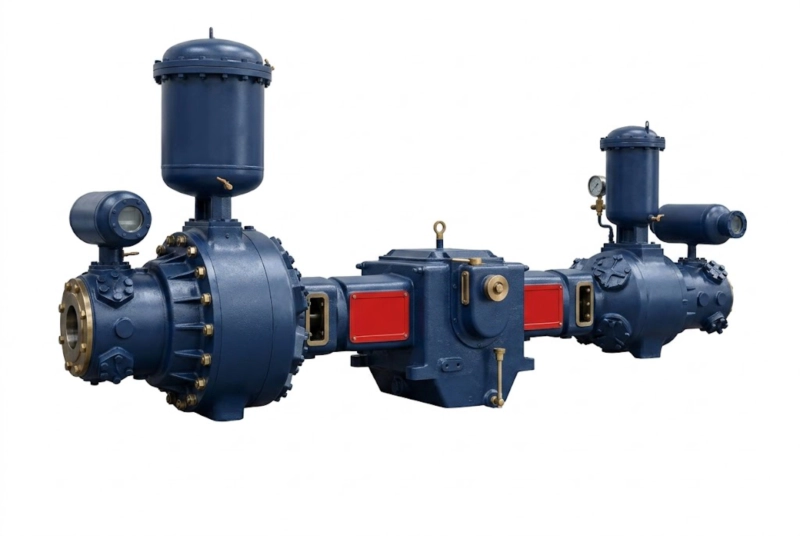
Product Overview: DW Series CO₂ Compressor
The DW series carbon dioxide compressor is a two-column horizontal opposed reciprocating piston compressor designed for the widest range of industrial CO₂ process duties in our product lineup. The DW designation identifies the two-column (D-type) horizontal arrangement, in which cylinders face each other on either side of the crankshaft, delivering better dynamic balance than single-column Z-type machines while maintaining a compact footprint and straightforward maintenance access. Two sub-series cover the full process pressure spectrum: a mid-to-high pressure series (1.2–10.0 MPa) and a low-pressure series (0.1–1.0 MPa).
Manufactured at our production facility in Russia to API 618 Fifth Edition and GOST-R requirements, the DW series provides engineering-grade performance as a direct alternative to Ariel JGT series, Dresser-Rand (Siemens Energy) HOS series, Burckhardt Laby-GI series, and Neuman & Esser PCH series compressors. These brands are referenced solely to assist process engineers in cross-referencing performance classes during equipment selection. All DW units are original designs; we do not manufacture or imply any affiliation with these brands, and we do not sell counterfeit or unlicensed copies of any product.
Industries served: CO₂ liquefaction and food-grade gas production, beverage carbonation supply, dry ice manufacturing, carbon capture intermediate compression, chemical synthesis (urea, methanol, supercritical extraction), EOR injection boost stages, industrial gas supply and distribution, fermentation CO₂ recovery, and LNG acid gas handling.
Technical Specifications — DW Series Mid-to-High Pressure (1.2–10.0 MPa)
Two-column, 3-stage and 4-stage configurations. Dual-pressure notation e.g. 4.00(3.00) MPa indicates maximum / standard operating pressure capability in the same frame.
| No. |
Model |
Configuration |
Flow (m³/min) |
Pressure (MPa) |
Dimensions L×W×H (mm) |
Weight (t) |
Power (kW) |
Voltage |
| 1 |
DW-25/30 |
2-col 3-stage |
25 |
3.00 |
5600×1800×1980 |
6.00 |
280 |
380/6K/10K |
| 2 |
DW-25/40(30) |
2-col 4-stage |
25 |
4.00 (3.00) |
5930×1450×1800 |
6.00 |
315 (280) |
380/6K/10K |
| 3 |
DW-30/30 |
2-col 3-stage |
30 |
3.00 |
5600×1800×1980 |
6.00 |
355 |
380/6K/10K |
| 4 |
DW-30/40(30) |
2-col 4-stage |
30 |
4.00 (3.00) |
6645×3225×2330 |
11.00 |
400 (355) |
6K/10K |
| 5 |
DW-32/30 |
2-col 3-stage |
30 |
3.00 |
5600×1800×1980 |
6.00 |
400 |
6K/10K |
| 6 |
DW-35/30 |
2-col 3-stage |
35 |
3.00 |
6645×3225×2330 |
11.00 |
400 |
6K/10K |
| 7 |
DW-35/40(30) |
2-col 4-stage |
35 |
4.00 (3.00) |
6585×3590×2095 |
13.00 |
450 (400) |
6K/10K |
| 8 |
DW-40/40(30) |
2-col 4-stage |
40 |
4.00 (3.00) |
6585×3600×2100 |
13.00 |
500 |
6K/10K |
| 9 |
DW-44/25 |
2-col 3-stage |
44 |
2.50 |
6100×1700×3300 |
11.00 |
450 |
6K/10K |
| 10 |
DW-46/30 |
2-col 3-stage |
46 |
3.00 |
6100×1700×3300 |
11.50 |
550 |
6K/10K |
| 11 |
DW-46/40(30) |
2-col 4-stage |
46 |
4.00 (3.00) |
6585×3600×2100 |
13.00 |
600 (550) |
6K/10K |
| 12 |
DW-50/25 |
2-col 3-stage |
50 |
2.50 |
6100×1700×3300 |
11.00 |
500 |
6K/10K |
| 13 |
DW-50/40(30) |
2-col 4-stage |
50 |
4.00 (3.00) |
6585×3600×2100 |
13.00 |
600 (550) |
6K/10K |
| 14 |
DW-60/40(30) |
2-col 4-stage |
60 |
4.00 (3.00) |
8500×2440×3020 |
17.00 |
710 (650) |
6K/10K |
| 15 |
DW-70/40(30) |
2-col 4-stage |
70 |
4.00 (3.00) |
8500×2440×3020 |
18.00 |
850 |
6K/10K |
Note: Pressure notation e.g. 4.00(3.00) MPa indicates dual-pressure design — 4.0 MPa maximum / 3.0 MPa standard operating. Dimensions are main unit only, excluding auxiliary skid. Custom configurations available to order within 11–3,000 kW motor power range.
Technical Specifications — DW Series Low Pressure (0.1–1.0 MPa)
Two-column, 1-stage and 2-stage configurations for large-volume low-pressure CO₂ recovery, fermentation gas recompression, and vent gas capture duties.
| No. |
Model |
Configuration |
Flow (m³/min) |
Pressure (MPa) |
Dimensions L×W×H (mm) |
Weight (t) |
Power (kW) |
Voltage |
| 1 |
DW-60/6 |
2-col 2-stage |
60 |
0.60 |
5000×1450×1800 |
6.00 |
350 |
380/6K/10K |
| 2 |
DW-68/4 |
2-col 2-stage |
68 |
0.40 |
5100×1450×3200 |
6.80 |
315 |
380/6K/10K |
| 3 |
DW-100/6 |
2-col 2-stage |
100 |
0.60 |
5600×1700×2660 |
13.00 |
550 |
6K/10K |
| 4 |
DW-116/6 |
2-col 2-stage |
116 |
0.60 |
5600×3540×2550 |
13.00 |
630 |
6K/10K |
| 5 |
DW-120/4 |
2-col 2-stage |
120 |
0.40 |
5560×3540×2260 |
13.00 |
550 |
6K/10K |
| 6 |
DW-130/4 |
2-col 2-stage |
130 |
0.40 |
5600×3540×2660 |
13.50 |
630 |
6K/10K |
| 7 |
DW-150/4 |
2-col 2-stage |
150 |
0.40 |
6000×3640×3000 |
18.00 |
710 |
6K/10K |
| 8 |
DW-190/2.5 |
2-col 1-stage |
190 |
0.25 |
6250×2100×2735 |
15.00 |
650 |
6K/10K |
| 9 |
DW-290/2 |
2-col 1-stage |
290 |
0.20 |
6500×3800×2535 |
17.00 |
1,000 |
6K/10K |
| 10 |
DW-300/1 |
2-col 1-stage |
300 |
0.10 |
6200×3640×2860 |
14.00 |
550 |
6K/10K |
| 11 |
DW-325/2 |
2-col 1-stage |
325 |
0.20 |
6500×3800×2535 |
18.00 |
1,100 |
6K/10K |
Note: Low-pressure series suitable for CO₂ recovery, fermentation gas recompression, vent gas capture, and carbon capture intermediate boost duties at 0.10–1.00 MPa discharge pressure.
General Series Parameters
| Parameter |
DW Series Range |
| Compression Medium |
Pure CO₂, CO₂ mixed gas, CO₂/N₂ blends |
| Pressure Range |
0.10 MPa (low-pressure series) to 4.00 MPa (mid-high series) |
| Flow Capacity |
25–325 m³/min (1,500–19,500 Nm³/h) |
| Motor Power |
280–1,100 kW (custom up to 3,000 kW) |
| Drive Voltage |
380 V / 6 kV / 10 kV |
| Frame Configuration |
2-column horizontal opposed (DW type); 1, 2, 3, or 4-stage |
| Lubrication |
Oil-lubricated or oil-free cylinder (specify at order) |
| Cooling Method |
Water-cooled standard; air-cooled skid package available |
| Design Standard |
API 618 Fifth Edition; GOST-R (Russia/CIS) |
| Quality Certification |
ISO 9001:2015, Pressure Vessel License Class I & II, GOST-R |
Working Principle and Structural Composition
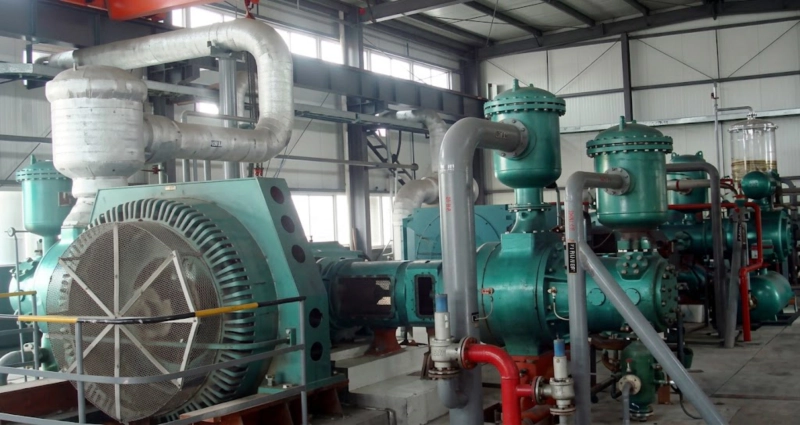
The DW series operates on the reciprocating piston principle with a two-column (D-type) horizontal opposed cylinder arrangement. A high-voltage induction motor drives the crankshaft, which converts rotational motion into the linear reciprocating motion of pistons facing each other on opposite sides of the crankframe. Because the pistons work against each other simultaneously, the primary inertia forces are substantially cancelled, giving the DW series significantly better dynamic balance than single-column Z-type machines of equivalent capacity while maintaining the simpler construction and lower cost of a two-column frame compared to the four-column 4MW or 6MW series.
The number of compression stages — one, two, three, or four — is determined by the required overall compression ratio. Low-pressure models (0.10–1.00 MPa) typically use one or two stages. Mid-to-high pressure models (1.20–4.00 MPa) use three or four stages, with shell-and-tube interstage coolers and liquid knockout separators between each stage to remove heat of compression and condensed moisture before the gas enters the next stage cylinder.
Key Structural Components
⚙ Crankshaft & Frame
Forged 42CrMo alloy steel crankshaft, journal induction hardened. Nodular cast iron frame with precision-bored bearing housings. Designed to API 618 combined rod load limits.
🔧 Cylinders & Pistons
HT250 grey cast iron cylinders; 316L stainless steel for wet CO₂ service. Chrome-plated piston rods. PTFE or PEEK piston rings; cast iron for oil-lubricated configurations.
📈 Gas Valves
Ring-plate or poppet valves with 316 SS seats and PEEK/PTFE elements. Low pressure drop, service life 8,000–12,000 hours. High-pressure stage valves in forged steel bodies.
❄ Interstage Cooling
Shell-and-tube heat exchangers between each stage. Interstage separators with automatic drain for condensate removal. Carbon steel standard; 316L SS for wet or sour CO₂ service.
🔐 Sealing & Distance Piece
PTFE pressure packing with Type C or D double-compartment distance piece per API 618. Crankcase fully isolated from process gas. Nitrogen purge available for sour or toxic service.
💻 Control System
PLC-based panel with HMI. Continuous monitoring of vibration, temperature, pressure, rod drop, and lube oil. Safety shutdown on all critical parameters. ATEX option available.
Core Advantages of the DW Series
🌎
Widest Flow Coverage in the Series
The DW series covers 25 to 325 m³/min in a single product family, making it the most versatile CO₂ compressor range in our lineup. A single manufacturer and single spare parts network covers the full flow range from medium industrial to large-scale gas plant duties.
⚖
Better Balance Than Z-Type at Lower Cost Than 4MW
The two-column opposed arrangement substantially cancels primary inertia forces, giving smoother operation and reduced foundation loads compared to Z-type single-column machines, without the additional cost and size of a full four-column 4MW or 6MW frame.
📈
Full API 618 & GOST-R Compliance
All DW units are designed to API 618 Fifth Edition including rod load certification, distance piece classification, and materials specification. GOST-R certification covers all models for Russian Federation and CIS procurement requirements.
🛠
Dual-Pressure Design Flexibility
The 4.00(3.00) MPa dual-pressure models can be configured at either 3.0 MPa or 4.0 MPa discharge by adjusting staging and valve clearances, reducing the number of unique machine types needed to cover a broad range of process pressures.
🏭
Skid-Mounted Factory-Tested Packages
Complete skid packages available with compressor, motor, coolers, separators, lube oil system, instrumentation, and PLC panel pre-assembled, pre-piped, and factory-tested on a single baseframe. Site commissioning completed in days.
🕑
Long Maintenance Intervals
Piston ring and packing service life 6,000–10,000 hours. Gas valve replacement at 8,000–12,000 hours. Main bearing overhaul at 40,000+ hours. All spare parts manufactured in-house for supply continuity over 20+ year plant life.
Structure and Material Quality Standards
| Component |
Material / Standard |
Notes |
| Crankshaft |
42CrMo forged alloy steel, journal induction hardened |
UT and MPI inspection; fatigue certified |
| Frame |
QT500 nodular cast iron or welded steel |
Stress-relief annealed; precision bearing bores |
| Cylinders |
HT250 grey cast iron; 316L SS for wet/sour service |
Hydrostatic test at 1.5 x MAWP |
| Piston Rods |
42CrMo steel, hard chrome plated |
Roundness ≤ 0.01 mm; hardness HRC 60–65 |
| Piston Rings & Packing |
PTFE standard; PEEK for high-temp or food-grade |
Service life 6,000–10,000 h |
| Gas Valves |
316 SS seats; PEEK or PTFE valve elements |
Service life 8,000–12,000 h |
| Interstage Coolers |
Carbon steel shell & tube; 316L SS available |
Manufactured under Pressure Vessel License |
| Bearings |
Full-shell aluminium-bronze main bearings |
Forced pressure lube; overhaul at 40,000 h |
Typical Application Scenarios
🥥
CO₂ Liquefaction & Food-Grade Production
The mid-to-high pressure DW series (3.0–4.0 MPa) compresses recovered or raw CO₂ to the pressure required for condensation into liquid CO₂ in a shell-and-tube condenser. Oil-free cylinder specification ensures compliance with ISBT food-grade CO₂ purity limits (total oil below 0.1 ppm). The liquid CO₂ produced is distributed to beverage carbonation lines and dry ice production facilities.
Note: Liquid CO₂ from this process is also used in PET bottle blowing for carbonated beverage packaging. If your operation includes beverage filling lines, our partner site offers a one-step injection stretch blow moulding machine compatible with CO₂-filling integrated lines — a complete solution for integrated beverage production facilities.
🔌
Fermentation CO₂ Recovery & Large-Volume Low-Pressure Recompression
The low-pressure DW series (0.10–0.60 MPa, 60–325 m³/min) is the preferred choice for brewery, bio-ethanol, and fermentation plant CO₂ recovery, where large volumes of near-atmospheric CO₂ must be collected from multiple fermentation vessels, cleaned, dried, and recompressed to storage or liquefaction pressure. Single-stage models (DW-190 to DW-325) handle the highest flows with the lowest compression ratio and energy consumption per unit of gas processed.
🌿
Carbon Capture Intermediate Compression (CCS/CCUS)
In post-combustion carbon capture chains, CO₂ exits the amine stripper at near-atmospheric pressure and must be raised to 3–4 MPa as the intermediate stage before high-pressure injection compressors take over. The DW series covers this intermediate stage across a wide range of plant capacities. For CCS applications, 316L stainless steel cylinders and interstage piping are specified to handle wet CO₂ with potential SO₂ and NOx impurities from the flue gas upstream.
⚙️
Chemical Synthesis & Process Gas Duties
In urea synthesis plants, the DW series operates as a feed stage compressor, raising CO₂ from reformer outlet pressure to the intermediate pressure level before the final high-pressure compression stage. For methanol synthesis via CO₂ hydrogenation, the DW series handles compression from capture plant outlet to synthesis reactor pressure (5–8 MPa). In supercritical CO₂ extraction processes for pharmaceutical and food applications, the DW series maintains the high-pressure circulation loop.
Selection Guide: Choosing the Right DW Model
Use the following decision framework to identify the correct DW sub-series and model for your application.
1
Select the correct pressure sub-series first
If your discharge pressure is 0.10–1.00 MPa, select from the low-pressure DW series (DW-60/6 to DW-325/2). If your discharge pressure is 1.20–4.00 MPa, select from the mid-to-high pressure DW series (DW-25/30 to DW-70/40). For pressures above 4.0 MPa, consider the 4MW series.
2
Confirm flow rate at inlet conditions with 10–15% design margin
Provide the actual flow in Nm³/min or Nm³/h at stated inlet pressure and temperature. Include the minimum and maximum flow the compressor must handle, as this determines the capacity control method (suction valve unloaders or VFD).
3
Provide complete gas composition including all impurities
CO₂ purity, moisture content, H₂S concentration, SOx, NOx, hydrocarbons. Even trace H₂S above the NACE threshold changes the materials specification to stainless or duplex stainless steel throughout. Free water in the gas requires 316L SS wetted parts.
4
Specify oil-free or oil-lubricated cylinder requirement
Oil-free cylinders (PTFE/PEEK rings, double-compartment distance piece) are required for food-grade CO₂, beverage carbonation, and any application with an oil content limit below 1 ppm. Oil-lubricated cylinders are acceptable for CCS, EOR boost, and chemical synthesis duties where downstream process tolerates trace hydrocarbons.
5
Confirm site utilities and installation environment
Cooling water temperature and flow, ambient temperature range, available drive voltage (380 V / 6 kV / 10 kV), hazardous area classification (ATEX/IECEx zone if applicable), and whether skid-mounted or loose supply is required. For GOST-R procurement in Russia and CIS, confirm GOST-R certificate requirements at enquiry stage.
DW Series vs. International Brands: Objective Comparison
Transparency Notice: Ariel Corporation, Dresser-Rand (Siemens Energy), Burckhardt Compression, and Neuman & Esser are referenced solely to assist process engineers in cross-referencing performance classes. We do not manufacture, sell, or claim any affiliation with these brands. All DW compressors are original designs. We do not sell counterfeit or unlicensed products.
| Factor |
DW Series (Our Make) |
Ariel JGT |
Dresser-Rand HOS |
Burckhardt Laby-GI |
| API 618 Compliance |
✓ Full |
✓ Full |
✓ Full |
✓ Full |
| GOST-R (Russia/CIS) |
✓ Certified |
Case by case |
Case by case |
Case by case |
| Capital Cost |
30–50% below European OEM |
High (USD) |
High (EUR) |
Premium (CHF) |
| Lead Time |
5–8 months |
8–14 months |
10–16 months |
10–18 months |
| Spare Parts |
In-house; rapid dispatch |
OEM only; import lead |
OEM only; high cost |
OEM only; premium |
| Russia/CIS Service |
Direct on-site support |
Third-party agent |
Regional office |
Regional office |
| Factory Acceptance Test |
✓ Full-load FAT standard |
✓ Standard |
✓ Standard |
✓ Standard |
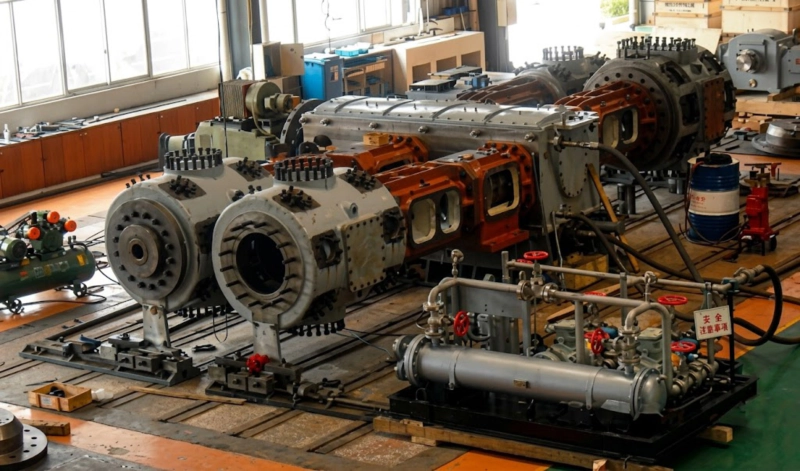
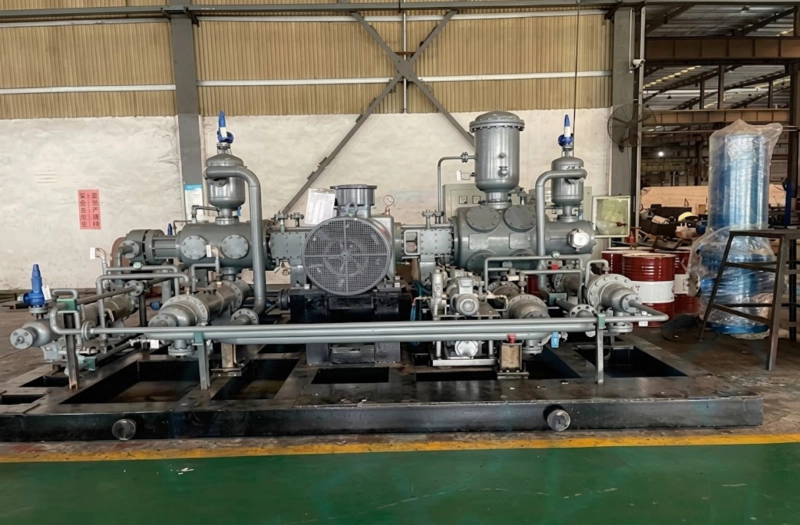
Full-load factory acceptance test — every DW series unit is tested at design operating conditions before shipment, with performance data documented against the contractual data sheet
Frequently Asked Questions — DW Series CO₂ Compressor
Q1: What is the difference between the DW series and the 4MW series?
The DW series uses a two-column horizontal opposed frame (D-type), while the 4MW series uses a four-column opposed frame. The DW design is more compact and lower in capital cost, making it the preferred choice for the 25–70 m³/min flow range in the mid-to-high pressure series. The 4MW design provides superior dynamic balance and is preferred for flows above 85 m³/min, for critical-path applications requiring minimum foundation loading, and for facilities where multiple compressors may be installed in the same building. Both series are available to the same API 618 and GOST-R standards.
Q2: Can the DW series handle wet CO₂ containing moisture or H₂S?
Yes, with appropriate materials specification. For CO₂ with free water or moisture above the saturation dew point at any stage, cylinder liners, heads, interstage piping, and cooler tubes are specified in 316L stainless steel or duplex stainless steel to resist carbonic acid corrosion. For streams containing H₂S above the NACE MR0175 threshold (0.0003 MPa H₂S partial pressure), full NACE-compliant materials and hardness limits are applied to all wetted pressure-retaining components. Upstream dehydration to a dew point of −20°C or lower is recommended as the primary protection measure regardless of cylinder material.
Q3: Is the DW series suitable for food-grade CO₂ and beverage carbonation?
Yes. For food-grade CO₂ production, oil-free cylinder configuration is specified: PTFE or PEEK piston rings, PTFE pressure packing, and a Type C or D double-compartment distance piece. This design eliminates oil from the gas compression circuit entirely, ensuring compliance with the ISBT food-grade CO₂ specification (total oil content below 0.1 ppm w/w). An outlet gas purity analysis verifying oil content, total hydrocarbons, and moisture can be included in the factory acceptance test on request.
Q4: What does the pressure notation 4.00(3.00) MPa mean?
This dual-pressure notation indicates that the compressor is designed to operate at either 4.0 MPa maximum or 3.0 MPa standard operating pressure in the same physical frame. The cylinder bore and stage pressures are sized to accommodate both operating conditions. Switching between the two pressure ratings typically involves adjusting valve clearance volumes or changing the staging configuration, which can be done during a planned maintenance stop. This dual-pressure capability reduces the number of distinct machine types required to cover a range of CO₂ process pressures.
Q5: Does the DW series require an API 618 pulsation study?
API 618 Chapter 3 pulsation and mechanical study is available as an option. It is recommended for DW series applications at discharge pressures above 3.0 MPa or where the compressor is on a critical process path (CCS, urea synthesis, EOR boost). For food-grade CO₂ liquefaction and fermentation recovery duties at lower pressures, a Chapter 2 analogue simulation is generally adequate. Specify the study level in the enquiry, as it affects the engineering scope and cost. Including the study in the purchase scope from the outset avoids expensive retroactive piping modifications during commissioning.
Q6: What is the typical delivery time for a DW series compressor?
Standard delivery from confirmed purchase order and signed-off technical data sheet is 5–8 months. This covers engineering design and approval, procurement of long-lead materials (forged crankshaft, alloy components), fabrication, assembly, and factory acceptance test. Accelerated delivery in 4–5 months may be achievable for standard configurations subject to production schedule at the time of order. Custom configurations, special material specifications, or ATEX electrical equipment may require additional time. Contact our engineering team with your required delivery date at enquiry stage.
Q7: Can DW series compressors be supplied with GOST-R certification for Russia and CIS?
Yes. All DW series compressors are available with GOST-R certification, which is the Russian Federation conformity mark required for process equipment procurement in Russia and CIS member states. GOST-R certification covers the compressor design, pressure-retaining components, and safety systems. The certification documentation package is provided with the equipment and can be used directly for customs clearance and plant registration purposes in the Russian Federation, Kazakhstan, Belarus, and other EEU member states. Please confirm the GOST-R requirement at the enquiry stage so that it is included in the engineering scope.
Q8: What capacity control options are available for the DW series?
Three capacity control methods are available. Suction valve unloaders allow step-wise capacity reduction in 25% or 50% increments (depending on number of cylinders) without stopping the machine — the most common and lowest-cost option for stable-demand applications. Variable frequency drive (VFD) on the main motor provides continuous smooth modulation from typically 50% to 100% of design capacity with optimal energy efficiency at part-load — recommended for applications where CO₂ supply or demand fluctuates continuously. A combination of VFD and unloaders provides the widest turndown range for the most variable operating profiles. Specify your minimum and maximum required flow rates at enquiry stage.
Q9: How does the DW low-pressure series handle near-atmospheric CO₂ from fermentation?
The low-pressure DW series (DW-60/6 to DW-325/2) is specifically suited to fermentation CO₂ recovery, where the gas exits fermentation vessels at near-atmospheric pressure (0.05–0.15 MPa) and must be collected, cleaned, dried, and recompressed to storage or liquefaction pressure. The single-stage models (DW-190 to DW-325) are the most energy-efficient for this duty because the overall compression ratio is low (typically 2:1 to 5:1 to a first-stage intermediate vessel) and single-stage compression minimises mechanical complexity. The suction system must include adequate liquid knockout to handle the moisture-saturated CO₂ from fermentation; upstream drying to −40°C dew point before the compressor suction is standard practice.
Q10: Are spare parts available throughout the compressor’s operating life?
Yes. All spare parts for the DW series — piston rings, packing rings, gas valves and valve elements, piston rods, bearings, seals, and gaskets — are manufactured in-house from our own production. This means we can commit to parts supply for the full design life of the compressor (typically 20–30 years) without dependency on external supply chains. At the time of order we provide a recommended commissioning spare parts list, a two-year operating stock list, and a major overhaul spare parts list. Critical consumables can be held in our warehouse stock for rapid dispatch on customer request, supporting the Russia and CIS market with minimised import lead times.
Request a Technical Proposal for Your CO₂ Compression Project
Our engineering team has over 70 years of experience manufacturing process gas compression equipment, with a particular focus on CO₂ compression for food-grade production, carbon capture, chemical synthesis, and EOR applications. The DW series CO₂ compressor family represents the most versatile product in our lineup, covering the complete flow range from medium to very large industrial duties in a single, well-supported product family.
DW Series CO₂ Compressor — Engineering Enquiry
Ready to Discuss Your CO₂ Compression Requirements?
Send us your process data and we will return a technical recommendation within 48 hours. All enquiries handled by qualified process engineers. GOST-R documentation provided for Russia and CIS projects.
Include in Your Enquiry
✓ Required flow rate (Nm³/min)
✓ Inlet and discharge pressures
✓ CO₂ gas composition
✓ Oil-free or lubricated requirement
✓ Cooling water availability
✓ Drive voltage (380V / 6kV / 10kV)
✓ GOST-R requirement (Russia/CIS)
✓ Required delivery date